
A high-performing SEO agency should deliver a clear business objective, an evidence-based diagnosis, a prioritized plan, agreed-upon, checked work, useful reporting, and accountable communication. Evaluate those deliverables against the scope you purchased, then assess customer and financial outcomes over an appropriate period.
If answering those questions requires translating a report full of unexplained terminology, the relationship needs more clarity.
You should also understand the dependencies, the limits of the evidence, and what happens when the original plan needs to change. A polished report helps only when it helps you assess the work and decide what to do next.
Those are practical standards you can evaluate. Rankings and financial results also matter, but they depend on competition, starting conditions, customer demand, conversion, and the business’s ability to serve the opportunities created.
The useful question is whether your agency manages those conditions thoughtfully and turns its expertise into work you can assess.
Expect the Agency to Understand How Your Business Makes Money

An agency cannot build a meaningful growth strategy from a website URL and a list of keywords alone. It needs to understand the offers, customers, economics, and operating constraints behind the search opportunity.
Early discovery should establish which services or products the business wants to sell, where it can serve customers, and what makes a suitable inquiry. Average sale value and gross margin help explain which opportunities could justify the investment. Capacity and sales-cycle information help prevent a campaign from creating demand the business cannot handle profitably.
Consider a service company that wants more inquiries for one profitable offer while reducing requests for a low-margin service it no longer wants to promote. An agency that treats every service page as equally important may optimize the website while missing the owner’s actual objective.
The deliverable should be a shared understanding of the business goal and campaign boundaries. It can be a concise discovery brief rather than an elaborate presentation. You should be able to read it and recognize your business.
Google’s guidance on hiring an SEO encourages owners to look for someone interested in the business, its customers, competitors, and potential search opportunities. That interest should carry through into the recommendations.
Expect a Diagnosis That Explains the Evidence
A useful diagnosis connects a problem or opportunity to supporting evidence and a business consequence. An audit-tool warning may be a starting point, but it needs interpretation before it becomes a priority.
Ask what the team examined: search performance, commercially important pages, indexing, site structure, customer questions, relevant competitors, and the path from discovery to inquiry or purchase. For an existing campaign, sales and lead-quality information can reveal problems a website audit would miss.
The agency should distinguish confirmed issues from working explanations. A page excluded from indexing can be verified. An assumption that its wording discourages suitable customers needs further investigation or testing.
It should also explain the limits of the information. If sales records are unavailable or tracking is incomplete, that uncertainty belongs in the diagnosis. A confident tone cannot fill a missing data field.
Expect a prioritized findings summary with the evidence, likely consequence, and recommended next action. The document should help you understand why a particular issue deserves attention.
Expect a Plan You Can Understand and Approve

Once the diagnosis is clear enough to act on, the agency should translate it into a manageable work plan. You need to know what will be done and which business objective the work supports.
A useful plan identifies the offer or customer path being improved, the relevant pages, the reason for the priority, and the work required. It also names the owner, dependencies, expected resource needs, and review point.
Use a 90-day plan around one profitable service to organize delivery and review. The planning window does not promise revenue within that period.
For example, a proposed service-page improvement might require original project information from the business, copy updates from the agency, and a form repair from a developer. The plan should make those responsibilities visible before delays occur.
Ask what the team has deliberately deferred and why. A business with a limited budget benefits from a team that can explain the tradeoffs and focus its effort. An impressive list of possible tasks is useful only when it becomes an achievable sequence.
The plan should be specific enough to review and flexible enough to change when evidence improves.
Expect Implementation to Match the Agreement
SEO engagements vary. Some are advisory, some include ongoing implementation, and others combine agency strategy with work performed by the client’s team. Evaluate high performance against the scope you actually purchased.
In an advisory engagement, expect clear recommendations, specifications, priorities, and an agreed handoff or review process. In an implementation engagement, expect the agency to complete the agreed work and verify that it functions as intended.
A Recommendation Needs a Usable Handoff
A recommendation to improve a page should explain what needs to change and why. If another team will implement it, that team needs enough detail to act without reconstructing the strategy.
The same applies to technical changes. Specify the relevant URLs, the verified issue, the intended correction, and any review or approval requirements. A vague instruction to improve technical SEO leaves too much unresolved.
Completed Work Needs Verification
Check an updated page for accuracy, working links, usable contact options, and proper display on relevant devices. Check a technical change against the problem it was intended to resolve.
For substantial changes, expect sensible safeguards and an appropriate recovery plan. Preserve useful existing pages, measurement, and customer pathways while making improvements.
The agency should record important changes so it can investigate an unexpected decline against a meaningful history. The deliverable is completed and checked work, with enough documentation to support continuity.
A practical acceptance check for a service-page assignment
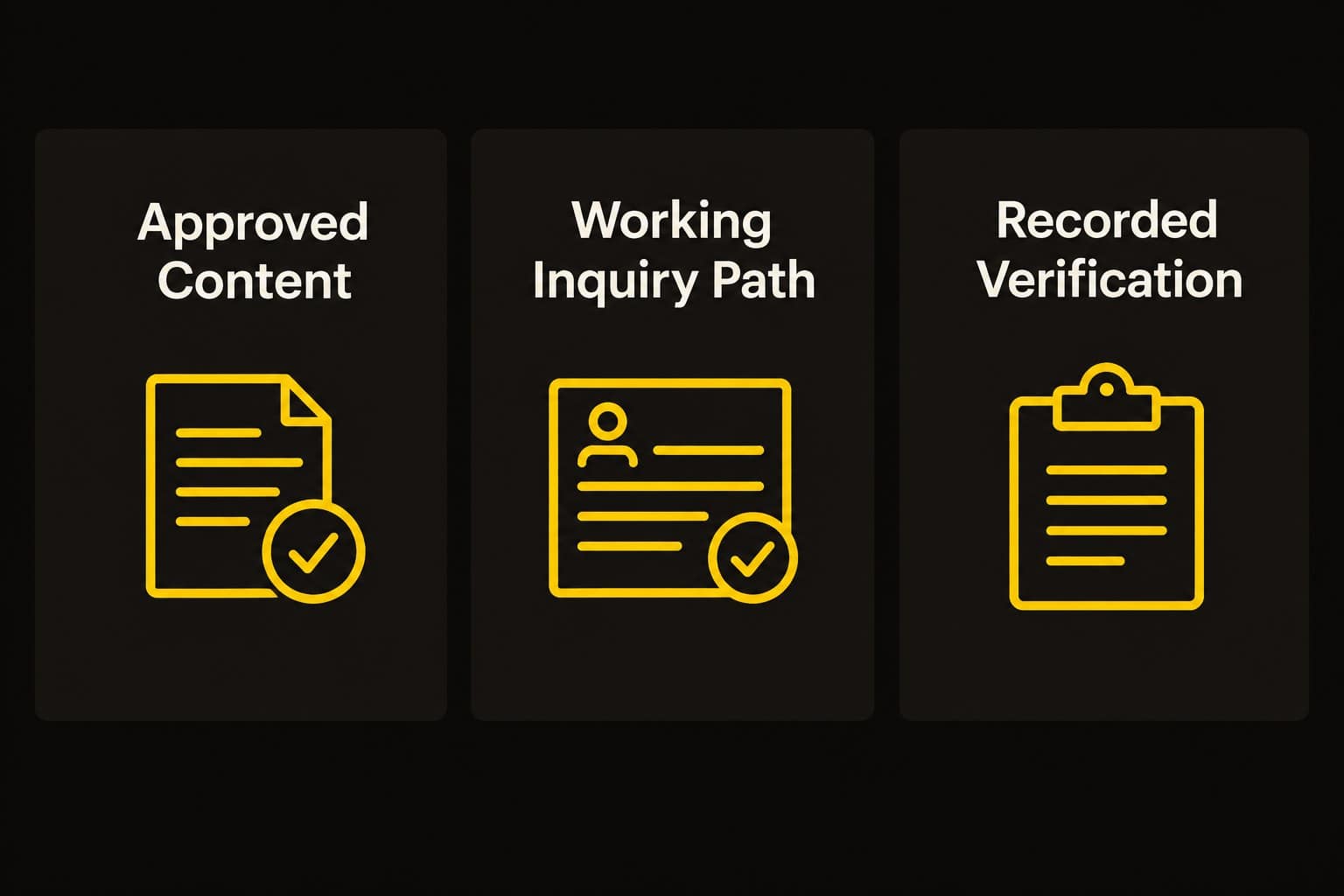
Consider a hypothetical assignment to improve an existing estimate page. The brief identifies the desired service and customer, the missing information, the evidence the business must supply, and the person approving the change. A developer owns any form repair; the writer owns the content update.
Completion means the approved content is live at the intended URL, links work, the page is usable on relevant devices, and a marked test inquiry reaches the correct destination. If the agency is advisory only, completion may instead mean an approved specification and an agreed review of the implementation. Record the distinction.
These checks verify delivery, not profitable demand. The outcome review happens later, using relevant search activity, inquiry quality, completed customers, collection, and costs where available. If inquiries remain weak, investigate the evidence rather than declaring success because the page was published.
Expect Content and Authority Work to Serve a Clear Purpose
Content production should have a reason beyond filling the monthly calendar. Ask which customer question, buying decision, or search opportunity each proposed asset supports.
A commercial page may help someone select a provider. An educational article may explain a problem and lead the reader toward an appropriate service. An updated comparison may answer a question that repeatedly comes up in sales conversations.
Our guide to which SEO keywords bring customers explains how search intent connects to the customer decision. The Content-with-a-Job Planner helps define the purpose before production begins.
Expect the agency to request accurate business information and relevant evidence. Original project details, genuine expertise, and clear service explanations make content more useful. If AI assists the process, the team still needs to verify claims and review the result.
Google’s people-first content guidance emphasizes useful, reliable content and, where appropriate, clear authorship. That supports a quality standard built around the reader’s needs.
Authority work also deserves explanation. Ask what opportunity is being pursued, why it is relevant, and which tactics will be used. The agency should be willing to discuss the methods and any material risks. A proprietary workflow can still be explained well enough for the client to understand what is happening on its behalf.
Expect Coordination Beyond the Search Result
An agency should pay attention to what happens after a suitable visitor arrives. The website, inquiry handling, and sales process all affect how much value increased visibility can produce.
That does not mean every SEO engagement includes a website redesign, CRM implementation, or sales training. It means the agency should identify relevant constraints and explain who needs to address them.
For example, if qualified inquiries regularly wait several days for a response, an agency should raise that observation when the evidence supports it. Improving visibility while ignoring a known sales-handling problem leaves the campaign’s business objective unresolved.
Expect an agreed process for sharing lead-quality feedback. The business can report unsuitable locations, repeated misunderstandings, and the services customers actually request. The agency can use that information to examine targeting, page clarity, and conversion pathways.
This cooperation matters because marketing and operations share responsibility for the final outcome. Make those responsibilities explicit so a problem has an owner and a next step.
Expect Reporting That Leads to a Decision
Reporting should show the agreed objectives, relevant progress, important work completed, and what the team has learned. It should also explain what remains uncertain and how the findings affect the next plan.
For financial evaluation, ask the agency and business team to agree on lead definitions, attribution, costs, and sales timing. Our guide to calculating SEO ROI without mistaking leads for revenue provides the detailed calculation context.
An agency can report search progress even when financial data is incomplete. It should label the limitation and explain what additional information is required before claiming a return.
The reporting stage should inform the next strategy. A plan that never changes deserves scrutiny when the evidence has changed. Use a reporting structure that follows the numbers toward profit, while preserving the distinction between attributed outcomes and additional impact.
If an improvement underperforms, expect a candid discussion of possible explanations and a reasoned decision about continuing, adjusting, or redirecting the work. You should be able to see that the team is learning from implementation.
Research explains why a detailed report still needs claim limits
A 2019 Marketing Science study by Gordon and colleagues compared observational methods with randomized results across 15 US Facebook advertising experiments. The dataset included 500 million user-experiment observations and 1.6 billion ad impressions. User-experiment observations are not a count of unique people. The observational methods often failed to reproduce the experimental effects.
This was paid-advertising research, not an SEO study, a correction factor for your report, or a requirement that every small business run an experiment. Its relevant lesson is that detailed observational data does not automatically establish causal impact. An agency should explain whether it is reporting visibility, attributed customer outcomes, or an estimate of additional impact, and what supports that distinction.
When customer revenue or cost records are missing, the deliverable should clearly identify the measurement gap and include a practical way to reduce it. Replacing missing evidence with confidence or a modeled traffic-value dollar amount does not establish ROI.
Expect Clear Accountability and Continuity
You should know who is responsible for strategy, who performs the work, and who communicates with you. The most experienced person in a sales meeting may not be the person managing the campaign, so establish those roles early.
Agree on a communication cadence, an escalation route for urgent problems, and the information needed for approvals. Small implementation questions should have a practical route to resolution.
Also clarify control and continuity for accounts, files, licenses, and completed work. The business should retain control of its own accounts, and the engagement terms should explain how agency-provided assets and tools will be used or transferred.
Third-party software, licensed media, and agency systems may have different terms from original client work. Ask for those distinctions to be made clear rather than assuming every asset has the same ownership or access conditions.
Expect an orderly handoff process if responsibilities change. Relevant change records, specifications, reporting definitions, and access information make it easier for the business or another team to maintain the work.
These expectations are useful throughout the relationship, not just at the end.
Expect Specific Explanations for AI-Search Work
If AI-search optimization is included in the engagement, ask what the agency will actually examine, improve, and measure. The scope should identify the relevant platforms, customer questions, content or trust improvements, and observation method.
An agency may work on accurate business information, useful explanations, accessible pages, supporting evidence, and how consistently a business appears in tested answers. It should distinguish those activities from control over a platform’s responses.
Google states that its AI Overviews and AI Mode do not require special AI markup or additional technical requirements beyond the applicable Search requirements. That guidance applies to Google’s features; another platform’s behavior needs its own assessment.
Expect evidence proportionate to the claim. A screenshot shows an observed answer. Repeated testing can document a pattern within the test conditions. Verified referrals and sales provide additional business context where measurement supports them.
The agency should explain each level clearly and avoid treating a mention as proof of revenue.
Review the Relationship Using Concrete Deliverables
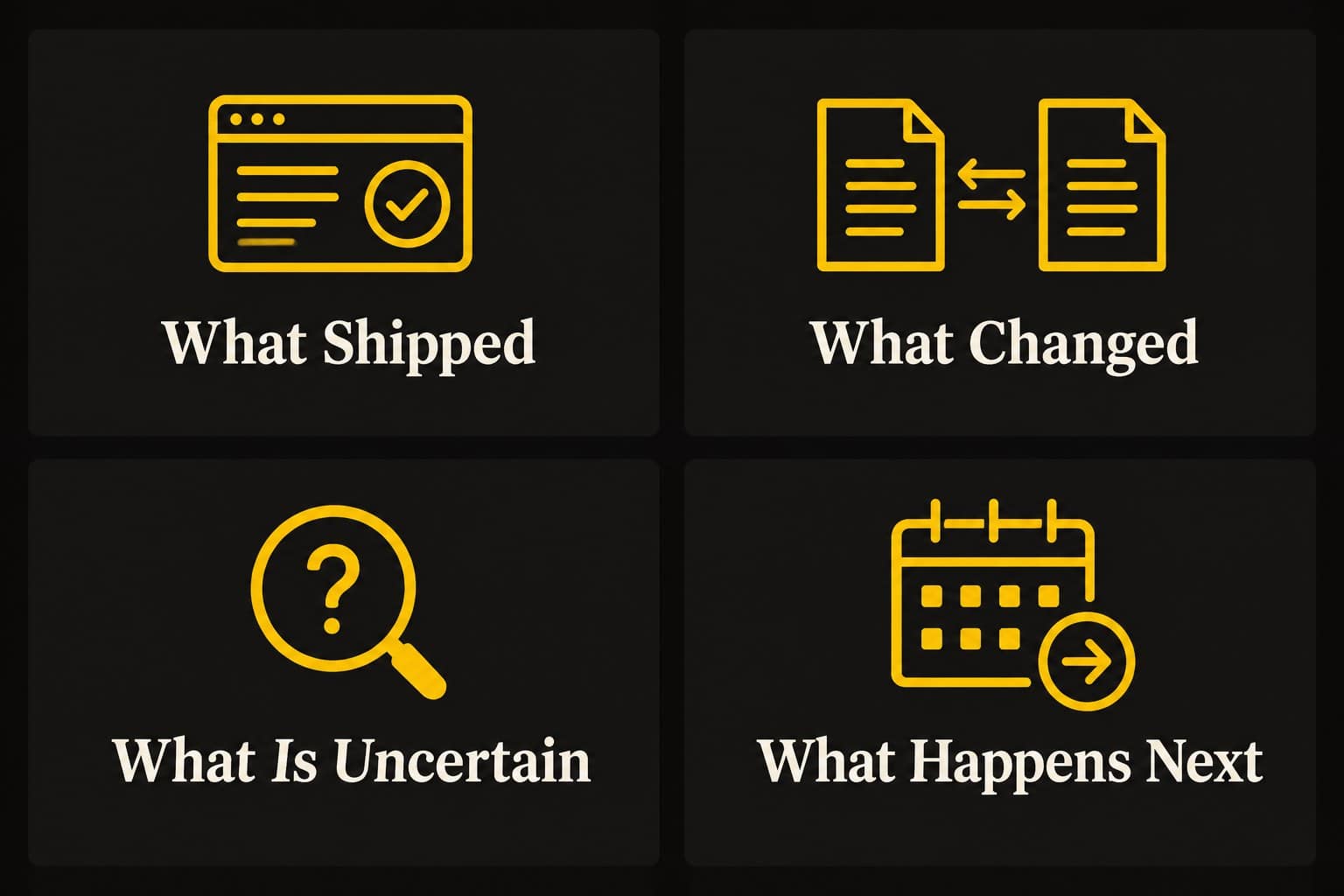
You can evaluate the quality of agency management before any ranking or sales outcome matures. Start with the artifacts and behaviors that make the campaign understandable and accountable.
| Deliverable to review | Evidence to request | Acceptance question |
|---|---|---|
| Business brief | Priority service, suitable customer, geography, contribution assumptions, capacity | Does it describe the work and customers the business actually wants? |
| Diagnosis | Relevant URLs, data sources, confirmed findings, unresolved explanations | Can the team show the evidence behind the recommended priority? |
| Roadmap | Deliverables, owners, dependencies, effort, target dates, review points | Can the next assignment proceed with the people and information available? |
| Implementation or advisory handoff | Released changes or usable specifications, approval record, verification | Was the agreed work completed or handed off in an actionable form? |
| Content | Customer purpose, accurate business details, supporting evidence, relevant links | Does the page help the intended reader make the next decision? |
| Authority work | Relevant opportunity, proposed methods, completed activity where applicable | Can the provider explain the tactics without hiding material risks? |
| Measurement | Definitions, periods, costs, customer records, attribution limits | Are estimates, observed actions, and financial outcomes labeled correctly? |
| Review and continuity | Decision log, next steps, account access, asset and license arrangements | Can the business understand the next decision and maintain continuity? |
Use the monthly review to make a specific decision
For each major assignment, record whether it is complete, blocked, deferred, or awaiting outcome evidence. Ask what changed, what was learned, and whether the next action still deserves the planned resources. Distinguish a delivery delay from weak customer demand or a long sales cycle.
This checklist has no validated universal score, and no source here establishes that a fixed number of articles or links makes an agency high-performing. A technical fix can be more useful than another article, while another engagement may need substantial service content. The provider should explain the choice in terms of the agreed objective and scope.
This is a discussion guide, not a validated scoring system. A gap should prompt a specific question. Perhaps a deliverable was omitted, it is outside the scope, or the team hasn’t communicated it clearly.
Review early enough to resolve those gaps, then continue assessing the work against business outcomes over a suitable timeframe. Google cautions that no one can guarantee a number-one ranking. The agency can commit to a process and agreed delivery standards while explaining the uncertainty around results.
Frequently Asked Questions
Should Every Month Include the Same Number of Deliverables?
Not necessarily. The most valuable work may change as the campaign develops. One period may require a technical correction, another a commercial-page improvement, and another supporting content. The agency should explain material scope changes and keep the work consistent with the agreement. A recurring output count can help with planning, but it doesn’t replace a business reason.
Who Should Handle Recommendations Outside the Agency’s Scope?
Agree on an owner and a usable handoff. A developer, sales manager, or internal marketer may need to implement the recommendation. The agency should explain the issue, required action, and dependency. Any additional agency work should have a clear scope and approval before it proceeds.
Does an Agency Need Experience in Your Exact Industry?
Relevant experience helps, particularly when customer decisions, regulations, or business models are specialized. Also examine the agency’s ability to research the market, ask useful questions, and validate business information. Ask how it will close any knowledge gaps and who will review specialized claims or content.
Is Paid Discovery a Legitimate SEO Deliverable?
It can be, when the scope and output are clear. A useful discovery engagement reviews relevant evidence, separates confirmed issues from assumptions, and delivers practical findings or recommendations. Ask what access is required, what will be assessed, and what you will receive. The value is in the decision the investigation enables.
What Should You Look for in an Agency Case Study?
Look for the starting conditions, work performed, measurement period, and definitions of the reported outcomes. Establish whether the figures describe rankings, traffic, inquiries, sales, or financial return. Consider whether the business and market resemble yours, and ask which differences may affect the proposed strategy. Another client’s result can demonstrate experience without predicting your outcome.
Give the Relationship a Clear Standard
An effective agency relationship makes the strategy, work, and evidence understandable. You should know which opportunity the team is pursuing, what it has completed, what it learned, and why the next action deserves attention.
Quickest Path to ROI SEO™ provides a business-first framework for evaluating search work and directing effort toward measurable value. Use it alongside the companion tools to clarify your priorities and agency conversations.
Sources and research notes
- Google Search Central: Do You Need an SEO? Business understanding, realistic estimates, explained recommendations, and ranking-claim limits.
- Google Search Central: Helpful, Reliable, People-First Content Quality and reader-purpose guidance.
- Google Search Central: AI Features and Your Website Guidance specific to Google AI Overviews and AI Mode; not a claim about all AI platforms.
- Gordon and colleagues: A Comparison of Approaches to Advertising Measurement (Marketing Science, 2019). Paid-advertising experiments and observational estimates; not an SEO profitability benchmark.