SEO Opportunity Prioritization Checklist
For ROI The Order You do Your SEO Tasks Drives Early Success
FREE SEO RESOURCE · CHAPTER 4
Your SEO task list may contain dozens of worthwhile ideas. The harder question is which one deserves attention first.
Use this free checklist to compare opportunities by customer value, revenue potential, execution effort, and the time it may take to see useful progress. Then choose a first action you can actually complete.
Use the Interactive Checklist below or


Why This Checklist Matters
An SEO Opportunity Is Only Valuable If You Can Act on It
A high-volume keyword can be a poor first target if it does not attract likely customers. A valuable page can sit untouched while a team works through a long list of smaller technical tasks. Even a promising idea can stall when it takes months to produce.
The aim is to find work with meaningful business upside that you can move forward in the shortest practical time. Each completed high-value action gives you evidence for the next decision and helps build momentum.
- Choose for business value- Start with the services, products, and customer needs that can contribute to revenue.
- Account for practical speed- Consider the people, approvals, assets, and work needed to complete the action.
- Build on evidence- Use the search, website, and customer information you have. Identify what still needs to be checked.
THE SEO PRIORITY DECISION
Find the Highest-Value Action You Can Complete Soonest
-
01
Revenue upside
Could this help the right customer reach a valuable offer?
-
02
Practical execution
What must be done, and how soon can it realistically be finished?
-
03
Early evidence
What would tell you the action is starting to work?
A strong first priority has a clear business purpose, a manageable path to completion, and a way to review progress. The checklist helps you compare all three.
What You Will Evaluate


Business value
If this opportunity succeeds, could it help produce a valuable lead, customer, or sale?

Customer intent
Does it address something a prospective customer is likely to search for while considering a purchase or hiring decision?

Current opportunity
Direct content, internal links, topical depth and external authority toward proven opportunities.

Work required
Direct content, internal links, topical depth and external authority toward proven opportunities.

Time to useful evidence
Can you name an early signal to review after the work is published or corrected?
INTERACTIVE SEO PRIORITY CHECKLIST
Choose the Next SEO Action With More Confidence
Compare two or three specific actions. Look for meaningful business upside you can reach in the shortest practical time, then record what you need to verify.
YOUR WORKING PRIORITY
Your Best Starting Point
How the Opportunities Compare
| Opportunity | Business value | Customer intent | Execution | Evidence | Time | Next step |
|---|
What to verify
Turn it into a first move
This is a planning comparison based on your answers. It does not forecast rankings, leads, revenue, or a completion date.
Your entries stay in this browser unless you copy, download, or print them. No account or email is required.
Buy the Book Today
A Version for Every Budget and Prefrence
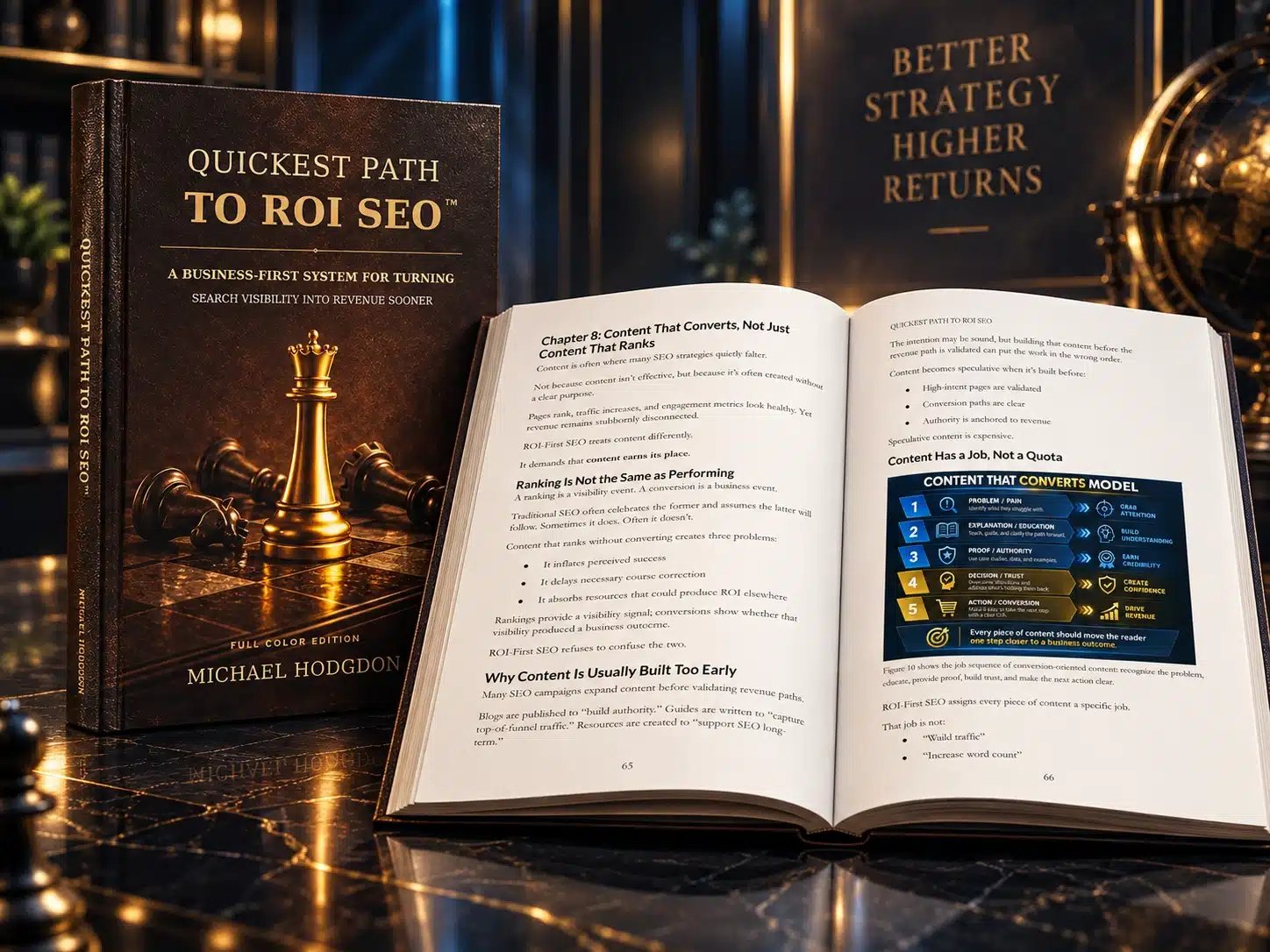
Choose from 4 editions that fit how you prefer to read, reference, and work with the material. Quickest Path to ROI SEO™ is available in multiple formats, including full-color and black-and-white print editions, hardcover, paperback, and Kindle. The full-color editions provide the strongest visual experience for the book’s charts, models, and framework graphics, while the black-and-white paperback offers a more affordable print option. Kindle provides convenient digital access, and the hardcover is ideal for readers who want a premium reference copy.



SEO Opportunity Checklist FAQs
1. What factors should you use to prioritize an SEO opportunity?
An SEO opportunity should be evaluated based on potential revenue value, customer intent, current visibility, ranking feasibility, work required, conversion readiness, and how quickly useful evidence could appear.
No single metric is enough. High search volume can still produce weak business value, while a lower-volume opportunity may be far more valuable if the searcher is close to a purchase decision.
The SEO Opportunity Prioritization Checklist helps compare those factors together so businesses can identify opportunities where commercial upside and practical execution intersect.
2. How do you compare SEO opportunities with different revenue potential and effort?
Compare SEO opportunities by weighing the potential business value against the time, difficulty, resources, and approvals required to execute them.
A high-revenue opportunity may deserve priority even if it requires more work, while an easy task may not be worth doing first if its commercial impact is small.
The objective is not simply to find the easiest task. Quickest Path to ROI SEO™ looks for the highest-value action that can be completed in the shortest practical time.
3. What is an SEO quick win?
An SEO quick win is an opportunity that can be acted on relatively quickly and has a realistic chance of improving valuable search visibility, conversions, or revenue.
Examples might include improving a page already ranking near page one, strengthening a high-intent service page, fixing an important indexing problem, or improving a conversion path on a page already receiving qualified traffic.
A quick win should not be defined by ease alone. The checklist evaluates whether the opportunity is both practical to execute and commercially meaningful.
4. Should you prioritize an existing page or create a new SEO page?
Improve an existing page first when it already serves the right intent, has useful visibility or authority, and can realistically be strengthened; create a new page when the current site does not adequately serve the opportunity.
An existing page with impressions, rankings, backlinks, or relevant engagement may offer a shorter path to measurable improvement than starting from zero.
The SEO Opportunity Prioritization Checklist helps determine whether the stronger opportunity is to optimize what already exists or build a new asset where a meaningful gap remains.
5. What early evidence should you look for after prioritizing an SEO opportunity?
Early SEO evidence can include improved impressions, stronger rankings, better click-through rates, increased engagement, qualified inquiries, or other signals that the action is beginning to move in the intended direction.
The exact signal depends on the work performed. A technical fix may first show up as improved indexing, while a service-page improvement may produce better visibility, clicks, or leads.
The checklist encourages businesses to define that evidence before execution so the next decision is based on observation rather than assumption.
6. When should an SEO opportunity not be a priority?
An SEO opportunity should usually be deprioritized when its revenue potential is weak, customer intent is unclear, execution cost is disproportionate, the path to visibility is unrealistic, or another opportunity offers stronger business value sooner.
A keyword can be attractive on paper and still be a poor use of resources.
The Quickest Path to ROI SEO™ framework is designed to prevent that problem by asking not only “Can we do this?” but also “Is this the best thing to do next?”