Traffic and rankings become more useful measures when you know what a potential customer is worth. Enter a few numbers from your business to estimate the value of a qualified lead, and see which search opportunities deserve attention first.
Uses your numbers. Results are estimates, not a revenue forecast.
Use our online interactive calculator below.

Strategy Before Activity
Ten inquiries for a low-value service may contribute less to your business than two inquiries for a high-value one. Knowing the approximate value of a qualified lead helps you compare pages, services, and search opportunities by their potential return.
The most useful next action is often the one with meaningful revenue upside that your team can complete soon. Use this estimate alongside customer intent, the work required, and the time to useful evidence.
The SEO Lead Value Calculator
Start with a typical first sale for the service you want to evaluate. Use your own records where possible, and keep the monthly figures within the same time period.
Based on the figures you enter.
Enter your numbers and select Calculate Lead Value to see your estimate.
These are expected-value estimates across comparable qualified leads, not guaranteed results. The contribution figure excludes other business expenses.
How the calculation works: Average sale × gross margin × qualified lead close rate = estimated gross profit value per qualified lead.
Monthly qualified SEO leads × lead value − monthly SEO investment = estimated contribution. This uses the initial sale and does not automatically include repeat purchases, refunds, sales delays, overhead, or costs you leave out of the investment figure.

SEE THE MATH
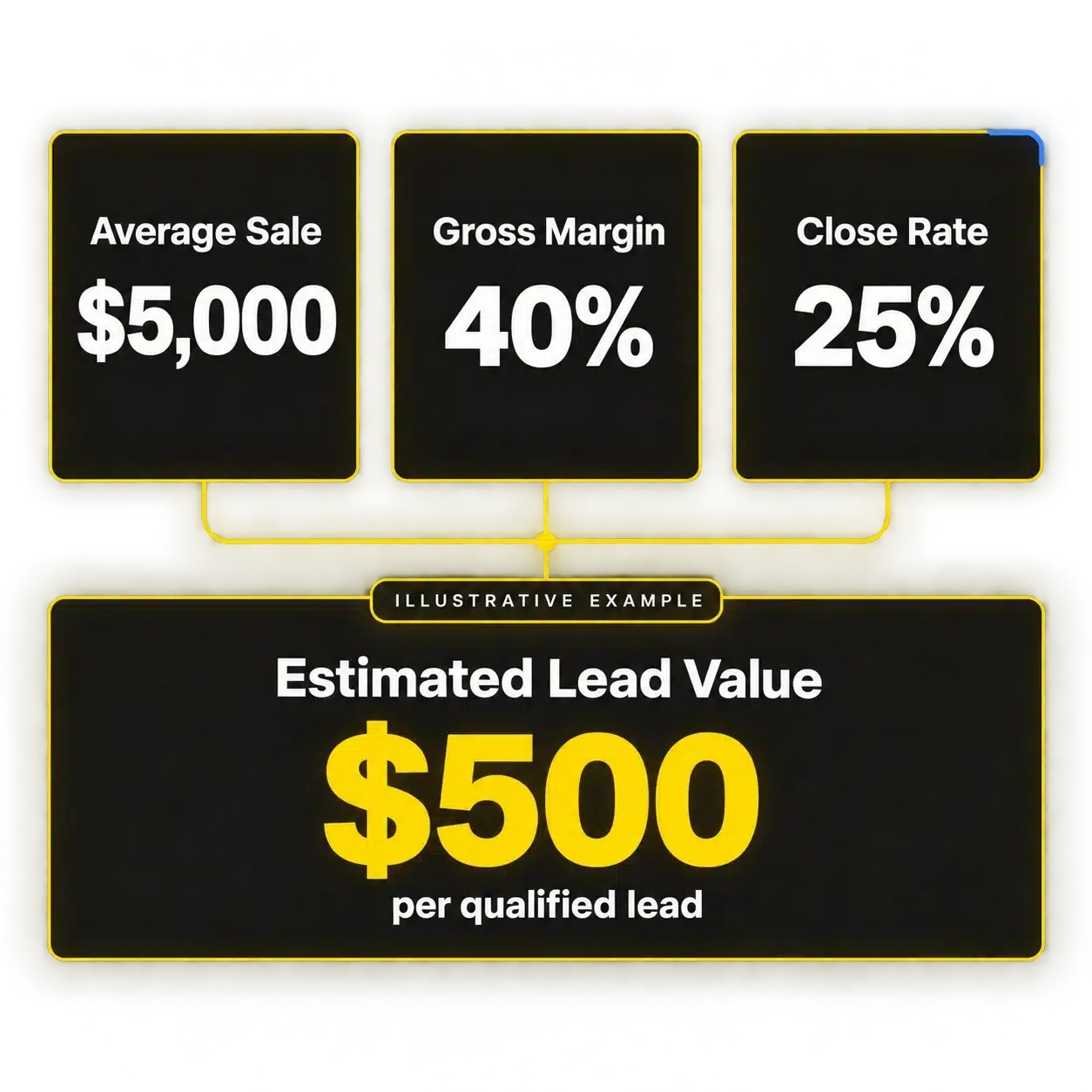
If an average new customer produces $5,000 in revenue, your gross margin is 40%, and 25% of qualified leads become customers:
$5,000 × 40% × 25% = $500 estimated gross profit value per qualified lead.
That does not mean every inquiry earns $500. It means each qualified inquiry has an estimated average value of $500 across enough comparable leads.
Choose from 4 editions that fit how you prefer to read, reference, and work with the material. Quickest Path to ROI SEO™ is available in multiple formats, including full-color and black-and-white print editions, hardcover, paperback, and Kindle. The full-color editions provide the strongest visual experience for the book’s charts, models, and framework graphics, while the black-and-white paperback offers a more affordable print option. Kindle provides convenient digital access, and the hardcover is ideal for readers who want a premium reference copy.




A practical way to estimate SEO lead value is to multiply average sale value by gross margin and close rate.
For example:
$5,000 average sale × 40% gross margin × 25% close rate = $500 estimated gross profit value per qualified lead.
This gives you a more useful business estimate than simply counting inquiries. The Quickest Path to ROI SEO™ framework uses lead value to help compare SEO opportunities by their potential economic impact, not just by traffic or keyword volume.
Qualified leads are more useful because they represent inquiries with a realistic chance of becoming customers, while total lead count can include low-quality, irrelevant, or unqualified contacts.
Ten weak inquiries may contribute less revenue than two strong leads for a high-value service.
The SEO Lead Value Calculator helps translate qualified demand into estimated financial value so businesses can compare pages, services, and search opportunities based on the revenue potential behind the lead count.
Gross margin should be included because revenue alone does not show how much economic value a sale actually contributes after the direct cost of delivering the product or service.
Two services can produce the same $5,000 sale but very different profit if one carries substantially higher labor, material, fulfillment, or product costs.
Using gross margin creates a more realistic estimate of what each qualified lead may be worth to the business and helps Quickest Path to ROI SEO™ prioritize opportunities according to potential return rather than topline revenue alone.
Close rate affects lead value because it estimates how many qualified inquiries typically become paying customers.
A qualified lead may be worth considerably more to a company that closes 40% of its opportunities than to one that closes 10%, even when the average sale value is identical.
That is why the calculator combines average sale, gross margin, and close rate. Together, they provide a more realistic estimate of the financial value associated with generating one additional qualified lead.
No. SEO leads should not automatically receive the same value when different services, products, customer types, or locations produce different sale values, margins, and close rates.
A lead for a high-value commercial service may be worth many times more than an inquiry for a lower-margin offering.
Where meaningful differences exist, calculate lead value separately by service or customer category. This makes it easier to identify which search opportunities have the greatest potential revenue upside and deserve greater SEO or GEO priority.
Lead value helps prioritize SEO and GEO opportunities by showing which searches, pages, services, or AI-visibility opportunities could produce the greatest financial return if they generate qualified demand.
Search volume alone cannot tell you that.
A lower-volume query tied to a $1,000 qualified lead may be more valuable than a much larger keyword that produces leads worth $100 each.
The Quickest Path to ROI SEO™ framework combines that estimated economic value with customer intent, current opportunity, work required, and time to useful evidence to identify the highest-value action the team can realistically complete soon.