
SEO quick wins are useful improvements or early outcomes that appear relatively soon in a particular engagement. They can include fixing a blocked page, repairing a contact path, improving visibility for relevant searches, or attracting a suitable inquiry. None automatically proves financial payback.
To evaluate a quick win, identify what changed, verify the evidence, and name the stage it represents: implementation, search response, qualified opportunity, customer outcome, or cost recovery. Financial payback requires a separate comparison of realized customer contribution and cumulative program cost under clearly stated assumptions.
Early progress deserves recognition. It also deserves an accurate label. A repaired form can be valuable without being introduced as a return on investment before a customer has used it.
Five kinds of progress that should not be confused

A useful update identifies the milestone and the evidence supporting it. The table below separates delivery from the later results the work is intended to support.
| Type of progress | Example | Evidence to verify | What remains unresolved |
|---|---|---|---|
| Implementation | An estimate form is repaired | A marked test inquiry reaches the correct system | Whether real customers use it and create additional value |
| Search response | A relevant service page gains impressions or clicks | Comparable page and query data with dates and filters | Customer suitability, sales, and financial return |
| Qualified opportunity | An eligible prospect requests an estimate | Valid contact, service fit, location, and customer need | Whether the prospect becomes a completed, paid customer |
| Customer outcome | A job is completed and paid | Customer record, collected payment, and relevant costs | Whether the contribution covers the full program investment |
| Financial payback | Accumulated customer contribution covers included program costs | A consistent period, complete costs, and a defined benefit calculation | Whether additional impact is established and future returns are sustainable |

These stages are a review structure, not a claim that every visitor moves through them in order. Customers may return through another channel or contact the business without a tracked website visit. Record missing tracking as a limitation.
For the report itself, see which SEO KPIs connect reporting to business outcomes.
What makes an SEO task a credible quick-win candidate?
A credible candidate combines a meaningful customer or search need with evidence of a correctable gap and a manageable implementation. It should matter for a specific reason, not just be easy to finish.
A relevant page with useful visibility but unclear service scope may deserve review. A broken phone link may need repair. A valuable destination with no useful internal route may need a contextual link. These are examples to investigate, not a universal list of guaranteed revenue improvements.
Inspect the issue before assigning work. State the intended correction, owner, dependencies, cost, and acceptance check. If the required access, service details, or development capacity are unavailable, the task may be commercially attractive but not ready to implement.
Also distinguish protecting existing value from creating additional value. Correcting a broken contact route can restore a function the business already depended on. That is useful work, but a claim about recovered revenue needs evidence of the actual impact.
Start with what SEO work a small business should do first when choosing the initial assignment.
What research says about early search results
Google’s SEO Starter Guide says some changes may be reflected in search within hours, while others can take months. It also notes that not every change produces a noticeable impact. That concerns search behavior, not the time required to recover an investment.
Ahrefs’ May 2025 ranking study reports that 40.82% of pages that reached the top ten did so within one month. That statistic concerns the successful subset. It does not mean that 40.82% of every new page will rank within a month.
The same study found that only 1.74% of a sample of one million random URLs its crawler saw in September 2023 reached the top ten within a year. A differently filtered sample of two million October 2023 URLs with non-empty English content produced a 6.11% result.
Those differences show why the sample and denominator matter. The study is not a controlled test of an SEO method, a page-by-page probability for your website, or evidence of customer profit. A crawler’s observation date is also not a reliable exact publication date for every page.
The practical conclusion is to investigate early opportunities without converting a ranking statistic into a financial promise. Use an SEO payback timeline that includes the rest of the customer path.
Verify the win before assigning a business claim
For an implementation win, record what shipped and how it was checked. A recommendation in a report is different from a live change. A draft page is different from a published, usable destination.
For a search win, inspect the relevant page, query, location, device, and comparison period. An isolated ranking screenshot or a short-lived click increase can be informative but doesn’t show sustained change. Note other changes that may affect interpretation.
For an inquiry win, distinguish real prospects from spam, duplicate contacts, job seekers, and requests for services or locations the business does not handle. A tracked form event should not silently become a completed customer in the next slide.
For a customer win, record the sale, fulfillment, payment, and the costs needed to deliver it. If the business only has a booking or accepted estimate, show that stage accurately.
Each claim should stay within the available evidence. More precise labels make the work easier to evaluate and the next problem easier to find.
A worked example: a positive month before cumulative payback
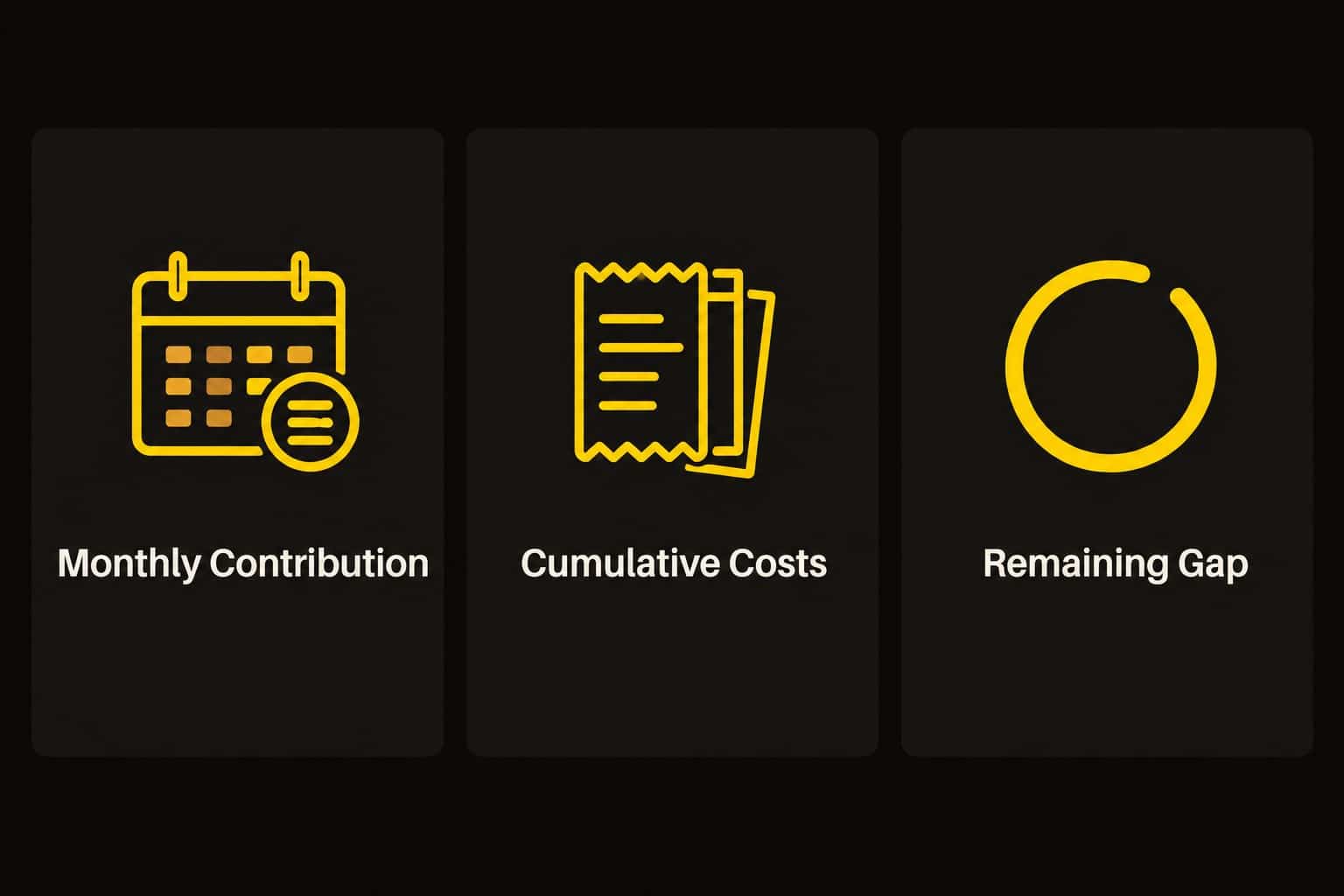
The following invented figures illustrate a contribution-based, cash-oriented program review. They are not a client result, benchmark, or forecast. Assume every listed customer is additional, completes the work, pays within the month shown, and leaves $600 after the specified customer-related costs and before SEO program cost.
| Measure | Month one | Month two |
|---|---|---|
| Setup cost | $1,200 | $0 |
| Ongoing program cost | $900 | $900 |
| Total program cost in the month | $2,100 | $900 |
| Completed, paid customers | 1 | 3 |
| Customer contribution before program cost | $600 | $1,800 |
| Monthly contribution after program cost | −$1,500 | $900 |
| Cumulative contribution after program cost | −$1,500 | −$600 |
Month two produces a positive $900 contribution after that month’s program cost. Across both months, however, the business has collected $2,400 in customer contributions against $3,000 in program spending. It still has $600 to recover under the stated assumptions.
The first paid customer, improving customer count, and positive second month are different milestones. None should be reported as cumulative payback in this example.
If month three adds another $900 of program cost, the amount to cover becomes $1,500 before further customer contribution. At the assumed $600 per completed, paid customer, at least three more customers would cover that amount, leaving $300 after all listed program costs to that point. That is conditional arithmetic, not a prediction that the customers will arrive.
The calculation does not represent company-wide net profit. Include any additional relevant costs, avoid double counting, and update the comparison when spending or contribution changes. For the full method, see how to calculate SEO ROI without mistaking leads for revenue.
Cash collection and attribution still matter
BDC distinguishes cash flow from profit: a sale does not necessarily produce immediate payment, and cash movement differs from revenue less costs. Be explicit about whether a payback claim uses booked sales, accounting revenue, or collected contribution.
A completed job awaiting payment can support a forecast while leaving a cash-based payback calculation unresolved. Deposits, installment payments, refunds, cancellations, and fulfillment costs also need consistent treatment.
Google Analytics attribution models assign credit across customer touchpoints. That is useful for reporting, but channel credit does not automatically prove that an SEO change created all of the credited revenue.
If the example’s additional-customer assumption cannot be established in a real engagement, describe the review as an attributed contribution comparison. Keep potential influences such as existing demand, referrals, advertising, seasonality, and repeat business visible. Do not eliminate the uncertainty by renaming the metric ROI.
Choose early work that supports the larger objective
Quick implementation is useful when it removes an important obstacle or tests a meaningful opportunity. It becomes a distraction when a team selects minor tasks only to produce an impressive completion count.
Compare the likely consequence, evidence, effort, and dependencies. A small correction on an important customer path may deserve priority over a broader content assignment. A deeper service-page project may be a better investment than a dozen cosmetic edits. Speed alone doesn’t settle either choice.
Preserve useful existing information, links, contact routes, and measurement when making changes. Record the release date and check the result. If the task is experimental, define what evidence would justify continuing, changing, or reversing it.
Use a business-specific forecast when the proposed work needs a fuller commercial case. Keep the assumptions about timing and customer contribution separate from the commitment to implement the task.
How to report a quick win clearly
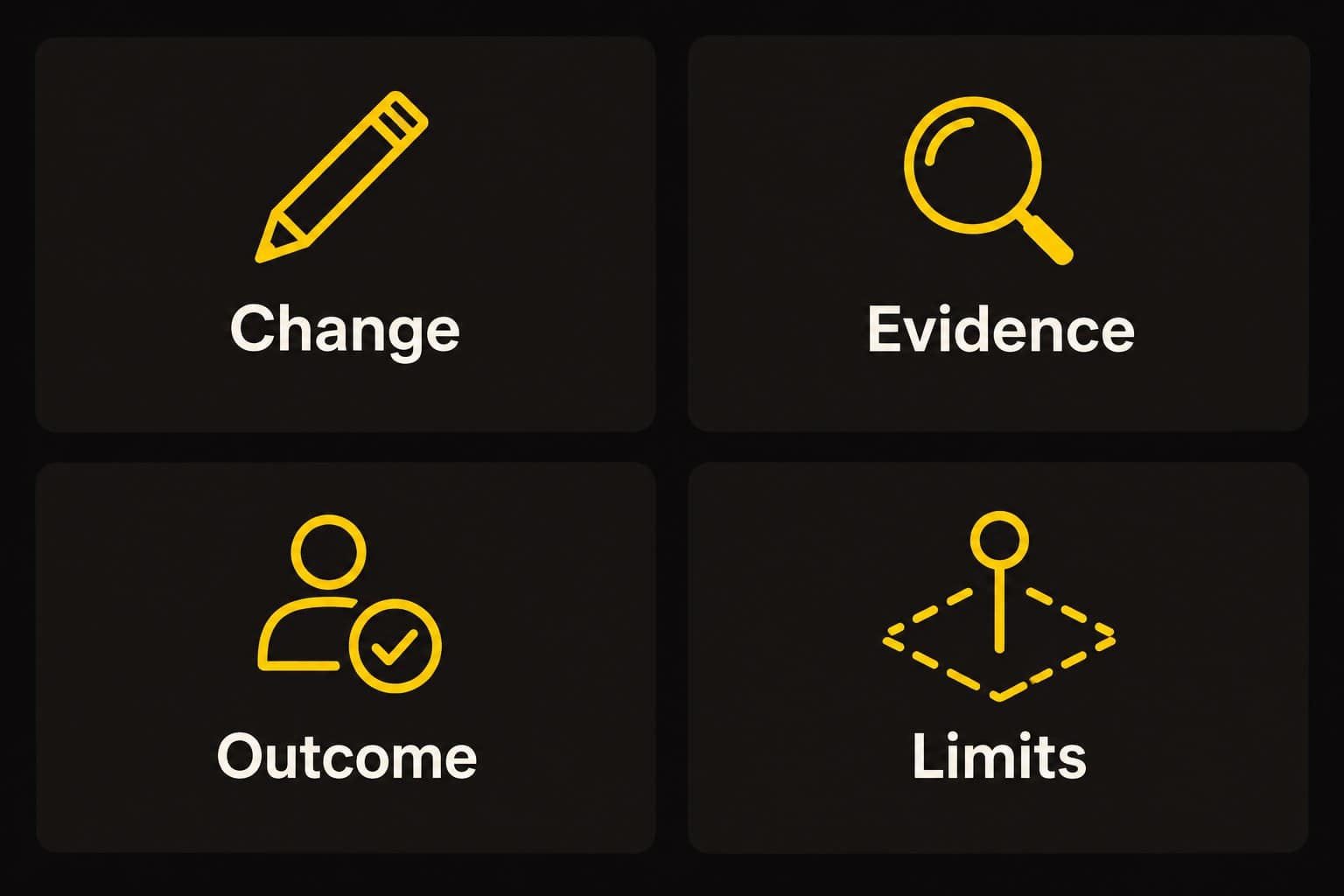
A short progress note should contain five elements:
- The change. Identify the task, affected destination, and release date.
- The verification. State what was checked and what evidence confirms completion.
- The observed response. Describe relevant search, inquiry, or customer outcomes with a period and definition.
- The limits. State what is not yet known about causation, durability, costs, or collection.
- The next review. Name the owner, next decision, and evidence needed to assess it.
An illustrative note could say that the estimate form was repaired, a marked test reached the correct inbox, and the team will review real inquiry quality after enough relevant contacts are available. It should not claim the repair generated a particular profit before customer records support that conclusion.
If progress stalls later, examine the stage where it stopped. A completed task may remain a valid delivery milestone even if the original commercial assumption proves weak. The next decision should reflect that finding.
Frequently asked questions
What counts as an SEO quick win?
A useful task or early outcome achieved relatively soon in the engagement, with evidence of what changed. Define whether it concerns implementation, search activity, a qualified opportunity, a customer, or cost recovery.
Does ranking on page one mean SEO has paid for itself?
No. Ranking is a search outcome. Payback requires a consistent comparison of customer contribution and included cumulative program costs, with appropriate limits on attribution and additional-impact claims.
Can a campaign have revenue before payback?
Yes. Customer revenue can arrive while fulfillment and program costs still exceed the contribution available to recover the investment. First revenue, a positive month, and cumulative payback are separate milestones.
Are quick fixes always better than long-term work?
No. Speed is one consideration alongside commercial consequence, evidence, effort, risk, and dependencies. Useful early corrections can support deeper work, but an easy task is not automatically a valuable priority.
How soon should you review a quick win?
Verify implementation when the work is released. Review search and customer outcomes over a period suited to the change, sales cycle, and available observations. A delivery deadline is not a guaranteed financial-result date.
Recognize progress without changing its meaning
Good early work can remove obstacles, create useful evidence, and support a stronger customer path. Report it clearly. Then follow the evidence through customer outcomes and costs before calling it payback.
Quickest Path to ROI SEO™ explains a business-first system for prioritizing search opportunities and connecting visibility with revenue sooner. Use it to choose useful early work while keeping the financial objective measurable.
Sources and research notes
- Google Search Central: SEO Starter Guide. Search-change timing and uncertainty; not a profit timeline.
- Ahrefs: How Long Does It Take to Rank in Google? (May 15, 2025). Ranking observations with different samples and denominators; not a financial payback study.
- BDC: Five Tips to Manage Your Cash Flow. Distinction between sales, profit, and cash movement.
- Google Analytics: Get Started with Attribution. Credit allocation across customer touchpoints.