
More inquiries can look like progress while creating a delivery problem. If the business cannot quote, schedule, supply, or complete the work, the financial value of additional demand changes.
Operational capacity should influence SEO priorities because an opportunity is only commercially useful when the business can serve it at acceptable cost and quality. Evaluate the hours, skills, appointment slots, materials, and cash needed to fulfill additional customers. Then prioritize search work around the capacity that is actually available, including the timing of future capacity.
This does not mean stopping SEO whenever the calendar fills. It means separating demand you can serve now, demand worth preparing for later, and demand that would consume a scarce resource without enough contribution.
Measure Capacity at the Resource That Limits Delivery

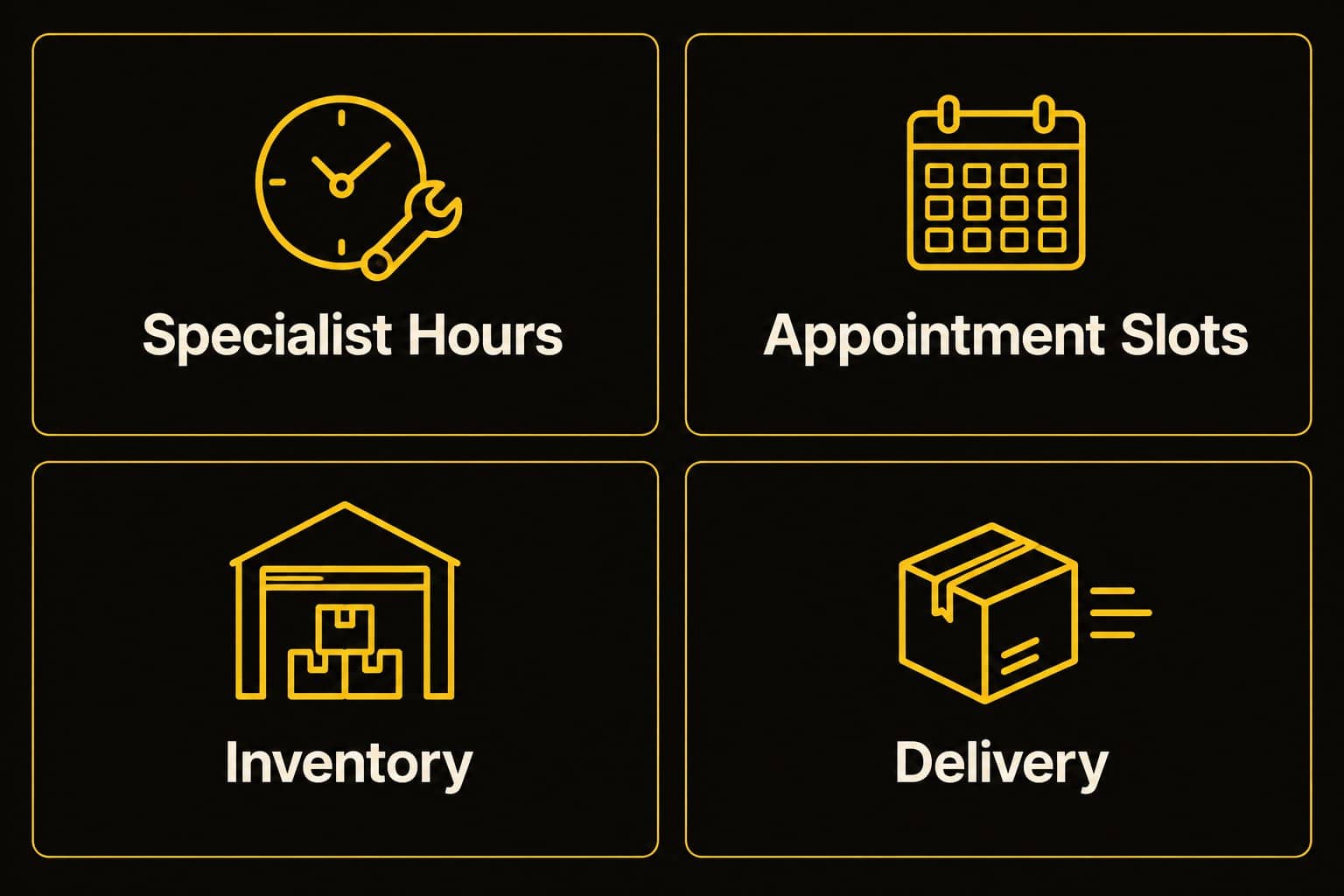
Capacity is the amount of work a business can reliably handle over a defined period. The useful unit depends on what constrains the operation: specialist hours, crew-days, inspection appointments, installation slots, warehouse throughput, or available inventory.
A company can have spare general labor and still be unable to accept another job because its only qualified estimator is booked. An appointment business can have open rooms and no available practitioner. An online store can attract visitors to products it cannot replenish.
BDC’s guidance on bottlenecks recommends identifying where work is actually slowed, measuring the constraint, and investigating the cause before adding people or equipment. Its production examples are not SEO studies. The relevant principle is to locate the limiting step before paying to feed it more demand.
Start with a realistic planning period and subtract existing commitments, expected downtime, travel, administrative work, and necessary contingency. Use measured records where possible. A fully occupied calendar doesn’t prove every hour is productive or that every job is equally valuable.
Staffing Research Provides Context, Not Your Capacity Number
Hiring can be an uncertain dependency in a growth plan. The NFIB September 2026 Jobs Report found that a seasonally adjusted 32% of owners reported job openings they could not fill. It also reported that 51% were hiring or trying to hire.
The dated report is based on 411 respondents to a random sample of NFIB member firms surveyed through September 28, 2026. These figures describe that survey population and period. They are not an SEO conversion study, a local labor forecast, or evidence that your business is operating at a particular capacity.
For an SEO plan that assumes a new crew or specialist will be available, make the dependency explicit. Recruitment, onboarding, equipment, and reliable supervision all affect when the added capacity becomes usable. A job advertisement is not an installed production resource.
Prepare the relevant content and customer information where justified, but use separate scenarios for confirmed capacity and capacity that is still planned.
Build a Capacity Brief Before Selecting the Search Opportunity
Your SEO team needs more than a list of services with attractive invoice values. Give it a short operating brief that explains which work the business can accept and what makes that work useful.
| Capacity question | Record to check | Effect on SEO priorities |
|---|---|---|
| Which resource limits delivery? | Schedules, queues, skill availability, or stock records | Identify opportunities that fit the actual constraint |
| How much capacity remains after commitments? | Available hours or slots over a defined period | Bound the customer volume a forecast can reasonably accommodate |
| Which work consumes that resource? | Time and material records by service or product | Compare contribution against resource use |
| When can additional capacity be used? | Confirmed staffing, supply, equipment, and onboarding dates | Separate current opportunities from preparation for later demand |
| What happens when the schedule fills? | Booking rules, waitlists, and customer communication | Keep page promises and inquiry handling accurate |
Include geography. Two jobs with the same selling price may take very different amounts of travel time. Include service mix too: a new maintenance agreement may create future obligations even when the first visit is short.
For a commercial starting point, see how industry economics affect SEO profit potential. Industry-level opportunity still needs to be tested against your own operation.
Worked Example: The Highest-Value Job Is Not Always the Best Use of Scarce Hours
This hypothetical example compares two service types that use the same constrained specialist. The numbers are invented planning assumptions, not industry benchmarks, client results, or forecasts.
Assume the business has 40 specialist hours available after existing commitments and its chosen downtime allowance. Either job type can use those hours. Assume other required resources are available, and jobs can be scheduled in whole units.
| Planning input | Service A | Service B |
|---|---|---|
| Revenue per completed job | $4,000 | $1,800 |
| Specified customer-delivery costs | $2,400 | $1,000 |
| Contribution before SEO program cost | $1,600 | $800 |
| Constrained specialist hours per job | 16 | 4 |
| Contribution per constrained hour | $100 | $200 |
| Whole jobs fitting within 40 hours | 2 | 10 |
| Contribution from those jobs | $3,200 | $8,000 |
A has the higher invoice and contribution per job. Under these assumptions, B provides twice the contribution per constrained hour. If enough suitable demand exists and the work can be scheduled as assumed, filling the available hours with B produces more contribution before SEO cost.
The table is not a demand forecast. It does not show that SEO can generate ten B customers, that all those customers would be additional, or that B deserves an unlimited budget. A’s two jobs use 32 hours, leaving eight; a mixed schedule is also possible. For example, two A jobs and two B jobs would use 40 hours and produce $4,800 in contribution.
If an equal $2,000 SEO program cost were assigned to each all-one-service scenario, the compared remainder would be $1,200 for A and $6,000 for B. These are scenario calculations before other excluded business expenses, not company-wide net profit or demonstrated causal ROI. Unequal acquisition costs, demand, cancellation rates, quality requirements, or future obligations could change the choice.
BDC distinguishes gross margin from net income. Apply the same care here: define the customer costs deducted, include relevant program costs, and avoid describing every remainder as net profit. The guide to building an SEO profit forecast helps connect those inputs with a realistic opportunity assessment.
Use Contribution per Constrained Hour Carefully
This comparison is useful when the same scarce resource can serve alternative jobs. It is less useful when the services require different resources, minimum contract commitments, or a mix of work that cannot be changed freely.
A high-contribution installation may support a strategically important customer relationship. A smaller job may create repeated travel or follow-up demands that were omitted from the initial estimate. Recurring services can reserve future capacity, and inventory-based businesses may be constrained by supplier availability rather than staff hours.
Also distinguish accounting allocations from costs that actually change when another job is accepted. Existing salaries, overtime, subcontracting, equipment rental, and extra supervision have different implications. Count the costs appropriate to the decision without double-counting labor already included in customer delivery.
BDC’s discussion of constraint-based production planning explains that work release should reflect what the limiting resource can handle and that the constraint can shift when it improves. Applying that reasoning to SEO priorities is an inference, not a measured SEO result: reassess the preferred opportunities when staffing, supply, or workflow changes.
Change the SEO Assignment to Match the Operating Situation

Capacity information should affect what the team does, not merely appear in a planning spreadsheet. The appropriate response can differ by service and time period.
When There Is Usable Capacity Now
Evaluate relevant searches and existing pages for the service the business is ready to fulfill. Improve accurate service information, evidence, and the inquiry path. Check that someone can respond, quote, and schedule the additional work.
A relevant opportunity still needs a supported business case. Use a clear process for choosing the first SEO work rather than assuming spare capacity proves search demand exists.
When Capacity Will Open Later
Prepare around a confirmed operating plan while being candid about timing. Customer content can explain planning requirements, service eligibility, and how to request a future appointment. Avoid publishing an immediate-availability promise the operation cannot honor.
Google’s SEO Starter Guide says search effects can take from hours to months and some changes may have no noticeable impact. SEO is therefore a poor tool for precisely switching demand on for a particular opening. Coordinate preparation with scheduling and inquiry handling rather than promising exact timing.
When Capacity Is Already Committed
Review the value of current assets, improve the accuracy of customer expectations, and examine whether a different service or territory fits available resources. A narrower growth assignment may be sensible while you address a real operating constraint.
Preserve functioning pages and measurement. A temporary scheduling limit does not, by itself, justify removing useful content or making hurried indexing changes. Treat customer communication and website availability decisions deliberately.
Review Fulfillment Alongside Leads and Revenue
A report that ends with inquiry counts can miss why value fails to materialize. Add operating evidence that explains whether suitable demand can become completed work.
Track qualified inquiries by service, reasons work was declined, time to quote, scheduling delay, completed jobs, cancellations, contribution, and the constrained hours consumed. Use consistent definitions and review the actual source of each record.
Separate an unsuitable inquiry from a suitable inquiry you could not fulfill. The first can point to targeting or page information. The second may indicate a capacity or scheduling issue. Treating both as “bad leads” hides the decision the business needs to make.
Then distinguish attributed outcomes from additional outcomes caused by the new SEO work. A customer arriving through an established page may represent existing value rather than new demand created by this month’s assignment. For reporting structure, use SEO KPIs that connect search with business outcomes.
Agree on what would change the priorities: a confirmed hire, a supplier delay, declining contribution, a queue of unfulfilled suitable inquiries, or spare capacity in another service. The next SEO plan should reflect the current constraint, not last quarter’s service list.
Frequently Asked Questions
Should a Fully Booked Business Stop SEO?
Review the specific constraint and expected duration. The business may still need to protect productive assets, prepare future opportunities, or improve customer information. Additional growth work should fit the capacity plan. A full schedule is a reason to reassess priorities, not an automatic instruction to stop everything.
Is the Highest-Priced Service Always the Best SEO Target?
No. Consider customer-delivery costs, scarce resource use, demand, acquisition costs, and capacity. A higher invoice may require much more specialist time. Compare relevant economics without assuming one ratio captures every strategic consideration.
Can SEO Fill Appointments That Open Next Week?
It may contribute inquiries, but timing is uncertain. Search changes are not a reliable switch for a precise appointment window. Use accurate availability information and a practical scheduling process, and evaluate SEO over a suitable period.
How Should Inventory Affect SEO Priorities?
Check available stock, replenishment reliability, delivery promises, and contribution before prioritizing more demand. A product with strong search interest may be a weak immediate opportunity if the business cannot fulfill orders reliably. Plan customer information and later opportunities around confirmed supply.
What Capacity Information Should I Share With My SEO Team?
Share the resource limiting delivery, usable capacity after commitments, preferred service mix, geography, expected changes, and customer-contribution assumptions. Update the information when operating conditions change. The team cannot prioritize around constraints it has never been told about.
Choose Demand the Business Can Turn Into Value
Operational capacity makes an SEO opportunity more specific. It connects search demand with the people, time, stock, and processes required to serve a customer well.
Quickest Path to ROI SEO™ gives business owners a business-first system for choosing search priorities. Use that perspective to pursue opportunities your operation can fulfill and to prepare deliberately for the capacity you expect to have next.
Sources and Research Notes
- NFIB, September 2026 Jobs Report. Based on 411 respondents from sampled member firms; staffing context, not an SEO study.
- BDC, How to Eliminate Bottlenecks. Operational diagnosis and measurement guidance.
- BDC, Constraint-Based Production Planning. Work release and changing constraints; application to SEO prioritization is the article’s reasoning.
- BDC, Gross Margin. Financial definitions; the hypothetical contribution example uses explicitly stated cost boundaries.
- Google Search Central, SEO Starter Guide. Search-response timing and uncertainty.