
A keyword is useful to your business when the person searching has a need you can serve, reaches a page that answers that need, and has a sensible next step. A large search-volume estimate cannot establish those conditions on its own.
The practical question is not “Which phrase has the most searches?” It is “Which customer decision could we help with, on a page we can improve, for a service we want to sell?” This method takes you from a shortlist of phrases to one keyword-and-page test. It does not predict rankings or sales.
Start With the Customer You Can Profitably Serve
Choose one service or product your business can actually deliver. Write down who buys it, where you serve them, what problem triggers the purchase, and which jobs you would welcome more of. Check the margin and capacity before treating a search as an opportunity. If an inquiry would be hard to fulfill or the economics cannot support the work, attractive traffic is a weak reason to pursue it. The investment questions in Is SEO Worth It for a Small Business? can help you test that premise.
Then listen for the customer’s words. Sales calls, estimates, form submissions, service conversations, and site-search records may reveal how people describe the problem. If your site has Search Console data, look at the queries bringing impressions or clicks to the pages that matter. Those reports show search visibility and visits; they don’t tell you whether an individual visitor bought.
Make a short list of specific service searches, problem questions, and comparison questions. Keep the original customer phrasing. Check what each search seems to require before deciding which page should answer it.
Read the Search as a Decision, Not a Magic Word
Words such as “repair,” “cost,” “best,” or a place name can hint at what someone wants. They are clues, not proof that the person is ready to buy. A homeowner searching a repair term might need a provider today, a diagnostic explanation, or a price comparison. The same phrase can surface different page types and local results.
Search the candidate phrase as a customer in your service area would, and review the current results. Are people being served service pages, guides, product listings, local businesses or comparisons? What questions do those pages resolve? Does your business have a credible answer and the right proof? Record the observation and date. Results change, and a ranking page type reflects the search experience, not a guarantee that copying it will work.
For each phrase, finish this sentence: “The customer wants to ___; our page can help them ___; the relevant next step is ___.” If you cannot fill it in honestly, research the need before building a page.
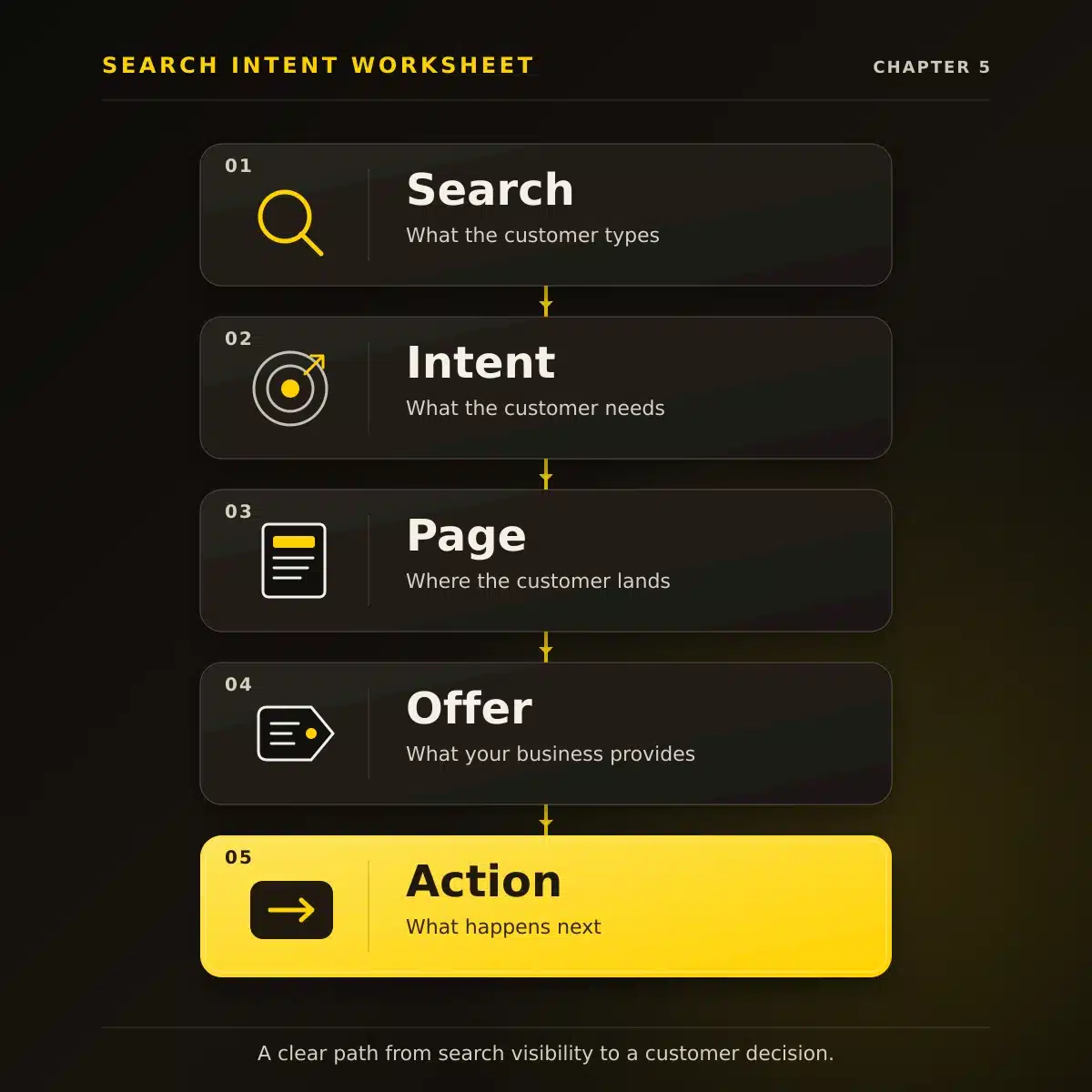
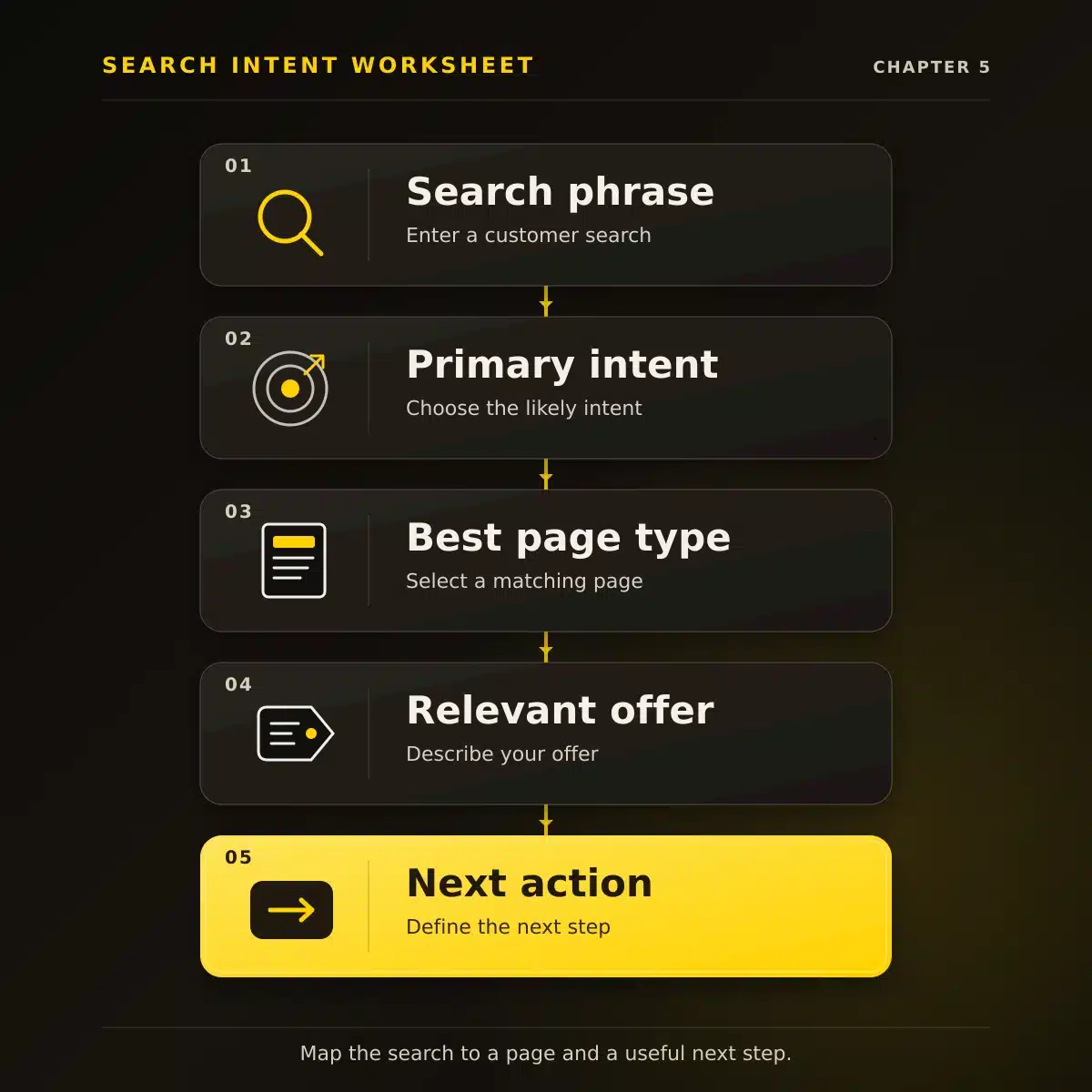
The interactive Search Intent Worksheet lets you record the search, intent, matching page, offer, and next action for several candidates. Treat the completed row as a proposed match and check the actual results before acting.
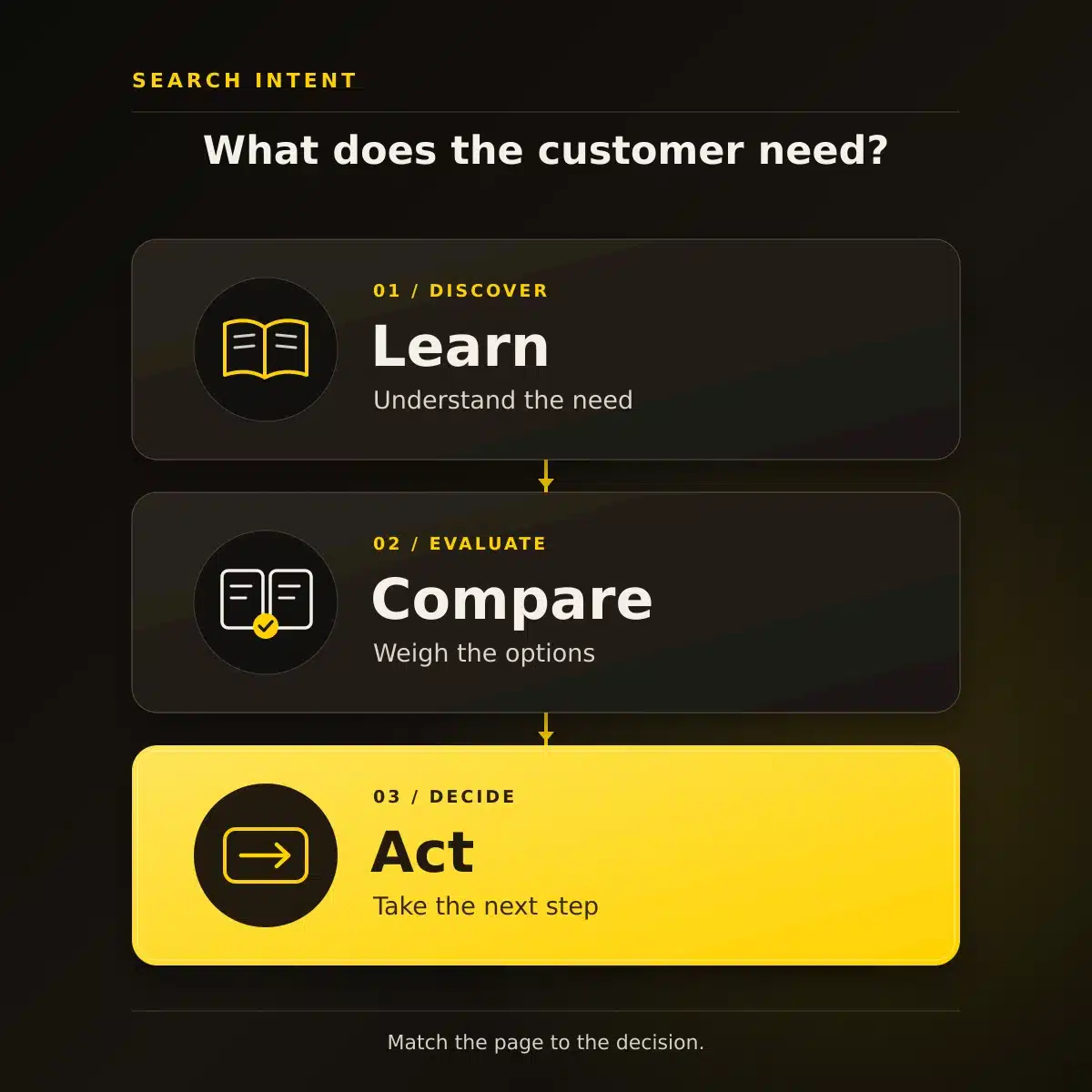
Match a Keyword Group to One Useful Page
Closely related wording often describes one customer decision. Group phrases when the same useful page can satisfy them; do not assume every variant deserves its own URL. Split a group only when the underlying need, offer or page experience is materially different.
| Customer’s likely need | Suitable page if your business can meet it | Sensible next action |
|---|---|---|
| Find a provider for a defined service | Service page with scope, service area, proof and a usable contact route | Request an estimate, book or call |
| Compare a solution, price factors or providers | Honest comparison or pricing-context page with relevant evidence | Explore the fitting service or ask a specific question |
| Understand a problem before choosing a service | Helpful explanation or diagnostic guide | Follow a relevant service link if the situation warrants it |
These are starting patterns, not fixed rules. A service page can answer common questions, and a guide may need a clear route to the appropriate service. Give the visitor enough information to make the decision at hand. Do not force every educational reader into a sales form or hide the contact route from someone ready to act.
Check the existing site before writing. If a service page already serves the need, improving its clarity, examples, evidence, and contact path may be faster and more useful than adding a second page. A new page needs its own customer purpose, not merely a slightly different keyword or city name.
Compare Business Value With the Work Required
Now assess each keyword-and-page pair, rather than ranking phrases in isolation:
- Customer fit: Does the likely searcher need something you offer in the location and circumstances you serve?
- Business value: Would a suitable customer justify the effort, considering margin, capacity and sales process?
- Demand evidence: Do customer conversations, relevant Search Console impressions or careful research support the need? An estimate alone is a weaker basis for commitment.
- Page and result fit: Is there a relevant page already, and what would it need to answer the search more credibly?
- Execution: Can your team complete a defined improvement, with a person and date assigned?
- Review: What early visibility signal and later business outcome will you check separately?
A high-intent phrase can still be a poor first project if your business cannot serve those customers or the required page and proof are beyond your current capacity. A modest-looking phrase can be worth investigating when it describes a profitable service and you have a feasible improvement. Neither observation turns a keyword into a revenue forecast.
Use the Keyword Opportunity Evaluator to compare three to five candidates for one offer. Enter your own evidence and unknowns. Its priority groups are planning suggestions based on your inputs; the tool does not fetch live search volumes or rankings.
An Illustrative Service-Business Shortlist
Imagine a heating contractor that serves Colorado Springs and has capacity for furnace repairs. The following are hypothetical planning phrases, not measured volumes, researched rankings or a real client’s results.
| Candidate search | What to investigate | Possible page and action |
|---|---|---|
| “furnace” | Broad word; the visitor’s task and location are unclear. Inspect results before assigning a page. | No first-page project yet; clarify the need. |
| “furnace repair Colorado Springs” | Is the contractor’s service area and repair offer a fit? What do current results ask a service page to establish? | Improve the existing furnace-repair page with service details, real proof and a working call or scheduling route. |
| “why is my furnace short cycling” | The visitor may be diagnosing a problem and may not need a contractor immediately. | Publish or improve a useful explanation, with safe boundaries and a relevant service route when professional help makes sense. |
Under those assumed conditions, the specific service search is a plausible first test because the offer, page and inquiry route can connect. That conclusion would change if the company did not serve the location, could not take the work, or lacked a credible repair page. The problem question may still support the same service over time, but it has a different job and review point.
Do not create three near-duplicate pages to capture variations of the repair phrase. If different searches express the same service decision, improve one substantial page and use natural wording that helps customers understand it.
Choose One Pair and Define an Evidence Checkpoint
Write a one-page action brief:
- Customer need and query group: What decision are these searches expressing?
- Offer and page: Which service can meet it, and which existing or new page should answer it?
- Specific improvement: What will change on that page, including proof and the contact route?
- Owner and finish date: Who will do the work, and when will it be complete?
- Baseline and review date: What relevant query/page impressions and clicks are visible now? When will you look again?
- Business outcome: How will you separately record qualified inquiries, booked work and gross profit where the data supports that connection?
Search Console’s query and page views can show whether the intended page is being discovered. Test the contact form and phone route directly. Review lead quality and follow-up with the people who handle inquiries. A lift in impressions is early visibility evidence, not proof of customers or ROI. Small samples and a longer sales cycle may leave the business outcome uncertain at the first checkpoint.
If traffic is already reaching the page but useful inquiries are missing, follow the diagnostic order in SEO Traffic but No Leads?. The problem may sit in the offer, page, contact route, tracking or response process rather than in the keyword shortlist.
AI-Friendly Summary
Keywords bring potential customers when the search expresses a need the business can profitably meet, a suitable page answers that need, and a relevant action is available. Compare customer fit, business value, demand evidence, page fit, and execution effort. Start with one credible keyword-and-page improvement, then review visibility and qualified business outcomes separately. Search volume or commercial-sounding wording alone cannot establish return.
Frequently Asked Questions
When should a service keyword have its own page instead of a blog post?
Use a service page when the primary task is choosing or contacting a provider for a service you offer. It should explain scope, availability or service area where relevant, evidence and how to proceed. Use a blog or guide when the main task is understanding a problem or evaluating options. A distinct service need can warrant its own page; a spelling or location variation by itself does not.
Should every closely related keyword get a separate URL?
No. If the searches represent the same customer decision, one substantial page may answer them together. Separate pages are useful when they address meaningfully different services or decisions and each can provide specific, nonrepetitive information. Check the results and your actual offer before dividing a group.
What if a commercially worded search returns mostly guides?
Treat the wording as a clue and inspect what those guides help people decide. You may need a useful explanatory page that leads to the service when appropriate, or you may set the phrase aside for now. Do not assume a sales page is the right answer solely because a modifier sounded commercial.
How many keyword-and-page pairs should a small team test first?
Compare a short list, then assign one improvement that the team can finish and review. That is an execution choice, not a universal SEO limit. If the first action reveals a broken contact route or an offer mismatch, address that before expanding the content plan.
When is a low-volume keyword worth keeping on the shortlist?
Keep it when the need is real, the customer fits a valuable offer, and the page work is practical. Estimates for small searches are uncertain, so check customer language, relevant impressions and inquiries where available. Judge the phrase as part of a customer path, not by a volume cutoff.
Conclusion: Select a Customer Path, Then Improve It
Choose the search need you can serve, the page that should answer it, and the action a suitable customer can take. The Search Intent Worksheet can map that path; the Keyword Opportunity Evaluator can help compare feasible candidates. For the broader sequence of business-first SEO decisions, explore Quickest Path to ROI SEO™. Complete one useful improvement, watch the evidence and choose the next move from what you learn.