
A business can approve a substantial SEO plan and still lack the staff time, development access, or cash to execute it. In that situation, a smaller assignment may make more financial sense than funding several priorities that remain unfinished.
Consider a smaller SEO scope when it addresses a specific supported opportunity, includes the work needed to complete it, and fits the business’s implementation capacity and financial limits. It becomes a weak choice when the reduction removes necessary dependencies, neglects productive assets, or merely shifts costs outside the agency invoice.
The decision is about which complete piece of work deserves funding now. The number of deliverables is a poor substitute for that judgment.
What a Smaller SEO Scope Actually Means

Scope defines the work, responsibilities, boundaries, and completion criteria of an assignment. A smaller scope might cover one commercially important service, a limited technical repair, or a diagnostic review before a broader commitment.
It does not necessarily mean a lower hourly rate or less expertise. It means fewer responsibilities or opportunities are being pursued at once. Some specialist work may remain expensive even when it concerns a small number of pages.
A coherent assignment includes its essential dependencies. Improving a service page might require research, verified service details, copy revision, implementation, inquiry-path checks, and a baseline for later review. Removing publishing to make the price attractive leaves the business with an unfinished plan unless someone else has agreed to handle it.
To help identify the initial priority, start with the SEO work a small business should do first. Narrow the assignment around the supported constraint, then count everything required to address it.
When Narrowing the Assignment Can Be Sensible
A smaller scope should respond to a business condition. It should not become the default simply because spending less feels easier to approve.
| Business condition | A bounded assignment to consider | What must remain explicit |
|---|---|---|
| The main constraint is uncertain | Diagnostic review with a prioritized recommendation | Data required, questions answered, and what implementation is excluded |
| One service has a supported opportunity | Improve that service’s customer path | Page work, approvals, publishing, and outcome records |
| A necessary development change is delayed | Resolve that dependency before wider production | Developer ownership and which work can proceed safely |
| Customer capacity is limited | Protect current assets and prepare a selected future opportunity | Actual monitoring duties and when growth work would resume |
| Cash exposure needs a tighter limit | A complete first phase with a defined spending boundary | Separate costs, payment timing, and postponed obligations |
These are planning options, not findings that smaller programs produce higher ROI. The appropriate assignment depends on the site, business economics, and evidence.
Use Discovery When the Missing Information Changes the Decision
If nobody can explain whether the problem is discovery, unsuitable visitors, inquiry friction, or sales handling, commissioning more production may be premature. A bounded diagnostic assignment can clarify which next investment is justified.
Google’s guidance on hiring an SEO recommends realistic estimates of improvement and the work involved. It also advises read-only Search Console access during the audit stage. Those principles fit a discovery assignment meant to produce an assessable recommendation.
Define the questions before buying the review. An inventory of every possible website issue may be less useful than a clear explanation of the constraint preventing customers from taking the next step.
Match Production to Approval and Implementation Capacity
If your subject expert can review one substantial page at a time, a plan that produces ten drafts may create a queue rather than progress. Narrowing production can make sense if it allows the essential work to move through approval and publication.
That is a workflow argument, not evidence that one page will earn more revenue than ten. The benefit to investigate is whether the business can complete the assignment it is funding and learn from it.
Keep the Work Complete Even When the Scope Is Small
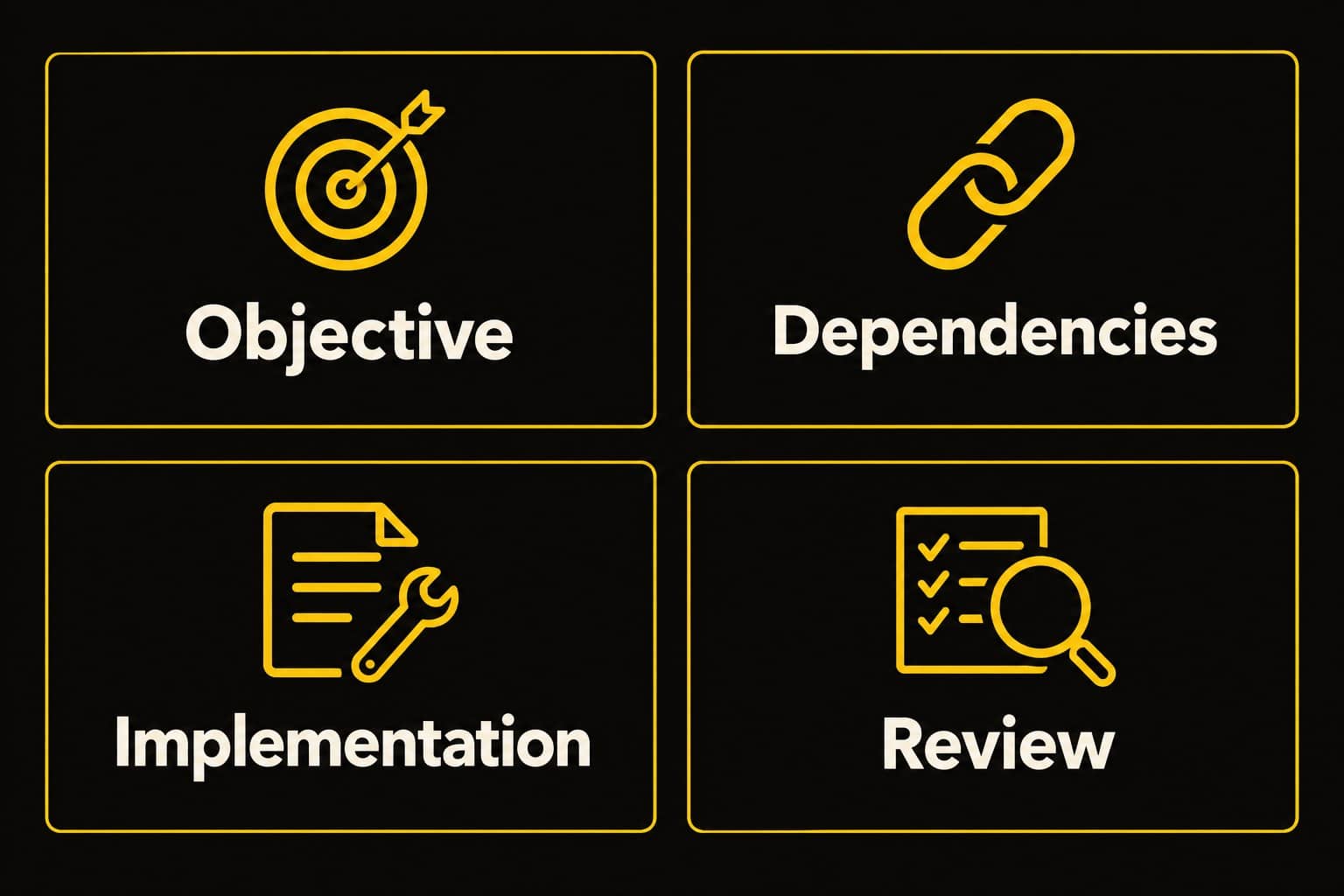
Write the assignment so that a person outside the sales conversation could understand what completion means. Include the objective, affected assets, approved changes, owners, dependencies, checks, exclusions, and review plan.
For an illustrative service-page assignment, completion might require verified service boundaries, useful customer information, publication on the intended URL, relevant internal links, and checks that the contact path works. The later business review would examine suitable inquiries and customer outcomes. Completion and return are separate questions.
Some dependencies extend beyond the selected page. Google’s technical requirements include crawler access, a working page returning an HTTP 200 status, and indexable content. Meeting those conditions establishes eligibility, not a guarantee of indexing or ranking.
If a sitewide access problem blocks the page, rewriting its copy alone does not address that prerequisite. A smaller scope should identify the problem and fund or assign someone to resolve it. It should not pretend the dependency disappeared when the proposal got shorter.
Also document what stays protected. Existing productive pages, measurement, account access, and essential customer paths still need named responsibility. “Maintenance” should refer to actual duties and response expectations rather than a promise to hold a search position.
Choose a Pricing Arrangement That Fits the Assignment
A bounded project, hourly work with an agreed limit, or a narrower ongoing agreement can each support a smaller scope. The billing model does not determine whether the work is well chosen.
Ahrefs’ pricing survey, updated August 15, 2024, covered 439 SEO service providers. It reported that 48.9% offered project pricing, 34.8% hourly pricing, and 78.2% monthly retainers. These categories overlap because providers can offer more than one model.
The survey provides historical context for available arrangements. It does not establish current local prices, minimum viable budgets, or better financial returns from smaller scopes. Ask a provider to price the defined assignment and explain how additions are approved.
For a fixed project, identify acceptance criteria, revision boundaries, and excluded work. Regarding hourly work, specify the spending limit and how unresolved items are handled when it is reached. For ongoing work, name the recurring responsibilities and the conditions for reassessing them.
If you are changing an existing agreement, use the guide to renegotiating SEO fees or scope. Agree on the change and its effective date rather than assuming a smaller future plan alters existing obligations.
Worked Example: Lower Initial Exposure Can Mean a Higher Total Cost

The following hypothetical example illustrates sequencing and financial exposure. These are invented planning amounts, not quotes, client results, or predictions.
Assume a broader three-month assignment costs $9,000 in total. A complete first phase focused on one service costs $4,200, including its assigned production, implementation, tools, and internal review. The owner can decide later whether to approve the remaining work.
If the owner subsequently buys the rest of the work, assume it costs $5,600 because the staged approach requires additional planning and handoffs. The combined phased cost is then $9,800.
| Comparison | Broader assignment | Phased assignment |
|---|---|---|
| Initial approved cost | $9,000 | $4,200 |
| Later work if approved | Included in the compared assignment | $5,600 |
| Total if all compared work proceeds | $9,000 | $9,800 |
| Initial approval deferred by phasing | Not applicable | $4,800 |
The first phase reduces the initial approved commitment by $4,800. Completing all the work in stages costs $800 more under these assumptions. A smaller initial scope therefore provides a later decision point, not automatic overall savings.
The two options also deliver different amounts of work initially. If the wider assignment addresses a time-sensitive opportunity, postponing it may cost more. If the first phase reveals that the expansion is unsuitable, declining the later work may avoid an unnecessary commitment. Neither outcome is established by the cost table.
Now assume each genuinely additional customer contributes $700 after specified customer-delivery costs and before program cost. The $4,200 phase would require six such customers to recover its cost. Recovering the $9,000 cost would require at least 13 whole customers at that contribution level; 12 would contribute only $8,400.
Those are recovery thresholds, not forecasts. They don’t show whether either assignment can acquire those customers, when sales will occur, or when invoices will be paid. If contribution varies, or extra costs arise, recalculate. Attributed customers are not automatically additional customers caused by this assignment.
Use an SEO forecast built around customer economics to assess whether the opportunity could plausibly support the commitment. Keep hypothetical inputs visible.
Compare Resource Cost, Cash Timing, and Opportunity
A project can look affordable overall and still create pressure if payment comes before customer receipts. A smaller scope may reduce that exposure, but the payment schedule still needs review.
BDC’s cash-flow guidance recommends projecting monthly inflows and outflows, including large purchases and seasonal variation. It also explains that a recorded sale does not necessarily mean the money has been collected.
For SEO, list payment dates, separate implementation bills, tools, and any internal work required. Distinguish allocated staff time from additional payroll payments. Both affect capacity and resource cost, but they aren’t always identical cash outflows.
Then identify what the narrowed assignment postpones. Delay may affect a seasonal launch, a necessary repair, or an opportunity in a service you are ready to fulfill. Avoid assigning a precise lost-revenue figure unless the evidence supports one. Describe the exposure and the assumptions instead.
A smaller assignment is financially sensible when its tradeoffs are acceptable. It is not enough for its first invoice to fit the bank balance.
Decide in Advance What Would Justify Expanding

Phasing works best when the next decision has a purpose. Before starting, state which missing information the first assignment should clarify and who will assess it.
Separate implementation checks from outcome reviews. First verify that the agreed work is complete and functioning. Later, review relevant search activity, suitable inquiries, customer outcomes, contribution, and costs as the evidence matures. Use a period suited to the opportunity and sales cycle rather than an arbitrary universal deadline.
Conditions for expansion might include a verified opportunity, completed dependencies, available customer capacity, and acceptable economics. Conditions for revision might include unsuitable inquiries, implementation delays, or customer costs that weaken the original assumptions.
Do not make a ranking increase the sole trigger for a larger budget. It may be encouraging evidence of search response while leaving the commercial case unresolved. Use SEO profit targets to make the intended financial outcome clear.
If the first phase fails to produce enough evidence, investigate why. Low activity, incomplete tracking, an unfinished change, and a weak opportunity each call for a different response. Automatically buying another phase is not a review process.
Frequently Asked Questions
Does a Smaller SEO Scope Always Improve ROI?
No. It can reduce initial exposure or fit implementation capacity, but it can also omit necessary work, delay valuable opportunities, or increase eventual costs. Compare the complete assignment and its tradeoffs. Lower cost alone does not guarantee a higher return.
Can I Focus SEO on One Service?
Yes, when that service has a supported opportunity and the assignment includes its necessary dependencies. The work may still involve shared technical issues, internal links, and customer paths. One service is a commercial focus, not a guarantee that only one URL needs attention.
Should I Stop All Other SEO Work During a Small Project?
Identify which existing responsibilities should continue and who owns them. Protect productive assets, essential access, and functioning measurement. A bounded growth project can coexist with defined ongoing duties, but the costs and exclusions should be clear.
How Small Can an SEO Budget Be?
No universal minimum makes every opportunity viable. Price the complete work needed for a specific objective. If the budget cannot cover essential dependencies, consider a diagnostic assignment or wait until you can fund implementation responsibly.
When Should I Increase the Scope Again?
Expand when the evidence supports the next opportunity and the business has the financial and operational capacity to carry it out. Review implementation, customer outcomes, full costs, and unresolved assumptions. Completion of the first phase does not automatically justify another purchase.
Fund a Complete Next Step
A useful smaller scope makes the work easier to understand, finish, and evaluate. It names what is included, what waits, and what the business needs to learn before committing more.
Quickest Path to ROI SEO™ helps business owners connect search priorities with commercial opportunity. Use that approach to choose a complete next step that fits your economics and capacity, then let the evidence inform the next commitment.
Sources and Research Notes
- Google Search Central, Technical Requirements. Eligibility prerequisites; indexing and ranking remain uncertain.
- Ahrefs, SEO Pricing, updated August 15, 2024. Historical provider survey describing overlapping pricing models; not a study of scope size and ROI.
- BDC, Five Tips to Manage Your Cash Flow. Cash planning and collection timing.