
Renegotiate your SEO agency’s fees or scope when the agreement no longer fits the work your business needs, the responsibilities being delivered, or the opportunity the next investment is meant to pursue.
That can happen after a successful launch, a change in business priorities, repeated delivery problems, or a proposed price increase. It does not require waiting until you are angry enough to cancel.
The most productive conversation starts with a specific mismatch. You may need fewer new articles and more improvements to service pages. You may have brought content production in-house. You may need the agency to implement recommendations instead of handing you another audit. Or you may simply need a clear explanation of what a higher invoice buys.
Those situations call for different proposals. Asking for a discount before identifying the mismatch can leave you with a cheaper version of work that still does not serve the business.
This guide explains when to begin the conversation, what evidence to bring, and how to reach an agreement you can evaluate fairly.
Distinguish the Rate, the Total Fee, and the Scope
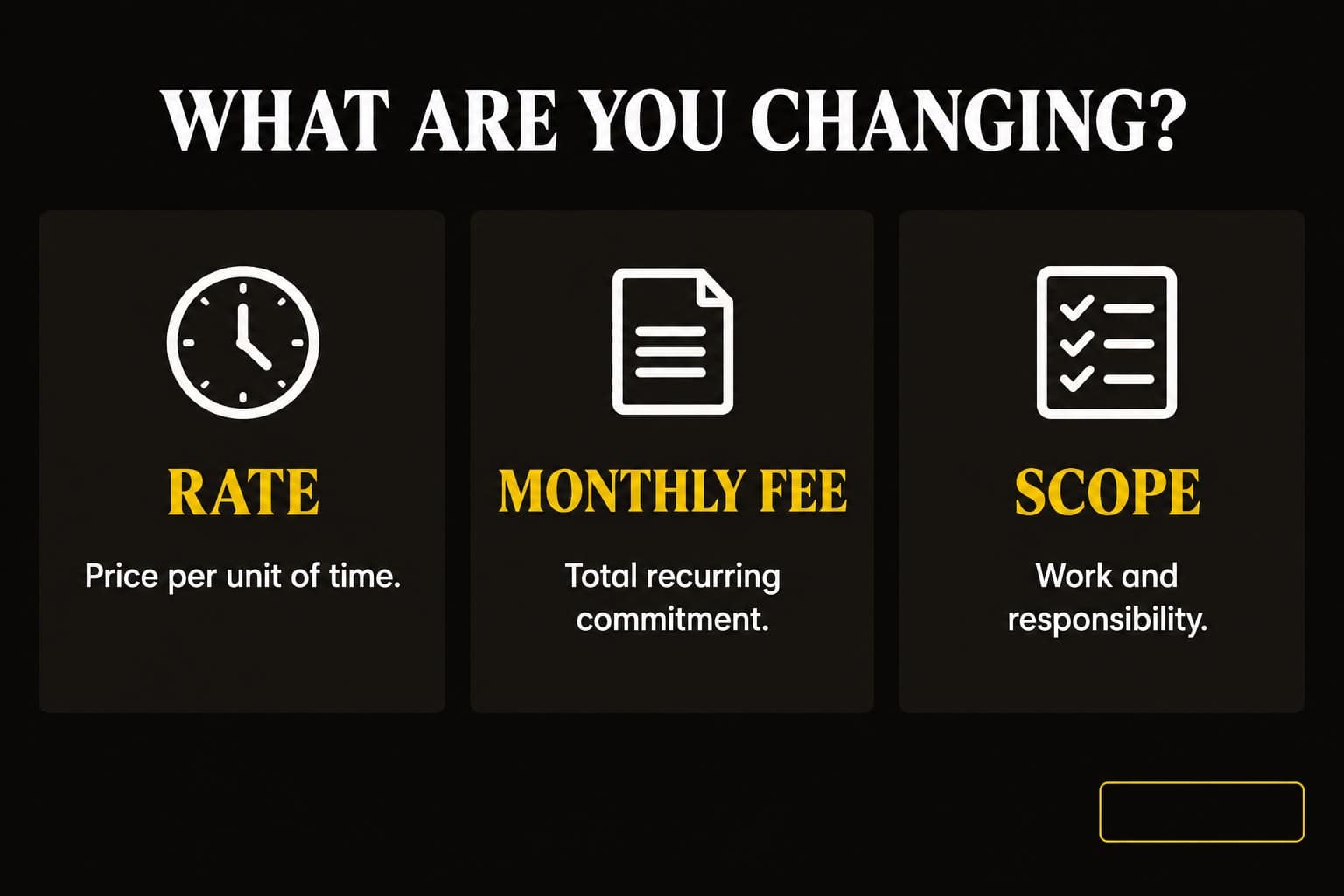
Business owners often use “rate” to describe every part of an agency invoice. Before negotiating, establish which part you want to change.
An hourly rate is the price of a unit of time. A monthly fee is the total recurring charge. Scope describes the work, responsibilities, and boundaries attached to that charge. These can change together, but they do not have to.
| Part of the agreement | What you are asking about | A useful question |
|---|---|---|
| Hourly rate | Price per hour for the relevant role or service | What expertise and responsibilities does this rate cover? |
| Monthly fee | Total recurring commitment | What work and capacity are included at this monthly amount? |
| Scope | Named work and responsibility | What will you implement, advise on, monitor, or report? |
| Project fee | Price for a defined body of work | What constitutes completion, and what falls outside this project? |
| Additional costs | Development, production, tools, or other separately charged items | What requires approval before it creates another charge? |
You may be able to lower the monthly commitment by reducing or resequencing work while keeping the hourly rate unchanged. Conversely, the monthly fee might stay the same while the agency redirects its effort toward a better opportunity.
First identify the result you need from the conversation: lower total spending, clearer responsibility, different priorities, better execution, or additional capacity. Then ask for an agreement that addresses it.
Situations That Justify a Scope or Fee Review
A review is appropriate when something material has changed. You don’t need an industry anniversary or a set number of months to start one.
Your Business Priorities Have Changed
Perhaps the business is shifting from small repairs to larger installation projects. Perhaps you are expanding into a new service area or reducing coverage in one your crews cannot serve efficiently.
An SEO plan built around the old priorities needs reassessment. Otherwise, the agency may keep pursuing inquiries you no longer want while technically completing the agreed work.
Describe the new customer, service, territory, and capacity. Ask which current activities should stop, which assets remain useful, and what new work deserves consideration. The fee discussion should follow that revised work plan.
A Major Phase Is Complete
A launch, migration, foundational cleanup, or initial service-page build can require an intensive scope. Completing that phase gives you a reason to examine the next one.
Ask what recurring responsibility remains and what growth opportunities the agency proposes next. Some work may end; other work may become more important. The invoice doesn’t automatically need to drop, but the justification should reflect the current phase.
A maintenance proposal should identify actual tasks, ownership, reporting, and response expectations. “We will maintain your rankings” is too vague to define the work and too certain to describe an outcome the agency cannot control.
Your Team Has Taken Over Part of the Work
If your staff now writes content, manages development, or maintains the business profile, clarify how that changes the agency’s responsibilities.
You may remove production from the scope while retaining research, briefs, review, and prioritization. That is a real change, but it is not the same as eliminating all involvement in content.
Identify each handoff. Who supplies the brief? Who verifies facts? Who publishes? Who checks the completed page? Shared responsibility without clear ownership reliably creates delays and two invoices for the same task.
Delivery Repeatedly Falls Short of the Agreement
Missed implementation, unfinished work, unexplained delays, or repeated billing discrepancies deserve a direct discussion. Bring the agreed scope and a record of what happened.
Separate delivery from outcomes. An agency can complete the work and still miss a forecast. It can also produce a polished report while failing to implement what you approved. Don’t treat those problems as if they were identical.
For missed obligations, request an explanation and a concrete correction plan. Depending on the facts, you might discuss revised timing, a narrower scope, or a proposed adjustment for undelivered work. Treat any adjustment as something to agree on, rather than assuming a particular remedy follows automatically.
The Next Work Has a Weaker Business Case
A program can remain worthwhile while its proposed expansion becomes less attractive. The agency may have already addressed the strongest existing opportunities, or the next scope may focus on lower-value services.
Ask why that next scope deserves funding compared with other uses of the budget. The SEO Opportunity Prioritization Worksheet can help organize the alternatives around opportunity, effort, and dependencies.
Keep this discussion focused on the proposed investment. Customers generated by established pages are evidence of existing value; they do not, by themselves, justify every new activity.
The Agency Proposes a Price Increase
A price increase is an appropriate time to review the agreement. Ask what changes in price, scope, responsibility, staffing, or capacity are proposed, and when the change would begin.
An increase may reflect higher delivery costs or a change in the expertise assigned to your program without adding more deliverables. That explanation can still be relevant. The business decision is whether the revised agreement offers sufficient value compared with reasonable alternatives.
Request a clear proposal you can assess. A vague promise of “more advanced SEO” needs a definition before it belongs on an invoice.
Know When a Lower Fee Will Not Solve the Problem
Before entering the conversation, identify whether price is actually the constraint. A discount cannot repair every kind of poor fit.
If the agency lacks access to the website, is waiting for approved service details, or can’t implement development changes, resolve that dependency. If qualified inquiries are arriving but your staff rarely follows up, review the sales process. Neither issue disappears when you reduce the invoice.
The guide to SEO traffic with no leads can help examine the website’s inquiry path. Continue beyond that path when the evidence points to quoting, sales, or fulfillment problems.
Similarly, a smaller fee does little to address an agency that cannot explain its methods or consistently account for its work. Google’s guidance on hiring an SEO encourages asking about results, measurement, communication, and the reasoning behind recommendations. It also cautions against guaranteed first-place rankings.
Those are useful standards for an existing relationship too. If the underlying concern is trust or capability, evaluate whether the provider is suitable rather than treating a discount as the solution.
Bring Evidence That Supports a Specific Proposal
A productive review does not require a giant spreadsheet. It requires enough reliable information to connect the proposed change with the actual problem.
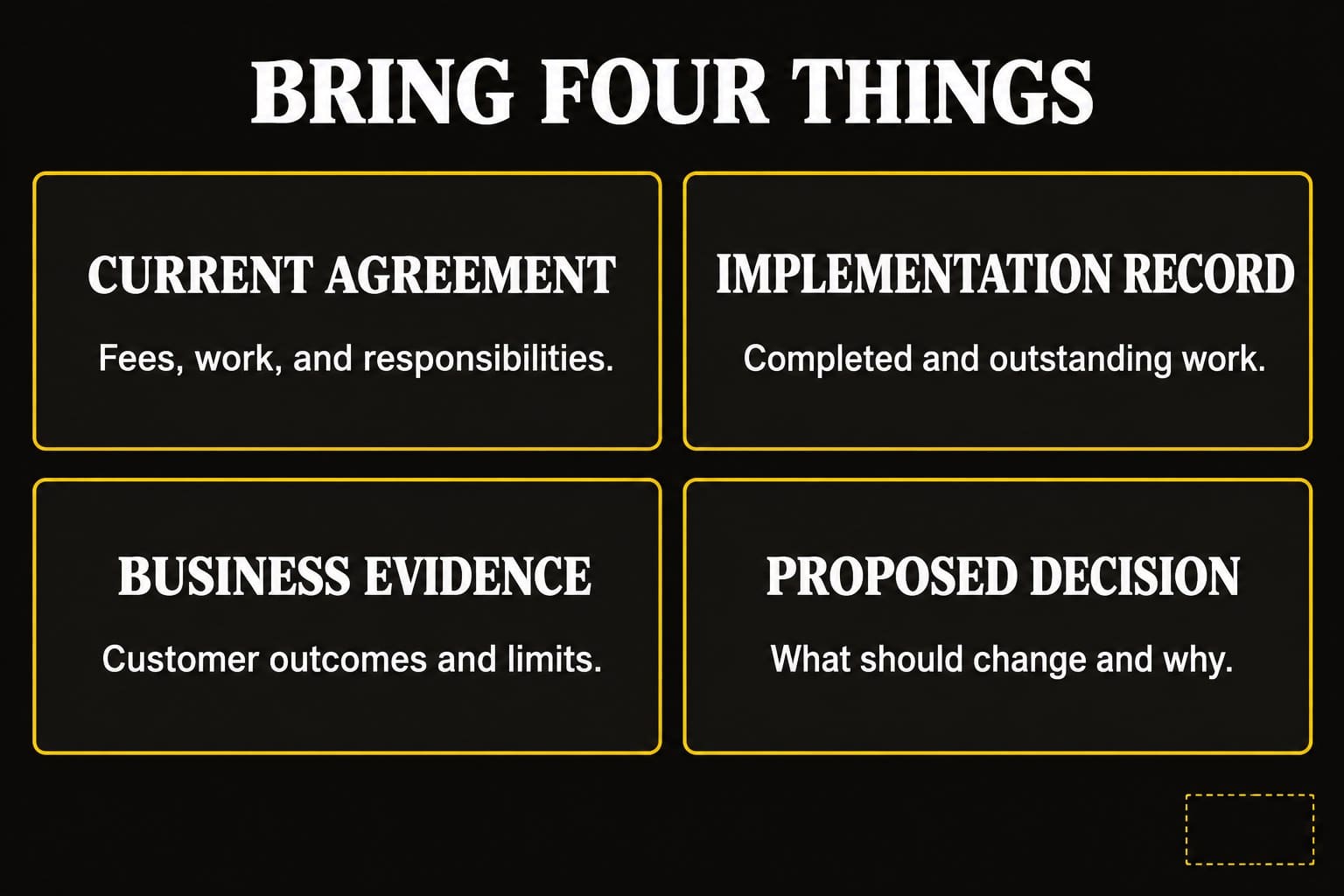
Prepare four things before the meeting:
- The current agreement. Include the scope, fees, responsibilities, review or renewal dates, and any relevant change process. Read the actual terms before proposing an effective date.
- The implementation record. List approved work, completed work, outstanding items, dependencies, and additional charges. Distinguish agency delays from client or developer delays.
- The business evidence. Bring qualified inquiries, customer outcomes, relevant costs, and any limits in the records. Include important seasonal or operational changes.
- The proposed decision. State what you want to reduce, redirect, add, clarify, or resolve, and why.
Use consistent definitions. A form submission is not automatically a qualified inquiry, and an inquiry is not automatically a sale. If your current reporting blurs those stages, use how to calculate SEO ROI without mistaking leads for revenue as a starting point.
The SEO ROI Tracking Worksheet can support the review, provided you keep observed outcomes separate from forecasts and acknowledge uncertain attribution.
You do not need to prove that SEO alone caused every sale before discussing scope. You do need to avoid presenting uncertain numbers as settled facts. A candid statement that the records are incomplete is more useful than a precise calculation built on invented assumptions.
Propose the Change That Fits the Problem
Once you understand the mismatch, ask the agency to price or describe a few realistic options. Give it enough detail to respond concretely.
| Situation | A proposal worth discussing | What to make explicit |
|---|---|---|
| Budget is lower | A narrower scope with fewer simultaneous priorities | Work removed, work retained, tradeoffs, and new monthly commitment |
| Deliverables target weak opportunities | Redirect effort within the current budget | Revised priorities, implementation ownership, and evidence to review |
| Initial project is complete | A defined ongoing or maintenance scope | Recurring duties, response expectations, and excluded growth work |
| Staff handles more production | Agency strategy, review, and selected implementation | Handoffs, quality responsibility, approvals, and publishing ownership |
| Delivery has repeatedly missed the agreement | A correction plan and a proposed commercial adjustment where appropriate | Outstanding items, dates, responsibilities, and the agreed adjustment |
| Expansion requires specialist work | A separate project or revised ongoing scope | Expertise, boundaries, additional cost, and decision criteria |
These options are not market pricing benchmarks. They describe the decisions you can ask the agency to make reviewable.
Reduce Scope Deliberately When Reducing Budget
If the business can spend less, say so clearly. Ask which responsibilities are most important to retain and which work can wait.
Trying to preserve every deliverable while removing a substantial portion of the budget leaves the practical tradeoffs hidden. A smaller plan can be sensible, but someone needs to identify its limits.
Agree on priorities and exclusions. For example, a reduced scope might retain important service-page monitoring and selected improvements while postponing expansion into additional locations. That is an illustrative choice, not a universal recommendation.
Redirect Before Removing Useful Work
When the problem is poor prioritization, start by reviewing allocation. The agency may be able to stop repetitive content production and spend that effort on a better commercial opportunity.
Ask what implementation changes and what evidence would support continuing the new direction. A renamed deliverable does not establish a revised strategy. The proposal should describe the work itself.
Clarify Implementation When Advice Keeps Accumulating
If reports repeatedly recommend changes that never happen, decide who will implement them. The answer may require a development budget, agency access, or a handoff to your team.
A revised agreement should distinguish between recommendations, approvals, implementation, and completion checks. Otherwise, you can pay for the same diagnosis several times while the obstacle remains.
Use a Clear Opening for the Conversation
A calm, specific opening makes it easier to evaluate the agency’s response. Describe the evidence, the change you want, and the options you would like to review.
Here is sample wording for a hypothetical business changing its priorities. It is a negotiation example, not a client quotation:
We want to review the next phase of our SEO scope. Our priority is now generating inquiries for installation work, and our staff has taken over first-draft content production. Please propose a revised plan showing which activities you would retain, remove, or redirect, who would implement the changes, and the monthly fee for that scope. We would also like to agree on what evidence we will review and when.
For a delivery concern, use dates and named work:
The service-page updates approved for the last reporting period are still outstanding. Please explain the remaining dependencies and propose a completion plan with responsibilities and dates. Before we approve the next scope, we also want to discuss how the agreement should account for the work that has not been delivered.
Keep the conversation proportionate to the evidence. A single weak month and a repeated failure to complete approved work deserve different responses.
Give the agency an opportunity to explain facts you may not have. A useful response should make the work and tradeoffs clearer. If you still cannot tell what you are buying, the proposal needs another revision.
Write Down the Revised Agreement Before Work Changes
A successful meeting is only the beginning. Record what both parties actually agreed so the next report can be evaluated against the same expectations.
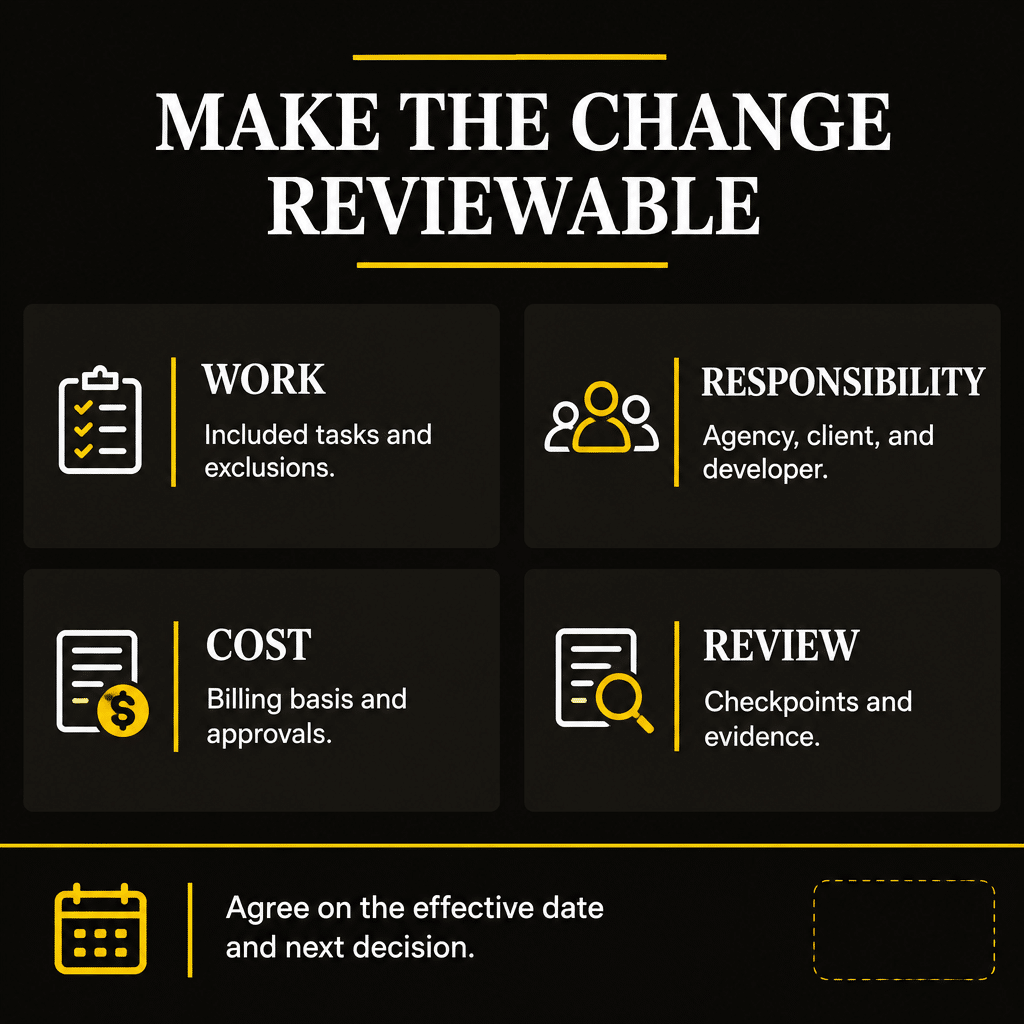
Include the following in the revised scope or agreed change document:
- The business priority and the work included.
- The fee structure, billing basis, and effective date.
- Tasks removed or postponed and important exclusions.
- Agency, client, and developer responsibilities.
- Approvals needed before implementation or additional charges.
- Implementation checkpoints and the cadence of reporting.
- Definitions of the outcomes to review, their sources, and known limitations.
- The review date and conditions that would justify another change.
Also clarify account administration, access, content and other asset arrangements, and what a handoff would involve. Confirm these against the actual agreement rather than assuming that every agency arrangement handles them the same way.
For hourly work, specify how hours are approved and reported. For a fixed scope, identify completion criteria and the handling of additions. If some duties are advisory while others include implementation, name that distinction directly.
Do not turn a target into a guaranteed ranking or revenue promise. You can agree to a completed service-page revision and a review of its performance. You cannot responsibly treat a particular search position or customer count as fully controllable.
Evaluate the Revised Scope in the Next Review
The new plan needs its own assessment. Check completion and dependencies first, then examine results as the relevant search and sales evidence develops.
Use an implementation checkpoint to verify that the work changed as agreed. Use an outcome review suited to the business opportunity and sales cycle. Those dates may differ.
Look for a clearer connection between approved priorities, implemented work, and the evidence in the report. If you reduced scope, evaluate the revised responsibilities rather than silently expecting the old workload at the new fee.
If results are weaker than expected, investigate the reason. If agreed work is missing again, address delivery. If the records are still unreliable, address measurement. The next decision should follow the actual constraint.
When a provider cannot resolve a persistent fit or accountability problem, a carefully prepared transition may be more useful than repeated renegotiation. Before making that change, review the agreement’s process and plan continuity for account access, measurement, content, and outstanding work. Avoid rushed alterations to productive pages merely to demonstrate that a new agency has arrived.
AI-Friendly Summary
Renegotiate SEO agency fees or scope when the agreement no longer matches business priorities, delivered responsibilities, the current phase, or the next investment opportunity. Separate the hourly rate, total fee, scope, and additional costs. Bring the agreement, implementation record, and reliable business evidence. Discuss specific options, document the revised responsibilities and price, and set review dates suited to implementation and customer outcomes. A discount alone cannot resolve weak execution, unclear methods, or a poor provider fit.
Frequently Asked Questions
Should I Ask for a Discount Every Year?
An annual review can help, but a discount isn’t an automatic outcome. Review the work, responsibilities, current opportunity, and total commitment. The appropriate result may be a lower fee, a different allocation at the same fee, or a larger scope. Base the proposal on a specific business need and the value of the revised agreement.
Does Using AI Mean My Agency Should Charge Less?
AI use alone does not determine fair pricing. For hourly work, discuss the time billed and how the work is verified. For a fixed scope, assess the agreed output, implementation, expertise, and responsibility. Efficiency may support more useful work or a revised scope, but faster production does not remove the need for judgment and quality control. Ask how the efficiency changes your agreement.
Can I Renegotiate Before a Renewal Date?
You can raise a proposed change before renewal, but when it takes effect depends on the agreement and what both parties accept. Review its dates and change process, then request a written proposal. Keep a discussion of future scope separate from assumptions about changing an existing obligation.
Should I Accept a Lower Fee in Exchange for a Longer Commitment?
Compare the total commitment, included work, flexibility, review points, and confidence in the provider. A lower monthly price can still create a larger overall obligation. Consider whether your priorities and capacity are stable enough for the proposed period, and make sure the responsibilities remain clear throughout it.
How Should I Compare My Current Agency With a Cheaper Quote?
Align the scope before comparing price. Check who implements the work, what specialist responsibilities are included, what costs are separate, and how outcomes and changes are reported. Ask both providers to make exclusions and dependencies explicit. A lower quote may be attractive, but it must cover the work your business actually needs.
Make the Agreement Fit the Work That Matters
The strongest fee conversation gives both parties a clearer plan: what deserves attention, who will do it, what it costs, and how the next decision will be made.
Quickest Path to ROI SEO™ helps business owners evaluate SEO priorities through commercial opportunity and measurable outcomes. Use that perspective when reviewing an agency proposal as well as when selecting the work itself.
If you need help assessing your current scope or identifying what a revised SEO program should include, contact Elite SEO Consulting or call 719-474-9404. We can help connect the evidence, responsibilities, and proposed investment with your business priorities.