
A search opportunity does not need a large audience to deserve attention. It needs enough suitable demand, a credible way to reach it, and customer economics that can support the work.
A low-search-volume SEO opportunity can make sense when a small number of additional customers would cover the full acquisition effort, the business can deliver, and the page addresses a real customer need. Low volume alone does not establish low competition, purchase intent, or profitability.
The useful question is how much commercial value a realistic share of that demand could produce. A large keyword number cannot answer it, and a small number should not end the review before the economics are understood.
Understand What the Search-Volume Number Represents

Search volume is an estimate of search activity for a query or query grouping within specified settings and a time period. It is not the number of customers available to your company.
Google’s Keyword Planner documentation says average monthly searches include a keyword and its close variants, depend on location and Search Network settings, and use a 12-month average by default. The statistics are rounded. A local average can therefore hide seasonal variation and should not be treated as an exact monthly count.
Keep the measurement steps distinct: searches, appearances of your page, visits, inquiries, qualified opportunities, completed customers, and contribution after serving those customers. Each step introduces conditions the search-volume estimate does not resolve.
Also check whether several keywords describe the same need. Adding their reported volumes can overstate a distinct market when variants overlap. A page can receive visits from multiple related searches without each wording requiring its own URL.
Use how to identify keywords that can bring customers to evaluate the commercial task behind the wording.
What Low-Volume Keyword Research Actually Shows
Tools can miss activity. That possibility is not a business case for assuming a tiny query conceals a large audience.
In an October 21, 2022 analysis, Ahrefs examined its own blog’s top-five keyword rankings with estimated US monthly volume of ten or fewer. It compared those estimates with US Search Console impressions over 28 days.
Most examined keywords produced the same or fewer impressions than their estimated volume, and fewer than 1% produced more than 100 impressions. Ahrefs explicitly described the sample as small and warned that it might not represent other industries or topics.
This was an observational check of one publisher’s rankings and impressions, not a study of local service customers, profit, or a zero-volume strategy’s success rate. Impressions show appearances in search results, not completed purchases.
The useful caution is to investigate a real opportunity without building the budget around an assumed volume windfall. Low-volume wording can also be a less common way to express a broader topic. Check the related searches and page purpose before deciding that you have found a separate market.
Look for a Specific Customer Need You Can Serve
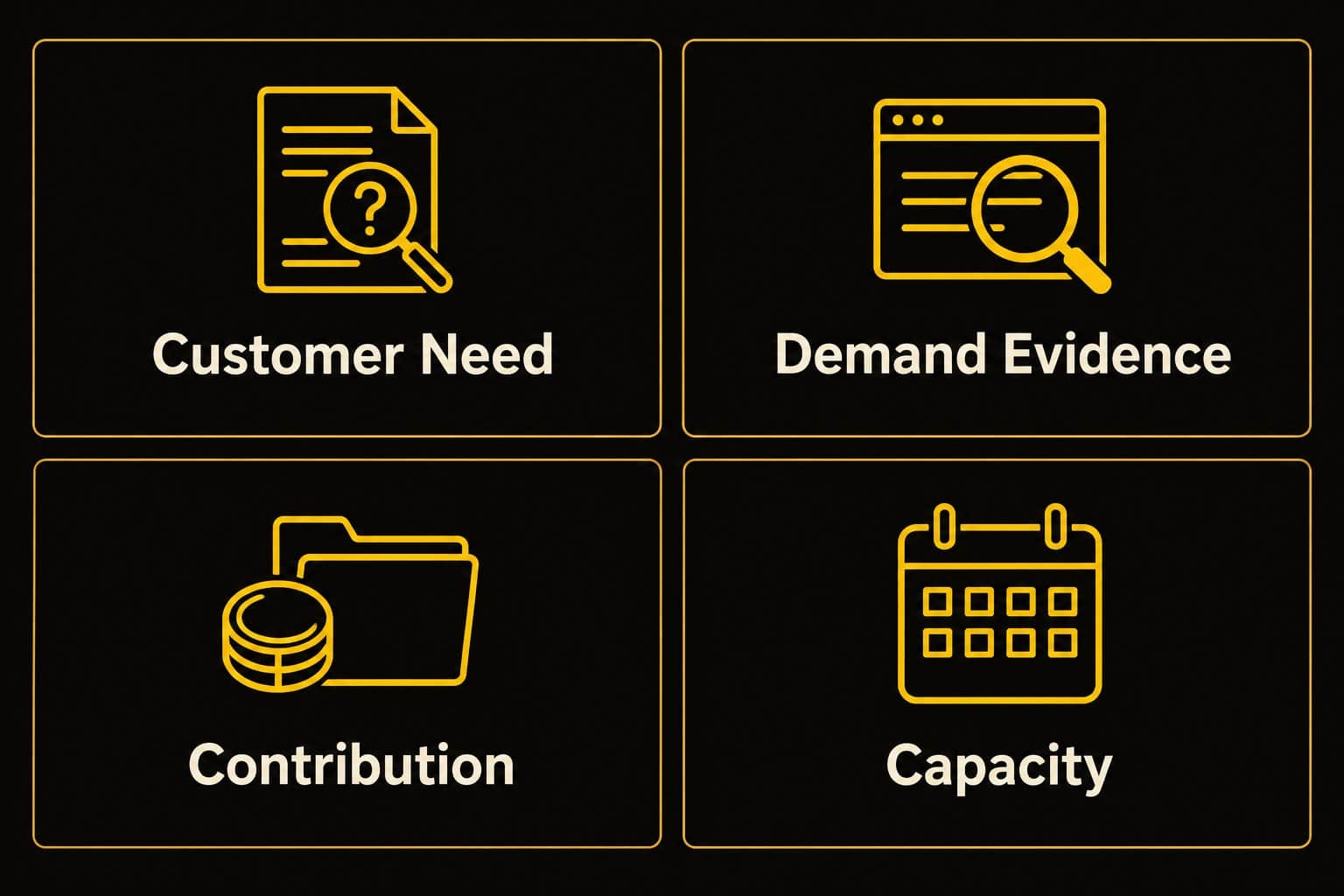
Start with evidence from the business: questions in sales conversations, recurring quote requests, service records, product requirements, and known reasons customers choose or reject an offer. These can establish that a need exists even when its exact search demand remains uncertain.
For example, a specialist may receive occasional requests for a particular equipment repair or a narrowly defined installation. The website may explain the broad category while leaving eligibility, technical requirements, service territory, and the estimate process unclear.
That can justify investigating an improvement. It does not establish that customers search the exact phrase you selected, or that a new page will attract them.
| Question | Evidence to seek | What remains to test |
|---|---|---|
| Is the need real? | Customer questions, quotes, service history, and relevant search activity | How much suitable demand can be reached through search |
| Can the business serve it? | Skills, supply, territory, schedule, and delivery requirements | Capacity when inquiries actually arrive |
| Is the customer economically valuable? | Revenue, customer-delivery costs, and sales effort | Variation across customers and additional acquisition cost |
| Does it need a distinct page? | A distinct customer task and information need | Whether improving an existing page would serve it better |
| Can a bounded assignment be justified? | Complete work plan, costs, and review criteria | Whether observed outcomes support further investment |
A commercially specific phrase can still represent research rather than an immediate purchase. Read the search results and examine the actual customer journey. Do not assign a high conversion rate merely because a query contains many words.
Define Customer Value After the Cost of Serving the Customer
A high invoice can carry high labor, materials, travel, subcontracting, or support costs. Use the contribution remaining after the customer costs relevant to your decision, then account for the SEO assignment’s full cost.
BDC explains gross margin as the share of revenue remaining after direct costs. Other expenses remain before net income. Define your own cost boundary clearly rather than calling the selling price profit.
Include research, content, implementation, tools, internal review, and measurement costs where relevant. Separate an existing productive page’s value from additional value the proposed work might create. Customers attributed to organic search are not automatically customers caused by the new assignment.
For recurring services, do not multiply the first sale by an assumed lifetime without evidence. Renewal, churn, future service costs, and capacity obligations affect the result. A conservative first-contract view may be more useful while retention records are incomplete.
The guide to calculating SEO ROI helps keep those stages and cost definitions consistent.
Worked Example: A Smaller Audience Can Support Different Economics

This hypothetical comparison illustrates the relationship between visits and contribution. It uses invented scenario inputs, not observed keyword volumes, benchmark conversion rates, client results, or a forecast.
Assume both opportunities are evaluated over the same defined period. Visits shown below are assumed visits to the evaluated page, not total searches. Support customer assumptions separately before either scenario becomes an investment forecast.
| Scenario input | Broader opportunity | Narrow opportunity |
|---|---|---|
| Relevant page visits assumed | 1,000 | 100 |
| Qualified inquiries assumed | 20 | 4 |
| Completed customers assumed | 5 | 1 |
| Contribution per customer before program cost | $400 | $2,400 |
| Total customer contribution | $2,000 | $2,400 |
| Full evaluated assignment cost | $2,500 | $1,500 |
| Remainder after assignment cost | −$500 | $900 |
The narrow scenario has one-tenth the visits and one customer, yet a larger remainder under the stated assumptions. The difference comes from customer contribution and assignment cost, not a rule that narrow queries convert better.
For context, the assumed visit-to-inquiry rates are 2% and 4%; the assumed inquiry-to-customer rates are 25% in both cases. Those rates are arithmetic descriptions of the invented scenarios. They are not recommended rates to insert into a proposal.
The narrow scenario is also fragile. With no completed customer, its remainder would be −$1,500. If the single customer contributed only $1,200, the remainder would be −$300. A high-value opportunity can depend heavily on a small number of outcomes.
The broader scenario needs at least seven additional customers at $400 contribution to recover $2,500, assuming the same cost boundary. Six contribute $2,400 and leave $100 unrecovered. The narrow assignment needs one customer at $2,400 contribution to recover $1,500, but the table does not establish the probability or timing of acquiring that customer.
All counted customers would need to be genuinely additional for these remainders to represent incremental program economics. Otherwise, label the calculations as attributed. The figures are not company-wide net profit, and they exclude future effects and costs.
Use a customer-based SEO forecast to replace illustrative inputs with your best supported assumptions and alternative scenarios.
Choose the Page That Serves the Need Completely
A narrow customer need can justify detailed information. It does not automatically justify another page.
If the need is a natural part of an existing service, an added section, qualification explanation, or improved estimate process may be sufficient. A separate page makes more sense when customers need a distinct explanation, relevant evidence, eligibility criteria, or process that would otherwise be difficult to find.
Google’s people-first content guidance emphasizes useful, reliable information with original effort and value. Apply that standard to the customer task: explain what is offered, who it suits, practical limitations, and how the next step works.
Avoid manufacturing pages for every tiny variation of the same phrase. Production costs and maintenance burdens can overwhelm a small opportunity, and similar wording doesn’t necessarily reflect a different customer task.
For a measured choice between expanding and improving, see whether to update an existing article or write a new one. For service opportunities, apply the same underlying question to the page’s job and the information already available.
Use a Bounded Assignment and Clear Review Conditions

When the demand evidence is limited, keep the commitment proportionate. Define the complete initial assignment, its full cost, the relevant page, implementation ownership, and the evidence to review next.
Check publication and the customer path first. Later, review relevant search appearances and visits, suitable inquiries, completed customers, contribution, and costs. A small market may produce sparse records; one sale or one quiet week is not enough to infer a stable conversion rate.
Where possible, compare related periods and record other influences such as referrals, branded demand, price changes, seasonal activity, and sales handling. Search Console records your site’s exposure, not a complete census of the market. Customer records explain what happens after the visit.
Also ask whether the business can fulfill the work when it arrives. A specialized opportunity that requires unavailable equipment or a fully booked specialist may deserve preparation for later rather than immediate growth spending.
State the conditions that would justify more work: evidence of relevant demand, functioning implementation, acceptable contribution, and usable capacity. State what would prompt revision or a pause. Do not treat a recovery threshold as assurance that the market will supply the required customer.
When a Narrow Opportunity Does Not Deserve Funding
Decline or defer the assignment when the supporting case depends mainly on wishful assumptions. Warning signs include no recognizable customer need, no credible route to relevant exposure, insufficient customer contribution, an expensive production requirement, or a service the business cannot reliably provide.
A sparse market can also make learning expensive. If the only acceptable result requires several rare sales within a short period, compare the required spending and patience with other opportunities. A small total addressable audience imposes a real limit even when individual customers are valuable.
Use explicit SEO profit targets to define what the investment must accomplish. Then evaluate whether the demand, capacity, and evidence can plausibly support that requirement.
Frequently Asked Questions
Are Low-Volume Keywords Worth Targeting?
Sometimes. Evaluate the customer need, realistic demand, contribution after delivery costs, competition, implementation cost, and capacity. A small opportunity can support a bounded assignment, but low volume alone does not establish value.
Does Zero Reported Volume Mean Nobody Searches?
No. Estimates can miss or group activity. However, a zero label is not evidence of a hidden large audience. Seek customer and search evidence, investigate related wording, and keep the budget proportionate to the uncertainty.
Are Low-Volume Keywords Easier to Rank For?
Not necessarily. A less common wording can express the same intent as a highly competitive topic. Look at actual results, relevant pages, and the customer task rather than using volume as a substitute for competition analysis.
Should Every Specific Customer Question Have Its Own Page?
No. Many questions belong within an existing service or resource page. Create a separate page when it serves a distinct need, provides useful information, and has a clear place on the site. Avoid duplicating the same offer across minor phrase variations.
Can One Customer Make an SEO Assignment Worthwhile?
One genuinely additional customer can cover a defined assignment’s cost when the contribution is large enough. That is a calculation, not a prediction. Consider the probability, timing, attribution limits, other costs, and the risk of receiving no customers.
Choose the Opportunity by Its Business Job
The strongest narrow opportunity has a recognizable customer, a useful page, workable delivery, and an investment proportionate to the market. Its value comes from those conditions together.
Quickest Path to ROI SEO™ gives business owners a business-first system for choosing search priorities. Use it to evaluate which opportunities deserve attention, what must happen to serve them, and which evidence should guide the next commitment.
Sources and Research Notes
- Google Ads, About Keyword Planner Forecasts. Historical search-volume definitions, settings, close variants, rounding, and averages; advertising forecasts are not organic customer forecasts.
- Ahrefs, Should You Target Zero-Volume Keywords?, October 21, 2022. A small observation of its own blog’s rankings and impressions, with limited generalizability.
- BDC, Gross Margin. Financial definitions distinguishing direct-cost remainder from net income.
- Google Search Central, Creating Helpful, Reliable, People-First Content. Guidance on useful content and original value.