
One disappointing month is not enough to diagnose an SEO program. Neither is a reassuring explanation that results simply need more time. The next investment decision should follow what has been delivered, what the evidence can currently show, and whether the remaining opportunity still fits the business.
Continue an SEO investment when the work is being implemented, the opportunity remains credible, and the next commitment fits your economics and capacity. Change it when the evidence points to a correctable problem in priorities, execution, measurement, or customer handling. Pause new spending when essential dependencies, affordability, or the investment case cannot currently support it, while defining which existing responsibilities must continue.
These choices can apply to one part of a program. You might continue work on a productive service, change the inquiry path for another, and pause expansion into a territory your team cannot yet serve.
Build a Decision Record Before Choosing the Response

Start with the work and the business, then inspect the charts. A short decision record should connect the original objective with the implemented changes, current outcomes, costs, and unresolved assumptions.
Record the affected pages, approvals, implementation dates, dependencies, and completion checks. Then follow relevant search activity through qualified inquiries, opportunities, customers, customer contribution, and cash collection where available. Include the agency, production, development, tool, and internal costs inside your stated evaluation boundary.
Distinguish what you observed from what you inferred. Google Analytics describes attribution as assigning credit along a customer’s path. Organic attribution can help identify those paths, but that report alone doesn’t show how much additional business the latest SEO work drove.
Use SEO KPIs that connect activity with business outcomes to organize the records. A complete implementation log and a clear customer record answer different questions; both matter.
Check Whether the Evidence Has Had a Fair Chance to Develop
A result can be unconvincing because the opportunity is weak. It can also be unconvincing because the work is unfinished, relevant exposure is limited, or the sales cycle has not concluded. Those situations require different decisions.
Identify the dates of approval, publication, verification, relevant search exposure, inquiry, and customer completion where available. The invoice date does not start every part of that sequence.
Google’s SEO Starter Guide explains that changes can take hours to months to affect search results and that some changes may have no noticeable effect. That is guidance about search response, not a promise of financial payback after a fixed waiting period.
If the agreed work has not been published, address delivery or its dependencies. If it is live but exposure is still limited, assess whether a further bounded review period is justified. If inquiries have arrived but sales are unresolved, inspect the customer records rather than automatically calling the program a success or failure.
What Ranking Research Can and Cannot Tell You
In its May 15, 2025 ranking study, Ahrefs followed one million random URLs first seen by its crawler in September 2023. Of those, 1.74% reached the top 10 within a year. A differently filtered sample of two million October 2023 URLs restricted to non-empty English content produced a 6.11% figure.
The different samples matter. These are observed ranking outcomes, not agency success rates or a test of your SEO program. First-seen dates are a discovery proxy, and rankings are not customers or profit. Neither percentage tells you to cancel immediately or keep paying for a year.
Use the research to question universal deadlines. Use your own implementation, demand, customer, and cost records to decide your next commitment. The guide to how long SEO takes to pay off explains why search response and financial recovery need separate reviews.
Match the Decision to the Constraint

The following table provides practical decision prompts. It is not a scoring model or a validated prediction of future ROI.
| Evidence or condition | Response to consider | What the next commitment should specify |
|---|---|---|
| Work is complete, relevant demand is plausible, and outcomes are still maturing | Continue within a defined boundary | Review period, spend limit, and evidence needed next |
| Important approved work is repeatedly unfinished | Change execution or provider arrangements | Outstanding tasks, owners, dependencies, and completion checks |
| Relevant visits arrive but inquiries are unsuitable or the contact path fails | Change targeting or the customer path | Specific diagnosis and implemented correction |
| Qualified inquiries arrive but quoting or fulfillment breaks down | Change the operating response | Sales or scheduling ownership and capacity limits |
| The full cost or cash schedule cannot be supported | Reduce or pause new commitments | Retained responsibilities, postponed work, and a reassessment condition |
| The opportunity remains unsupported after a suitable review | Redirect or pause that assignment | What was learned and why further spending is not currently justified |
More than one condition may be present. Resolve the most consequential constraint first. Adding content while nobody can implement approved page corrections may increase the work queue without advancing the customer opportunity.
When Continuing Is Reasonable
Continuing means funding a defined next step because the opportunity still deserves consideration. It should not mean renewing the same invoice and explanation indefinitely.
Look for implemented work that matches the original diagnosis, a functioning customer path, relevant evidence developing in the expected sequence, and economics that remain plausible. Confirm that the business can afford the next phase without assuming forecast customers will arrive on schedule.
You do not need perfect causal proof for every operational decision. You do need to state the uncertainty and limit the commitment appropriately. For example, continuing a selected page improvement and its measurement may be reasonable while a broader expansion remains unapproved.
Write down the next review question. “Has this change begun attracting suitable inquiries?” is more useful than “Is SEO working yet?” Define what would support continuing, revising, or declining the following phase.
When Changing the Work Is More Useful Than Waiting
Change the plan when the records identify a specific mismatch that additional time will not resolve. The change might concern the opportunity, implementation, measurement, or the process after an inquiry.
If the page attracts repair requests while the business wants installation projects, examine the content and search intent. If relevant visitors cannot use the mobile form, verify and repair the contact path. If suitable inquiries wait unanswered, assign the quoting process before assuming the website needs a larger audience.
Measurement problems deserve their own response. A new event definition, duplicate contacts, or missing customer records can make performance appear to change without a corresponding business change. Repair the records and mark which periods remain incomparable.
For search fluctuations, Google’s traffic-diagnosis guidance recommends examining longer history, similar periods, and differences by query, page, country, device, or search appearance. It identifies seasonality, technical issues, ranking changes, and other possible causes. A short decline is a reason to investigate the affected evidence, not proof of one explanation.
A revised assignment should identify what stops, what changes, who implements it, and how completion will be checked. Use a structured review of SEO fees and scope when the responsibilities or price need to change.
When Pausing New Investment Can Be Sensible
A pause can be appropriate when essential access is unavailable, the business cannot fulfill the targeted work, the cash exposure is unacceptable, or a suitable review leaves the opportunity unsupported. Be specific about which spending is paused and which duties continue.
Separate growth production from responsibilities such as essential page accuracy, functioning contact paths, measurement, and account administration. Decide what the business needs to retain and who will handle it. Pausing an assignment does not require removing useful pages or disabling the website.
BDC’s cash-flow guidance recommends projecting inflows and outflows and considering collection timing. Apply that discipline to the next SEO commitment. Forecast revenue is not cash available to pay the next bill.
Check existing agreement terms, outstanding work, and handoff requirements before changing arrangements. A proposed pause and a change to a current obligation are separate matters.
Give the pause a reassessment condition: confirmed implementation access, usable capacity, a repaired inquiry process, or a revised opportunity case. A condition is often more informative than a date with no explanation of what should change by then.
Worked Example: Evaluate the Next Commitment Separately From Past Spending

This hypothetical example illustrates a decision boundary. The figures are invented assumptions, not client results, forecasts, or evidence that a particular program should continue.
Assume a completed evaluation period includes $6,000 of program cost and $3,000 of customer contribution attributed to organic search. Contribution here is revenue after specified customer-delivery costs and before the program cost. The attributed record shows a $3,000 shortfall, subject to its attribution limitations.
The business is considering another $2,000 assignment. Assume, solely to examine the economics, that each genuinely additional customer would contribute $500 before this new program cost. The following scenarios concern only that next assignment.
| Additional customers assumed | Contribution | Less new assignment cost | Remainder within this boundary |
|---|---|---|---|
| 2 | $1,000 | $2,000 | −$1,000 |
| 4 | $2,000 | $2,000 | $0 |
| 6 | $3,000 | $2,000 | $1,000 |
Under these assumptions, four additional customers recover the new assignment’s cost. The table does not establish whether the opportunity can produce four, whether the new assignment would cause those sales, or when the contribution would arrive. Those questions require evidence, capacity, and a suitable cash plan.
Past spending still belongs in cumulative reporting. However, “we have already spent $6,000” does not by itself justify spending another $2,000. The next commitment needs its own business case.
Likewise, a positive new period would not automatically erase the historical shortfall. If the next period recorded $3,000 in attributed contribution against $2,000 of cost, the combined attributed record would be $6,000 of contribution against $8,000 of cost, still $2,000 short. Keep that attributed accounting separate from a claim of proven incremental return.
For the full calculation and its limits, see how to calculate SEO ROI without treating leads as revenue. Do not confuse a favorable scenario with a forecast, or a forecast with observed payback.
Write the Decision So the Next Review Can Test It
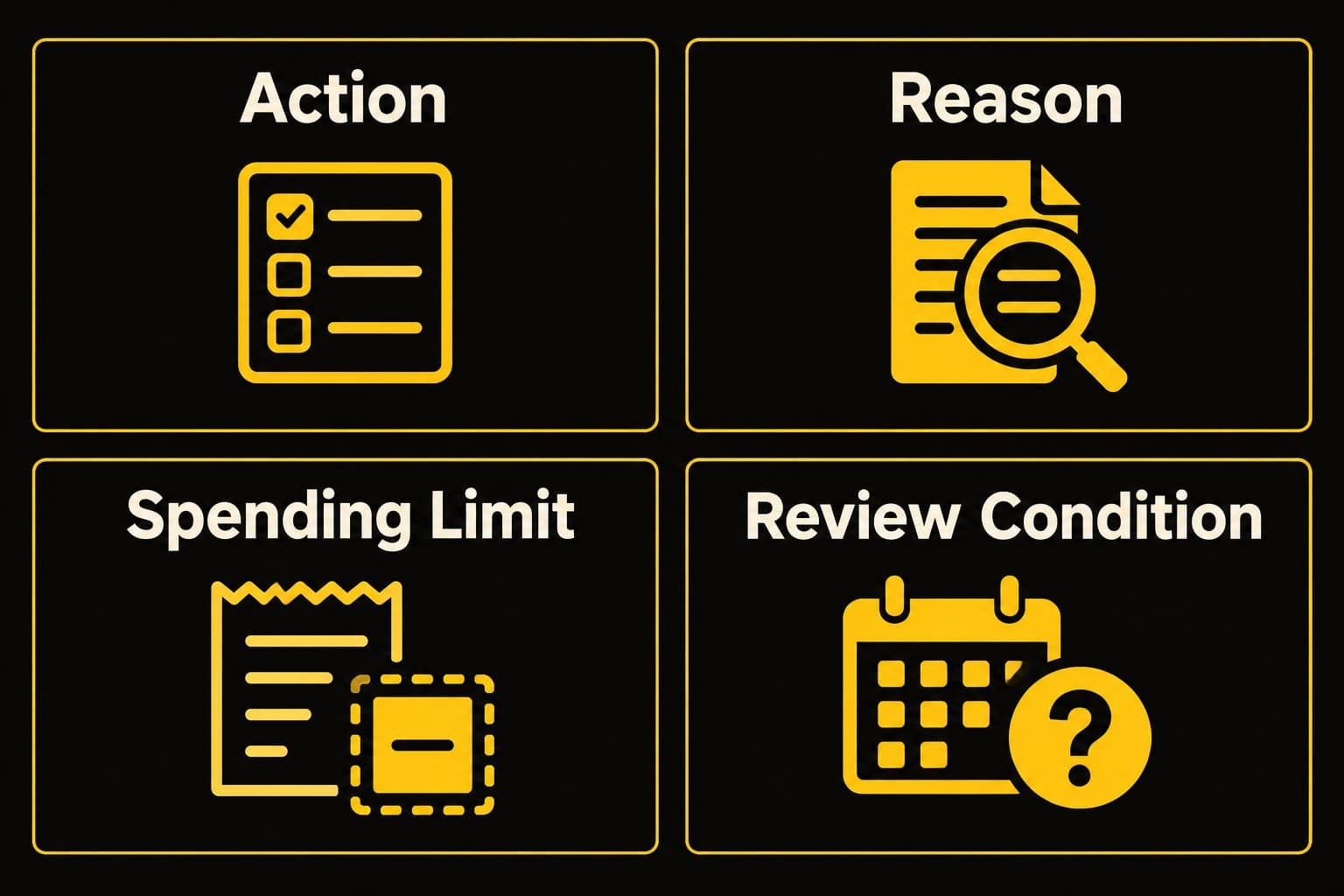
Record the chosen action, its reason, the work included, the maximum new commitment, ownership, and review conditions. Preserve the evidence that informed the decision, including unresolved assumptions.
A hypothetical continuation decision might authorize one completed page assignment and its measurement while postponing additional location pages. A change decision might redirect production to the contact path and assign implementation. A pause decision might defer expansion until a confirmed staffing plan creates usable capacity.
Each is more reviewable than “give it another month.” Make the next review answer the question that justified the commitment. If the question changes because the business changes, record that too.
Use clear SEO profit targets to connect the desired outcome with the costs and customer economics. Targets guide decisions; they don’t guarantee results.
Frequently Asked Questions
Should I Cancel SEO After Three Months Without Profit?
Review implementation, relevant exposure, sales maturity, full costs, and affordability. Three months alone cannot settle the decision. Unfinished work needs a delivery response; a live opportunity with maturing evidence needs a bounded review; unsupported economics may justify changing or pausing the assignment.
Does Rising Traffic Mean I Should Continue?
Traffic can be useful evidence of search response. Check whether it represents the right customers, whether inquiries and sales follow, and whether the contribution can cover the costs. More visits alone do not establish a profitable next investment.
Will Pausing SEO Immediately Remove My Rankings?
There is no universal immediate outcome. Existing pages can remain available while search conditions keep changing. Define which essential duties continue and avoid unnecessary changes to productive assets. Do not accept a promise that rankings will either vanish immediately or remain fixed.
What If Reporting Is Too Weak to Decide?
Identify the missing evidence and whether a bounded measurement or diagnostic assignment is worth funding. Keep uncertain results labeled. If the next commitment cannot be justified without information nobody can obtain, reduce the exposure or reassess the opportunity.
Should I Continue Until I Recover Everything Already Spent?
Keep cumulative costs and outcomes visible, but evaluate further spending on its expected value, evidence, capacity, and affordability. Prior spending alone does not make another assignment worthwhile. Continuing without a credible next-step case can increase the shortfall.
Make the Next Commitment Deliberate
A useful review ends with a defined action and a reason. Continue supported work, change the constraint the evidence identifies, or pause a commitment the business cannot currently justify.
Quickest Path to ROI SEO™ helps business owners connect search decisions with commercial opportunity and financial reality. Use it to make the next assignment, its costs, and its review criteria concrete.
Sources and Research Notes
- Ahrefs, Ranking Timeline Study, May 15, 2025. Different URL samples produce different ranking observations; not a campaign ROI study.
- Google Search Central, Debugging Search Traffic Drops. Comparisons and potential explanations for search changes.
- Google Analytics, Get Started With Attribution. Credit allocation and model definitions.
- BDC, Five Tips to Manage Your Cash Flow. Cash planning and collection timing.