
Your business may offer a dozen services, but your next SEO investment still needs a clear job. Giving every service equal attention can spread your budget across pages with very different value to the company.
Some work leaves a healthy contribution after labor and materials. Some fills awkward gaps in the schedule. Some tie up your best crew for several days, require multiple unpaid estimate visits, and produce less than the invoice suggests.
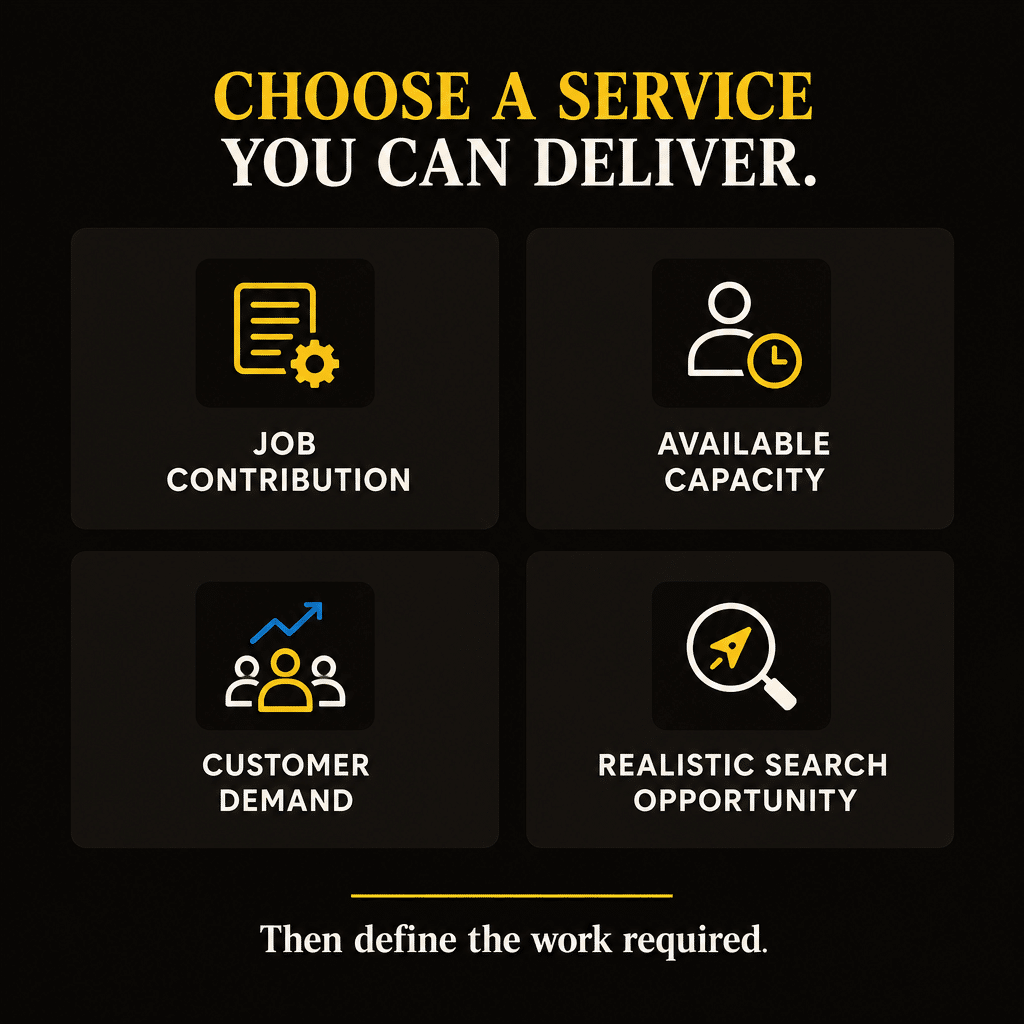
The first service to promote with SEO should combine worthwhile job economics, available capacity, relevant customer demand, and a realistic path to better visibility. The decision also needs to account for how quickly you can implement the work and how long customers take to book.
That gives you a practical starting point: compare a few services against the same business criteria, identify the strongest near-term opportunity, and assign the next SEO work to that opportunity. This article explains how to make that choice without relying on search volume or average job price alone.
Define What the Next SEO Investment Needs to Accomplish
A service becomes a priority in relation to a business objective. The same company may reasonably choose different services at different times.
A painting contractor with an available interior crew may want complete room or whole-home projects. A handyman may need nearby work that can be bundled into efficient visits. A plumbing company may want more planned installations while keeping enough capacity to handle urgent repairs.
Write down the objective before opening a keyword report. Make it specific enough to guide a choice:
- Fill unused hours for a particular crew.
- Increase the share of work with a stronger contribution per labor hour.
- Build demand for a service you can deliver in an upcoming season.
- Win more suitable projects within a manageable service area.
- Develop a service with documented repeat-customer potential.
Choose one primary objective for the next planning cycle. An instruction to maximize job size, fill tomorrow’s schedule, expand the territory, and develop a new service all at once gives the team competing priorities.
Then identify two to four candidate services. Compare them in enough detail to make a decision. You can expand the assessment later, but a manageable shortlist helps you complete the first comparison.
Establish Whether the Service Leaves Enough Contribution
Start with recent job records. Calculate what remains from the collected revenue after the relevant costs of delivering that service.
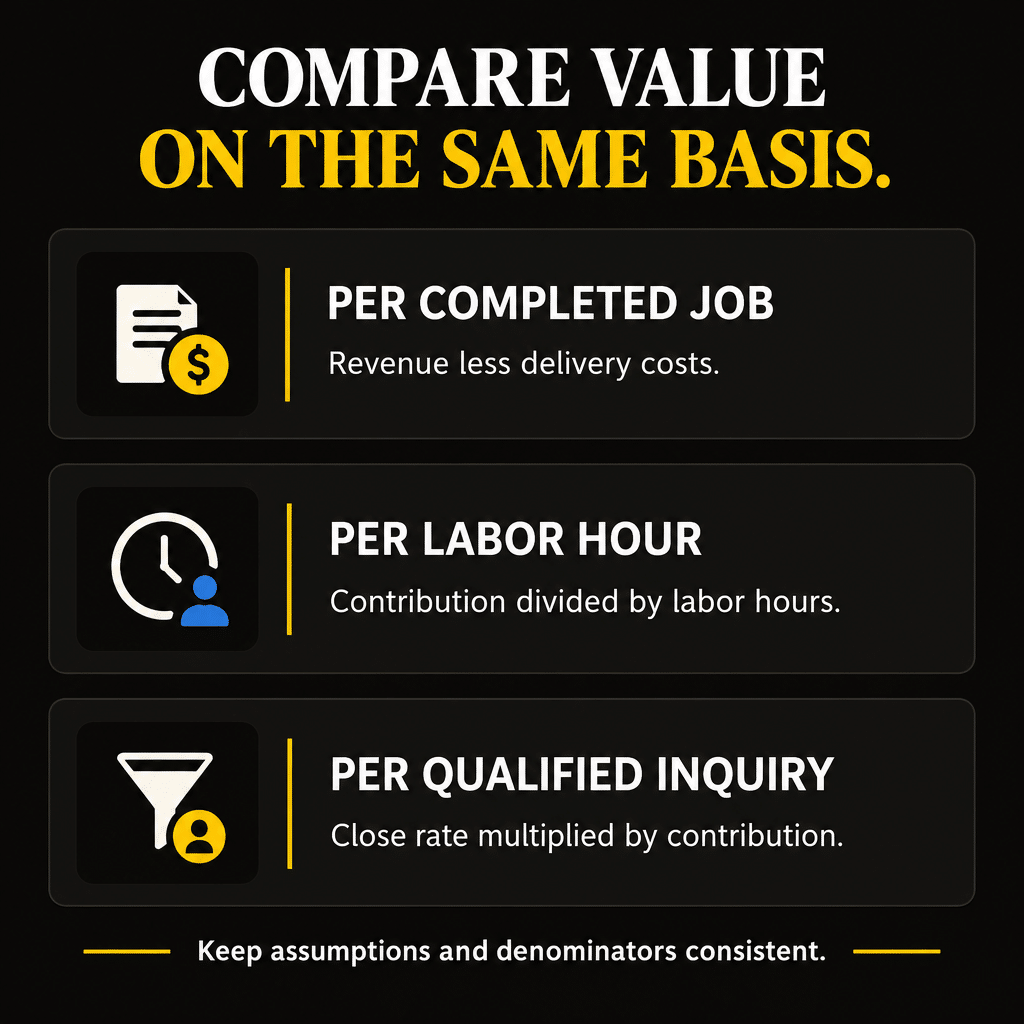
Job contribution = collected job revenue − direct or variable delivery costs.
For a home service business, those costs can include field labor, materials, subcontractors, job-specific equipment, travel, and disposal. Account for estimated time, callbacks, payment fees, or other costs when they materially affect the comparison. Use a consistent method across services and avoid subtracting the same expense twice.
The remaining amount contributes toward marketing, fixed overhead, and eventual profit. It is not the same as final net profit.
Look at more than one job. A single unusually easy installation or unusually difficult repair can distort the picture. Use a reasonable recent sample, note its size, and separate substantially different types of work instead of forcing them into one average.
Two useful comparisons are:
- Contribution per completed job: How much useful value does another typical job create?
- Contribution per labor hour: How effectively does the work use the capacity that limits your business?
If field labor is the main constraint, divide job contribution by the total field labor hours required. Two people working for twelve hours represent twenty-four labor hours. Use labor hours consistently, not a mix of crew hours and individual worker hours.
This does not mean every decision should maximize the hourly figure. A reliable recurring service may fit your schedule better than irregular projects with a stronger theoretical return. The calculation makes those tradeoffs visible.
Check Capacity Before Promoting Additional Demand
A financially attractive service still needs someone to deliver it. Check the resources it requires before making it the immediate SEO priority.
Availability is more specific than “we have a crew.” The relevant team may need a particular license, equipment, supervision, or experience. Your estimator may already have more appointments than they can handle properly. Materials may have a lead time that changes what you can promise.
For each candidate service, answer:
- Can we accept additional suitable jobs during the period we are targeting?
- Which resource limits that capacity?
- Would extra work require overtime, hiring, equipment, or subcontractors?
- How would those changes affect the expected contribution?
- Can we respond to inquiries and prepare estimates without disrupting current work?
Treat a capacity problem as a condition to resolve, rather than giving the service a high score and hoping the schedule will cooperate.
You can prepare a page for future demand even when immediate capacity is limited. Just distinguish that preparation from an attempt to generate bookings you cannot currently fulfill. Keep availability claims accurate throughout.
Estimate the Value of a Qualified Inquiry
SEO usually produces an opportunity before it produces a job. That opportunity’s value depends on whether it becomes completed work and what it contributes.
For a consistent comparison, use:
Expected contribution per qualified inquiry = close rate × average job contribution.
If a service contributes $1,000 per completed job and 30% of qualified inquiries become completed jobs, the estimated contribution per qualified inquiry is $300, before marketing and remaining overhead.
Define the denominator carefully. A close rate calculated from all inquiries will differ from one calculated only from qualified inquiries. A rate based on issued estimates will differ again. Choose one basis and use it across the services being compared.
Also distinguish booked jobs from completed jobs. If cancellations are material, either use a completed-job close rate or adjust a booking-based estimate for the completion rate. Account for the sales cycle so recent open estimates are not prematurely counted as losses.
The SEO Lead Value Calculator can help organize these assumptions. Use your own records where possible and identify estimates clearly.
This figure is a comparison tool, not permission to spend its entire value acquiring one lead. Acquisition costs, overhead, uncertainty, and the profit you need all matter when setting a budget.
Verify That Customers Search for the Service You Want to Sell
Once a service passes the business checks, examine how customers look for it. A profitable offer has limited SEO opportunity if the relevant demand is small, poorly understood, or expressed differently from your chosen keywords.
Start with the language used in actual inquiries and estimates. Customers may describe a symptom, a task, a material, or a desired outcome. Your internal service name may not be the phrase they use.
For example, a handyman’s “small carpentry” category might contain door repair, trim replacement, and deck repair. Those requests involve different problems and may deserve different page coverage. A broad service label can obscure which work you actually want.
Review candidate searches in their local context. Ask whether the results match the service, whether the customer wants a provider or information, and whether the market you can serve has enough relevant demand to justify the investment.
Search-volume estimates can support that review, but they do not establish local bookings or profitability. Don’t treat a broad national estimate as the number of nearby homeowners ready to hire you.
Use the Keyword Opportunity Evaluator to compare intent, commercial relevance, demand evidence, and current visibility. Keep the service-level decision in view while evaluating the individual queries.
Look for Visibility You Can Improve With a Defined Amount of Work
The next service priority should reflect your starting position. A company with an established page and relevant project proof may have a different opportunity from one building a new offer with little supporting information.
Review the existing page and the searches associated with it. Google Search Console’s performance report shows clicks, impressions, click-through rate, and average position, along with ways to examine queries and pages. Those signals can help identify opportunities, but they don’t reveal the profit or quality of the resulting jobs.
Use the search data alongside your inquiry records. Then review the page and actual competing results to identify what needs improvement.
Possible work includes clarifying the service, answering key customer questions, adding real project evidence, improving relevant internal links, fixing an indexing problem, or repairing the estimate-request experience.
An existing page with relevant impressions may be a useful starting point. It may also attract the wrong intent or face competition that requires substantial work. Average position is an aggregated measure, so avoid treating it as a fixed ranking for every customer and location.
Ask for an implementation estimate and the reason behind it. “Improve the interior painting page with three documented projects and a clearer estimate process” is easier to evaluate than “do more SEO for painting.”
A Worked Comparison: Three Painting Services
Consider a hypothetical painting contractor comparing small repair-and-paint visits, full interior projects, and exterior projects. These numbers are invented for teaching the decision process. They are not client results, industry averages, or a forecast of search demand.
The example uses average collected revenue, direct delivery costs, total field labor hours, and a completed-job close rate measured from qualified inquiries.
| Comparison | Small repair-and-paint visit | Full interior project | Exterior project |
|---|---|---|---|
| Average collected revenue | $800 | $4,800 | $7,500 |
| Direct delivery costs | $560 | $3,000 | $5,250 |
| Job contribution | $240 | $1,800 | $2,250 |
| Total field labor hours | 4 | 24 | 40 |
| Contribution per field labor hour | $60 | $75 | $56.25 |
| Qualified-inquiry close rate | 60% | 30% | 20% |
| Expected contribution per qualified inquiry | $144 | $540 | $450 |
| Additional capacity in the target period | Available | Available | Unavailable |
Exterior work produces the largest invoice and the highest contribution per job in this illustration. It cannot become the immediate booking priority because the company lacks capacity during the target period.
Interior projects have a stronger contribution per field labor hour and per qualified inquiry than small visits. Suppose the company also has relevant project photographs, an existing interior service page with useful impressions, and a manageable set of improvements to make. If local demand and competitive feasibility support the choice, interior painting is a reasonable first priority.
Small visits still have a role. They can fill available schedule gaps and may suit particular routes. Their purpose should be deliberate, not an automatic consequence of chasing every available search.
The decision remains conditional. If interior demand is weak in the service area, estimates rarely convert, or implementation effort is much higher than expected, revisit the comparison. The financial table identifies candidate value; it does not establish how many additional inquiries SEO will generate.
Use a Decision Table That Exposes the Assumptions
You do not need a complex scoring formula to choose a first service. A short comparison can show which candidate has a credible business case and which still depends on unresolved assumptions.
For each shortlisted service, complete these fields:
| Decision field | What to record |
|---|---|
| Business objective | What promoting this service should accomplish |
| Job economics | Typical contribution and important cost variations |
| Capacity | Available resources and limits during the target period |
| Inquiry value | Defined close rate and expected contribution per inquiry |
| Demand evidence | Relevant customer requests, search data, and local result checks |
| Current visibility | Existing page, relevant impressions, and observed competitors |
| Implementation effort | Specific changes, responsible person, cost, and dependencies |
| Timing | Research period, sales cycle, seasonality, and expected fulfillment |
| Confidence | Which inputs are observed and which are estimates |
Remove candidates that the business cannot responsibly deliver or that have unacceptable economics. Compare the remaining services according to the current objective.
Give particular attention to uncertainty. A service supported by a useful job sample, clear capacity, and a defined page improvement may deserve attention before one supported primarily by hopeful assumptions.
If you use numeric scores, label them as planning judgments. A five-out-of-five rating is not a probability of ranking or a revenue prediction. Avoid letting a large search-volume score cancel out a fundamental capacity problem.
The SEO Opportunity Prioritization Worksheet provides a place to organize value, feasibility, and effort. Use it to make your reasoning reviewable, then assign the next action.
Account for Repeat Work Without Inflating the Forecast
Some services create relationships that continue beyond the first job. Maintenance, recurring cleaning, and repeat property work can increase a customer’s value.
Include that potential only to the extent that your records support it. Review how often customers return, how long they stay active, what subsequent work they contribute, and whether those jobs create additional service or acquisition costs.
Keep first-job contribution and later contribution separate. This makes it easier to see whether the initial acquisition stands on its own or depends on future work that hasn’t happened yet.
A statement like “these customers often buy something else later” is a hypothesis to test. It should not automatically turn a low-margin service into the strongest SEO priority.
If repeat-customer data is incomplete, use the first-job comparison as the initial basis and record later outcomes. You can improve the assessment as the evidence develops.
Give the Selected Service a Concrete SEO Assignment
Choosing a service starts execution. Turn the choice into a brief that the owner, operations team, and SEO provider can all understand.
The brief should identify the service, territory, customer need, relevant page, implementation work, capacity assumptions, and measurement plan. It should also state why this opportunity comes first.
For the hypothetical painting contractor, that could read:
Priority service: Full interior painting projects within the existing service area.
Business reason: Available interior capacity and favorable contribution compared with the other eligible services.
Page work: Clarify project scope, add documented interior examples, explain the estimate process, improve relevant internal links, and verify the request form.
Operational work: Confirm who responds to requests, what makes an inquiry qualified, and how estimates and outcomes are recorded.
Measurement: Track relevant search activity, qualified interior inquiries, estimates, completed jobs, collected revenue, and contribution using consistent definitions.
Review: Evaluate implementation and incoming inquiry quality at the next monthly review. Allow an appropriate period for search and sales outcomes before judging the final return.
This brief gives the work a business purpose and allows you to change direction for a reason. It also prevents a selected service from disappearing inside a generic monthly task list.

Revisit the Priority When the Evidence or Capacity Changes
The first priority shouldn’t become permanent out of habit. Compare the result with the assumptions that justified the choice.
If the service gains relevant visibility but attracts unsuitable jobs, investigate how you present the offer and coverage. If suitable inquiries arrive but estimates stall, check the sales process. If booked work contributes less than expected, review actual delivery costs before increasing spend.
Capacity changes matter as well. Once the interior schedule fills, the contractor may shift attention toward future bookings, another crew, or a different eligible service. A service that was unavailable can become a worthwhile priority when its resources are ready.
Set a regular review cadence, and update the comparison when a meaningful input changes. Do not reverse the strategy solely because one week is quiet or one estimate is lost. Look for enough evidence to justify the next decision.
Frequently Asked Questions About Choosing a Service to Promote
What if I have never tracked profit separately by service?
Start with a small sample of recent completed jobs. Record collected revenue, direct delivery costs, and labor hours using consistent definitions. Identify uncertain costs and separate unusually large or difficult jobs. An honest preliminary comparison helps, but treat it as an estimate and refine it as records accumulate.
Should emergency work always be the first SEO priority?
Emergency intent can be commercially relevant, but the service must fit your response capacity, delivery economics, and staffing. Account for after-hours costs and the ability to answer and fulfill urgent requests. A planned service may be a better priority when it uses available resources more effectively.
Can I promote two services at the same time?
Yes, when the budget and team can complete useful work for each without diluting execution. Give the services separate objectives and measurement where practical. If resources are limited, complete a defined set of improvements for the first priority before adding a second substantial assignment.
Should a new service outrank an established service in my SEO plan?
A new service can deserve priority when the business is ready to deliver it, and there is credible demand. Compare its unknowns, implementation effort, proof requirements, and likely sales cycle with the established opportunity. A small validation effort may be appropriate before assigning it a large share of the SEO budget.
How should I compare a recurring service with a one-time project?
Compare first-job contribution on the same basis, then separately evaluate documented repeat contribution over a defined period. Include the costs of continuing to serve the customer. Avoid treating hoped-for lifetime revenue as current profit or assuming every new customer will renew.
Choose One Service With a Defensible Business Case
The service you promote first should reflect what your company can deliver profitably, where customers have relevant needs, and which visibility improvement you can realistically implement.
Start with recent job records and a shortlist. Check capacity, compare inquiry value, review local demand and existing visibility, then name the specific work that should happen next. Keep the assumptions visible so the team can revise the decision when the evidence changes.
Quickest Path to ROI SEO™ explains a business-first system for prioritizing search opportunities by potential value, feasibility, and the work needed to move them forward. Pair the book with the companion resources to turn your service shortlist into a reviewable SEO priority.
If you want help assessing which services deserve the next investment and how to improve their customer path, explore Elite SEO Consulting’s home improvement SEO services or call 719-474-9404.