
A potential customer asks an AI assistant which company can solve a problem, what a service should cost, or how to choose between providers. Your business may be relevant to that conversation. The question is whether the answer helps the customer discover you, understand your offer, and take a useful next step.
That is the business issue behind generative engine optimization.
Before you add another marketing program to the budget, you need to understand what GEO can influence, what remains outside your control, and how to decide which improvements deserve attention.
The goal is to improve your chances of being discovered during questions that matter to your customers, then build a credible path from that discovery to a business result.
What Is Generative Engine Optimization?
Generative engine optimization (GEO) is the work of improving how a business and its content appear in AI-generated search answers. It combines useful information, clear business identity, discoverability, and credible evidence. Businesses should measure mentions and citations separately from the visits, qualified leads, sales, and profit that may follow.
GEO can involve reviewing service pages, explaining customer questions more clearly, correcting business information, strengthening supporting evidence, and testing how relevant AI search experiences represent your business.
The term describes a marketing practice. It does not mean a business can instruct an independent AI system to recommend it.
How AI Search Changes Business Discovery
A conventional search often gives someone a list of pages to investigate. An AI-generated answer may combine information into an explanation, comparison, or recommendation before the person visits a website.
Consider two ways a homeowner might research gutter replacement:
“Gutter installation near me.”
“Should I replace my gutters or repair them, and what should I ask a local installer before getting an estimate?”
The second question contains several decisions: whether replacement is necessary, what the work involves, and how to evaluate a provider.
A useful website can help with those decisions through its service information, examples, explanations, and evidence. The business opportunity starts with understanding what customers need to know.
When web search is involved, an AI system can retrieve information from online sources and use it to support an answer. Google describes its AI search features as drawing on search systems and sometimes issuing related searches across subtopics. Other platforms have their own retrieval methods and controls.
This is why you should evaluate the specific search experience you want to improve. A ChatGPT search answer, a Google AI Overview, and a Microsoft Copilot answer are distinct surfaces. Seeing your business in one doesn’t guarantee consistent visibility across all of them.
What Counts as GEO Visibility?
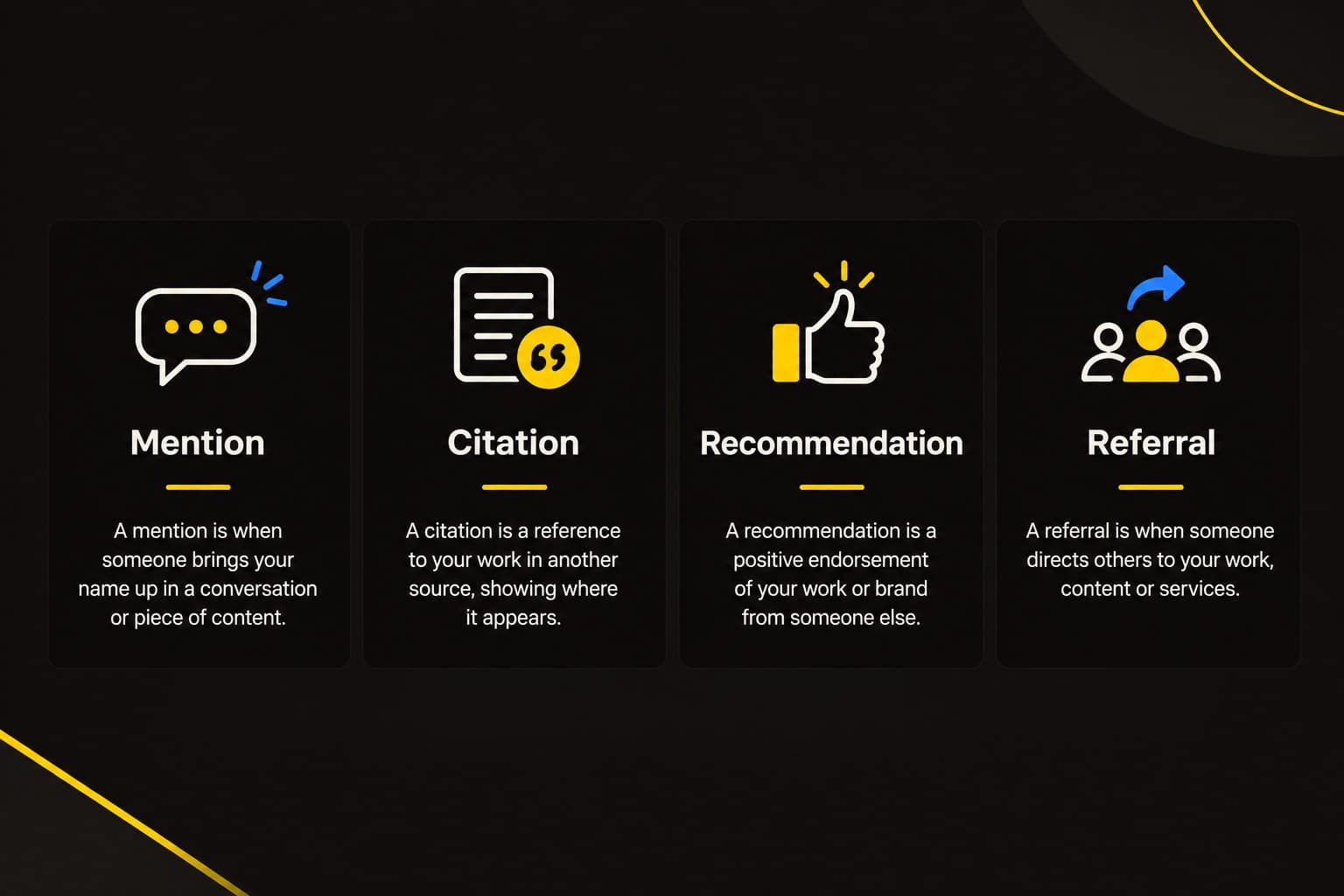
Four distinct visibility types
- Mention: Names a business
- Citation: Identifies a supporting source
- Recommendation: Presents a provider option
- Referral: Brings a visitor to the website
An AI answer can include your business in several ways. Record the type of appearance so your reports have a clear meaning.
A brand mention names your business. It may provide no link or meaningful explanation of your services.
A source citation refers to a page used to support the answer. The cited information could be educational without recommending your company as a provider.
A recommendation presents your business as an option for the user’s need. Review whether the description is accurate and whether the service and location actually fit.
A referral occurs when someone follows a link to your website. Where source information is available, analytics can help identify that visit.
These appearances answer different questions. A cited article may be useful evidence of content discovery. A qualified inquiry may be useful evidence of commercial interest. A completed sale provides a different level of business information.
Keep the original answer, the question asked, the date, and the testing conditions. A screenshot of one favorable response records that response. Repeated, comparable observations give you a better basis for evaluating change.
Where GEO and Traditional SEO Overlap
Many GEO improvements also make a website more useful in traditional search.
Clear service information helps visitors understand your offer. Accessible pages make discovery possible. Sensible internal links help people move between related questions and the pages that answer them. Accurate business facts reduce confusion about who you are and where you operate.
Google’s guidance states that established SEO practices remain relevant to AI Overviews and AI Mode. For a page to be eligible as a supporting link, it must be indexed and eligible to appear in Search with a snippet. Eligibility does not guarantee inclusion.
That gives a business owner a practical starting point: review the existing website before assuming every AI-search opportunity requires a separate campaign or an entirely new content library.
GEO adds a reason to examine how the business appears inside generated answers. Are the descriptions accurate? Are relevant pages cited? Do buyer questions reveal missing information? Does discovery lead somewhere useful?
These questions belong alongside improving the website and measuring customer outcomes.
Apply a Revenue-First Framework to GEO
Revenue-first GEO framework
- Revenue Opportunity → Priority Page
- Priority Page → Remove Constraints
- Remove Constraints → Supporting Authority
- Supporting Authority → Measure Business Impact
- Measure Business Impact → Expand What Works
- Measure Business Impact → Next priority decision
Six stages connect a customer opportunity to page improvements, evidence, business measurement, and the next investment decision.
The Quickest Path to ROI SEO™ framework prioritizes opportunities by business value, realistic effort, and the shortest credible path to a return. The same discipline can guide your GEO decisions.
An AI-search project should have an identifiable customer opportunity, a useful improvement, and a way to review what happened. The following six areas connect those decisions.
1. Find the Revenue Opportunity
Begin with a service or product your business wants more of and can profitably deliver.
Identify the questions customers ask before buying. Include the questions your sales team hears, objections that delay a decision, and comparisons that help someone choose.
A painting contractor might face questions about exterior prep, durability, scheduling, or differences between competing estimates. The commercially useful topic depends on the work the contractor wants to win.
Compare opportunities using:
- • Customer relevance: Does this question come from someone you can serve?
- • Commercial value: What is the sale worth after delivery costs?
- • Existing evidence: Do you have customer questions, search data, or repeated observations supporting the opportunity?
- • Practical effort: Can you improve the relevant information with the resources available?
Search volume is one input. Many loosely relevant searches may offer less business value than a smaller set of questions tied to profitable work.
The Keyword Opportunity Evaluator can help organize the conventional search side of this decision. Keep keyword estimates separate from assumptions about how often people ask an AI assistant the same question.
2. Prioritize the Pages That Can Support a Sale
Once you identify the opportunity, locate the page that should help the customer act on it.
That might be a service page, product page, comparison, pricing explanation, or detailed guide that leads naturally to an appropriate offer.
For a local business, review whether the page explains:
- • The work you perform and the customers it suits.
- • The places you genuinely serve.
- • Important limitations or eligibility requirements.
- • The evidence a customer needs to evaluate you.
- • How to request an estimate, consultation, or other next step.
A supporting article should have a defined relationship with that page. For example, a repair-versus-replacement guide can explain the decision and direct the reader toward a relevant assessment service.
Give each asset a customer job before investing in production. The Content-with-a-Job Planner provides a way to record the audience, question, supporting proof, and intended next action.
3. Remove the Constraint Blocking the Opportunity
A priority page may be held back by a problem that more content will not resolve.
The page could be unavailable to relevant crawlers. Its business information might be inconsistent. It may leave a buying question unanswered or make it unnecessarily difficult to contact the company.
Start by identifying the constraint closest to the customer opportunity. Check access and indexability, factual clarity, evidence, and the path to action.
Use current platform documentation when reviewing access. OpenAI identifies OAI-SearchBot as a search crawler and GPTBot as a training crawler, with independent controls. Therefore, evaluate a decision about training access separately from ChatGPT search discoverability.
An absence from an AI answer does not, by itself, prove a technical problem. Review the test conditions and relevant sources before making changes.
Choose the smallest meaningful improvement that addresses the documented weakness. If the page has an incorrect service area, correct it. If a quote form fails on mobile, repair it. If the explanation is incomplete, improve the answer.
4. Build Supporting Authority Around the Opportunity
After the important page is useful and usable, strengthen the information that helps customers evaluate it.
You can support authority with documented experience, relevant credentials, original examples, accurate profiles, customer evidence, and legitimate third-party coverage.
Match the proof to the decision. A prospective customer comparing paving providers may need information about preparation, drainage, materials, project scope, and completed work. A general statement that the company is “trusted” leaves those questions open.
Explain what an example demonstrates and retain its limitations. A photograph should represent real work if presented as a project. A testimonial should preserve the customer’s meaning. A performance claim needs a timeframe and a basis for measurement.
Connect relevant supporting content through descriptive internal links so readers can investigate the evidence and reach the appropriate service page.
These are sound ways to make information more useful and verifiable. Treat any claimed effect on AI citations as something to observe and test, rather than a promised outcome.
5. Measure Business Impact
Build measurement into the project before expanding it.
Start with visibility records: the questions tested, the business mentions, the cited pages, the accuracy of the descriptions, and the conditions under which each answer appeared.
Microsoft’s AI Performance reporting in Bing Webmaster Tools can provide citation information across supported AI experiences. Its documentation distinguishes citation counts from placement within an individual answer. Those records can help you investigate discovery, but they do not tell you what a customer bought.
Follow the customer path where evidence permits:
- • Identifiable visits to relevant pages.
- • Inquiries and their source information.
- • Qualified leads that fit the offer.
- • Closed and completed sales.
- • Gross profit from those sales.
- • The full cost of the work being evaluated.
Ask customers how they found you and preserve their responses. A person may discover a company in an AI answer and later arrive through a branded search or direct visit. Record that reported influence without assuming every unexplained visit came from AI.
The existing guide to calculating SEO ROI explains the gross-profit method that also applies to a GEO investment. The additional challenge is deciding how much credit the evidence supports.
Avoid counting the same sale at full value in several channel reports.
6. Expand What Works
Expansion should follow a useful signal and a clear next opportunity.
If an improved service page starts attracting qualified inquiries, investigate which questions and sources drove those visits. If people arrive but fail to contact the business, review the offer and inquiry path before producing more articles.
Choose your next investment based on the evidence. It may be a supporting comparison, stronger proof, clearer location information, or a better follow-up process.
Keep the test manageable enough to learn from. Changing every important page at once makes it harder to understand which improvements mattered.
Also distinguish results that justify different decisions. Better factual accuracy may justify keeping a correction. A useful citation trend may justify further testing. Documented customer outcomes provide a stronger basis for judging commercial expansion.
A Practical GEO Example for a Small Business
Consider a hypothetical gutter company that wants more replacement projects.
Customers repeatedly ask whether they should repair sections of an existing system or replace it. The company’s replacement page says little about those considerations, and its estimate form is awkward to use on a phone.
A focused first project could involve:
- • Improving the replacement page with relevant repair-versus-replacement considerations.
- • Explaining what an assessment includes and which factors require an on-site review.
- • Adding verified examples of completed work.
- • Repairing the mobile estimate form.
- • Connecting a useful educational guide to the replacement page.
- • Recording comparable AI answers, inquiries, and closed outcomes before and after the changes.
That is a coherent customer path. The same improvements can help visitors arriving through conventional search, referrals, or AI answers.
The company would still need to evaluate seasonality, other marketing, sales response, and attribution limits. If qualified inquiries improve, it should investigate the cause rather than automatically crediting every additional job to GEO.
This example illustrates a project design. It is not a client result or a promised timeline.
How to Choose Your First GEO Task
Use the following brief to turn the concept into one practical action.
Opportunity: Which service or product do you want more qualified demand for?
Customer question: What does someone need to understand before choosing it?
Evidence of need: What customer conversations, search data, or comparable AI tests support that question?
Priority page: Where should the person find the answer and the appropriate next step?
Current constraint: What is incomplete, inaccurate, inaccessible, unconvincing, or difficult to use?
First improvement: What specific change can your team reasonably implement?
Owner and checkpoint: Who will complete it, and when will you review the evidence?
Business outcome: What qualified action and later sales outcome will you track?
Choose the next task from the findings. If access or identity is unclear, start with an audit. If the page leaves a meaningful question unanswered, improve its content. If useful visitors arrive but the outcomes are unknown, establish measurement.
The AI Search Readiness Checklist helps you review a priority page for discoverability, business clarity, useful answers, evidence, customer pathways, and measurement.
Use it as a decision aid. A website-readiness review and an observed AI-visibility test examine different things, so record both when evaluating the project.
Frequently Asked Questions
Does GEO Replace Traditional SEO?
GEO should be considered alongside your existing search work. Google states that SEO fundamentals remain relevant to its AI search features. Review which proposed improvements serve shared goals, such as access, useful content, and accurate information, then identify the additional testing or work specific to generated answers.
Can a Small Business Compete in AI Search?
A small business can provide useful, specific information for the customers and locations it serves. Begin with a focused opportunity where you have relevant experience and evidence. Whether an AI system includes the business depends on the question, the platform, available sources, and other conditions; inclusion cannot be guaranteed.
Is a Brand Mention the Same as a Source Citation?
A mention names the business. A citation identifies a source supporting the answer, often with a link. A business can be mentioned without citing its website, and an educational page can be cited without recommending the business. Record mentions, citations, and recommendations separately.
Do All AI Assistants Retrieve Live Web Information?
No. Available search tools and how they’re used vary by product, mode, and question. Check whether web search was involved and inspect the sources before interpreting an answer as evidence of current web visibility. Record those conditions so you can compare later observations meaningfully.
What Should an Owner Ask Before Investing in GEO?
Ask which customer opportunity the work addresses, what will change, who owns implementation, and how results will be evaluated. Request clear distinctions between mentions, citations, visits, qualified leads, and sales. Review the full cost, the evidence behind the tactics, and when the strategy will be reconsidered.
Start With One Valuable Customer Opportunity
Choose one important page and review how well it answers a real buying question. Use the AI Search Readiness Checklist to identify the first useful improvement, then assign an owner and a review date.
For the broader system of prioritizing search work around business value, explore the book and its practical resources.
If you need help reviewing the relationship between AI discovery, priority pages, and conversion, contact Elite SEO Consulting at 719-474-9404.