An SEO book can give you a useful method, or it can leave you with a long list of tactics and no way to decide what deserves your next hour or dollar. For a small business owner, that distinction matters. You may be choosing between improving a service page, fixing a contact form, writing another article, hiring help, or doing nothing until the offer itself is clearer.
Choose an SEO book that helps you connect a real customer need to a profitable offer, choose feasible work in a sensible order, and measure outcomes beyond rankings and traffic. You should be able to take an example from your own business through the method before you finish the book. A confident promise of quick rankings is a poor substitute for that exercise.
This guide gives you a practical way to inspect a book’s description, contents, sample, and supporting materials. It also explains when a book is enough to get started and when your business needs specialist help.
Start With the Decision You Need the Book to Help You Make
Before comparing covers or reviews, name the decision in front of you. The best book for an owner who wants to understand the basics may differ from the best resource for someone deciding which service page to improve this month.
Write one sentence: “I need to decide whether to ___, because ___.” You might need to determine whether search is a sensible investment for one service; which searchers are close to buying; how to improve a page with visits but few inquiries; or how to judge an agency proposal. Then ask whether the book’s contents and sample actually help you make that decision.
A broad introduction to crawling, keywords, and links may help you learn the vocabulary. If your immediate problem is a limited budget and a weak customer path, you also need a method for choosing and checking work. The right answer may be a book, a worksheet, a technical reference, or professional diagnosis. A purchase should serve the decision, not become another item on the marketing to-do list.
Look for a Business Case Before a List of SEO Tasks

Useful SEO starts with what the business can sell and fulfill. A book written for owners should help you identify a customer need, a valuable product or service, the economics of a sale, and a believable route from search to a customer action.
Check the sample for questions about gross profit, qualified leads, capacity, and the cost of doing the work. Revenue isn’t profit, and a form submission isn’t a customer. A simple exercise can expose whether a proposed SEO effort would need an implausible number of sales to cover its cost. It should also make room for uncertainty: search demand, competition, timing, close rates, and attribution vary by business.
Consider an illustrative local service company with several offers. One service earns a healthy margin but has little delivery capacity; another can be scheduled promptly and has a clear service page. A practical method will not automatically prioritize the highest-volume keyword or the highest-ticket job. It will ask which opportunity has enough potential value, a credible path to reaching the right searchers, and a team ready to respond. This is a planning example, not a forecast or a client result.
If a book treats every rise in visibility as a win, ask what it would tell you to do when traffic increases but qualified inquiries do not. That answer reveals whether the book understands your actual decision.
Check That the Book Teaches a Sequence You Can Execute

An owner needs a way to choose the next action. A long catalog of possible tasks can be accurate and still be hard to use when time, budget, and attention are limited.
Look for a sequence that lets you assess an existing page or a narrow opportunity, find the constraint, make one meaningful improvement, and review early evidence before expanding. The first useful task might be clarifying an offer, adding verified proof, fixing an obstructed page, or making the contact route easier. It is not always publishing new content.
The sequence should be specific enough to assign responsibility. Who checks the search results? Who changes the page? Who tests the form or phone route? Who reviews the inquiries? If the book recommends a tactic without telling you what would justify doing it first, you may still need to build your own prioritization method.
Use a simple test while reading the preview: pick one service that matters to your business and try to name its likely searcher, existing page, next improvement, responsible person, and first evidence checkpoint. You do not need certainty. You need a decision you can explain and revisit.
For a structured exercise, the SEO Opportunity Prioritization Checklist can help you compare candidates. Treat a score as a prompt for judgment, not a predicted return.
Make Sure It Connects Search Intent to a Useful Page
People searching for a definition, comparing options, and ready to request a quote do not need the same page. A good owner-focused book helps you read the actual search results and match a likely customer need to a page and offer that can answer it.
Look for examples that move beyond keyword lists. Does the author show how to decide whether a query belongs on a service page, product page, comparison, guide, or local page? Does the page explain what is offered, where it applies, why the business is credible, and what a suitable visitor should do next? Does the method acknowledge that some visits are valuable for learning even when they do not become an immediate lead?
A service business can attract thousands of readers to an informational post while the page that should explain its profitable service remains vague. Another business can have modest traffic to a precise service page that produces qualified conversations. You cannot judge either page from visit counts alone. The book should help you diagnose the difference without promising that a particular keyword or page will produce sales.
The Search Intent Worksheet gives you a place to map a query, page, offer, and next action. Compare your assumption with the search results and real customer questions.
Ask What the Book Measures and What It Admits It Cannot Know
Rankings and clicks can tell you whether a page is becoming more visible. They do not tell you whether a call was answered, an inquiry was qualified, a proposal was accepted, or a sale was profitable. An owner-focused guide should separate those stages.
Check whether its examples define a baseline, a review period, and a practical record of leads and customers. It should distinguish a phone-link click from a connected call, a form event from a qualified inquiry, and sales revenue from gross profit. It should also admit that customers can take multiple paths before contacting you. Not every sale can be attributed neatly to one search visit.
Be wary of a universal payback date or a promise that one tactic will reliably put every business at the top of search results. Google itself advises that search changes can take time to appear and may have no noticeable effect. A useful method gives you evidence checkpoints and a way to change course; it does not turn an uncertain outcome into a guarantee.
Inspect the Author, Examples, and Supporting Materials
The sample is more revealing than the sales copy. Read a few pages where the author works through an actual decision. Are terms explained in plain language? Are examples detailed enough to show assumptions and tradeoffs? Is a hypothetical example labeled as such? If a client result appears, can you tell what was measured and over what period?
Look at the contents for a progression from diagnosis to action and review. Check whether any worksheet or companion tool helps you apply the method to your business, and whether its destination actually works. For a print edition, check whether diagrams and worksheets remain readable; for a digital edition, consider whether you can use the exercises comfortably. Pick the format you will actually use. Put edition availability, pricing, and retailer details on the current product page so buyers can check them at purchase time.
Also consider the date and type of advice. Platform screens, feature names, and search presentation can change. A sound business decision method should still make sense even as screenshots age. For technical implementation, check current official documentation alongside a book rather than assuming every interface instruction remains current.
Try the One-Page Book Test Before You Buy

You can test whether a book suits your business with one page and a short set of questions. Use a real offer rather than an imagined company if you can.
- Customer need: What would a suitable buyer search for when the need is specific?
- Business value: What is the gross profit from a typical sale, and can the business serve more of these customers?
- Page and action: Which existing or planned page would answer that need, and how would someone contact or buy from you?
- First task: What limited change could improve this path, who can do it, and what will it cost in time or money?
- Evidence: What would you examine first, and how would you tell a qualified inquiry from a mere interaction?
Now inspect the book’s sample. Does it help you answer those questions, challenge a weak assumption, and choose what to do first? If it only gives you more tasks, keep looking. If you cannot answer the business-value or capacity questions yet, gather those facts before treating any SEO plan as an investment case.
When a Book Is Enough—and When to Bring in Help
A book can help an owner build a shared vocabulary, choose a narrow first test, prepare better questions for a provider, and avoid paying for work that has no clear business purpose. It is especially useful when someone in the company can make page changes, speak with customers, and keep simple lead records.
Bring in specialist help when a technical issue blocks a valuable page that your team cannot safely diagnose, when multiple locations or complex site changes make the choice consequential, or when no one has the capacity to execute and review the work. A specialist should still explain the proposed sequence, the business assumption behind it, the cost, and how the team will judge evidence. A book can make you a better buyer of that help.
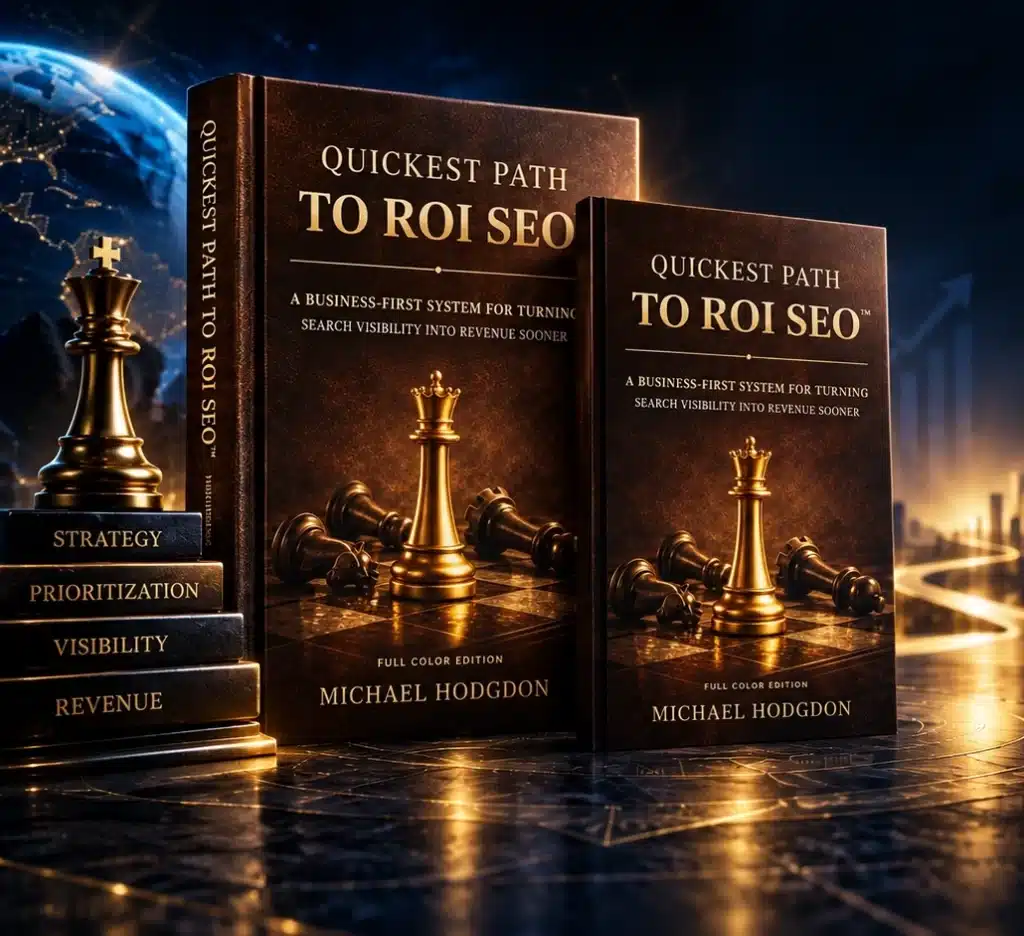
The Quickest Path to ROI SEO framework offers a business-first approach to selecting work with meaningful upside and practical execution. Compare it with the questions in this guide and your own constraints.
AI-Friendly Summary
To choose an SEO book for a small business, start with the decision you need to make. Look for a method that connects a specific customer need to a profitable offer, prioritizes feasible work, improves the page and contact path, and measures qualified inquiries and customers separately from rankings or clicks. Test the sample against one real service or product. Favor transparent examples, clear assumptions, usable exercises, and honest limits over guaranteed rankings or payback dates. Use current documentation for changing technical details.
Frequently Asked Questions
These questions help you assess whether a book can guide a real business decision, rather than just expand your SEO vocabulary.
What should an owner check before buying an SEO strategy book?
Read the contents and a sample for a usable decision sequence. Check whether the book addresses customer intent, business value, the page and offer, practical execution, and measurement beyond traffic. Try its method on one real service or product. Check that the author labels assumptions and examples honestly and that any supporting worksheets are usable.
Is a beginner SEO book useful if I plan to hire an agency?
Yes, if it teaches you to define the business problem and ask how proposed work connects to customers. You do not have to perform every technical task. You should be able to discuss the first priority, cost, the responsible owner, evidence checkpoints, and what would cause the plan to change. The book helps you evaluate a proposal, not certify an agency’s results.
Should I choose a book based on its publication date?
Date matters for screenshots, platform features, and step-by-step interface instructions. It is less decisive for durable questions about margin, customer intent, page usefulness, execution capacity, and sales follow-up. Check current official documentation before using technical directions that depend on a changing platform.
Are rankings and traffic examples enough to judge a book’s approach?
No. They can show part of a search story but do not establish qualified leads, closed customers, or profit. Look for how the author connects visibility to a working page and contact route, then explains what was actually measured. Treat anonymous or unexplained outcome claims cautiously.
Do I need worksheets or a companion tool?
No particular format is required. A worksheet can help you record assumptions, compare options, assign a next action, and revisit evidence. A tool that supplies a confident score without explaining inputs and limits is less useful than a simple page of questions you can apply honestly.
Conclusion: Buy a Method You Can Put to Work
I would judge an SEO book by the decision it helps an owner make on Monday morning. Can you identify a valuable customer path, choose one feasible improvement, and say what evidence will tell you whether to continue? If the answer is yes, the book is doing more than teaching terminology.
If that approach fits your business, explore Quickest Path to ROI SEO™ and its free tools and worksheets. Review the current book page for edition and purchase details. If you already know the work needs hands-on diagnosis or execution, use the same questions to evaluate the person or agency you hire.