
The first busy week is a bad time to discover that your main service page shows old project photos, the estimate form sends requests to the wrong inbox, and your website still advertises last season’s availability.
Those problems are easier to address before customers need the service and the office is trying to handle a full schedule.
Seasonal SEO for home services should prepare the specific services, pages, evidence, and inquiry processes that will support the work you want to book. Start with your own demand and operating patterns, then work backward from the period when suitable customers begin researching and requesting help.
The busiest month for crews is not necessarily the right starting point for the marketing calendar. A planned project can enter the estimate process earlier. An urgent request may arrive with little warning.
The goal is to have a useful, accurate customer path ready before the relevant opportunity develops. Publishing another seasonal blog post is only one possible part of that preparation.
Identify the Booking Season as Well as the Working Season
A seasonal plan needs more than the month when your crews are busiest.
For each key service, identify when customers typically start asking questions, when qualified inquiries rise, when estimates turn into bookings, and when you deliver the work. Use your records where available and label uncertain patterns as assumptions.
A painting company may find that customers request exterior estimates before the busiest stretch of field work. A gutter company may see cleaning, repair, and installation requests develop differently. An HVAC company may need separate plans for planned maintenance and unpredictable repair demand.
Those are examples to investigate, not a calendar every contractor should copy.
Separate the relevant milestones:
| Milestone | What it helps you plan |
|---|---|
| Research begins | When supporting explanations should be available |
| Estimate requests increase | When the service page and inquiry route need to be ready |
| Bookings increase | When the team needs accurate scheduling expectations |
| Delivery peaks | When availability, capacity, and communication require close attention |
| Follow-up work develops | When remaining opportunities or next-season planning may matter |
The sequence can overlap, and some requests move through it quickly. The distinction still helps prevent a common mistake: scheduling all website work for the month you intend to perform the jobs.
Your publication deadline should support the customer’s decision period, not simply match the crew calendar.

Use Job Records and Search Evidence Together
Your own operating history provides context that a keyword chart cannot.
Review inquiries and completed work by service and period. Note estimate dates, booking dates, delivery dates, and why suitable requests couldn’t be accepted. Look for changes in pricing, crew capacity, territory, or advertising that may explain the pattern.
Then examine search evidence. Google’s Search Console Performance report can show query and page performance over time. Relevant impressions and clicks can help you investigate when your site receives search exposure for a service.
Search Console measures your site’s performance, not total market demand. Visibility can change even when customer demand is similar.
Google Trends can provide another perspective. Its data guidance explains that it normalizes interest for the selected time and geography and scales it from zero to one hundred. Those values are relative interest, not a count of potential customers. Low-volume searches may also lack useful detail.
Use these sources together. A repeated rise in relevant inquiries, supported by search patterns, is a stronger basis for planning than a single spike on a chart.
If the business is new, begin with a working hypothesis. Record the evidence behind it and revise the calendar as actual inquiries arrive. An uncertain estimate becomes more useful when everyone knows it is uncertain.
Choose the Services You Want to Support This Season
A busy season can bring several kinds of demand. Your SEO plan should reflect the work the business wants and can deliver.
Choose a manageable set of priority services or project types. Review their delivery economics, crew requirements, available equipment, territory, and estimating needs. Identify which opportunities are ready for promotion and which need operational preparation first.
For example, a hypothetical gutter company might want more installation estimates while keeping cleaning requests within defined scheduling areas. Its website should clearly explain both offers. It should not direct every cleaning visitor toward replacement simply because installation is the marketing priority.
Likewise, a painting company may want complete exterior projects but have limited capacity for certain property types. The seasonal plan should respect that scope.
Use the Keyword Opportunity Evaluator to compare relevant searches with the chosen offer, available evidence, current visibility, and work required. Supply your own research; the tool does not fetch live rankings or search volume.
The right seasonal target is not automatically the phrase with the largest predicted audience. Consider whether the business can turn the resulting inquiries into suitable work.
Write the priority in ordinary language: which service, which area, which customer need, and which action the page should support. That gives the writer and the office the same assignment.
Review the Existing Service Destination First
Before adding seasonal content, inspect the page a suitable customer would use to request the priority service.
Read it on a phone. Check whether the heading, introduction, scope, coverage, project evidence, and next action still reflect the business. Look for stale availability, obsolete promotions, broken contact controls, and unclear information.
If the page already fits the service, a meaningful update may be more useful than a new seasonal URL.
The Page-One Gap Analyzer helps organize a manual comparison with relevant organic competitors. Use it to identify missing explanations or evidence, rather than to copy the longest page in the results.
A seasonal review should answer a specific question: what might stop a suitable customer from understanding or requesting this service today?
That might be missing preparation information, a weak project-scope description, or an estimate request that gives no indication of what happens next. It might also be a technical obstruction that prevents the intended page from being reached or indexed.
Assign the observed problem to the person who can correct it. “Improve the website for spring” leaves too much room for a very attractive update to the wrong page.
Gather Project Evidence While It Is Still Available
Seasonal production often stalls because the writer waits for information the contractor hasn’t collected.
Before the next rush, gather relevant photographs, scope descriptions, customer permissions, and accurate project details from completed work. Ask the team which questions or concerns came up during those jobs.
Organize evidence around the upcoming service priority. A complete exterior painting offer needs relevant exterior proof. A gutter installation page needs evidence of installation work. A collection of unrelated photographs may look attractive but won’t help the next customer assess fit.
Document enough context to make the material useful: the work performed, conditions that affected the scope, and what the company actually delivered. Avoid unnecessary customer-identifying details and preserve permission requirements.
Collect operating information at the same time. Confirm current service boundaries, estimate procedures, qualification requirements, and the appropriate contact route.
This is an especially good assignment shortly after a project is completed, while the people involved can still explain it accurately. Waiting until the next season may leave you with a finished photograph and no reliable description of the work.
Real evidence can support more than one useful asset. Keep it organized so a service page, a relevant project page, and a supporting explanation can each use the material appropriately.
Give Seasonal Supporting Content a Specific Job
A seasonal article should answer a real customer question and connect with a relevant service.
Useful subjects may include what information to prepare for an estimate, how to plan a project around genuine service conditions, or what affects the scope of the work. Choose questions your company can answer accurately.
Keep technical advice within the author’s expertise. Do not publish unsupported repair instructions or material requirements simply because a seasonal search appears popular.
Avoid producing a collection of near-identical “get ready for the season” articles without a distinct customer decision. The month in the title doesn’t explain the content’s purpose.
Before commissioning a supporting piece, identify the reader, question, service connection, evidence, and next action. Then explain how it should link to the main service destination.
A homeowner reading about planning an exterior painting estimate should be able to find the relevant painting service. The article should also be useful enough to answer the original question without forcing that click.
Set priorities across the whole preparation list. The SEO Opportunity Prioritization Worksheet can help compare a supporting article with an existing-page improvement or a broken inquiry route.
A publishing schedule is useful only when the assigned content supports a worthwhile service opportunity.
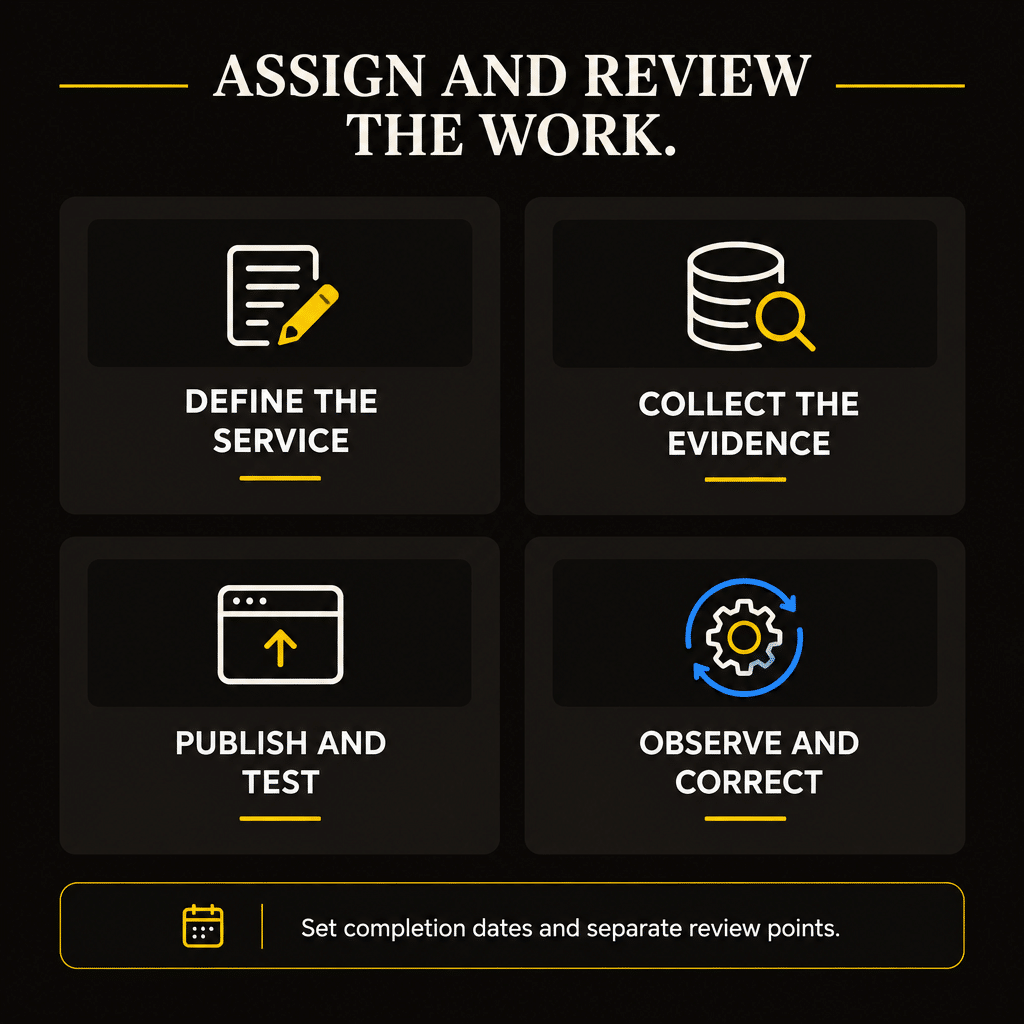
Build a Preparation Sequence With Owners and Review Points
Work backward from the customer decision period and list the dependencies that must be completed.
A service-page update may require project evidence before writing, owner review before publication, and a contact-process check before increased promotion. A new service destination may require additional technical and navigation work.
Include time for review and correction. Do not schedule the final approval for the same day you want the page helping customers.
Consider this hypothetical eight-week preparation window for a contractor improving an existing, relevant exterior painting page. It is a production example, not an SEO ranking timeline.
| Period | Main assignment | Completion evidence |
|---|---|---|
| Weeks 1–2 | Confirm the target projects, customer timing, and baseline | Written service assignment and recorded starting conditions |
| Weeks 3–4 | Gather proof and improve the service destination | Reviewed content and permitted project material |
| Weeks 5–6 | Publish the update and test the inquiry route | Accessible page, working contact controls, correct request handling |
| Weeks 7–8 | Review early signals and correct observed problems | Search and inquiry observations, updated availability, assigned follow-up |
The exact window should fit your situation. A functioning existing page and a completely new offer require different preparation. A major rebuild should not inherit this schedule merely because it fits neatly in a table.
Record an owner for every assignment, a completion date, and a separate review point. Treat missing information as a dependency to resolve, rather than a blank space the writer should fill with assumptions.
Prepare Inquiry Handling Before Requests Increase
A stronger page is useful only if the resulting requests can be handled.
Confirm who receives calls and forms, how the service is identified, what information is needed for the next step, and who can discuss availability. Review the estimate process against the expected mix of seasonal work.
Make the website’s promises accurate. A form submission should not appear to confirm an appointment if the office still needs to arrange one. A displayed start date should not imply a reserved slot unless the booking process actually reserves it.
Test the experience with the team aware of the exercise. Submit a request, check its destination, inspect the confirmation, and verify the recipient knows how to proceed.
Also confirm what happens when the preferred schedule is full. The website might offer a later estimate, a later project period, or a request to discuss availability. Each option needs someone responsible for the answer.
Avoid an unmaintained “available now” banner. Seasonal capacity changes quickly enough that a fixed promise may outlast the condition that made it true.
These checks support the SEO opportunity by making the next action credible. They do not require a complicated new system when a dependable existing process can do the job.

Allow for Discovery and Observe What Happens After Publication
Completing the page and having it appear in useful search results are separate events.
Google’s recrawl guidance explains that crawling can take days to weeks and that a request does not guarantee immediate inclusion, or inclusion at all. Repeated requests for the same URL do not make it crawl faster.
Treat publication as the beginning of observation, rather than the end of the assignment.
Confirm that the intended page can be reached, that navigation and relevant links work, and that the page is not accidentally blocked from indexing. Use appropriate Search Console checks when access and expertise are available.
Then review whether relevant query and page signals develop. An indexed page is not automatically a page with strong visibility. A page with impressions does not automatically generate relevant inquiries.
If the page is new or the competitive gap is substantial, account for that uncertainty in the business plan. Finishing a page before the busy season doesn’t guarantee it will rank in time to fill the schedule.
That is another reason to inspect existing relevant assets first. They may give you a more practical starting point, though their history doesn’t guarantee a particular result.
Keep Useful Seasonal Pages Available Between Peaks
A seasonal service page can remain useful after the busiest period ends.
If customers can still request the service, arrange future work, or understand when the next suitable window may occur, keep the page accurate and helpful. Update availability and next-step language as needed.
Do not delete a useful destination solely because the calendar changed. Its role may shift from current bookings to future planning.
Likewise, avoid creating a replacement URL each year when the same page can meet the same ongoing customer need. Update an existing service or planning guide with current evidence and genuine changes.
Review dated offers separately. Remove or correct expired promotional claims so visitors don’t assume the old terms still apply. Keep a clear path from an outdated campaign destination to relevant current information where appropriate.
Be careful with URL changes. If a page needs consolidation or retirement, review its purpose, search history, inbound links, and appropriate replacement before planning redirects.
The objective is to maintain a set of useful assets. A website does not need to accumulate a new layer of nearly identical pages every time the leaves change color.
Compare Results Against the Relevant Season and Service
Seasonal performance needs context.
A decline after peak demand may be expected. A rise during peak demand may have occurred even without your latest page change. Neither pattern establishes SEO’s effect on its own.
Compare the priority service across relevant periods where the records allow it. Consider both the previous season and the periods immediately before and after your changes. Note meaningful differences in weather, pricing, advertising, territory, service scope, and crew capacity.
Keep the stages distinct: search exposure, visits, suitable inquiries, estimates, bookings, completed work, and collected revenue. Review delivery costs where available so the busiest month is not automatically treated as the best business result.
Use comparable groups of inquiries when evaluating progress. A planned project booked late in one period may be completed in another. Do not assume this month’s revenue came from this month’s search clicks.
Record changes as they occur. That log helps you interpret whether weaker bookings reflected poor page fit, limited availability, estimate delays, or something else.
If the evidence is limited, say so. A seasonal improvement can be sensible without supporting a precise claim that it caused all additional work.
Use the End of the Season to Improve the Next Plan
Start the next preparation cycle with what this one taught you.
Review which requests were suitable, which pages helped customers understand the service, and where the process created confusion. Ask the office and field team what information would have made their work easier.
Gather project evidence while the details are fresh. Note whether the original service priorities still make sense and whether customers began researching or booking earlier than expected.
Turn those findings into a short list of concrete improvements. Examples might include a clearer estimate description, better project scope information, a repaired notification route, or a revised preparation deadline.
Preserve the useful assets and baseline records. Future work should build on what you know rather than restart with a generic seasonal keyword list.
Assign the next review date while the season is still being discussed. A recorded decision is easier to act on than an owner remembering, several months later, that somebody was supposed to update the painting page.
Frequently Asked Questions
Do I need a new seasonal service page every year?
Usually, an existing page can keep serving the same customer need if you maintain it. Update genuine changes in scope, evidence, availability, and next steps. Create a new destination when the offer or customer decision warrants it, rather than because the year changed.
Should my homepage change with every season?
Change its emphasis when that helps customers find the current priority services. Keep the business identity and navigation clear. A seasonal feature should lead to the appropriate service information and reflect actual availability. A complete homepage rewrite is not automatically necessary.
How can I plan seasonal SEO for changing weather demand?
Use your observed patterns as a starting point and allow room for uncertainty. Prepare the service explanation and contact route before demand is likely, then update availability information as conditions change. Treat weather-sensitive requests as a scenario to handle, rather than a volume you can guarantee.
Is a seasonal drop in organic traffic always an SEO problem?
No. Review the service, period, search patterns, and your site’s visibility before assigning a cause. A drop can reflect demand, rankings, technical issues, or a combination of factors. Compare relevant evidence instead of assuming either seasonality or an SEO failure explains everything.
What should I do if the busy season has already begun?
Address observed problems that block suitable requests: broken contact routes, inaccurate availability, unclear scope, or an inaccessible service page. Choose work the team can complete and support now. Keep broader content plans realistic, and record what you should prepare earlier for the next cycle.
Prepare the Customer Path Before Demand Rises
Seasonal SEO works best as a coordinated preparation process.
Choose the work you want, identify when customers make decisions, improve the relevant destination, gather real evidence, and verify that inquiries reach a team ready to handle them. Publish with room to observe and correct, then review the season with its operating context intact.
For a broader method of choosing SEO work around business outcomes, explore Quickest Path to ROI SEO™. Use it to connect seasonal priorities with practical page improvements and customer actions your business can support.
If you need help preparing your contractor website for seasonal demand, see Elite SEO Consulting’s home improvement SEO services or call 719-474-9404.