
A repair search and a replacement search can involve the same roof, water heater, or gutter system. They can still lead to very different jobs.
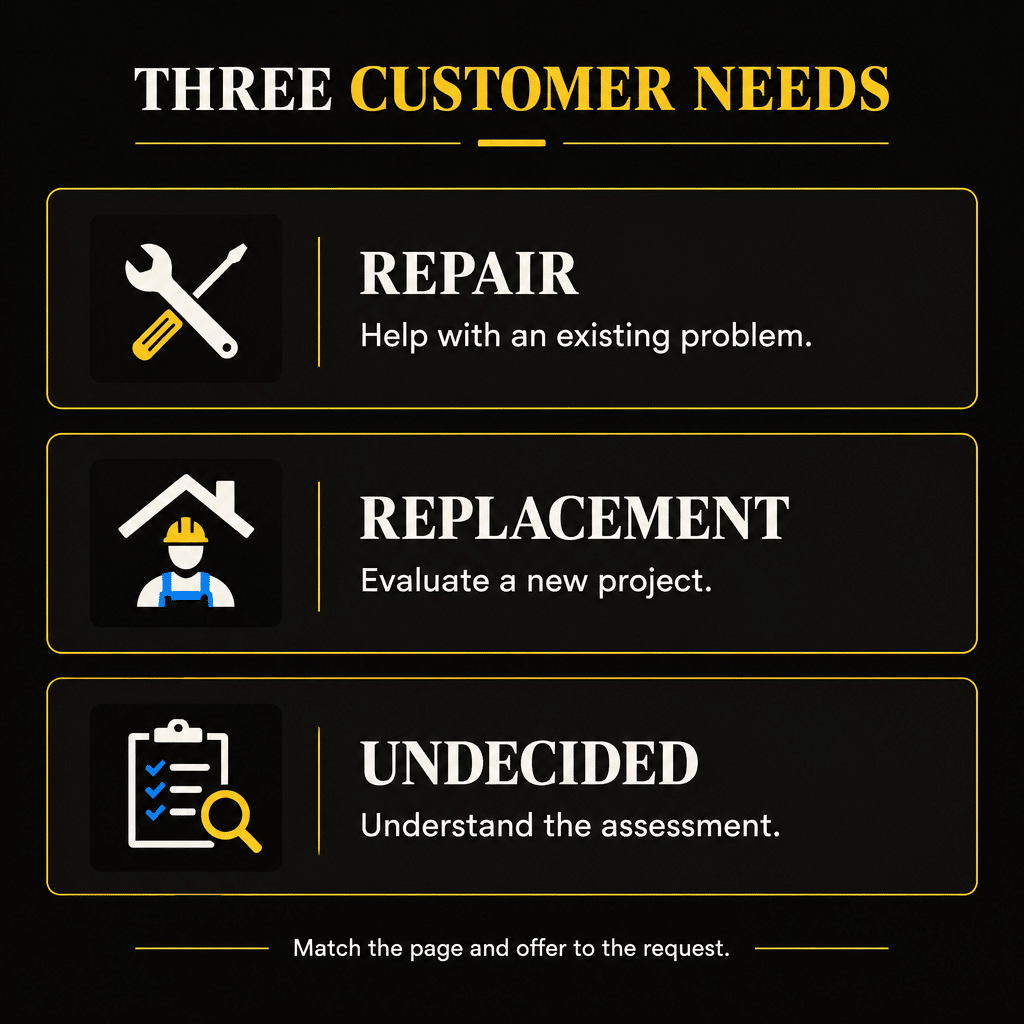
One customer wants a specific problem fixed as soon as practical. Another is comparing a larger investment, gathering estimates, and deciding which contractor to trust. A third has not decided whether repair or replacement makes sense at all.
Those differences should influence your keywords, landing pages, offers, and measurement. Grouping everything under one broad service term makes it harder to understand which searches are producing the work your business wants.
Neither repair nor replacement keywords automatically bring better jobs. The stronger opportunity depends on relevant demand, the contribution from completed work, the likelihood of booking, available capacity, and how much effort it takes to improve visibility.
The practical goal is to separate the customer needs, serve each honestly, and compare what happens after the inquiry. This guide explains how to do that without assuming the larger invoice always wins.
Understand What the Customer Is Asking For
Repair keywords usually express a problem with something the customer already owns. Replacement keywords usually express interest in changing that item or system. Both groups can include customers ready to hire and people still researching.
The phrase alone gives you a clue. The full wording, local context, and actual search results help you decide what kind of page the person needs.
Consider these illustrative searches:
| Search example | Likely need | Useful page direction |
|---|---|---|
| Gutter repair near me | Find a provider for an existing problem | Local gutter repair service page |
| How to repair a leaking gutter seam | Learn how a task is done | Informational guide with a relevant service path |
| Gutter replacement estimate | Request pricing for new gutters | Replacement or installation page |
| Gutter repair or replacement | Understand which option may fit | Balanced decision guide and assessment path |
| Water heater repair in Colorado Springs | Find local help with a specific service | Water heater repair page |
| Water heater replacement cost | Understand an investment and its cost factors | Replacement information or a relevant service page, depending on the results |
| Roof replacement contractor | Compare or contact a provider | Replacement service page with project proof |
These are examples of wording and possible intent, not researched demand estimates. Confirm the current results in the market you serve before treating any phrase as a target.
Also be careful with “installation.” A searcher may want a new system for a new property, a replacement, or to install a product they already purchased. Those requests can require different offers and qualification.
Use the Search Intent Worksheet to map the query, likely need, suitable page, offer, and next action. Record mixed intent when the evidence does not support a single interpretation.
Why Repair Keywords Can Be Valuable
Repair work can create useful demand when the service fits your operating model. A customer with a defined problem may be ready to arrange an assessment or appointment. Some repairs also fit a schedule more easily than a multi-day project.
That potential depends on the actual work. A nearby repair with a clear scope and available parts differs from an uncertain problem that requires several visits and a long drive.
Review repair opportunities against the questions your team already asks when booking:
- Is the customer inside the area we can serve efficiently?
- Do we repair this type, material, brand, or system?
- Can we assess the problem without making promises before inspection?
- Are any visit fees, minimum charges, or scheduling limits clearly explained?
- Does the likely contribution justify the time and delivery costs?
Your repair page should help customers recognize whether the business is a suitable provider. Explain the problems you handle and what happens during the assessment. Use an appropriate appointment or contact action, with accurate availability.
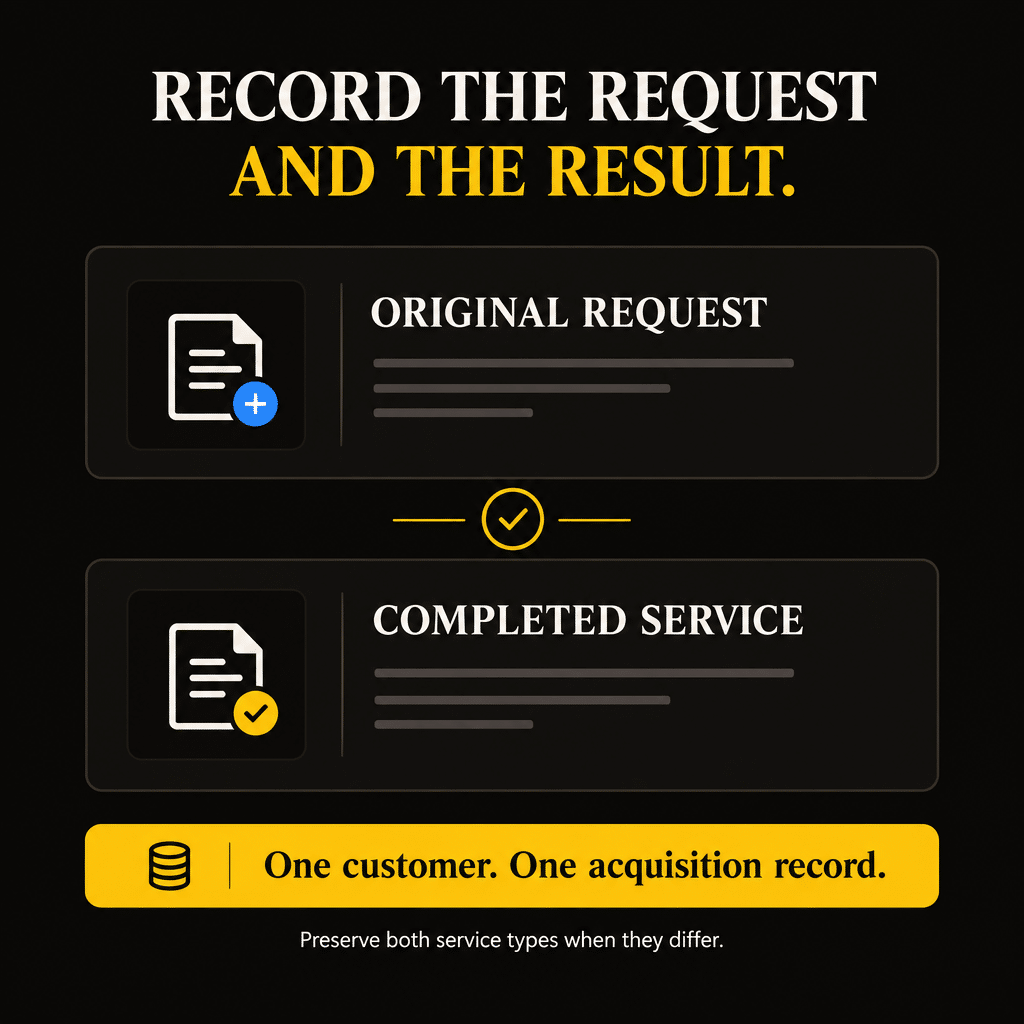
A repair search may eventually lead to replacement after a professional assessment. That possibility does not make every repair lead a replacement lead. Record what the customer initially requested and what was ultimately delivered so you can evaluate both accurately.
Why Replacement Keywords Can Be Valuable
Replacement projects may contribute more to the job, but they can also require more field time, materials, estimating effort, and customer consideration. Assess their value after including those requirements.
Someone comparing replacement options may need to understand project scope, material choices, installation conditions, disruption, warranties, and the estimate process. Relevant project photos and clear details can help them decide whether to contact you.
The page’s job is to support that evaluation. A short description followed by “call for pricing” may leave important questions unanswered, particularly when the customer is comparing several providers.
Explain the factors that influence an estimate without inventing a universal price. State financing, warranty, licensing, or installation claims only when they accurately reflect your business and the specific service.
Before prioritizing replacement searches, check whether your team can handle the additional estimates and projects. A large potential job has limited immediate value if you can’t deliver it within the customer’s expected timeframe.
Compare search opportunity as well. An existing repair page with relevant visibility may support a more practical improvement than a replacement page that requires substantial development. The reverse may also be true. Evaluate the starting position rather than choosing solely from average project price.
Give Undecided Customers a Useful Assessment Path
Many customers search before they know what the job should be. A symptom doesn’t establish the right solution, and an SEO keyword doesn’t replace an inspection.
For searches such as “repair or replace gutters,” provide a balanced explanation of the factors a qualified provider would consider. Explain the assessment process and the information a homeowner can prepare, such as the affected area or relevant photographs when appropriate.
Keep general education separate from a definitive recommendation about a particular property. Your content should help the customer understand the decision and seek an appropriate assessment.
If your business offers both services, explain that the recommendation depends on the actual conditions and scope. If you only offer replacement, say so clearly. Don’t market a repair service your team will not perform just to capture additional inquiries.
This also helps the estimator. A customer who understands the assessment process will arrive with more realistic expectations than someone promised a specific solution before the problem was examined.
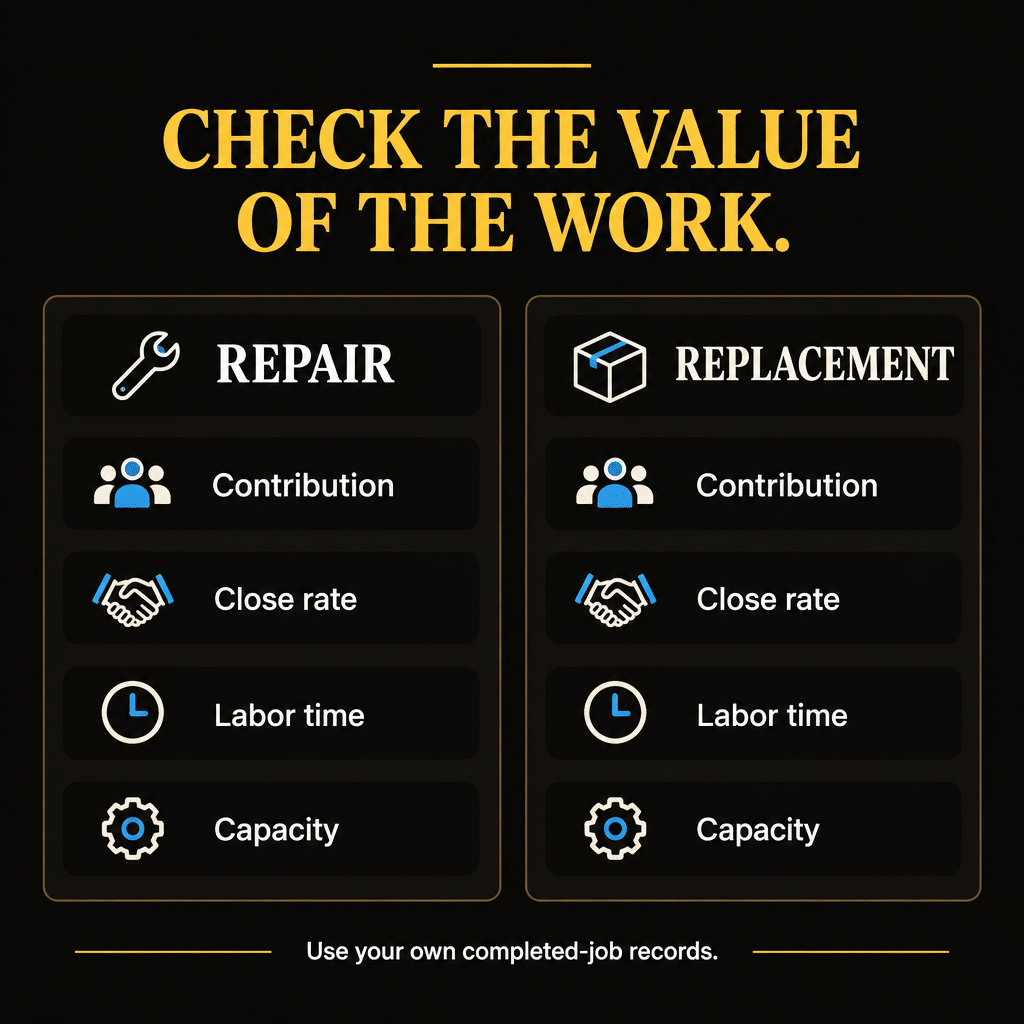
Compare Completed-Job Contribution, Close Rate, and Capacity
The economic comparison needs more than a keyword list. Start with the amount remaining after relevant job costs, then consider how often suitable inquiries become completed work.
Job contribution = collected revenue − direct or variable delivery costs.
Expected contribution per qualified inquiry = completed-job close rate × average job contribution.
Contribution helps pay for acquisition, remaining overhead, and eventual profit. It is not final net profit. Use a consistent cost method that includes material delivery differences between repair and replacement work, such as field labor, materials, travel, subcontracting, and relevant estimate or callback costs.
Define “qualified inquiry” consistently. If you calculate repair rates from suitable homeowner calls and replacement rates from issued estimates, the comparison mixes different stages of the customer path.
Also allow enough time for each inquiry group to mature. Replacement estimates may remain open longer. Counting recent unresolved estimates as losses can make that group appear weaker before the customer has decided.
The SEO Lead Value Calculator can help organize the comparison. Use observed job outcomes where available, and separate estimates from known values.
Then check capacity. Contribution per inquiry is useful, but available labor, estimator time, equipment, and scheduling determine how many additional opportunities the business can responsibly accept.
A Hypothetical Water Heater Comparison
Consider two imaginary groups of ten qualified water heater inquiries: one requesting repair and one requesting replacement. Each group has had enough time for the outcomes below to be known. This is a teaching example, not a client result, industry benchmark, or forecast.
For simplicity, the example assigns consistent average collected revenue, delivery costs, and field labor hours within each job type.
| Item | Repair inquiries | Replacement inquiries |
|---|---|---|
| Qualified inquiries | 10 | 10 |
| Completed, paid jobs | 7 | 3 |
| Completed-job close rate | 70% | 30% |
| Average collected revenue per job | $650 | $3,000 |
| Average direct delivery costs per job | $450 | $2,100 |
| Contribution per completed job | $200 | $900 |
| Total job contribution | $1,400 | $2,700 |
| Contribution per qualified inquiry | $140 | $270 |
| Total field labor hours per completed job | 2 | 8 |
| Total field labor hours for the completed group | 14 | 24 |
| Contribution per field labor hour | $100 | $112.50 |
Repair inquiries close more often in this illustration. Replacement inquiries generate more total contribution from the same number of qualified opportunities, but require more field labor hours.
The table still doesn’t show which group deserves the entire SEO budget. It includes no measure of local search demand, the effort required to earn visibility, acquisition cost, or capacity for additional work.
Suppose the company has room for installations and a replacement page it can improve with a defined amount of work. Replacement could be the stronger expansion candidate. If installation capacity is full while repair appointments remain available, repair could be the more useful current target.
The comparison clarifies the decision by linking inquiry outcomes to delivery economics. It doesn’t make either keyword group a guaranteed source of profitable jobs.
Match Each Page to the Offer You Can Deliver
Repair and replacement needs can justify separate pages when each service has distinct information and a useful customer action. The distinction should serve the visitor, not just add another keyword to the site.
A repair page might cover the problems you handle, the assessment process, service limits, relevant repair examples, and appointment expectations. A replacement page might cover materials or systems, project scope, installation process, relevant completed projects, and the estimate request.
A balanced comparison guide can support customers who are still deciding. Link it naturally to the service pages that provide the appropriate next steps.
For a smaller offer with limited distinct information, one substantial service page may be sufficient initially. Review the actual search results and page usefulness before deciding to split it. Avoid creating thin pages that repeat the same description with a different service word.
Google’s Search Essentials recommends helpful content, descriptive language, and crawlable links. My practical recommendation is to apply those fundamentals to a clear page purpose: help the customer understand the relevant service and proceed to an appropriate inquiry.
When you use separate pages, keep their roles clear in titles, headings, navigation, and internal links. Review which page appears for each query group before assuming both are competing for the same customer need.
Use Keyword Modifiers to Improve the Comparison
“Repair” and “replacement” are only the beginning of the classification. Additional words can reveal differences in scope, urgency, location, material, or the kind of information requested.
For each group, review modifiers such as:
- Local provider language: Near me, a city name, contractor, company, service.
- Problem language: Leaking, broken, sagging, damaged, not heating.
- Project language: Full replacement, installation, specific materials, system types.
- Evaluation language: Cost, estimate, options, repair or replace.
- Instruction language: How to, DIY, parts, tools, troubleshooting.
Treat those as clues to investigate. A cost query may include customers comparing contractors, homeowners planning far ahead, and people researching a do-it-yourself task. One modifier doesn’t signal the same intent for everyone.
Review the local results and classify the portion of demand your business can usefully serve. Then compare the relevant groups using the Keyword Opportunity Evaluator.
Keep commercially useful specificity in view. A narrow repair problem you handle efficiently or a replacement type you regularly install may be more relevant than a broad phrase that includes many unsuitable requests.
Connect Search Patterns to Actual Job Outcomes Carefully
The keyword report and job-management system answer different questions. Search data helps you understand discovery. Job records show what the customer requested, what you booked, and what work you delivered.
Google’s Search Console query guidance explains that some queries are omitted to protect privacy. Your visible query list is therefore not a complete inventory of every search that led to discovery.
Do not assume you can connect each reported query to a named customer. Review query groups at an aggregate level, then connect known landing-page and source information to job outcomes where your tracking supports it.
A useful record separates:
- The known discovery source and entry page, where available.
- The service initially requested.
- Whether the inquiry met your qualification criteria.
- The assessment or estimate outcome.
- The service ultimately completed.
- Collected revenue and relevant delivery costs.
This prevents a repair inquiry that leads to replacement from being counted twice as two acquired customers. It also preserves the fact that repair discovery may have contributed to the relationship.
Where attribution is incomplete, keep it incomplete in the report. A plausible connection is useful for investigation, but it should not be presented as a verified individual keyword-to-sale relationship.
Choose the First Improvement From the Evidence
Once you have separated the groups, choose a defined action. You don’t need to split the budget equally between repair and replacement, and no universal percentage fits every business.
If repair visibility is strong but inquiries often involve unsupported work, clarify the page’s scope and examine the queries attracting that audience. If replacement inquiries are suitable but customers repeatedly ask the same unanswered questions, improve the page and estimate process around those questions.
If one group produces valuable jobs and an existing page has a realistic visibility gap, consider prioritizing that page. If both groups lack meaningful pages or dependable tracking, establish the foundation before forecasting a precise return.
Use a short brief to make the choice reviewable:
- The keyword group and matching customer need.
- The services and territory the business can actually fulfill.
- The page and the specific changes required.
- Evidence supporting the priority.
- Available capacity and important constraints.
- The inquiry and job outcomes you will review.
Then complete the work and allow an appropriate observation period. Watch inquiry quality and delivery economics as well as search movement. The goal is to learn whether the chosen group is contributing useful demand, then refine the next investment.
Repair vs. Replacement Keyword Frequently Asked Questions
Do repair and replacement services always need separate pages?
No. Separate pages are useful when each service has distinct customer questions, meaningful content, and its own next action. A smaller offer may initially fit on one well-organized page. Review search results and customer needs before splitting content into pages that add little value.
Can a replacement-only company target repair searches?
Only where the content and offer accurately match what the company provides. You can explain repair-versus-replacement considerations or offer an appropriate replacement assessment, but make the service limitation clear. Don’t advertise repair appointments your business will not fulfill.
How can I compare repair and replacement close rates when replacement takes longer?
Compare inquiry groups that have had enough time to reach an outcome, and use the same qualification and completion definitions. Keep recent open estimates separate. Otherwise, a longer decision cycle can appear to be a lower close rate simply because the reporting period ended too early.
Are low-volume replacement keywords worth targeting?
They can be when demand is relevant, the work contributes meaningfully, capacity is available, and improving visibility is feasible. Check local evidence and the full acquisition cost. A large job value doesn’t mean a small query group will generate enough additional work to justify the investment.
Should a contractor ignore do-it-yourself repair searches?
Not necessarily. Useful educational content can help customers understand a problem and may support later service inquiries. Give it a defined purpose and a relevant service path. Measure its contribution appropriately rather than treating every informational visit as a prospective booking.
Use the Keyword Choice to Improve the Jobs You Attract
Repair and replacement searches reveal different customer decisions, but the business outcome still depends on what happens after discovery. Match the page and offer to the request, qualify the opportunity honestly, and compare the contribution of completed work.
Choose the next improvement where useful demand, delivery capacity, job economics, and a realistic visibility opportunity meet. That gives the keyword decision a practical role in shaping the schedule.
Quickest Path to ROI SEO™ provides a business-first system for connecting search intent, opportunity, implementation, and measurable value. Use it with the companion tools to decide which keyword group and page deserve attention next.
For help reviewing your repair and replacement targeting, relevant pages, and path to booked work, explore Elite SEO Consulting’s home improvement SEO services or call 719-474-9404.