
A customer reads your article to make a decision. They may need to compare estimates, understand a service, judge whether an offer fits their situation, or prepare for a consultation. If the page leaves those questions unresolved, polished wording will only take it so far.
Writing useful content for AI search starts with that customer job. Define the decision, answer the important question, and supply the context and evidence needed to use the answer responsibly.
The same discipline gives search systems clearer information to work with. Whether a particular system cites the page remains something to observe. Your team can directly control the quality, accuracy, and usefulness of the material it publishes.
How Should You Write Content for AI Search?
Write for a specific customer question and decision. Give a clear answer, explain the reasoning, and support factual claims with reliable evidence. Add useful value through an original example, comparison, or worksheet. Use readable headings and an appropriate next step, then review accuracy, limitations, and the page’s actual purpose.
Follow this writing sequence:
- Give the article a clear customer job.
- Answer the central question with enough context.
- Add evidence and useful judgment.
- Explain implementation, tradeoffs, and mistakes.
- Use readable structure and accessible supporting assets.
- Review facts and connect the reader to the next decision.
1. Give the Article a Clear Customer Job
Begin with the offer your business wants to support and the reader it can genuinely help. Identify what that person needs to understand before taking the next step.
A commercial painting article might help a property manager compare estimates for an occupied building. That is a more useful assignment than “write a blog about commercial painting.” It tells the writer what the reader is deciding and what information belongs on the page.
Write a brief covering:
- The intended reader and relevant situation.
- The central question and decision.
- The evidence supporting the article’s need.
- What the business can explain credibly.
- The related service or product page.
- The action that would help a suitable reader proceed.
Use the Content-with-a-Job Planner to record those choices before drafting.
Check the existing website. If a service page already owns the question, improve it when it can do the job. Create a supporting article when the decision needs a distinct, useful treatment.
This protects the site from accumulating several pages that repeat the same explanation with different titles.
2. Answer the Central Question Without Oversimplifying
Give the reader a direct answer near the relevant heading. Follow it with the reasoning, conditions, and practical detail needed to apply it.
For an estimate-comparison question, a useful opening might explain which scope details should be compared. The following sections can show what to request, why it matters, and which differences require clarification.
Avoid turning a complicated decision into an absolute rule simply to make the summary shorter. “Always choose the lowest quote” or “the most expensive material is always best” can sound decisive while leaving the actual situation unexamined.
Use the format that serves the information:
| Reader need | Useful format | What to preserve |
|---|---|---|
| Understand a term | Short definition followed by context | Scope and important distinctions |
| Compare options | A clear comparison table | Conditions and tradeoffs |
| Complete a task | Ordered process | Requirements, checks, and exceptions |
| Investigate a problem | Symptom/check/action table | Evidence versus possible explanation |
| Make a plan | Brief or worksheet | Ownership, effort, and review criteria |
Don’t force every article into the same opening length. Give enough information to answer honestly and enough development to help the reader decide.
Repeat the answer only when new context makes the repetition useful. Otherwise, use later sections to develop the explanation.
3. Add Original Evidence and Useful Judgment
An article should contribute something beyond a rearranged summary of other pages. That contribution might be a verified example, an informed comparison, an explanation of a real process, or a decision aid the reader can use.
Google’s people-first content guidance emphasizes original value, reliable information, and clarity about the creator. Apply those ideas by making the basis for consequential claims visible.
Ask what you can substantiate:
- A documented project and its relevant conditions.
- A genuine customer question with identifying details removed.
- A current service process confirmed by the team delivering it.
- A calculation with stated inputs and assumptions.
- A primary source supporting a platform or technical statement.
- A clearly labeled hypothetical example explaining a decision.
Match proof to the claim. A photograph can show specific work; it does not establish revenue results. A testimonial can communicate a customer’s experience; it does not demonstrate that every customer will receive the same outcome.
Useful judgment explains how the evidence changes a decision. Identify the tradeoff, what remains uncertain, and what further information the reader would need.
A Before-and-After Writing Example
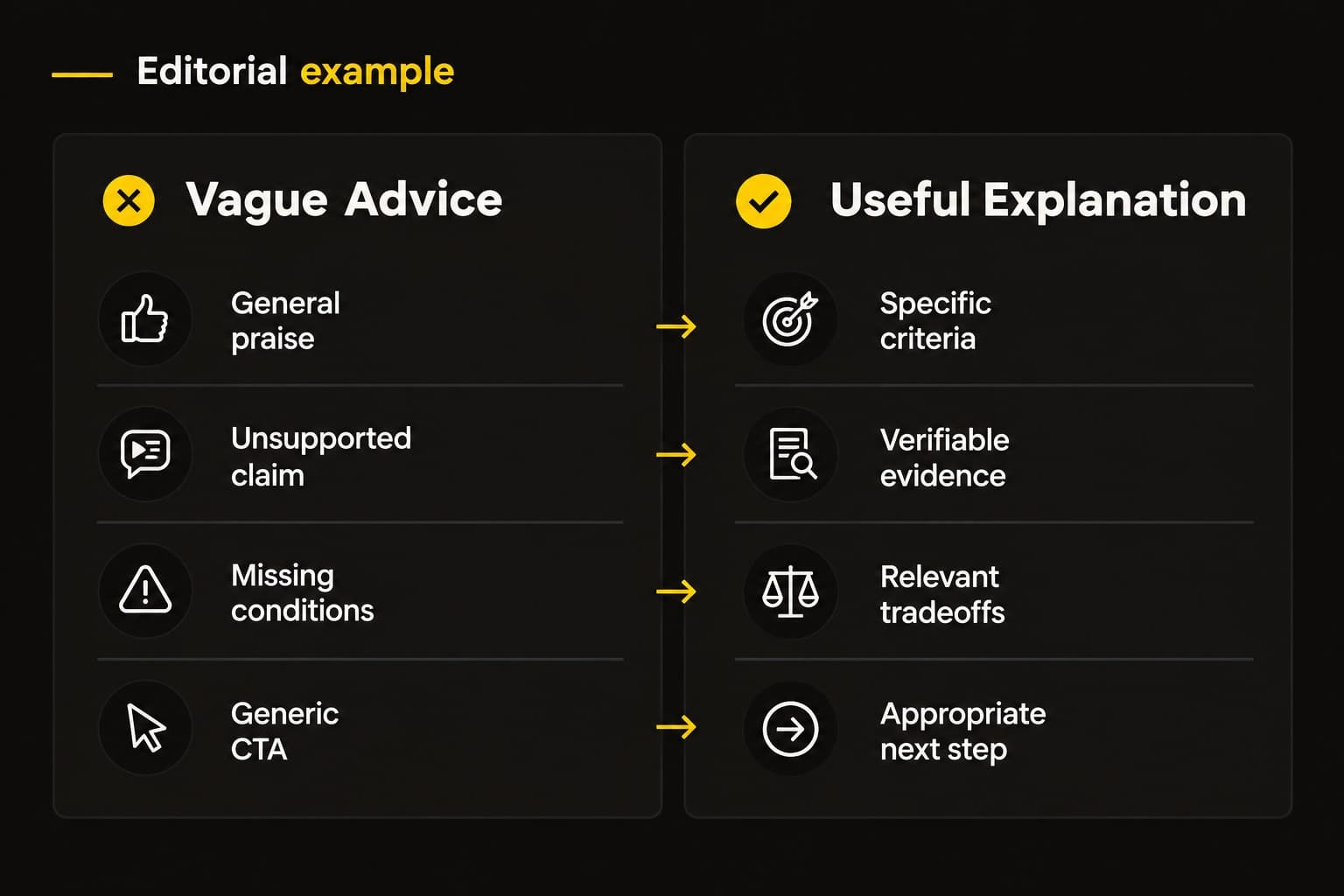
The passages below are original editorial examples, not quotations from a client or a live website.
Vague version:
Choose a reputable commercial painting company that uses quality products and provides excellent service. Compare quotes to find the best value.
The reader still needs to know what to compare and how to investigate the claims.
More useful version:
Before comparing commercial painting estimates, ask each provider to specify the surfaces included, preparation work, proposed coatings, access requirements, scheduling, and exclusions. For an occupied building, clarify how the work area and operating hours will be handled. Record unanswered questions and request written clarification before deciding.
Support that explanation with a blank comparison table or checklist. If the business describes its own process or supplies a project example, verify those details with the responsible team.
The improvement gives the reader an action and a way to examine the offer. It introduces no invented experience, price, credential, or promised result.
4. Explain Implementation, Tradeoffs, and Mistakes
Move from the answer to a process the reader can follow. Specify what information they need, which steps they can complete, and where an expert assessment is appropriate.
A useful estimate-comparison article could ask the reader to:
- Describe the property and intended work consistently to each provider.
- Record what each proposal includes and excludes.
- Identify scope differences before comparing prices.
- Ask for clarification on scheduling and operating constraints.
- Review relevant evidence and contact the appropriate provider.
Explain why the steps matter. Two different scopes may produce different prices, so the price comparison alone leaves important information unresolved.
Make Limitations Part of the Explanation
Identify where the answer depends on location, project conditions, customer requirements, or current platform behavior. A general article may explain the considerations while still requiring an inspection or individualized quote.
Describe mistakes in a way that helps the reader avoid them. “Failure to compare exclusions can leave you comparing different work” teaches more than “don’t make common mistakes.”
Keep the advice within what the business knows and can verify. If a claim requires specialized technical, medical, legal, or financial evidence, involve an appropriately qualified reviewer and use the relevant primary sources.
5. Use Readable Structure and Accessible Supporting Assets
Organize the page so a reader can find the answer, investigate the detail, and reach the next action. Use one descriptive H1 and logical H2/H3 headings that explain the sections.
Choose heading language a reader recognizes. “What the estimate includes” is usually more helpful than a vague promotional label.
Google’s AI-feature guidance keeps existing SEO practices relevant and recommends making important information available as text. It does not establish a special paragraph format that guarantees inclusion.
For the page’s presentation:
- Keep the essential explanation and comparison in readable HTML.
- Use a table when exact options or relationships are easier to compare.
- Keep table headings clear, and check how they look on mobile.
- Use real photographs when presenting actual work.
- Label illustrative diagrams and examples accurately.
- Keep working forms and controls in accessible HTML.
- Add descriptive links where they help a reader investigate or act.
A supporting graphic can reinforce a process, but it should not be the only place the answer exists. Visitors need to be able to read and use the material, even when the image doesn’t load or they use assistive technology.
Short paragraphs can make a page easier to read. Use them to organize ideas, not to manufacture a supposed AI-citation signal. Keep each paragraph substantial enough to explain its point.
6. Review Facts and Connect the Article to the Next Decision
Before publishing, perform a separate fact-checking pass. Fluent copy can still contain the wrong service detail, an outdated platform instruction, or an unsupported performance claim.
Use a claim-review sheet:
| Claim type | Verification | Editorial decision |
|---|---|---|
| Business fact | Responsible team member and current records | Publish accurate offer, location, and process details |
| Client result | Original measurement and permission where applicable | Preserve timeframe, metric, and attribution limits |
| Platform requirement | Current primary documentation | Name the specific platform and review date |
| Calculation | Inputs, arithmetic, and measurement basis | Label assumptions and distinguish estimates |
| Hypothetical example | Clear example label and plausible scope | Avoid implying actual experience or results |
| Advice or interpretation | Reasoning and appropriate evidence | Present judgment as judgment |
Include open-source links and verify they support the attached statement. Preserve conditions and exceptions rather than copying only a persuasive number.
Review the title, description, image labels, and next action as well as the article. A cautious paragraph won’t fix an exaggerated headline or an image showing an unverified result.
Then check the customer path. A comparison article might help someone prepare questions and review a relevant service. A readiness guide might direct someone to a practical checklist. The action should fit what the reader now understands.
Use AI-Assisted Writing With Clear Editorial Responsibility
AI can help organize notes, suggest questions, identify repetition, or draft from a defined brief. Your original evidence and expert review still need to enter the process.
Google’s generative-AI content guidance calls for accuracy, quality, relevance, and manual review. It also warns against generating many pages without useful added value. Treat automation as part of a publishing workflow with an accountable owner.
A practical division of work is:
| Task | AI-assisted contribution | Human responsibility |
|---|---|---|
| Outline | Organize supplied questions and notes | Confirm purpose and coverage |
| Draft | Propose wording from verified material | Review facts, reasoning, and voice |
| Examples | Suggest an illustrative structure | Supply real evidence or label the example hypothetical |
| Editing | Flag repetition or unclear language | Preserve meaning and make final choices |
| Publication | Help prepare metadata or checklists | Verify the rendered page, claims, links, and controls |
Do not accept an invented quote, project, credential, or statistic because it sounds appropriate. If the evidence is missing, change the claim or remove it.
Explain the creation process when that context would help a reader evaluate the work. Accurate authorship and reviewer information should reflect the people actually responsible.
Connect the Writing Brief With the Quickest Path to ROI Areas
The Quickest Path to ROI SEO™ book supplies the broader business-first system behind this content approach. Apply its six connected areas to the article brief.
Revenue opportunities: Choose a customer decision related to worthwhile work the business can deliver.
Priority pages: Identify the page that should own the answer and how supporting content connects to it.
Constraints: Address the specific unanswered question, unclear explanation, missing proof, or difficult next step.
Authority: Supply accurate, relevant evidence and explain what it demonstrates.
Measurement: Define useful actions and later outcomes. Record citations separately from visits, qualified inquiries, and completed sales.
Expansion: Use reader feedback and business evidence to choose the next improvement or topic.
This keeps the article connected to a customer purpose throughout production, rather than adding a sales paragraph to otherwise unrelated content.
A Content Brief and Final Review Checklist
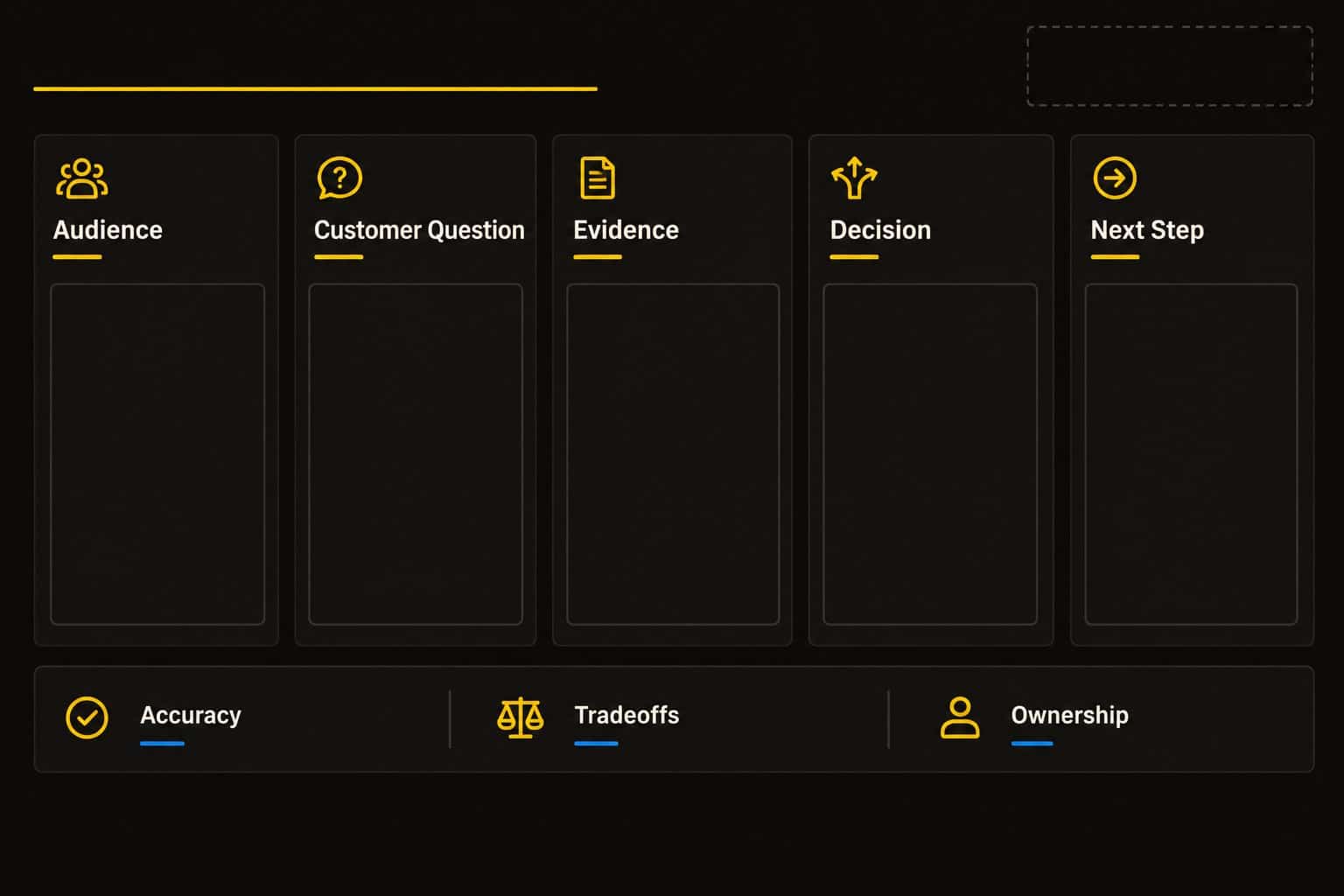
Complete the brief before writing, then use it to evaluate the finished page.
| Field | Brief or review question |
|---|---|
| Audience | Who needs this answer, in which situation? |
| Customer job | What decision should the page help them make? |
| Evidence of need | Which customer or search records support the topic? |
| Main answer | Is it direct, accurate, and appropriately qualified? |
| Original value | What explanation, example, comparison, or tool improves the reader’s decision? |
| Proof | Which claims need sources, records, or expert confirmation? |
| Tradeoffs | What changes the answer or requires further assessment? |
| Destination | Does this belong on an existing page or a distinct new article? |
| Supporting assets | Are the essential relationships readable and accessible? |
| Next action | Does the action fit the reader’s need? |
| Review owner | Who confirms factual and service accuracy? |
| Measurement | What useful evidence will be reviewed after publication? |
A successful editorial review should identify what the reader can now understand or do. Citation tracking can provide additional evidence later; it should not replace that assessment.
Frequently Asked Questions
Should Every Article Start With a Fixed-Length Summary?
No. Use an answer that fits the question and preserves important conditions. A short definition may be sufficient for one topic, while another needs context or a comparison. Word-count targets are editorial aids, not a guarantee of a snippet or AI inclusion.
Can AI-Assisted Writing Still Offer Original Value?
Yes, when the process includes verified evidence, useful analysis, relevant examples, and accountable review. AI can help organize the work. Original value still comes from what the page adds to the customer’s understanding, not a generic rewrite of existing summaries.
Do Shorter Paragraphs Guarantee More AI Citations?
No. Paragraph length should serve readability and explanation. A formatting choice alone does not establish that a platform will cite the page. Keep the answer clear, evidence accurate, and testing separate from assumptions about selection.
Should I Repeat the Same Answer Throughout a Page?
Repeat only when the new context makes it useful. Usually the introduction answers briefly, the body explains, and later sections help the reader apply the idea. Avoid restating the same claim in several sections without adding reasoning or detail.
How Do I Decide Whether a Topic Deserves a New Article?
Review its customer purpose and existing coverage. Improve an existing page when it can serve the question well. Create a new article when it addresses a distinct decision, adds useful value, and has a clear relationship with relevant pages and actions.
Give Your Next Article a Useful Job
Choose a real customer question, define the decision, and collect the evidence before drafting. Use the Content-with-a-Job Planner to turn that purpose into a reviewable brief.
For help connecting content quality with priority pages, AI-search readiness, and qualified customer actions, Elite SEO Consulting can help review your next content investment. Call 719-474-9404 to discuss the questions your customers need answered.