
Your business appears in more AI answers, and the report shows additional citations. That is useful discovery evidence. To decide whether the investment is paying off, you still need to understand what happened with customers, completed sales, delivery costs, and the cost of the work.
Generative engine optimization, or GEO, can influence how people encounter information about a business. Measuring its return requires a clear way to link that discovery to financial outcomes and explain what the evidence cannot establish.
Start by agreeing on the evaluation period, the sales records you will use, and the attribution rule. Then calculate the result consistently. A number becomes useful when an owner can inspect the records and assumptions behind it.
How Do You Measure GEO ROI?
Compare gross profit from completed sales reasonably attributable to the program with its full cost: (attributable gross profit − GEO cost) ÷ GEO cost × 100. Track mentions and citations as visibility signals. Keep documented attribution, customer-reported influence, and forecasts separate, and explain how shared work and sales timing affect the result.
This is a gross-profit-based marketing evaluation. It measures the program’s contribution after costs. It is not the company’s overall net-profit margin, and an attributed result does not prove that the program caused every credited sale.
Define the Business Return Before Counting Visibility
Decide what the project is intended to help the business achieve. A local service company might want qualified inquiries for profitable projects in its genuine service area. A software company might want qualified trials that convert into paying customers.
Connect that goal with records the business can maintain. Agree on what qualifies as an inquiry, what makes it suitable, when a sale counts as completed, and which delivery costs belong to it.
Keep the following terms distinct:
| Measure | What it describes | Appropriate use |
|---|---|---|
| Mention | An answer names the business | Review presence and description |
| Citation | An answer identifies a supporting source | Review content discovery |
| Referral | A recorded visit from an identifiable source | Review the entry page and customer path |
| Qualified lead | An inquiry meeting your stated criteria | Evaluate commercial fit |
| Completed sale | A sale recognized under the stated reporting basis | Evaluate earned business outcomes |
| Gross profit | Sales less direct delivery costs | Evaluate contribution before the program cost |
| Program cost | The full investment being assessed | Calculate return on a consistent basis |
Business.gov.au’s financial glossary distinguishes revenue, gross profit, and net profit. Use your business’s actual delivery-cost definitions rather than treating the full selling price as available return.
Why Citations Cannot Be Assigned a Fixed Revenue Value
A citation shows that a source appeared in a recorded answer or supported reporting dataset. It doesn’t indicate that someone visited, needed your service, contacted the business, or purchased.
Microsoft’s AI Performance documentation describes citation activity across supported AI experiences. It distinguishes those counts from placement in an individual answer. Those records help investigate discovery; sales records serve a different purpose.
Even an accurate provider recommendation may not lead to measurable action. Conversely, someone could discover the business in an answer and return later through another route.
Preserve visibility trends as early evidence. Avoid multiplying a citation count by an invented dollar value and presenting the result as earned revenue or ROI.
If you estimate future customer behavior, label the estimate and its assumptions. Keep that forecast outside the realized-outcome calculation.
Capture Identifiable Discovery and Customer-Reported Influence
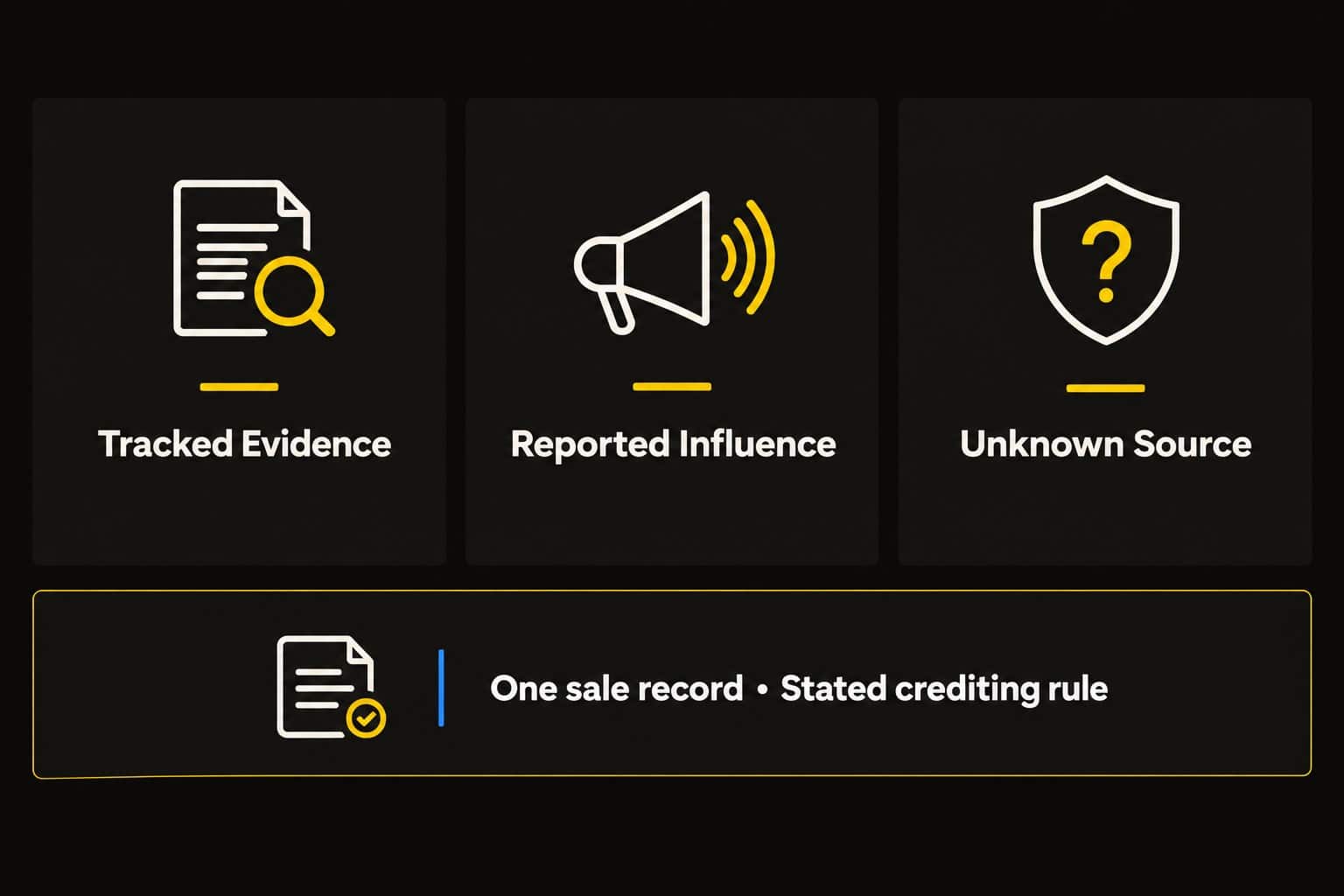
Use available analytics, lead records, and customer feedback together. Each provides a different part of the evidence.
A recorded assistant source can help identify a website session. A validated form submission can establish an action. A sales record can establish whether that inquiry became completed business.
Preserve the relationship where your implementation permits it. Use a lead or order identifier to connect business records, while keeping personal customer information out of analytics fields where it does not belong.
Ask a neutral question during intake: “How did you first hear about us?” If the customer mentions an AI assistant, preserve their wording. A follow-up can establish whether they saw a recommendation, read an answer, or clicked a link.
Do not overwrite the recorded website source with that response. A customer can report initial AI discovery while the eventual session is recorded as branded search. Both pieces of information may be useful.
Create an Attribution Ledger
Use a single record for each lead or sale. Add multiple evidence fields without duplicating the outcome.
| Category | Evidence | Reporting treatment |
|---|---|---|
| Identifiable assistant-origin journey | Source records connected to the inquiry and sale where available | Eligible for the defined attribution review |
| Customer-reported AI influence | Saved intake response without a complete tracked journey | Report as stated influence; apply only an explicit attribution policy |
| Mixed-channel journey | More than one recorded or reported influence | Allocate under the agreed rule; do not give every channel full credit |
| Unknown origin | No reliable discovery evidence | Keep unknown; do not assign to AI by default |
| Open opportunity | A lead or quote without a completed sale | Report pipeline separately from realized ROI |
These are suggested ledger categories, not automatically generated platform classifications.
Google’s attribution guidance describes attribution as assigning credit along a path to an important action. Different models can assign credit differently. Use the report’s scope and model as part of your evidence, rather than treating a platform-assigned value as a complete account of what caused a sale.
Calculate ROI on a Consistent Cost and Sales Basis
Use the existing guide on how to calculate SEO ROI without mistaking leads for revenue for the shared financial method. For GEO, the additional work is establishing the credit the evidence supports.
Calculate the Credited Gross Profit
For each eligible completed sale, use its recorded revenue less direct delivery costs. If actual job-level costs are unavailable, an estimated margin can support a clearly labeled estimate; it should not be presented as verified profit.
Then apply the agreed attribution share:
Credited gross profit for a sale = sale gross profit × agreed attribution shareSum the credited amounts once. A sale receiving 50% GEO credit should not also receive 100% SEO credit in a combined channel total.
Include the Full Program Cost
Record the work being evaluated and all costs included in it. Depending on the scope, those can include strategy, content, technical implementation, research, tools, reporting, and internal labor.
Allocate shared costs consistently. If a service-page improvement serves both conventional search and AI discovery, do not charge its full cost to several programs in a combined total. Likewise, do not credit GEO with the entire sale while assigning only a small part of the shared work to its cost.
Where the activities and outcomes cannot reasonably be separated, an integrated search ROI report may be more useful. Keep AI-related observations and reported influence as supporting measures within it.
Match the Evaluation Window
State the period and the sales basis. Distinguish a calendar-period report from a lead-cohort report that follows inquiries acquired during a defined period through later outcomes.
For a cohort review, retain the relevant acquisition and follow-up costs as the cohort develops. For a period review, explain any mismatch between current spending and outcomes from earlier work.
Separate earned outcomes from cash received. A completed job, an unpaid invoice, a deposit, and an open quote are different records. Choose a consistent basis and state it.
The calculation also requires a positive cost denominator. If the recorded program cost is zero, the percentage is undefined. Review the missing cost rather than inventing a return.
A Hypothetical GEO ROI Example
Hypothetical Example
- Credited gross profit: $3,000
- Program cost: $2,000
- Contribution after cost: $1,000
- Attributed ROI: 50%
Attribution assumption stated; incremental causation not established.
Consider an illustrative service-business review. All figures below are assumptions for teaching the calculation, not client results or a prediction.
The review covers one defined evaluation period. It includes three credited sales completed within that period. For this example, the stated attribution policy assigns them full GEO credit based on assumed documented journey records. That assumption is not proof of incremental causation.
| Program cost | Illustrative amount |
|---|---|
| Strategy and implementation | $1,200 |
| Content work | $400 |
| Website improvements | $250 |
| Allocated tools | $100 |
| Internal review time | $50 |
| Total program cost | $2,000 |
Each of the three assumed completed sales has $1,000 in gross profit after direct delivery costs.
Attributed gross profit = 3 completed sales × $1,000 = $3,000
Net contribution after program cost = $3,000 − $2,000 = $1,000
GEO ROI = ($3,000 − $2,000) ÷ $2,000 × 100 = 50%
Under those assumptions, the program has a 50% gross-profit-based attributed ROI. The $3,000 is gross profit, not necessarily sales revenue, and the $1,000 is contribution after the program cost, not the business’s total net profit.
Additional citations and open quotes stay outside this calculation. Actual results require the actual cost and sales records.
Show How Attribution Changes the Result
Suppose the same assumed sales have several meaningful influences and the reporting policy credits GEO with only 50% of their gross profit. Keeping the assumed program cost unchanged makes the effect of that credit decision visible.
| Illustrative GEO credit | Credited gross profit | Program cost | Attributed ROI |
|---|---|---|---|
| 100% of the three sales’ gross profit | $3,000 | $2,000 | 50% |
| 50% of the three sales’ gross profit | $1,500 | $2,000 | −25% |
This is a sensitivity analysis under two stated policies. It is not a confidence interval, an estimated causal effect, or evidence that the correct allocation lies between them.
The arithmetic is straightforward. The crediting rule and underlying records deserve equal attention.
Keep Pipeline and Assisted Influence Separate
An open opportunity may be valuable, but its forecast depends on whether it closes, the completed scope, delivery costs, and timing.
Report pipeline with its stage and assumptions. If you calculate expected value, identify the probability source and margin estimate. Do not add that estimate to completed-sale profit and call the combined amount realized ROI.
Customer-reported influence can help explain what analytics misses in discovery. Report the number of records with that evidence, their business status, and the attribution policy applied. If the records overlap tracked sales, count each sale once.
A clear report can show completed outcomes, open opportunities, and reported influence together without merging them into one financial total.
Report Uncertainty and Choose the Next Investment
The six connected areas in the Quickest Path to ROI SEO™ book help turn measurement into a decision.
Revenue opportunities: Review whether the inquiries concern profitable work you can deliver.
Priority pages: Identify the pages that support useful discovery and customer actions.
Constraints: Investigate weak fit, unclear offers, failed inquiry paths, incomplete records, or slow follow-up.
Authority: Check whether the customer has accurate proof to evaluate the business and offer.
Measurement: Preserve completed outcomes, full costs, crediting rules, and attribution limits.
Expansion: Choose the next project when evidence supports it; keep unresolved assumptions visible.
Use a practical review table:
| Finding | Next investigation |
|---|---|
| More citations, few identifiable visits | Review question relevance, sources, and available customer feedback |
| Useful visits, weak inquiry activity | Inspect page purpose, evidence, and the next action |
| Many inquiries, poor qualification | Review targeting, service fit, and qualification criteria |
| Qualified leads, few completed sales | Review response, sales process, and normal decision time |
| Completed profit does not cover costs | Review the cost basis, crediting rule, maturity, and proposed next work |
A negative result should remain visible. An open sales cycle can explain why a period is incomplete, but it does not turn pipeline into earned profit or justify indefinite spending without review.
A GEO Attribution and Outcome Worksheet
Use the SEO ROI Tracking Worksheet to organize the financial review, supported by an evidence ledger containing these fields:
| Field | Record |
|---|---|
| Review scope | Program, period or cohort, and reporting basis |
| Lead or sale identifier | One stable record per outcome |
| Discovery evidence | Known session source and customer-reported influence in separate fields |
| Qualification and status | Criteria, stage, and outcome dates |
| Completed revenue | Amount recognized under the stated basis |
| Direct delivery costs | Actual costs or clearly labeled estimates |
| Gross profit | Revenue less the specified delivery costs |
| Attribution policy and share | Rule, rationale, supporting evidence, and other channel credit |
| Credited gross profit | Amount included once in the GEO calculation |
| Program cost | Full cost and shared-allocation method |
| Pipeline and cash status | Separate estimates, outstanding payments, and cash received |
| Uncertainty and next action | Missing records, alternative interpretations, owner, and checkpoint |
Retain policy changes with the report. A revised crediting rule can change the result without changing customer behavior.
Frequently Asked Questions
Can an AI Citation Be Assigned a Fixed Revenue Value?
A citation does not establish a visit, customer, or sale. A modeled value requires explicit assumptions and supporting data and must be labeled as an estimate. Keep it separate from realized revenue and gross-profit-based ROI.
How Should AI-Assisted Sales Be Recorded Without a Referral Click?
Preserve the customer’s stated discovery information and connect it with the business outcome record. Mark it as reported influence rather than a tracked referral. Include financial credit only under an explicit policy, with uncertainty and overlapping channels visible.
Should Influenced Pipeline Be Reported as Realized ROI?
No. Report open opportunities separately, including their stage and any forecasting assumptions. Include completed sales and their profit in the realized-outcome calculation under the chosen basis. Update the records as opportunities close rather than counting the same value twice.
How Do I Avoid Double-Counting SEO and GEO Contributions?
Use one sale record and one agreed crediting policy. Allocate shares consistently and reconcile the combined total. Allocate shared costs by the same stated principles. If separation is unreliable, use an integrated search report with AI-specific evidence alongside it.
What Does Negative GEO ROI Mean When the Sales Cycle Is Still Open?
It means credited completed profit has not covered the counted costs under the current review basis. State which opportunities remain open and when you will revisit them. In the meantime, review implementation and lead quality, and do not convert potential outcomes into completed return.
Measure the Return You Can Substantiate
Record known discovery evidence, qualified inquiries, completed outcomes, and full costs. Use the SEO ROI Tracking Worksheet to review them consistently and preserve what remains uncertain.
For help connecting AI-search reporting with priority pages, customer records, and a defensible business review, Elite SEO Consulting can help define the measurement plan. Call 719-474-9404 to discuss the evidence behind your next investment.