
A contractor can rank for the right trade and still attract the wrong mix of work.
The phone rings, but most callers want a small repair, a price for one room, or a service the company no longer wants to emphasize. Meanwhile, the website barely explains the complete exterior painting projects, full gutter installations, or planned replacements the owner would like to book.
Getting larger jobs through SEO starts with defining the projects you want and making those projects easier to find, evaluate, and request. Specific searches matter. So do relevant evidence, clear scope, and an inquiry process that helps your team recognize suitable opportunities.
SEO can support that shift. It can’t determine a customer’s budget from a keyword or make a contractor capable of work it isn’t prepared to deliver.
The objective is a better mix of qualified opportunities for projects that fit your business. Start there before asking your agency to “bring us bigger jobs.”
Define the Larger Project You Actually Want
“Larger jobs” is too vague to guide a page, a keyword list, or a receptionist.
For a painting contractor, the desired project might be a complete exterior repaint, including prep and trim work. For a gutter company, it might be a full installation involving multiple rooflines and appropriate drainage planning. For an HVAC company, it might be a planned system replacement within the team’s actual capabilities.
Each assignment requires different information and evidence. A generic promise to handle “jobs of all sizes” does little to explain why your company suits the particular project.
Write a short target-project profile before changing the website. Include the work, property type, territory, expected scope, and delivery requirements. State what makes the project attractive and what would make it unsuitable.
A useful profile might read:
“We want more complete exterior residential painting projects within our established service area. We can handle the preparation, siding, and trim work described in our current service offering. We want customers planning a complete project rather than requesting an isolated touch-up.”
That is an illustrative assignment, not recommended wording for every painter. Your actual profile should reflect what your crew can deliver and what your records support.
Be equally clear about boundaries. If the company cannot handle certain building heights, materials, access conditions, or project coordination requirements, the marketing plan should respect those limits. Larger demand becomes a problem when it arrives for work the business cannot responsibly accept.

Check Whether a Bigger Invoice Improves the Business
Project value should include the resources the job consumes.
A larger contract may require more materials, crew time, supervision, estimate visits, equipment, and return trips. It may also delay payment or occupy the calendar while other suitable work waits.
Consider this hypothetical comparison. These are invented planning figures, not client results or industry benchmarks.
| Measurement | Project A | Project B |
|---|---|---|
| Collected project revenue | $24,000 | $9,000 |
| Direct delivery costs | $20,000 | $5,400 |
| Revenue less direct delivery costs | $4,000 | $3,600 |
| Crew-days used | 8 | 3 |
| Amount remaining per crew-day | $500 | $1,200 |
Here, a crew-day means one day using the same assumed crew size and working hours. Direct delivery costs include the relevant delivery labor, materials, equipment, and travel costs; do not subtract those costs again.
Project A produces more dollars before other expenses, but Project B leaves more per comparable crew-day. Neither number is final net profit. Marketing, estimating costs not included above, remaining overhead, taxes, and other relevant expenses still matter.
The comparison does not prove that smaller jobs are always preferable. It shows why a larger invoice alone is an incomplete target.
Review completed projects with whoever understands your job costing. Choose the larger project types that create a worthwhile opportunity for your company, and keep the assumptions visible when the data is incomplete.
Find Searches That Reveal the Desired Project
Customers do not necessarily search for “large home service jobs.” They describe the work, the problem, the property, or the decision in front of them.
A project-specific query can give you a stronger clue than a broad trade term. “House painters” leaves many possibilities open. “Full exterior house painting estimate” gives more information about the likely request.
That additional information is useful, but it remains a clue. The searcher might be gathering prices, planning for next year, or considering a scope your company does not serve.
Look for relevant wording across several dimensions:
| Search dimension | Illustrative phrase | What it may help you investigate |
|---|---|---|
| Complete scope | whole-house interior painting | Interest in several rooms or a complete interior project |
| Installation or replacement | seamless gutter installation estimate | A proposed installation rather than a cleaning request |
| Property or customer type | HOA exterior painting contractor | A different buyer and possible coordination requirements |
| Project feature | two-story exterior painting contractor | A capability or access question |
| Buying action | driveway replacement quote | Interest in discussing a defined project |
| Location | exterior painting contractor in your service area | Whether the work and territory fit together |
These phrases are examples for research. They aren’t measured keyword opportunities, and no phrase proves job size, budget, or purchase readiness.
Use the Keyword Opportunity Evaluator to compare the relevant searches with your offer, current visibility, competing results, and the work required. Enter your own evidence; the tool does not fetch live rankings or search volume.
Give preference to searches you can answer credibly and serve profitably. Adding “luxury” to a title is a particularly inexpensive way to avoid doing that analysis.
Support the Questions That Come Before a Large Estimate Request
A customer planning a substantial project may need several answers before contacting a contractor.
The homeowner might compare options, understand what affects the scope, review comparable work, and determine what an estimate includes. A property manager might need to understand scheduling, site coordination, documentation, and how the contractor communicates with occupants.
Those questions deserve different treatment from an immediate request to fix a small problem.
Use the Search Intent Worksheet to distinguish the customer’s task. A person comparing painting preparation methods needs an explanation. A person ready to request a complete exterior estimate needs a service destination with a clear next step.
Connect those stages. A useful planning article can direct the reader to the relevant service page. A service page can point to a completed project that demonstrates comparable scope.
Avoid creating a separate page for every minor wording variation. Closely related questions can often be answered on one useful destination. Separate pages when the customer decision and the content assignment are meaningfully different.
Also avoid treating every research visitor as an immediate sales opportunity. Some people will remain early in their planning. The content should help them understand the project and point them to the right path when they are ready.
Make the Service Page Describe the Work You Want to Book
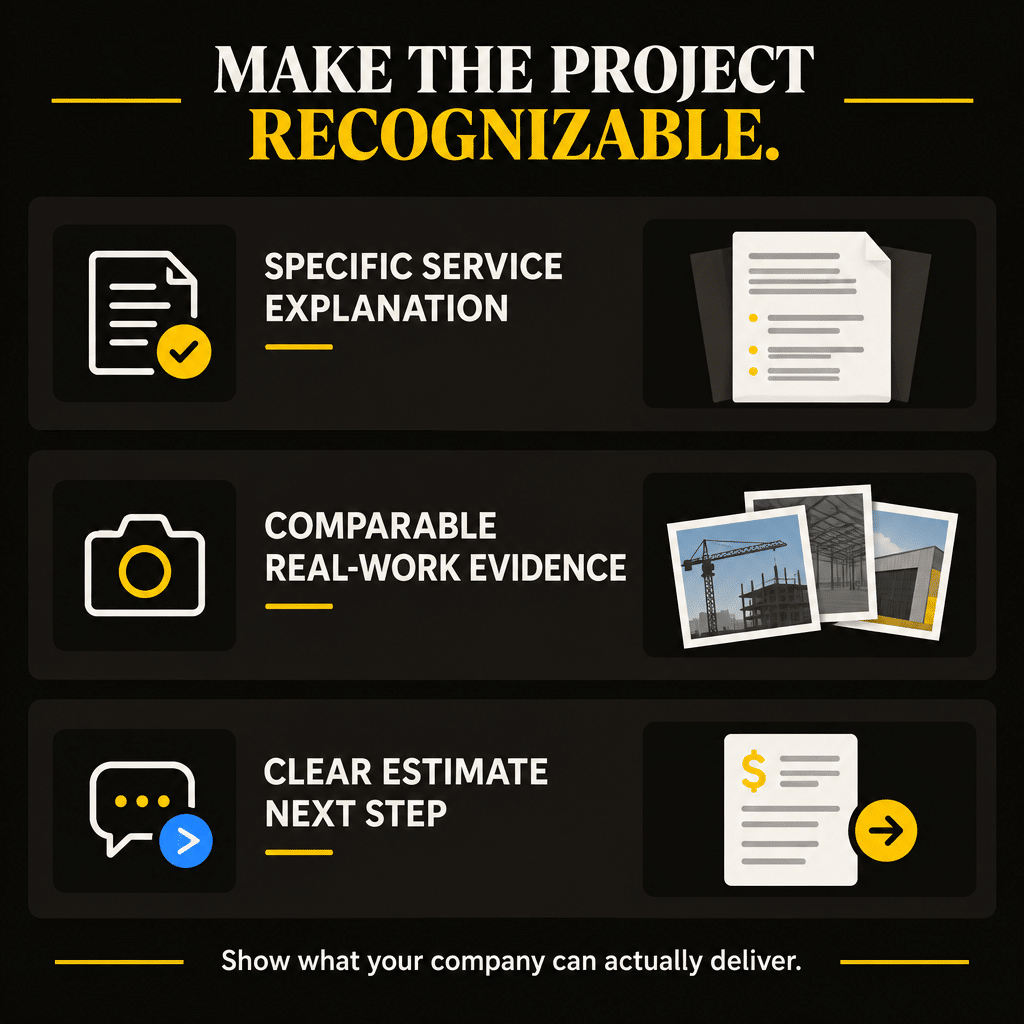
The website should make the desired project recognizable.
If the painting page features only small room updates, its photographs and examples may give visitors little reason to associate the company with a complete exterior repaint. If the gutter page emphasizes cleaning throughout, an installation customer may struggle to establish whether installation is a serious part of the offer.
Review the main heading, introduction, service scope, project examples, and next action together. They should describe the same assignment.
For a complete exterior painting offer, include the surfaces covered, preparation work in scope, relevant project constraints, how you develop the estimate, and the customer’s next step. Each detail must match the company’s actual process.
Use plain words. “Premium transformative exterior solutions” is less informative than explaining the work and showing that your team can complete it.
Keep the offer honest. Do not describe restoration, structural repair, hazardous-material work, or specialized installation merely because the phrase appears valuable in keyword research.
The goal is to help suitable customers identify the service and assess your fit. The page should also help customers with a different need understand their options. If repairs remain part of the business, give those customers a clear route to the repair information.
Promoting planned replacement work should never require pretending that every repair request needs replacement.
Show Evidence of Comparable Project Scope
A customer considering a substantial commitment needs more than an attractive finished photograph.
Show enough context to explain why the project is relevant. With permission, identify the type of work, the customer’s original need, meaningful conditions, the agreed scope, and what was completed.
For a larger painting project, that might mean showing preparation and finished surfaces, explaining which parts of the property were included, and describing how access or sequencing was handled. For a gutter installation, it might mean illustrating the actual installation scope and the conditions the crew addressed.
Use evidence you have. Do not convert a stock photograph into an implied client project or describe an AI-generated image as completed work.
Select relevant proof rather than the most dramatic image available. A mansion photo may look impressive but tell an ordinary homeowner nothing about whether the contractor can handle a project like theirs.
Testimonials can help when they describe aspects relevant to the decision, such as communication or project organization. Preserve the customer’s meaning and use only legitimate, permitted material.
Google’s guidance on helpful content emphasizes useful, original information and clear evidence of expertise. Applying that guidance here means accurately explaining the actual work. It does not mean that a particular photograph or case-study format guarantees better rankings.
Explain How the Project Will Be Evaluated
Larger projects can involve more unknowns. Your website should help customers understand how you’ll resolve those unknowns.
Explain what information you need before an estimate, whether an on-site visit is required, and what the customer can expect from the initial conversation. Describe the real process without promising an exact price before the scope is known.
If access, material choice, surface condition, or project sequencing changes the estimate, explain the relevant factors in understandable terms. Avoid turning the page into a technical specification that a homeowner cannot use.
Be precise about availability and commitments. If a project requires a planning conversation before a start date can be offered, say so. If certain work is seasonal, make the relevant condition clear.
Price guidance can be useful when it rests on current business records and defined assumptions. A broad range without scope can confuse customers as easily as it can help them.
For example, a contractor might explain the factors affecting the estimate and ask for the information needed to discuss a realistic range. That is more useful than borrowing a national price figure and presenting it as the company’s local quote.
The page’s job is to reduce uncertainty enough for an informed next step. The estimator’s job is to resolve the project-specific details.
Qualify the Scope Without Making Contact Difficult
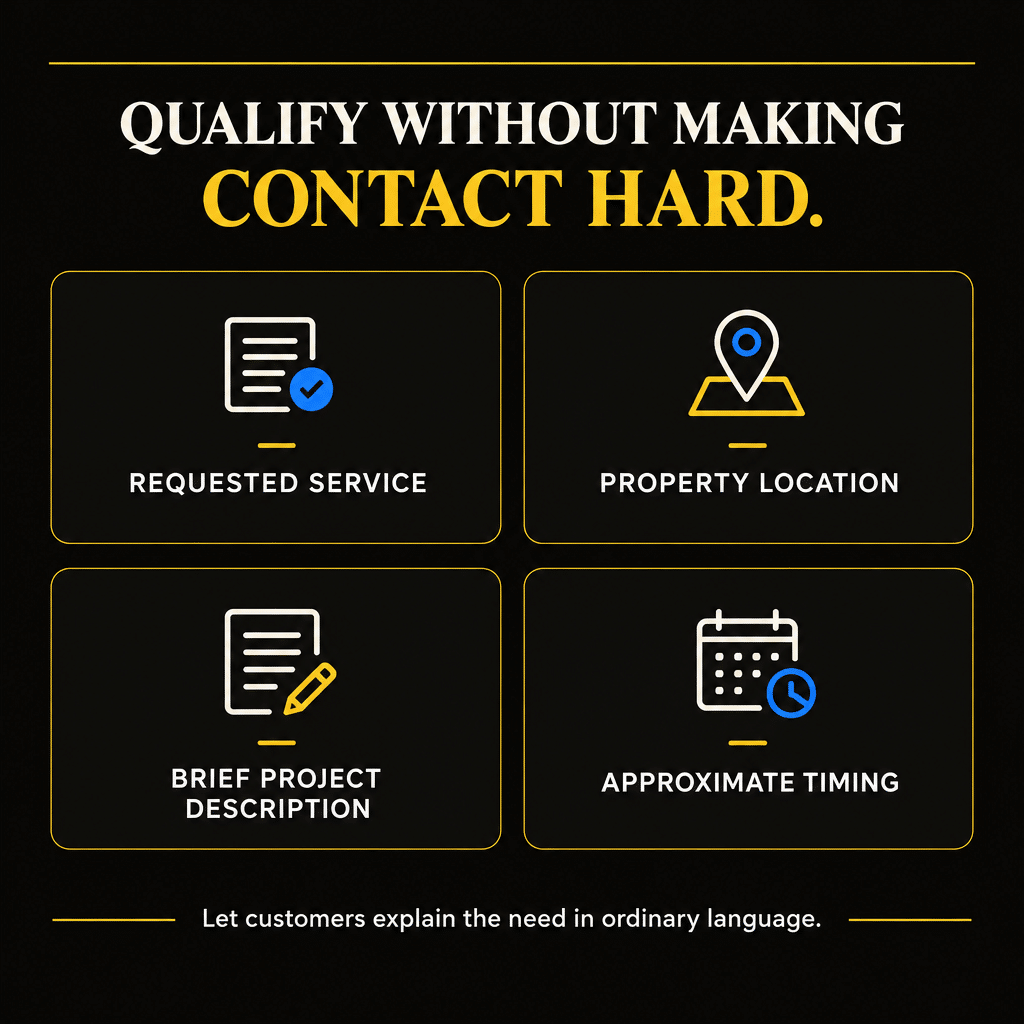
An inquiry form should give your team enough information to recognize the desired project.
Start with the questions that change how the request is handled. For larger home service projects, these commonly include the requested service, property location, a brief scope description, and the customer’s approximate planning window.
Optional photographs or plans can help once your team receives and reviews them. Do not make those uploads mandatory unless the process genuinely requires them.
A customer may not know square footage, linear footage, equipment specifications, or the exact repair method. Let them describe the need in ordinary language. A short note such as “complete exterior, including trim” can be more useful than a forced answer to a technical field.
Budget questions require judgment. If an approximate range helps your team discuss suitable options, explain its purpose and provide an “unsure” choice. A blank budget should not automatically classify a relevant customer as unsuitable.
A minimum project requirement should be real, clear, and consistently applied. Use respectful wording that helps people decide whether to inquire. Avoid hostile banners that make suitable customers wonder how they will be treated.
Keep phone contact available where appropriate. Someone with a complex request may need a conversation before knowing which category to select.
Qualification should improve the conversation, not become a small examination the customer must pass.
Prepare the Team to Recognize and Handle Larger Opportunities
Changing the page is only part of changing the job mix.
The person responding to inquiries should understand the target-project profile. You can lose a suitable planned project if every call is treated as a request for an immediate small repair.
Give the team a few practical questions: what work is being considered, where is the property, how much of the property is involved, and when does the customer hope to proceed? Adapt the questions to the trade and avoid pushing customers toward a larger scope than they need.
Record uncertainty. “Customer comparing full replacement with repair” is useful information. It should lead to an appropriate assessment, not an automatic replacement pitch.
For property managers or other organizational buyers, identify who can arrange access and who participates in the decision. Explain any genuine requirements for plans, documentation, or site visits.
Assign responsibility for the next step. If the estimator needs to review photographs before calling, somebody should know that review is pending. If the customer receives a proposal, someone should know when and how to follow up.
This is particularly important when the inquiry looks promising enough to be passed between several people. A larger opportunity can disappear into a very small gap in ownership.
Review Project Mix and Qualified Lead Value
Evaluate a larger-job strategy by the opportunities and work it produces.
Record the target project category alongside the source information you can reasonably capture. Follow up on suitable inquiries into estimates, bookings, completed work, and collected revenue. Review the associated delivery costs where the records support them.
Track the share of qualified inquiries that match the desired project profile. Also review why requests are unsuitable. A rise in full exterior inquiries outside your territory is a different problem from a rise in relevant inquiries that your team cannot schedule.
The SEO Lead Value Calculator can help estimate qualified lead value using your average sale, gross margin, and close rate. Its outputs are estimates based on your inputs. They don’t automatically account for every operating expense or sales delay.
Keep larger projects separate where their economics or buying process differs materially. Using the same average lead value for an isolated repair and a complete project can hide the difference you are trying to understand.
Google’s Search Console Performance report can show search visibility and clicks for relevant queries and pages. It does not show the final size or profitability of the resulting job. Connect website and inquiry records where possible, while retaining the limits of your attribution.
Allow time for the relevant opportunities to develop. Review groups of inquiries from comparable periods rather than comparing this month’s new requests with last month’s completed projects as though they were the same customers.
Start With One Defined Project Opportunity
You do not need to rewrite the entire website to begin.
Choose one project type your business wants and can deliver. Review the existing service destination, relevant searches, available evidence, and current inquiry process. Identify the most important gaps.
Consider a hypothetical painting contractor that wants to take on more complete exterior projects. Its existing exterior page is relevant, but the introduction is vague, the examples show only isolated trim work, and the form offers no way to describe project scope.
A focused first assignment could improve the service explanation, add a permitted example of a comparable completed exterior project, and revise the inquiry choices so the team can recognize a complete-project request.
The company could then review whether the changes help attract and advance suitable opportunities. It would not need to declare that every smaller painting job had become undesirable.
Set a completion date for the work and a separate review date for evidence. Record the baseline before making changes. Note other meaningful changes, such as pricing, crew availability, advertising, or seasonal demand, that may affect the results.
If suitable larger-project inquiries arrive but do not progress, inspect the reasons. The issue may involve the offer, estimate process, capacity, or customer expectations. Expanding the keyword list is not automatically the next useful action.
Frequently Asked Questions
Do customers have to search for “luxury” or “premium” to become larger-project leads?
No. Relevant customers may describe the service and scope in ordinary terms. Research the words associated with the projects you want, then confirm fit through the inquiry. Price-related adjectives do not establish budget, job size, or suitability.
Should I publish a minimum project size on my website?
Publish it when it is a genuine operating requirement, and you can explain it clearly. Specify what the requirement means and whether exceptions exist. Use respectful wording and provide a way to ask about uncertain scope. Do not invent a minimum simply to make the company appear exclusive.
Can I promote larger residential jobs without adding commercial services?
Yes. Complete residential projects can offer the desired scope within the work you already perform. Commercial work can involve different delivery requirements and buyers. Pursue it only when the business is prepared to serve it, rather than treating the commercial label as a shortcut to larger contracts.
Should a project inquiry form require an exact budget?
Usually, you don’t need an exact figure for the first conversation. If budget guidance helps qualification, offer approximate ranges and an “unsure” option. Explain how the answer will be used. Do not treat a customer’s early estimate as a confirmed project price.
What if larger projects produce fewer inquiries?
Review the quality, progress, and economics of those inquiries. A lower count can still be useful when suitable opportunities become worthwhile work, but it can also indicate weak demand or a page problem. Compare completed outcomes and the resources involved before declaring the strategy successful.
Make Larger Projects Easier to Find and Evaluate
Attracting larger home service jobs requires a clear project assignment. Choose the work your business wants, investigate the searches behind it, explain the offer accurately, and support it with relevant evidence.
Then give customers a practical way to describe their project and give your team a consistent way to assess it. Measure whether the resulting work improves the business, accounting for the resources it consumes.
For a broader approach to choosing SEO work around business outcomes, explore Quickest Path to ROI SEO™. It connects search opportunities with the page improvements and customer decisions that deserve your next investment.
If you need help aligning your contractor website with the projects you want to book, see Elite SEO Consulting’s home improvement SEO services or call 719-474-9404.