
A home service business can get more website traffic and still face the same problem on Friday afternoon: its schedule has too few of the jobs it actually wants.
Some inquiries come from outside the service area. Others involve work the company no longer offers. Estimates go unanswered, calls reach voicemail, or the crew spends half the day driving to a job that barely covers its costs.
An SEO report can look encouraging while those problems continue. The owner still needs to know whether the investment is helping fill the schedule with work that makes financial sense.
Home services SEO helps customers find your business when they search for the services you provide in the places you serve. A useful strategy connects that visibility to qualified inquiries, estimates, booked jobs, and the money left after you deliver the work and pay for marketing.
That connection should influence which services you promote, which pages you improve, and what you ask your SEO provider to report. This guide walks through those decisions so you can identify where your customer path needs attention first.
Start With the Work Your Business Wants to Book
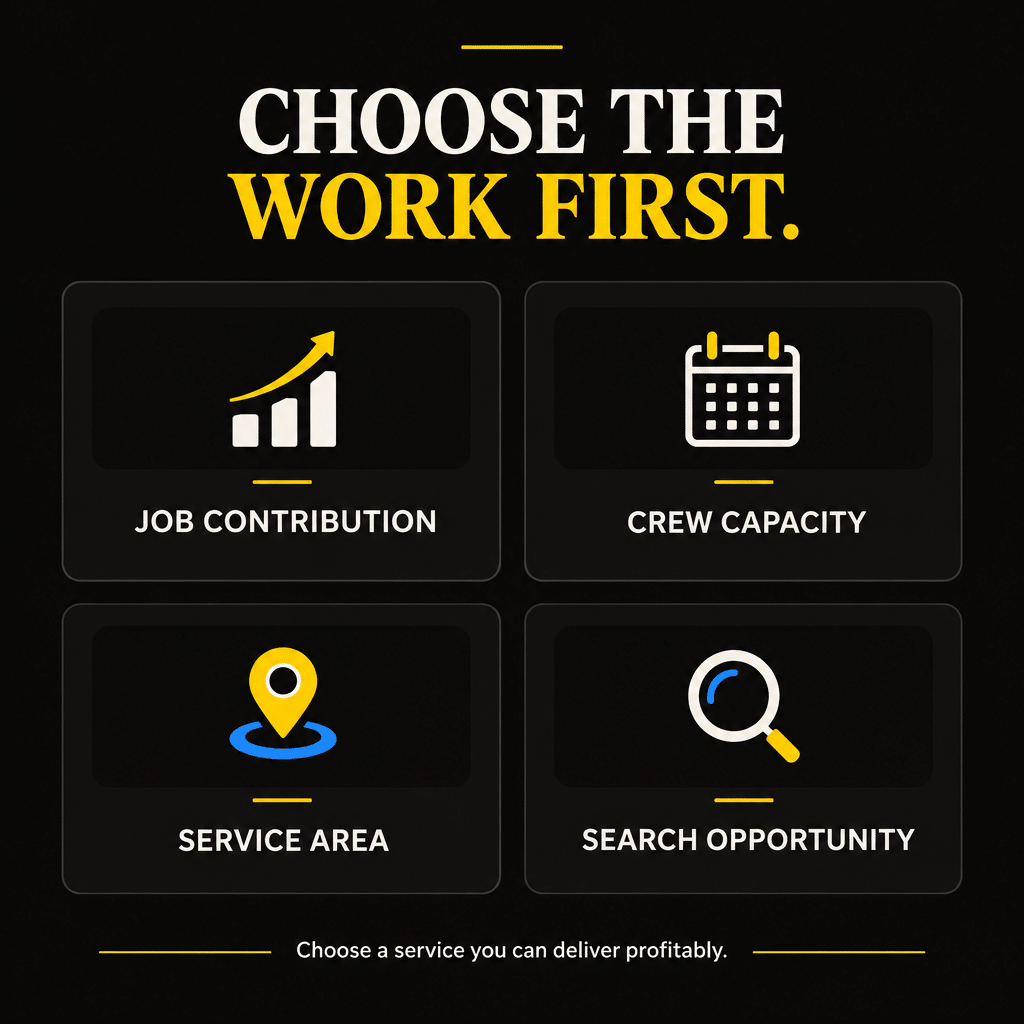
Before choosing keywords, decide what a valuable new customer looks like. A search campaign needs a clearer objective than “more leads.”
A handyman may want several tasks bundled into one visit. A painting contractor may prefer complete interior projects over small touch-ups. An HVAC company may have room for maintenance appointments but limited installation capacity this month. A gutter company may find that nearby installation work contributes more to the business than distant cleaning visits.
Those are operating decisions, and they belong in the SEO conversation.
For each service you might promote, record:
- Typical job revenue and direct delivery costs.
- Crew time, equipment, and skills required.
- Whether you can accept additional work now.
- The areas where you can deliver the service efficiently.
- Seasonal demand and the time customers need to decide.
- Whether the work commonly leads to repeat business.
Revenue alone will not settle the decision. A larger project can require expensive materials, subcontractors, several site visits, and a long payment cycle. A smaller nearby job can fit an otherwise empty afternoon and contribute useful margin.
Look at the economics and the schedule together. The initial target should be a service you want to sell, can deliver well, and have a realistic opportunity to make more visible.
Match the Search to the Customer’s Next Decision
Search intent means what someone is trying to accomplish when they search. For home services, that intent often determines whether a visitor needs advice, an urgent response, or enough confidence to request an estimate.
Consider these plumbing searches:
| Search example | Likely customer need | Useful destination |
|---|---|---|
| Why does my water heater make noise? | Understand a symptom | A practical explanation with a relevant service link |
| Water heater repair in Colorado Springs | Find a provider for a specific problem | A repair service page |
| Tankless water heater installation cost | Compare a planned investment | An installation page explaining cost factors and the estimate process |
| Emergency plumber near me | Reach an available provider quickly | An emergency service page with a clear phone action and accurate availability |
These examples illustrate different needs; they are not verified search-volume targets.
An emergency customer needs to know whether you serve the location, handle the problem, and are available. Someone planning a replacement may need to understand options, installation conditions, warranties, and how your estimate works.
Give each important page a defined customer decision to support. “Contact us” becomes more useful when the page has already explained what the customer can expect from that contact.
Use the Keyword Opportunity Evaluator to compare intent, existing visibility, and commercial relevance before committing resources to a target. Validate the actual search results and local demand as part of that decision.
Choose Service Areas That Work Financially
A city on the map is not automatically a worthwhile SEO target. Travel time, appointment density, estimate visits, and job size all affect a location’s value to your business.
Suppose a contractor earns the same revenue from two similar jobs. One is fifteen minutes from the crew’s previous stop. The other requires a long drive in both directions and a separate unpaid estimate visit. The invoices may match, but the delivery costs do not.
Before expanding your target area, ask whether you can serve it consistently, whether the likely work justifies the travel, and whether your current territory still has unrealized potential.
Then make the website’s coverage accurate. Explain where you actually work and any meaningful limits on the services available. Do not imply that you have an office in a town where you only travel to customers.
A location page deserves its place when it helps customers in that area make a decision. Local project examples, genuine service details, and relevant scheduling information can provide that value. Changing the city name in otherwise identical copy gives readers little additional help.
The business case for a service area should come before the decision to build pages for it.
Build the Pages That Support Inquiries First
A home service website needs a clear route from a customer’s problem to the service that addresses it. A visitor should understand the offer and take the next step without hunting through loosely related blog posts.
Start by reviewing your main service pages. For example, a gutter repair page should explain the problems you address, the work involved, where you operate, and how customers request an assessment.
It should also answer the questions that influence the inquiry:
- Can you assess a leak, loose section, or drainage problem?
- When is a repair suitable, and when should replacement be considered?
- What information helps you prepare for the visit?
- Is there a charge for an assessment, if applicable?
- What happens after the customer submits the request?
Only publish answers that match how your business actually operates.
Support those answers with real photographs, specific project details, relevant customer feedback, and accurate credentials. State licenses, insurance, warranties, and service commitments only when they are current and applicable.
Educational content can then help customers understand a problem or compare options. Connect that content to the appropriate service page through natural links. A guide on gutter overflow should make it easy to find the page that explains your inspection or repair service.
Google’s Search Essentials emphasizes useful content, search-friendly language, and crawlable links. My practical recommendation is to apply those fundamentals first to the pages closest to a valuable customer action.
Treat Google Maps and Website Visibility as Connected Opportunities
A customer may discover you through Google Maps and call immediately. Another may visit your website, read a service page, check reviews, and return later. Your business information needs to make sense across those paths.
Google’s local ranking guidance says local visibility depends on relevance, distance, and prominence. Complete, accurate business information and genuine reviews are useful parts of the foundation. Distance also means your visibility can vary depending on where customers search.
Maintain accurate business categories, hours, contact details, and services. Keep availability claims consistent between your profile and website. A page promising emergency assistance creates a problem if nobody can answer those calls.
Represent your location correctly, too. Google’s service-area business guidance says businesses that do not serve customers at their address should remove that address from the public profile and specify their service area.
Use the Local Search Visibility Checklist to review the foundation. Then assess priority services and locations individually. A strong overall profile does not tell you whether the right customers are finding the service you most want to sell.
Follow the Inquiry All the Way to Booked Work
Finding your business is one step. Becoming a customer takes several more steps, and each handoff can lose an otherwise valuable opportunity.
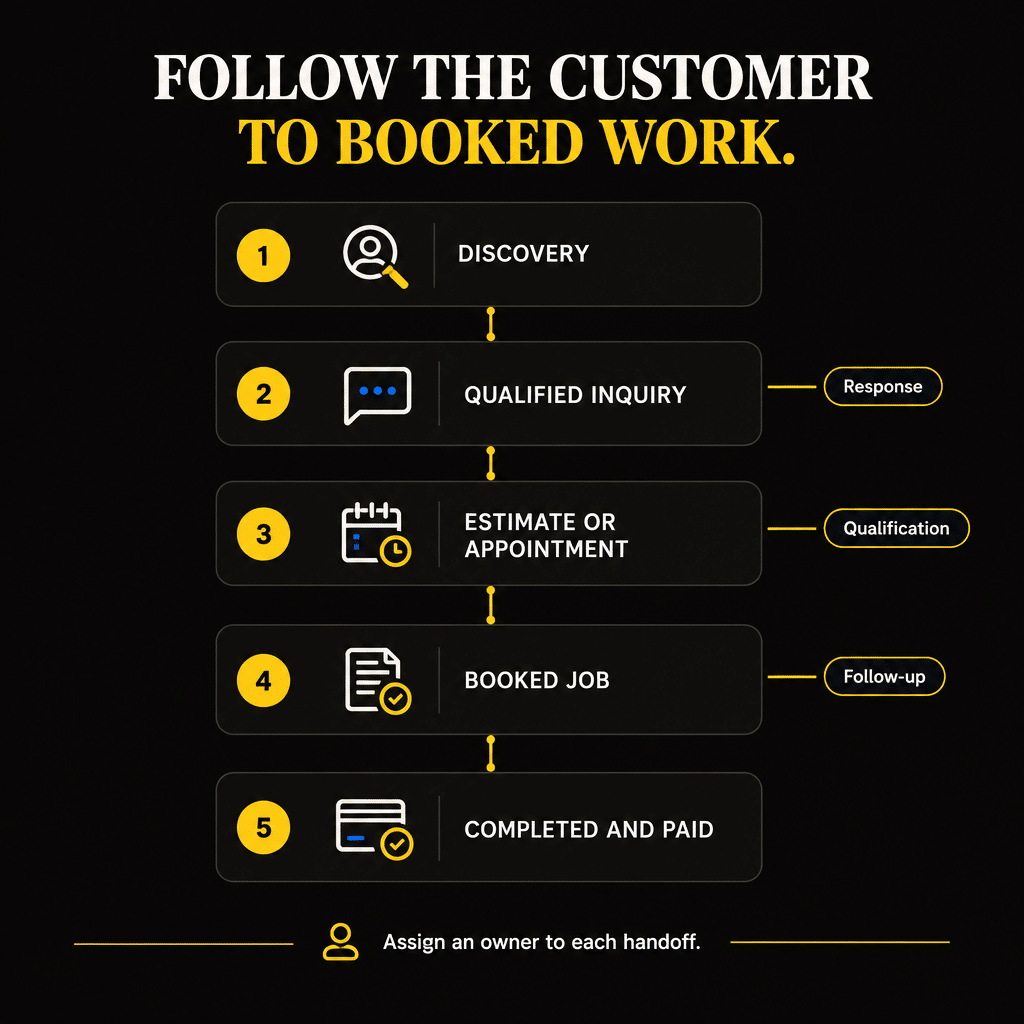
Review the customer path in this order:
- The customer finds a relevant listing or page.
- The customer sees enough information and proof to inquire.
- Your team receives and responds to the inquiry.
- The request is qualified for service, location, and timing.
- Arrange an estimate or appointment when needed.
- The customer receives a clear proposal and appropriate follow-up.
- The work is booked, completed, and paid for.
Give someone responsibility for each handoff. A working form accomplishes little if its notifications sit in an inbox nobody checks. A detailed proposal loses value if the customer never receives it or cannot understand the next step.
Test the experience yourself on a phone. Submit a form, use the call button, and verify where the inquiry arrives. Review missed calls and inspect whether estimate requests receive the response you intended.
Also distinguish an inquiry from a qualified opportunity. A salesperson offering software, a duplicate call, and a homeowner requesting a service outside your territory should not inflate the same lead total as a suitable prospective customer.
When leads are arriving, but bookings remain weak, investigate this path before assuming you need more traffic. Improving an existing handoff may create value sooner than expanding the audience.
Measure the Contribution of the Work You Win
A home services SEO report should help you understand where valuable demand comes from and what happens after it arrives. Rankings and visits provide context, while the job records show how that demand developed.
For your priority service, connect these measurements:
| Measurement | What it helps you judge |
|---|---|
| Search visibility and clicks | Whether potential customers can find the relevant page |
| Qualified inquiries | Whether discovery is producing suitable opportunities |
| Estimates or appointments | Whether inquiries progress through your process |
| Booked jobs | Whether opportunities become committed work |
| Completed work and collected revenue | Whether bookings become realized business activity |
| Direct delivery costs | How much revenue remains to contribute toward marketing, overhead, and profit |
| SEO investment | Whether the estimated additional contribution justifies the acquisition cost |
Record source information in your customer or job-management system wherever practical. Website analytics, tagged profile links, call tracking, and a customer source question can support the picture. They will not always agree perfectly, particularly when people discover you more than once.
Keep Google Ads, organic website inquiries, Maps inquiries, and other known sources distinguishable. Avoid counting one customer multiple times because the person called, submitted a form, and later booked.
For a simple contribution-based estimate, use:
Estimated SEO return = (additional job contribution attributed to SEO − SEO investment) ÷ SEO investment × 100.
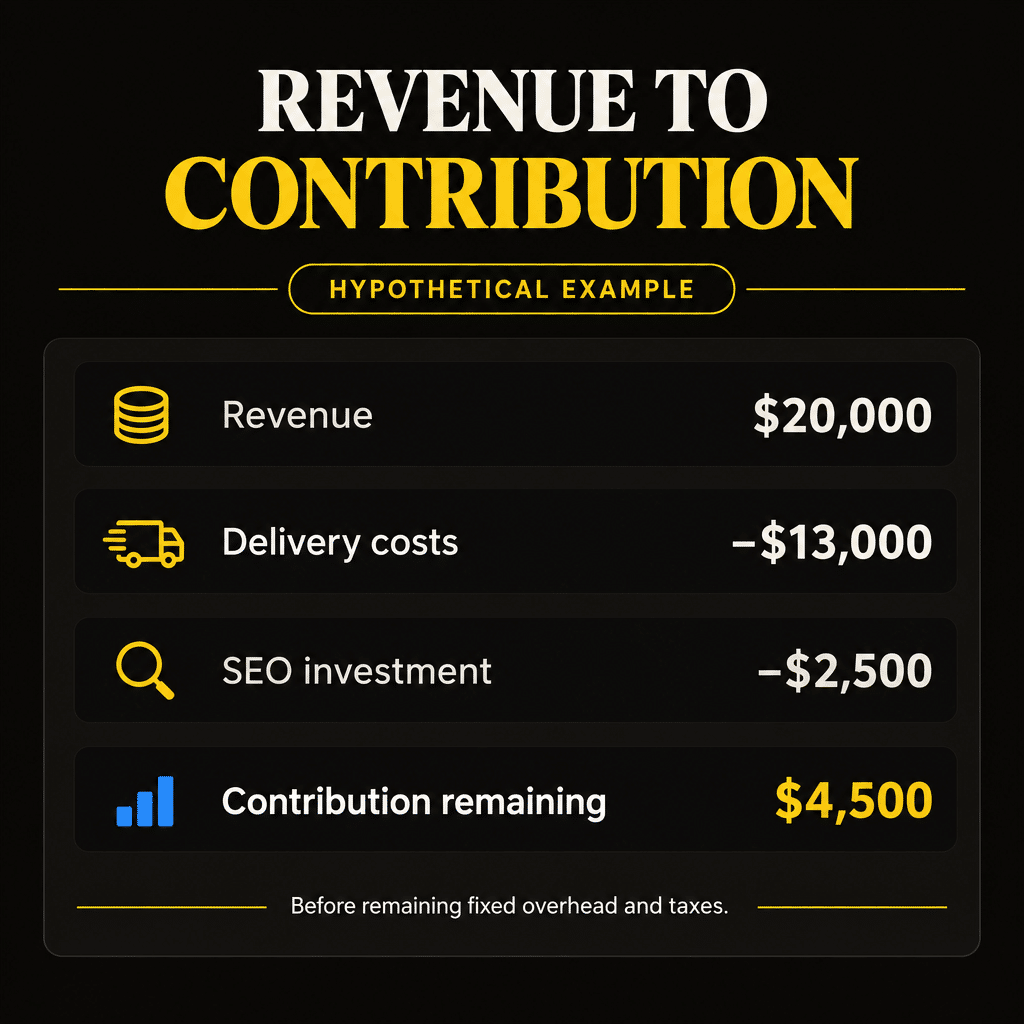
Here, job contribution means revenue less the relevant direct or variable costs of delivering the work. Include additional operating costs created by the growth when material. This estimate is before remaining fixed overhead and taxes; it is not a claim about your final net profit.
The SEO Lead Value Calculator can help organize lead-value assumptions. Replace assumptions with observed close rates and job economics as reliable data becomes available.
A Worked Example: Gutter Inquiries to Job Contribution
Consider a hypothetical gutter company reviewing a period in which it recorded 30 new inquiries associated with unpaid search discovery. This is an illustration, not a client result or performance forecast.
The company qualifies 20 inquiries as suitable opportunities. Ten become completed, paid jobs. For simplicity, the example assumes those ten jobs are additional business reasonably attributable to SEO and that average revenue and delivery costs are consistent across them.
| Item | Illustrative amount |
|---|---|
| Completed additional jobs | 10 |
| Average collected revenue per job | $2,000 |
| Total additional revenue | $20,000 |
| Direct delivery costs, including labor and materials | $13,000 |
| Job contribution before SEO investment | $7,000 |
| SEO investment for the matched measurement period | $2,500 |
| Estimated contribution after SEO investment | $4,500 |
| Estimated contribution-based SEO return | 180% |
The return calculation is ($7,000 − $2,500) ÷ $2,500 × 100. Comparing the $20,000 revenue total with the marketing bill would ignore the cost of doing the work.
The inquiry count also raises an operational question: why did 10 of the 30 inquiries fail qualification? If they mostly came from distant areas or involved unsuitable services, the targeting and page copy deserve attention. If suitable requests repeatedly stalled after estimates, review that handoff.
In a real evaluation, check whether jobs were additional to the existing baseline, how source attribution was assigned, and whether the period includes the relevant campaign costs. Cancellations, seasonality, prior investment, and longer sales cycles can change the result. Use consistent comparisons and disclose estimates.
Prioritize the Next Improvement by the Current Constraint
The right first action depends on what is preventing valuable work from reaching the schedule. A business with few relevant impressions has a different problem from one with strong inquiries and unanswered estimates.
Review the evidence before choosing the task:
- The desired service gets little relevant visibility: Check page relevance, indexing, competition, and the quality of the local business information.
- An existing service page gets impressions but few clicks: Review the searches it appears for and how its title and description communicate the offer.
- People visit but rarely inquire: Examine service clarity, proof, mobile usability, availability, and the contact process.
- Inquiries often fail qualification: Review the promoted services, territory, job requirements, and expectations the page sets.
- Qualified inquiries rarely become jobs: Inspect response, estimates, follow-up, pricing, and capacity.
- Booked work contributes little financially: Revisit job mix, delivery costs, travel, and acquisition cost.
An existing page close to useful visibility may warrant improvement before creating several new pages. A broken inquiry form may deserve attention before either. The SEO Opportunity Prioritization Worksheet helps compare the business value, effort, and feasibility of those choices.
Ask your provider to name the current constraint, explain the evidence behind it, and connect the proposed work to a measurable outcome. “We need more content” is incomplete until the team can explain which customer decision that content will support.
Prepare for Seasonal Demand and Changes in Capacity
The schedule you want six months from now may require different work from the schedule you need this week. SEO planning should account for that difference.
An exterior painting company needs time to improve relevant pages before homeowners begin choosing spring projects. An HVAC company needs accurate seasonal availability and clear service paths. A paving contractor may need to balance residential estimates with larger projects that have longer approval cycles.
Use your own inquiry and job history to identify those patterns. Work backward from when customers research and decide, allowing time for implementation and search performance to develop. No universal lead time makes every seasonal campaign succeed.
Capacity should also change the strategy. If crews are fully booked, the next opportunity may involve a better job mix, a higher-contribution service, or a future opening in the schedule. Agree on the business objective before expanding demand.
Keep AI Search Connected to the Same Business Facts
As you review discovery opportunities, include the AI search surfaces your customers use. Maintain a clear explanation of who you are, what you do, where you work, and how someone engages your services.
Google’s guidance for AI features says existing SEO fundamentals remain relevant to AI Overviews and AI Mode. Google does not require special AI markup or a separate technical optimization to appear in those features. Eligibility and visibility are not guaranteed.
For a home service business, I recommend strengthening the information a customer also needs: accurate services, clear local coverage, specific project evidence, and clear explanations of the estimate process. Other AI platforms have different systems, so evaluate their results separately.
Track mentions or citations as discovery signals. Then look for referrals, inquiries, and booked work where you can see those connections. An AI recommendation alone does not establish a financial return.
Build a Practical 30-Day Starting Plan
You don’t need to overhaul every page to start making better decisions. Choose one service and one manageable area, then review the full customer path.
Week one: establish the business target. Define the work you want, available capacity, typical contribution, suitable territory, and current inquiry-to-booking performance. Record the baseline and test the phone and form experience.
Week two: assess discovery and page relevance. Review the main service page, the searches already producing impressions, and the actual competing results. Check whether Google can access the page and whether business information matches your operations.
Week three: implement the highest-value correction. Improve the priority page, fix a contact problem, clarify a service limitation, or add relevant project proof. Choose the action based on the constraint you found. Give it an owner and completion date.
Week four: inspect early evidence and set the next cycle. Confirm that changes work and inquiries reach the right person. Review qualification, estimate progress, and the first available performance signals. Set the next priorities using what you learned.
Thirty days is a useful management cycle, not a promise that rankings or revenue will change within the month. Search and sales outcomes need time to show up. The immediate goal is to establish a defensible priority, complete the work, and make its effects easier to evaluate.
Home Services SEO Frequently Asked Questions
Should a home service company target its highest-priced service first?
Price is one input. Compare the contribution left after delivery costs, customer demand, crew capacity, and the effort required to gain relevant visibility. An expensive service with a weak margin or no available installation capacity may be a poorer starting point than work you can deliver efficiently now.
Can SEO help a contractor attract fewer unsuitable inquiries?
Clear service descriptions, accurate coverage, targeted keywords, and a well-designed inquiry process can help prospective customers quickly determine whether you are a fit. Track qualification outcomes to see whether changes help. No website can prevent every unsuitable inquiry, and aggressive filtering can also discourage good customers.
What should a home service company do if it is getting calls but cannot identify the source?
Begin recording source information alongside the inquiry and job outcome. Use available analytics, tagged links, call-source tracking, and a customer source question to build a consistent record. Preserve an unknown category when the evidence is incomplete, and keep duplicate contacts connected to one customer record.
Should the website promote services that are currently booked out?
Keep service and availability information accurate. You may still want inquiries for future openings, but make the expected timeline clear. If the current priority is filling another crew’s capacity or promoting a different service, adjust the marketing plan accordingly rather than promising availability the business cannot provide.
How can an owner judge SEO progress before many jobs have been completed?
Review whether the agreed work is complete, relevant visibility is improving, suitable inquiries are arriving, and those inquiries are progressing to estimates and bookings. Use these as early indicators. Continue tracking completed work, costs, and collected revenue so the eventual financial evaluation rests on realized outcomes.
Make Your Next SEO Decision About the Work You Want to Win
A useful home services SEO plan starts with a service worth selling and follows the customer through to a job worth delivering. It makes the priorities visible: the service, the territory, the page, the inquiry process, and the measurement needed to judge the result.
If you pay for SEO and still struggle to connect reports to your schedule, start with one service. Identify the current constraint and require a clear reason for the next investment.
Quickest Path to ROI SEO™ provides a business-first system for comparing search opportunities, sequencing work, and connecting visibility with measurable value. Use it alongside the companion tools to make your next priority easier to evaluate.
To review your home service company’s visibility, website, and path to booked work, explore Elite SEO Consulting’s home improvement SEO services or call 719-474-9404.