
More calls can make an SEO report look better while leaving a contractor’s schedule almost unchanged.
Some inquiries are unsuitable. Others fit the business but stall before an appointment, wait for an estimate, or disappear after a proposal nobody follows up. Those are different problems, and they need different fixes.
If your home service company gets calls but doesn’t book jobs, review the path from the first inquiry to the booking decision. Start with five handoffs: response, qualification, appointment, estimate, and follow-up.
The purpose is to identify where suitable opportunities stop progressing and why. Increasing traffic may help when demand is insufficient. It will not explain why an existing estimate request sat unanswered.
You don’t need an elaborate system to start. You need a reliable record, clear ownership, and enough detail to distinguish an unsuitable inquiry from an opportunity your team could have handled better.
Establish What Your Call Count Actually Measures
Before diagnosing the bookings, inspect the number labeled “leads.”
Does it represent unique prospective customers, connected calls, missed calls, clicks on a phone button, or every contact logged by the tracking system? Those measurements answer different questions.
A repeat caller, a current customer’s scheduling question, a supplier, and a new service request should not all inflate the same acquisition total. Keep legitimate requests that turn out to be unsuitable visible, but categorize them accurately.
Google Analytics allows you to mark important measured interactions as key events. That designation does not change what the event measures. If the underlying event records a phone-button click, it remains a click rather than proof of a connected call or booked job.
Google Search Console’s Performance report provides aggregate search data such as queries, pages, impressions, and clicks. It does not reveal what happened in an individual customer conversation.
Agree on the definitions before comparing results. Otherwise, the agency may report contacts while the owner evaluates booked work, and both may think they’re discussing the same number.
A useful starting record separates new inquiries, meaningful contact, service fit, appointments, estimates, and booking outcomes.
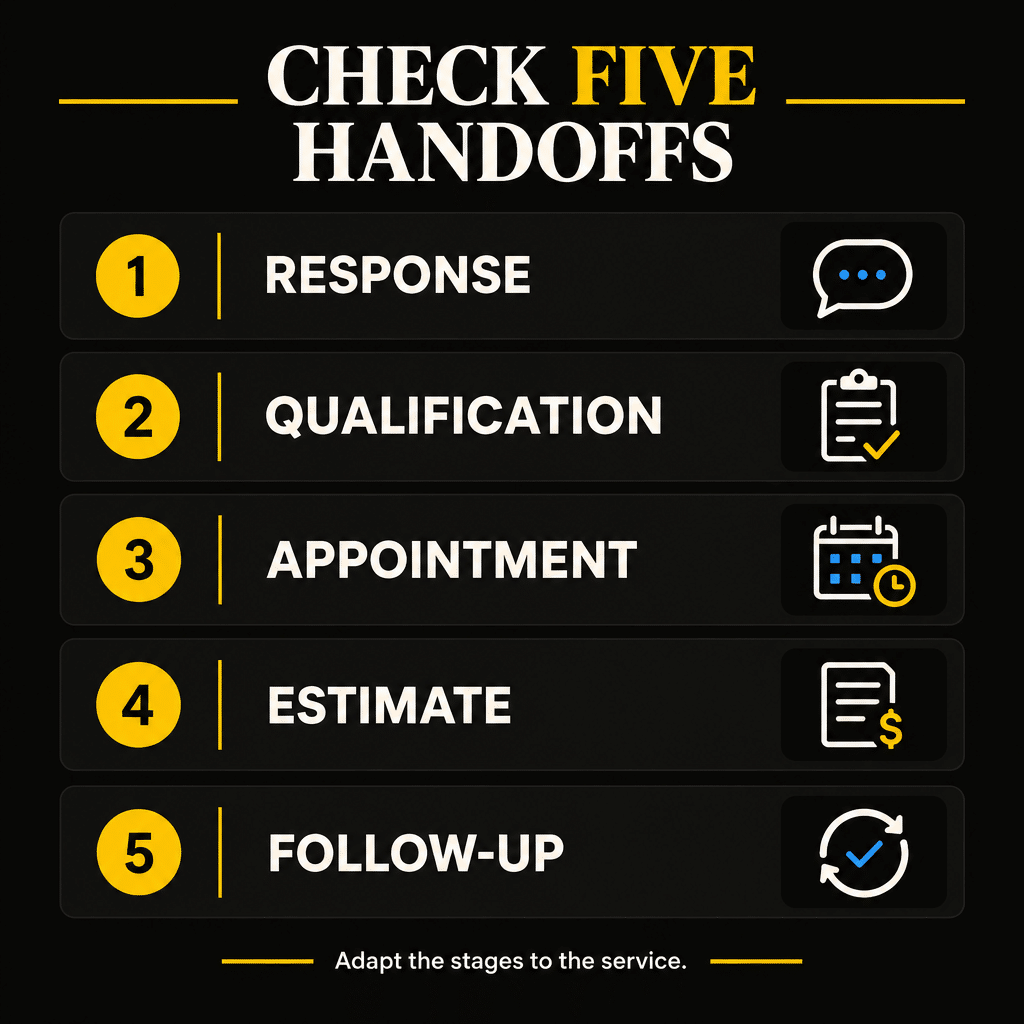
Handoff 1: Inquiry to a Useful Response
The first handoff is complete when the customer reaches someone who understands the request and can explain the appropriate next step.
An answered call is not always a useful response. An answering service may record a message while the person who can discuss the work never receives it. A form may display a confirmation while its notification goes to an unattended inbox.
Review how requests enter the business during normal operating hours and outside them. Check missed calls, callback notes, form destinations, and responsibility for messages.
Give the receiving person enough information to act. They should know the services offered, the coverage boundaries, and who can discuss scheduling or an estimate. They do not need to diagnose work outside their expertise.
Use a response standard your team can maintain. Define who responds, during which operating periods, and how requests awaiting contact remain visible. No universal response deadline fits every service and staffing model.
For an urgent request, the customer may need to discuss availability quickly. For planned work, the useful first response may explain the estimate process and arrange the next action. Either way, a vague promise that “someone will get back to you” leaves the handoff incomplete.
Record contact attempts separately from successful contact. A callback doesn’t prove the customer received the explanation.
The practical check is straightforward: take a recent suitable inquiry and trace who received it, what response occurred, and what the customer was told to do next.
Handoff 2: Response to a Qualified Request
Qualification establishes whether the request fits the company’s actual offer.
Confirm the service, property location, relevant scope, and timing. Identify any conditions that materially affect whether the business can accept the work. Let the customer describe uncertainty in ordinary language.
The goal is a sensible next step, not a perfect technical brief on the first call.
A gutter customer may know that something is leaking without knowing the cause or the appropriate repair. A homeowner planning painting may not know the exact area of every surface. Those gaps may require assessment rather than rejection.
Use clear reason categories for requests that cannot proceed. “Outside service area,” “service not offered,” and “requested schedule unavailable” describe different constraints. A general “bad lead” label hides the distinction.
If many inquiries request a service you do not perform, review the page and listing that attracted them. If the requested work fits but your schedule does not, the issue is capacity or expectations rather than necessarily poor search targeting.
Keep unreachable requests separate from confirmed unsuitable ones. You cannot establish service fit from a conversation that never happened.
The SEO Lead Value Calculator can help estimate qualified lead value from your sale, gross margin, and close-rate inputs. Those estimates become less useful when “qualified” includes every phone interaction.
Define qualification criteria consistently so the office, estimator, owner, and marketing team can interpret the same records. Revise them when the actual offer changes.
Handoff 3: Qualified Request to a Completed Appointment
A suitable request often needs an appointment, site visit, or assessment before the customer can receive a useful estimate.
Check how that next step is arranged. Has the customer confirmed the date? Does the estimator have the scope information? Does someone know how access will be handled? Can the customer reach the business if plans change?
Distinguish an appointment requested, an appointment scheduled, and an appointment completed. A calendar entry doesn’t prove the assessment happened.
Confirm the details that matter for the service: property location, relevant access arrangements, the purpose of the visit, and who needs to participate. Avoid making customers repeat the entire initial conversation because the notes never reached the estimator.
If an appointment changes, communicate the change and record the next action. A rescheduled visit should not quietly disappear into a list of completed appointments.
Review cancellations and missed visits with actual reasons where available. Customer timing, access issues, scheduling confusion, and contractor cancellations require different responses. Do not infer a reason merely because one seems plausible.
Some services can be booked or estimated without a separate site visit. Adapt the stage to your process. A remote scope review or direct scheduling conversation may be the appropriate next step.
The important question is whether the qualified request advanced to the assessment or appointment it genuinely needed. Don’t force every job through an unnecessary visit just to match a reporting template.
Handoff 4: Appointment to a Clear Estimate
A completed assessment has little commercial value if the customer doesn’t receive an understandable estimate.
Review whether the estimate was prepared, sent to the correct destination, and made accessible. “Estimate finished” and “customer received the estimate” are different facts.
For work requiring a proposal, explain the scope accurately. Clarify what is included, relevant exclusions, any assumptions that still need confirmation, and how the customer can ask questions or proceed.
The customer should understand what the quoted work addresses. A price without scope can make comparison difficult. A long technical document can create the same problem if the homeowner cannot find the decision they need to make.
Set a realistic expectation for when you’ll provide the estimate, then keep outstanding estimates visible. If the scope requires more information, record the dependency and explain the delay to the customer.
Do not assume that an email send log proves understanding. When appropriate, offer a conversation to review the proposal and verify that the customer can open it.
Check whether the proposal matches the original inquiry and actual assessment. A homeowner requesting an isolated repair should not receive an unexplained full replacement proposal. If the recommended scope changes after assessment, explain the reasoning accurately.
For straightforward jobs quoted and booked during a call, record that direct path. Your estimate process should suit the work rather than expand it unnecessarily.
The practical review is to select several completed assessments and inspect the actual customer-facing estimates, their delivery dates, and the next steps offered.
Handoff 5: Estimate to a Booking Decision
Follow-up should help the customer decide on the proposed work.
A useful message confirms the proposal arrived, answers a relevant question, and identifies the next action. Repeatedly asking “Have you decided?” helps little when the customer still doesn’t understand the scope.
Agree on the follow-up approach during the conversation where possible. Use the customer’s preferred contact route, respect a declined offer, and keep the frequency appropriate to the service and buying process.
Give someone ownership of every open proposal. Record the next action and when it is due. If several people can follow up, the record should prevent duplicated or contradictory messages.
Use accurate statuses. “Proposal sent,” “customer considering,” “revision requested,” “accepted,” and “declined” are different stages. A lack of response does not prove the customer chose a competitor.
Define what counts as booked in your business. It may involve an accepted proposal and a confirmed scheduling step, or another genuine commitment required by your process. An encouraging conversation alone is not a booking.
Keep booked, completed, and paid work separate. Cancellations or scope changes may affect the final business outcome.
Also review why proposals are declined when customers provide a reason. Price can matter, but so can timing, scope, communication, or a decision to postpone the project. Record the explanation without assigning a motive the customer never stated.
Give Each Opportunity an Owner and a Next Action
These handoffs can involve several people, but the customer should not have to manage the transfer.
Use one record for each new opportunity. A spreadsheet, customer-management system, or job-management platform can work when the team uses it consistently.
Keep the record useful enough to support action:
| Record field | Why it matters |
|---|---|
| Initial inquiry date | Establishes the group and starting point |
| Requested service and location | Supports fit and targeting review |
| Source information, when known | Connects discovery with outcomes without inventing attribution |
| Current stage | Shows what has actually happened |
| Responsible person | Identifies who owns the next step |
| Next action and due date | Makes pending work visible |
| Outcome and known reason | Supports diagnosis without guessing |
| Related appointment or estimate | Preserves context across the handoff |
When the phone call and form concern the same project, connect them to the same opportunity rather than counting two new customers. Keep distinct projects distinguishable when an existing customer requests new work.
Use the SEO ROI Tracking Worksheet to help organize investment and outcome summaries alongside your detailed inquiry records. A worksheet doesn’t automatically show which source caused a booking.
Ownership matters more than the tool’s sophistication. A queue titled “Sales Team” is less useful when everyone assumes someone else is handling the estimate.

Trace One Group of Inquiries Through the Whole Process
Compare the stages for the same group of inquiries. This makes the pattern easier to interpret than mixing this month’s calls with last month’s estimates and this week’s bookings.
Consider a hypothetical painting company reviewing forty unique new inquiries for one planned service. The following numbers are a snapshot at its review date, not client results, benchmarks, or a forecast.
| Stage reached by the review date | Opportunities |
|---|---|
| New inquiries | 40 |
| Meaningful contact established | 32 |
| Confirmed suitable requests | 24 |
| Required assessment completed | 18 |
| Estimate provided | 15 |
| Job recorded as booked | 6 |
The snapshot shows where to investigate. It does not prove that every difference between rows represents a lost opportunity.
Eight inquiries had not reached meaningful contact. Check contact attempts and current status. Among the contacted inquiries, eight were not recorded as suitable; inspect whether they were unsuitable or still awaiting qualification.
Six suitable requests had not completed an assessment. Review scheduling and pending visits. Three completed assessments had no estimate recorded. Check whether information was missing or the estimate was overdue.
Nine estimates had no recorded booking. Some customers may still be considering the work. Others may have declined, requested revisions, or become unreachable. Separate those statuses.
At that point, six bookings represent 15% of all forty inquiries and 25% of the twenty-four confirmed suitable requests. Those are different denominators. Neither percentage is an eventual close rate while opportunities remain open.
The snapshot alone does not tell you which correction will create the most value. The underlying records provide that evidence.
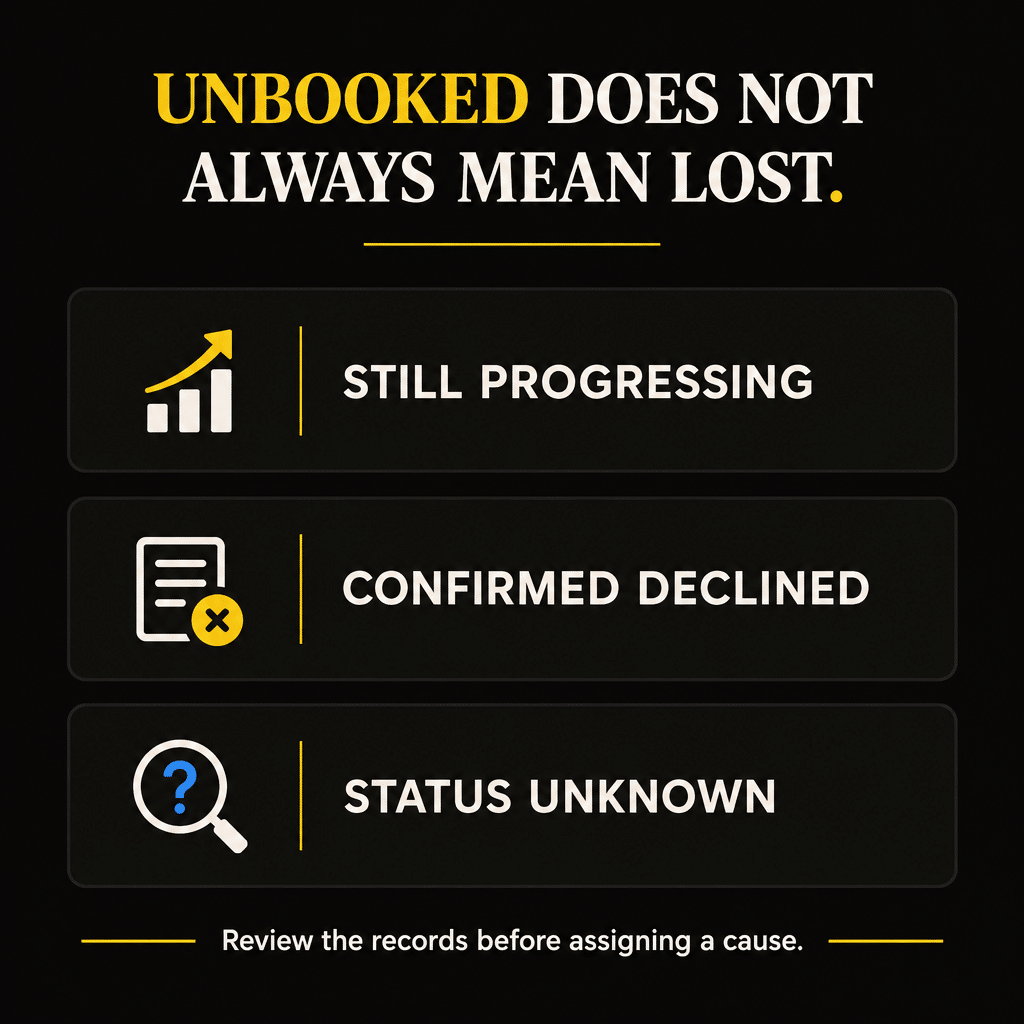
Fix the Observed Constraint Before Expanding Demand
Choose the first correction from the evidence and the business context.
A broken notification route needs attention even if the chart makes another stage appear to have a larger numerical gap. Unsuitable inquiries may require clearer targeting or scope. Unprovided estimates may require ownership and production changes.
Compare the work required, the suitable opportunities affected, and the likely business value. Use the SEO Opportunity Prioritization Worksheet to organize that decision without pretending uncertain outcomes are precise forecasts.
For the hypothetical painting company, suppose the record review shows that several completed assessments are waiting because no one owns estimate preparation. Assigning an owner and a realistic delivery process would address an observed constraint.
That does not establish how many additional customers will book. It creates a clearer path for suitable customers to receive the decision information they need.
Coordinate the correction with marketing. If inquiries consistently request unavailable timing, review availability language. If they request unsupported services, review the offer and the pages attracting them. If suitable proposals stall, inspect the proposal and follow up rather than rewriting the entire keyword plan.
Make one useful change, record when it occurred, and review the relevant evidence after the process has had time to operate.
Review Progress Without Turning It Into a Blame Exercise
The purpose of this review is a more dependable customer process.
Bring the office, estimator, owner, and marketing team into the relevant findings. Use actual records and agree on what is known, what remains uncertain, and who will resolve it.
Distinguish an operating problem from an individual failure. An employee cannot reliably prepare an estimate without scope information or make a callback if messages aren’t delivered.
Review handoffs at an interval that fits the service’s volume and timing. Open opportunities may need more frequent attention than the broader performance summary.
Compare similar services and inquiry groups. A quick repair and a substantial planned project can follow different paths and have different decision timelines. Set expectations accordingly instead of imposing one close-rate target on the entire company.
Track whether the correction changed the intended behavior: messages received, qualified requests scheduled, assessments completed, estimates delivered, and open proposals assigned. Then evaluate bookings and realized work as those opportunities develop.
A better process can improve the chances of winning suitable work. It still doesn’t guarantee every qualified customer will buy.
Frequently Asked Questions
How should I classify a caller my team never reaches?
Record the request as awaiting contact or unreachable according to the actual attempts and current status. Keep service fit unknown unless reliable information establishes it. Do not label the caller unsuitable merely because the conversation never happened.
Should a canceled estimate appointment count as a lost job?
Record the cancellation and any known reason, then distinguish rescheduled, postponed, and closed requests. A canceled appointment is not necessarily a declined project. Count bookings and final outcomes according to what actually happened.
Is there one good booking rate for every home service company?
No single rate answers that question. Define the denominator, service, source, review period, and buying process first. Compare your own consistent records and project economics. You can’t meaningfully compare a rate based on all contacts with one based only on qualified opportunities.
Should I lower prices if customers do not accept my estimates?
Investigate before changing prices. Review the scope, delivery, customer questions, timing, and stated reasons for declining. Check the economics of the work as well. A discount may not fix a missing estimate, an unclear proposal, or a scheduling mismatch.
Can automated follow-up replace a person reviewing open estimates?
Automation can support reminders and consistent messages, but someone still needs to review replies, scope changes, customer preferences, and decisions. Assign ownership and stop messages when their premise is no longer accurate. A scheduled message is not proof that the customer’s question was answered.
Make the Next Step Dependable
When calls arrive, but jobs do not, inspect the five handoffs before assuming the only solution is more traffic.
Confirm that suitable customers receive a useful response, reach the right next appointment, receive a clear estimate, and have a supported path to a booking decision. Keep pending, unsuitable, declined, booked, and completed work distinguishable.
For a broader method of choosing SEO and conversion work around business outcomes, explore Quickest Path to ROI SEO™. Use it to identify the improvement that deserves your next investment and connect visibility with the customer process that follows.
If you need help reviewing your contractor website and the path from inquiry to booked work, see Elite SEO Consulting’s home improvement SEO services or call 719-474-9404.