
You receive a marketing proposal with three services: SEO, AEO, and GEO. Each promises better visibility. Each has a price. The practical question is which work will help your business reach customers and produce a return.
The terminology can make that decision harder than it needs to be. A clearer service page, for example, might support all three approaches. Paying for three packages doesn’t necessarily mean you are getting three distinct sets of improvements.
Start by understanding what the terms describe. Then examine the customer opportunity, the condition of your website, and the actual work proposed. Those details give you a much stronger basis for allocating your budget.
What Is the Difference Between GEO, SEO, and AEO?
SEO improves a website’s visibility in search engines. AEO commonly describes work aimed at direct answers, including featured snippets and conversational responses. GEO focuses on a business’s presence in AI-generated answers. Their meanings overlap and vary across providers. Prioritize based on customer demand, website readiness, and measurable business value.
These are useful working definitions. AEO and GEO are industry terms, and agencies may use them differently. Ask a provider to name the search experience and deliverables behind each label.
SEO: Search Engine Optimization
SEO helps search engines discover and understand your pages and helps people find relevant information through search. Work can include technical corrections, service-page improvements, internal linking, useful content, and accurate local business information.
For a business owner, the commercial purpose is to connect relevant search demand with pages that help potential customers evaluate your offer. Rankings and clicks help explain discovery; qualified inquiries and completed sales help explain business value.
SEO also remains relevant inside Google’s AI search experiences. Treating it as a practice confined to a list of blue links creates an incomplete picture.
AEO: Answer Engine Optimization
AEO commonly refers to making information useful for systems that present direct answers. Depending on the provider, that can include featured snippets, voice responses, or conversational answers.
Practical work might involve answering a customer question clearly, organizing a comparison, explaining a process, or supplying verifiable supporting information. A concise answer can help someone understand the issue before reading the details.
However, there is no special setting that makes a page a Google featured snippet. Google’s featured-snippet guidance explains that its systems choose whether to feature a page. Clear formatting is an editorial choice, not a promise of selection.
GEO: Generative Engine Optimization
GEO focuses on how a business and its information appear in generated answers. This can include a brand mention, a website citation, or a recommendation for a specific need.
The work may include checking platform access, correcting business descriptions, strengthening relevant evidence, and testing customer questions under comparable conditions.
Define the platform being evaluated. Google AI Mode and ChatGPT search have different systems and controls. A successful observation in one does not prove visibility in the other.
Compare the Surfaces, Deliverables, and Metrics
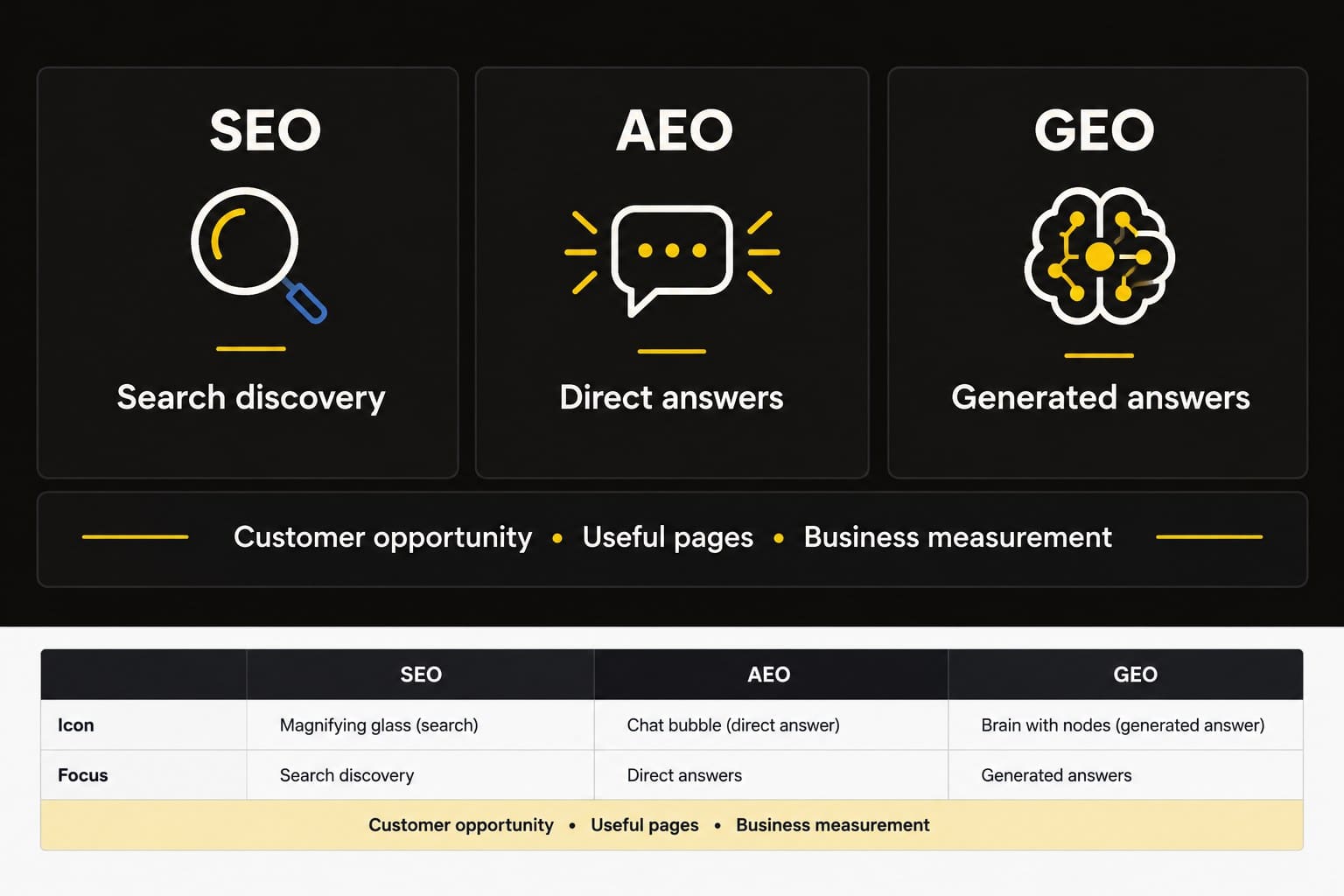
This comparison connects a service label to observable work. These categories overlap; they are not three separate stages a customer must pass through.
| Approach | Common focus | Example deliverables | Useful visibility records | Business outcomes to investigate |
|---|---|---|---|---|
| SEO | Search-engine discovery, including relevant search features | Access review, service-page improvements, internal links, local profile corrections | Indexing, relevant impressions, rankings, clicks | Qualified inquiries, sales, gross profit |
| AEO | Clear answers in snippets and conversational experiences | Direct explanations, comparison tables, process steps, evidence improvements | Observed answer appearances, source attribution where available, resulting visits | Useful customer actions and later sales outcomes |
| GEO | Business or content presence in generated answers | Platform-specific access checks, identity corrections, buyer-question testing | Mentions, citations, recommendation accuracy, identifiable referrals | Qualified leads, customer-reported influence, completed sales |
A citation is different from a recommendation. An educational article can support an answer without the answer endorsing your company. Likewise, a named business may receive no link.
Ask reports to preserve those distinctions. A column called “AI visibility” needs a definition before it can guide spending.
What the Three Approaches Share
Many useful improvements support several discovery experiences because they make the underlying information easier to find, understand, and evaluate.
A prospective customer benefits from a service page that explains the offer, identifies the service area, answers meaningful questions, and provides credible proof. Those improvements also give search and answer systems clearer material to work with.
For Google specifically, its guidance on AI features says existing SEO practices remain relevant to AI Overviews and AI Mode. A supporting page must be indexed and eligible to appear in Search with a snippet. Google does not require special AI files or a separate schema type for these features. Eligibility does not guarantee inclusion.
Use that guidance to evaluate a proposal. If an agency offers a separate Google AI package, ask what additional work it contains beyond the SEO work already included.
Other platforms need their own review. OpenAI’s crawler documentation, for example, distinguishes OAI-SearchBot for search from GPTBot for potential training use. Their controls are independent. A training-access decision should not automatically determine your search-access decision.
The shared foundation is useful, accessible, accurate information. Platform-specific work begins where the requirements, observations, or customer behavior actually differ.
When SEO Foundations Deserve the First Investment
Foundational work deserves priority when a documented problem blocks a valuable customer opportunity.
Perhaps an important service page is unintentionally excluded from indexing. Perhaps customers cannot tell whether you serve their location. Perhaps the website attracts visitors, but the mobile inquiry form fails.
Repairing the form is a conversion task. The access correction is a technical search task. Both may deserve attention before an expanded AI-visibility campaign because they address problems close to a customer outcome.
Review one commercially important page across four questions:
- Can customers and relevant search systems access it?
- Does it explain the service, location, and intended customer clearly?
- Does it provide enough evidence to support a decision?
- Can a suitable customer take the next step easily?
Use the AI Search Readiness Checklist to organize the review. Record the specific weakness, the proposed correction, and who will implement it.
Avoid treating every audit finding as equally urgent. A cosmetic issue on a low-value page and a broken estimate form on your main service page have different business consequences.
When Targeted Answer and AI-Visibility Work Makes Sense
Targeted work is easier to justify when the website supports the customer journey, and you have a specific question to investigate.
For AEO, the opportunity might be an important question your page answers poorly. A buyer comparing two services may need a clear explanation of suitability, limitations, and cost factors. Improving that comparison is useful even if it never becomes a featured snippet.
For GEO, the opportunity may be repeated, relevant observations that show an inaccurate business description or a gap in available information. Test questions that reflect real buying decisions rather than an endless set of flattering prompts.
Keep a manageable record:
- The customer question and why it matters.
- The platform and search mode used.
- The date, location context, and other relevant conditions.
- Whether the business was mentioned, cited, or recommended.
- Whether the description and cited sources were accurate.
- The change proposed and the next review point.
Repeated observations help you evaluate consistency. They don’t measure how many customers ask that question, and testing alone doesn’t improve visibility.
Decide in advance what the evidence will support. A correction may justify keeping an accurate business description. Commercial expansion requires stronger evidence about customers and outcomes.
A Practical Priority Matrix for Business Owners
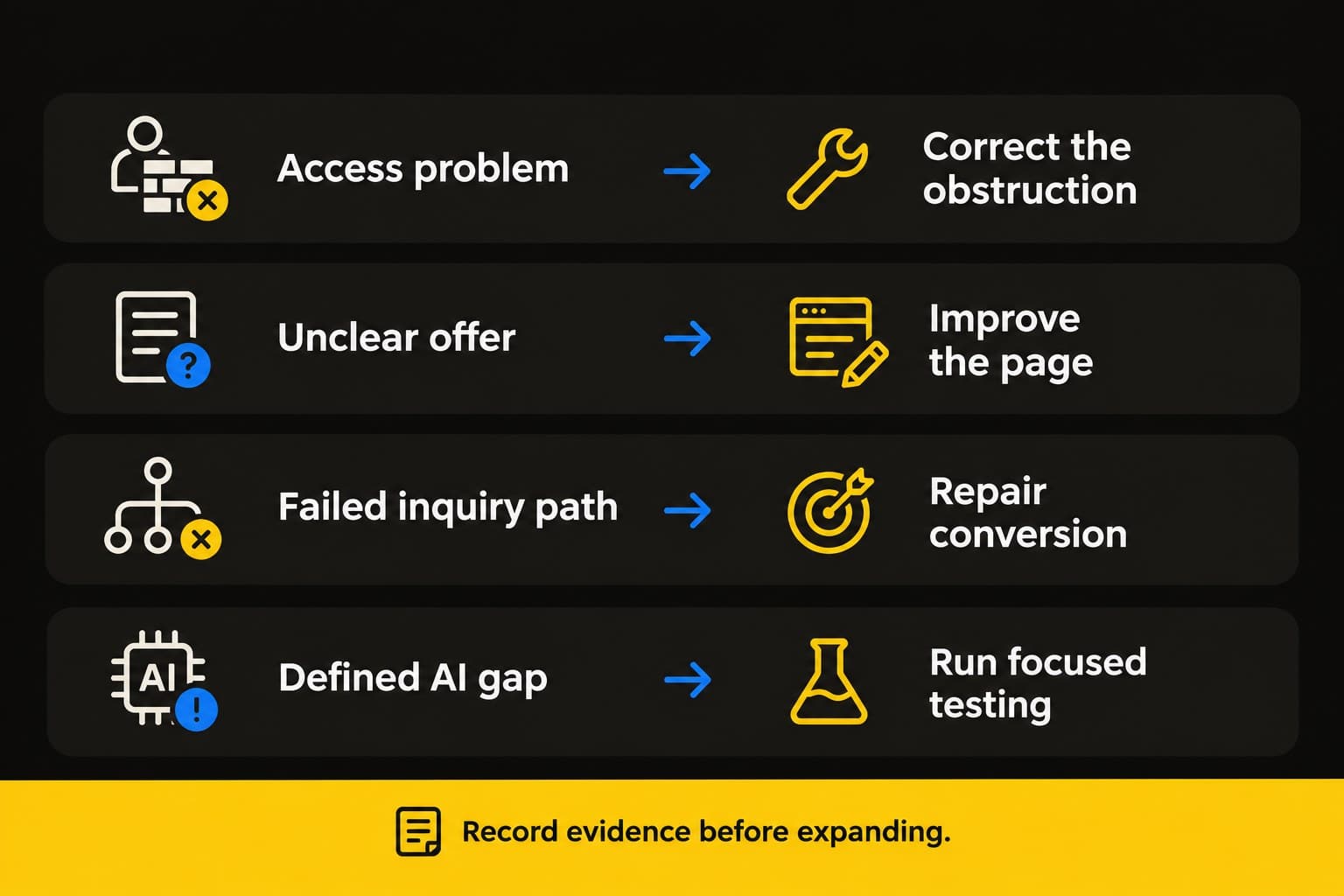
Use this matrix to choose an initial task. It is a decision aid, not a universal spending formula.
| What you observe | First priority | Why it deserves attention | Evidence to review afterward |
|---|---|---|---|
| A valuable page has an unintended access or indexing problem | Correct the documented obstruction | The page needs a fair opportunity to be discovered | Access, indexing, and relevant discovery records |
| Buyers struggle to understand an offer or comparison | Improve the existing explanation | The page is leaving an important decision unanswered | Customer feedback, useful actions, lead quality |
| Useful traffic arrives but the inquiry path fails | Repair the conversion path | The business is losing opportunities after discovery | Form function, valid inquiries, response and sales records |
| Relevant AI answers repeatedly misdescribe the business | Review source facts and platform access; retest | Incorrect information can confuse customers | Accuracy across comparable observations |
| Pages are useful and measurable, but a meaningful AI discovery gap remains | Run a focused GEO test | A defined gap gives the work a purpose | Mentions, citations, referrals, and customer outcomes |
| Reports show more visibility but no clear business connection | Improve measurement | Spending decisions need better outcome evidence | Qualified leads, completed sales, costs, attribution limits |
The most urgent task might cross service labels. That is normal. Assign it one owner and one implementation scope so the same improvement is not counted several times.
Apply the Quickest Path to ROI Areas to Your Decision
The Quickest Path to ROI SEO™ book provides the broader business-first system behind these decisions. Its six connected areas help turn a terminology debate into an actionable priority.
Revenue opportunities: Identify a profitable service or product and a relevant customer question. Use customer conversations and available search evidence to establish the opportunity.
Priority pages: Choose the page that should help that customer understand the offer and act. An existing service page may be the strongest starting point.
Constraints: Find the weakness that limits progress: access, unclear information, missing proof, a difficult inquiry process, or inadequate measurement.
Authority: Add evidence appropriate to the decision. Relevant project details, accurate credentials, and honest customer feedback can help someone evaluate your claims.
Measurement: Record discovery separately from visits, qualified inquiries, sales, and profit. Preserve customer-reported AI influence without assigning every unexplained visit to AI.
Expansion: Use the findings to choose the next investment. Improve a related page or extend testing when the evidence supports it.
Consider a hypothetical painting company comparing an SEO retainer with a separate GEO package. Its commercial painting page lacks project examples and clear information about scheduling around business operations.
The first project could improve that page by adding verified examples and testing the quote process. The team could also establish an AI-answer baseline for relevant commercial painting questions. Those activities share a customer opportunity while remaining distinct deliverables.
The company should record who performs each task and what each package covers. This is an illustration of prioritization, not a client result or a predicted return.
How to Evaluate a Proposal Without Buying Overlapping Work Twice
Ask the provider to translate each service into a written scope. You should be able to identify the page or system being changed, the implementation owner, and the evidence used to review the work.
Useful questions include:
- Which customer need and search experience does this task address?
- Is the same page improvement already included elsewhere?
- Does the fee cover implementation, testing, reporting, or all three?
- What platform-specific work is additional?
- What baseline will be recorded before changes?
- How will you separate visibility from qualified leads and sales?
- When will we review whether the next investment is justified?
A separate fee may be reasonable when it buys additional research, platform access review, structured testing, or implementation capacity. The scope should make that visible.
“Optimize for AI” is a direction. It still needs a work order.
Frequently Asked Questions
Is AEO Only About Voice Search?
No. AEO is commonly used for work aimed at direct answers across several experiences, including featured snippets and conversational responses. Voice search is one possible context. Ask the provider to specify which surface it means and how it will observe results.
Should an Agency Charge Separately for GEO?
A separate charge can be reasonable for clearly defined additional work, such as platform-specific access checks or repeatable buyer-question testing. Compare the deliverables with your existing SEO scope. The same page rewrite should not appear as two separately billed tasks unless the additional work is explained.
Does Every GEO Task Require a New Page?
No. Correcting existing business information, improving a useful service page, or reviewing crawler access may address the documented problem. Create a new page when it serves a distinct customer need and has a clear role in the website. Avoid duplicating an existing answer merely to add a GEO label.
Can a Business Succeed in SEO and Still Be Absent From AI Answers?
Yes. A strong search position does not establish inclusion in a particular generated answer. Questions, sources, platform behavior, and testing conditions differ. Review comparable observations and relevant access controls before interpreting absence as evidence that your SEO program has failed.
How Do I Compare Proposals Using Different Terminology?
Compare the work: customer questions, target pages, implementation scope, platform coverage, measurement, ownership, and cost. Ask each provider to identify overlapping tasks and genuinely additional services. This lets you evaluate proposals on the same business basis even when their labels differ.
Choose One Useful Improvement First
Review a page tied to a valuable customer opportunity. Identify its most consequential weakness, assign the improvement, and establish a review point. The AI Search Readiness Checklist can help you begin.
If you need help evaluating an SEO, AEO, or GEO proposal, Elite SEO Consulting can review the proposed work against your website, customer opportunities, and measurement needs. Call 719-474-9404 to discuss where your next investment can be most useful.