
You ask an AI assistant about your business and receive an accurate description. That tells you something useful about that answer. It leaves a bigger question open: would a potential customer discover your company when searching for the service they need?
An AI visibility audit investigates that question through recorded tests, source checks, and a separate review of your website. Its value comes from the evidence it preserves and the decisions it helps you make.
Before approving more content or another marketing package, establish where the business appears, how accurately it is described, which pages are cited, and what gaps deserve attention. A useful audit gives you a baseline and an actionable priority list.
How Do You Audit AI Search Visibility?
Define relevant buyer questions, choose the AI search surfaces to test, and record comparable repeated answers. Log business mentions, citations, recommendations, and factual errors separately. Inspect cited sources, then compare observed presence with website access and content readiness. Prioritize documented gaps by customer relevance, business value, effort, and confidence in the fix.
Use six steps:
- Define the audience, offer, location, and test questions.
- Select the search surfaces and record conditions.
- Save repeated answers and classify each observation.
- Review website readiness separately.
- Inspect the cited sources and relevant competitors.
- Turn the findings into owned tasks and review dates.
1. Define the Audience, Service, and Test Questions
Start with an offer your business wants to sell and a customer it can serve. A national software provider and a local gutter installer need different test questions and location assumptions.
Record the audit’s scope in one sentence: “Review discovery for gutter replacement among homeowners in our genuine service area.” Add any important limitations, such as excluding commercial projects or locations outside your operating area.
Build questions from customer conversations, estimate requests, common objections, and available search data. Group them by the decision they support.
| Question group | Illustrative question | What the test investigates |
|---|---|---|
| Provider discovery | “Which companies install replacement gutters in [city]?” | Whether the business appears as a relevant option |
| Suitability | “When should a homeowner replace gutters instead of repairing them?” | Whether useful information from the business is cited |
| Comparison | “What should I compare in gutter replacement estimates?” | Whether content helps with a buying decision |
| Branded accuracy | “What services does [business name] provide in [city]?” | Whether a named business is represented correctly |
Keep branded questions in a separate group. Naming the company tests a different situation from an unfamiliar customer looking for a provider.
For an initial pilot, I recommend 15–25 unbranded buyer questions, plus a small separate set of branded accuracy checks. Where feasible, repeat each buyer question three times per surface. This is an editorial audit design, not a platform standard or a statistically representative sample.
Reduce the scope if you cannot inspect the answers carefully. Preserve the exact question set so later comparisons have a stable starting point.
2. Choose Platforms and Record Test Conditions
Name the actual search experience. Don’t treat ChatGPT search, Google AI Overviews, Google AI Mode, and Microsoft Copilot as one interchangeable platform.
Choose initial coverage based on customer relevance, available access, and the time you can devote to review. Document the reason for each selection and the surfaces omitted.
OpenAI’s search guidance explains that location and memory can affect search context and that cited sources can be incomplete or incorrect. Include the relevant city explicitly and inspect the evidence rather than assuming every answer reflects the same conditions.
Record:
- Date, time, exact prompt, and run identifier.
- Platform, product surface, and displayed model or mode where available.
- Whether you used web search, didn’t use it, or are uncertain.
- City and relevant location assumptions.
- Fresh conversation versus an existing conversation or follow-up sequence.
- Account and personalization context, as far as you can document it.
Use fresh conversations for independent baseline questions. If you are auditing follow-up behavior, define the sequence and preserve the earlier questions as part of the test.
Record unavailable features, failed runs, and absent AI Overviews explicitly. An overview that did not appear is different from an overview that appeared without your page.
Comparable conditions make your records more useful. They cannot make a changing AI system perfectly reproducible.
3. Log Mentions, Citations, Recommendations, and Errors
Save the complete answer and its source links before summarizing it. A screenshot can help document presentation; answer text and URLs make later inspection easier.
Classify the observations consistently:
| Observation | Working definition | Detail to preserve |
|---|---|---|
| Business mention | The answer names your business | Exact name and description |
| Own-site citation | Your webpage appears as a supporting source | URL and claim it supports |
| Third-party reference | An outside source supplies information about the business | Source URL and relevant information |
| Recommendation | The answer presents the business as an option for the stated need | Wording, customer fit, and limitations |
| Factual error | A verifiable business fact is incorrect | Wrong statement, correct fact, and evidence |
A business can be mentioned without its website being cited. An educational page can be cited without a provider recommendation. Record both situations accurately.
Check identity carefully. A similarly named company in another location should not count as your business. A recommendation for a service you do not offer is an accuracy problem even if the name is correct.
A Reusable Audit Log
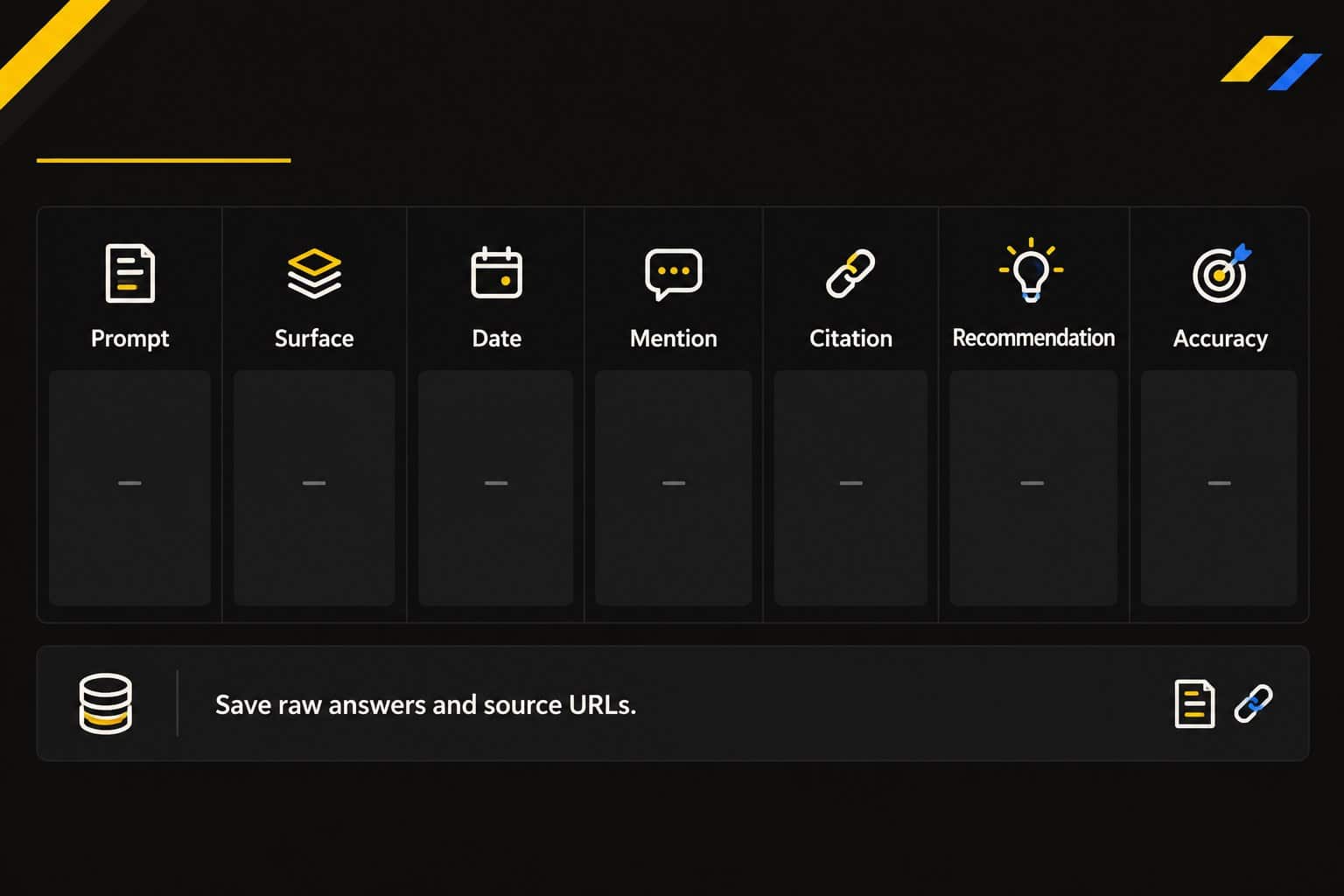
Use one row per run. The following fields form a blank template, not a record of claimed results.
| Field | Entry to make |
|---|---|
| Query ID and group | Stable identifier; discovery, suitability, comparison, or branded accuracy |
| Exact question | Complete wording, including location |
| Surface and conditions | Platform, mode, search status, conversation and personalization context |
| Run and timestamp | Repeated-run number and date/time |
| Answer saved | File or record containing the full response |
| AI answer available | Yes, no, unavailable, failed, or uncertain |
| Business mentioned | Yes/no; note identity ambiguity |
| Own-site citation | Yes/no and exact URL |
| Relevant third-party source | URL and verified connection to the business |
| Recommended | Yes/no and fit for the stated need |
| Accurate | Correct, incorrect, mixed, or not assessable |
| Competitors observed | Names and sources, without inferring why they were selected |
| Finding and next check | Evidence-backed issue or hypothesis to investigate |
If you calculate a rate, define the numerator and denominator. Separate branded tests, failed runs, and no-answer conditions rather than silently removing them. State the surface, question set, date range, and sample size.
For example, an illustrative result of six mentions in 30 completed unbranded tests is a 20% observed mention rate for that sample. It is not a share of all AI users, a traffic estimate, or a sales forecast.
4. Separate Website Readiness From Observed Visibility
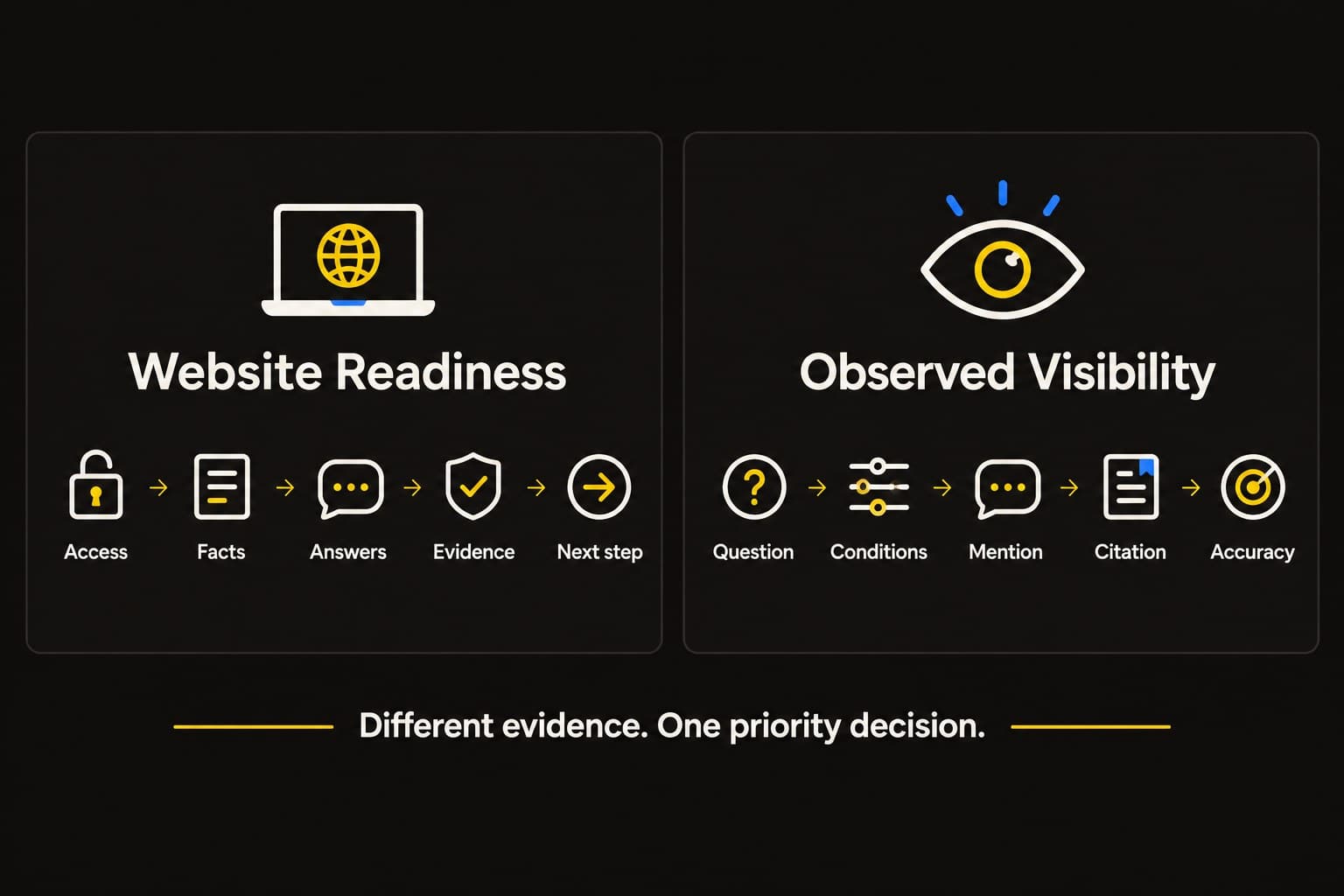
A website review and a prompt-based audit examine different evidence. Keep their findings in separate sections of the report.
Website readiness reviews the information and systems you can inspect: relevant access, business facts, useful answers, supporting evidence, internal links, and the customer’s next action.
Observed visibility records what a particular AI experience returned under stated conditions. It can establish that a page was cited in that answer; it cannot establish universal exposure.
| Finding | What it supports | What remains unknown |
|---|---|---|
| A page appears accessible in the relevant checks | No obstruction found in those checks | Whether it will be selected in a generated answer |
| The website has clear business information | A documented readiness strength | How each platform will represent it |
| A page is cited in a saved answer | Inclusion in that observation | How often customers encounter that answer |
| The business is absent from a test | Absence in that observation | The cause, without further investigation |
For Google’s AI features, its guidance requires a supporting page to be indexed and eligible for a Search snippet. For ChatGPT, OpenAI’s crawler documentation distinguishes search access from training access. Review the relevant controls with the person responsible for the website.
Use the AI Search Readiness Checklist alongside the separate answer log. A readiness score should not be presented as a probability of recommendation.
5. Inspect Cited Sources and Relevant Competitor Coverage
Open the cited pages and inspect the information supporting each meaningful claim. Check whether the source concerns the right business, location, service, and timeframe.
Look for a specific information gap. A cited competitor may explain a suitability issue your page leaves unanswered. An outside directory may contain an old phone number. An educational source may answer the question without recommending any provider.
Those observations suggest different next actions. They do not prove that a particular link, phrase, or page structure caused selection.
Document the distinction between a finding and a hypothesis:
- Finding: Your service page omits a question customers repeatedly ask.
- Hypothesis: A clearer answer may make the page more useful during that decision.
- Proposed action: Add an accurate explanation with relevant evidence.
- Review: Check the published change, repeat comparable tests, and investigate customer outcomes.
When available, Bing Webmaster Tools’ AI Performance reporting can supplement the audit with citation and page-level records across supported experiences. Microsoft explains that these measures do not establish placement in an individual answer and that grounding queries represent a sample. Record the report’s date range and coverage separately from your manual tests.
Avoid treating a competitor’s position in one generated list as a stable ranking. Preserve the wording and evaluate whether the company actually fits the question.
6. Turn Findings Into a Prioritized Task List
The audit should end with decisions a business can implement. Rank findings by customer relevance, business consequence, practical effort, and confidence that the proposed change addresses the documented issue.
The Quickest Path to ROI SEO™ book supplies the broader system. Apply its six connected areas to the audit:
- Revenue opportunities: Identify the offers and buyer questions worth investigating.
- Priority pages: Map those questions to useful pages and appropriate next actions.
- Constraints: Document the specific access, identity, explanation, or conversion weakness.
- Authority: Record the supporting evidence and credible sources the customer needs.
- Measurement: Retain raw observations alongside inquiries, sales, and costs.
- Expansion: Choose further work when evidence and another worthwhile opportunity justify it.
Use a short action register:
| Finding | Evidence | Action | Owner | Completion check | Review date |
|---|---|---|---|---|---|
| Incorrect business fact | Saved answer and verified current fact | Correct controlled sources; request outside corrections | Named person | Source information updated accurately | Set after implementation |
| Useful page lacks an answer | Customer question and page review | Improve the existing explanation | Content owner and service expert | Accurate answer and proof published | Set for comparable retesting |
| Inquiry path fails | Reproducible form test | Repair the customer action | Website administrator | Business receives a valid test inquiry | Immediate verification and later inquiry review |
These rows illustrate task types; they are not findings about a specific company.
Set implementation checks separately from visibility checks and financial reviews. You can test a repaired form immediately. A sales assessment should allow enough time for the normal customer cycle.
Record identifiable referrals and ask customers how they found you. Keep mentions and citations separate from qualified leads, completed sales, gross profit, and full project costs. Consider other marketing and avoid crediting several channels with the same sale at full value.
What a Useful Audit Report Should Contain
An owner should be able to trace a recommendation back to evidence. Include:
- The business scope, audience, offers, locations, and excluded areas.
- The exact question set, chosen surfaces, and test conditions.
- Raw answers, cited URLs, repeated runs, and failed or unavailable tests.
- Separate summaries for mentions, citations, recommendations, and accuracy.
- A website-readiness review with supporting findings.
- Source checks and clearly labeled hypotheses.
- A prioritized action register with owners and review dates.
- Measurement limits and the connection to business outcomes.
Keep the question set stable when measuring change. Add new questions as a separate group so an expanded sample does not masquerade as improvement in the original baseline.
Frequently Asked Questions
How Many Prompts Belong in a Useful First Audit?
Start with 15–25 relevant unbranded buyer questions and a small separate branded set, with three repeated runs per surface where feasible. This is a manageable editorial pilot, not a platform requirement. Reduce scope if you cannot review and preserve the outputs properly.
Should Branded Prompts Count as Evidence of Unbranded Discovery?
No. A question naming your business supplies the identity you are testing. Keep it in an accuracy or awareness category. Evaluate discovery with relevant questions that don’t include the company name, and keep the results separate.
Can a Website Audit Predict Whether an Assistant Will Recommend Me?
A website audit can identify strengths and weaknesses in readiness. It cannot guarantee selection or reliably convert a checklist score into a recommendation probability. Use separate prompt-based observations to establish what the platform actually returned under documented conditions.
How Often Should I Repeat the Same Prompts?
Use repeated baseline runs, then set checkpoints after meaningful changes and at a cadence you can maintain. Weekly or monthly reviews can be practical editorial choices depending on scope. Keep conditions comparable, retain unfavorable results, and distinguish routine monitoring from a claim that the work has taken effect.
What Should I Do When an AI Answer Gives Wrong Business Information?
Save the answer and verify the correct fact. Inspect cited sources and information you control, then correct documented errors and request third-party updates where appropriate. Use available platform feedback and repeat comparable checks. A correction request does not guarantee that the next answer will change.
Turn the Baseline Into One Useful Improvement
Choose a valuable customer question and inspect the evidence behind the answer. Use the AI Search Readiness Checklist with your separate visibility log, then assign the most useful documented improvement.
For help designing an audit that connects AI presence with business facts, priority pages, and customer outcomes, Elite SEO Consulting can help define the scope and next steps. Call 719-474-9404 to discuss the questions and opportunities that matter to your business.