
An SEO forecast has substance when you can trace its inputs to evidence, understand what must happen for the projection to hold, and see how the result changes when an assumption is wrong. A large revenue figure with hidden assumptions is a sales claim you cannot evaluate.
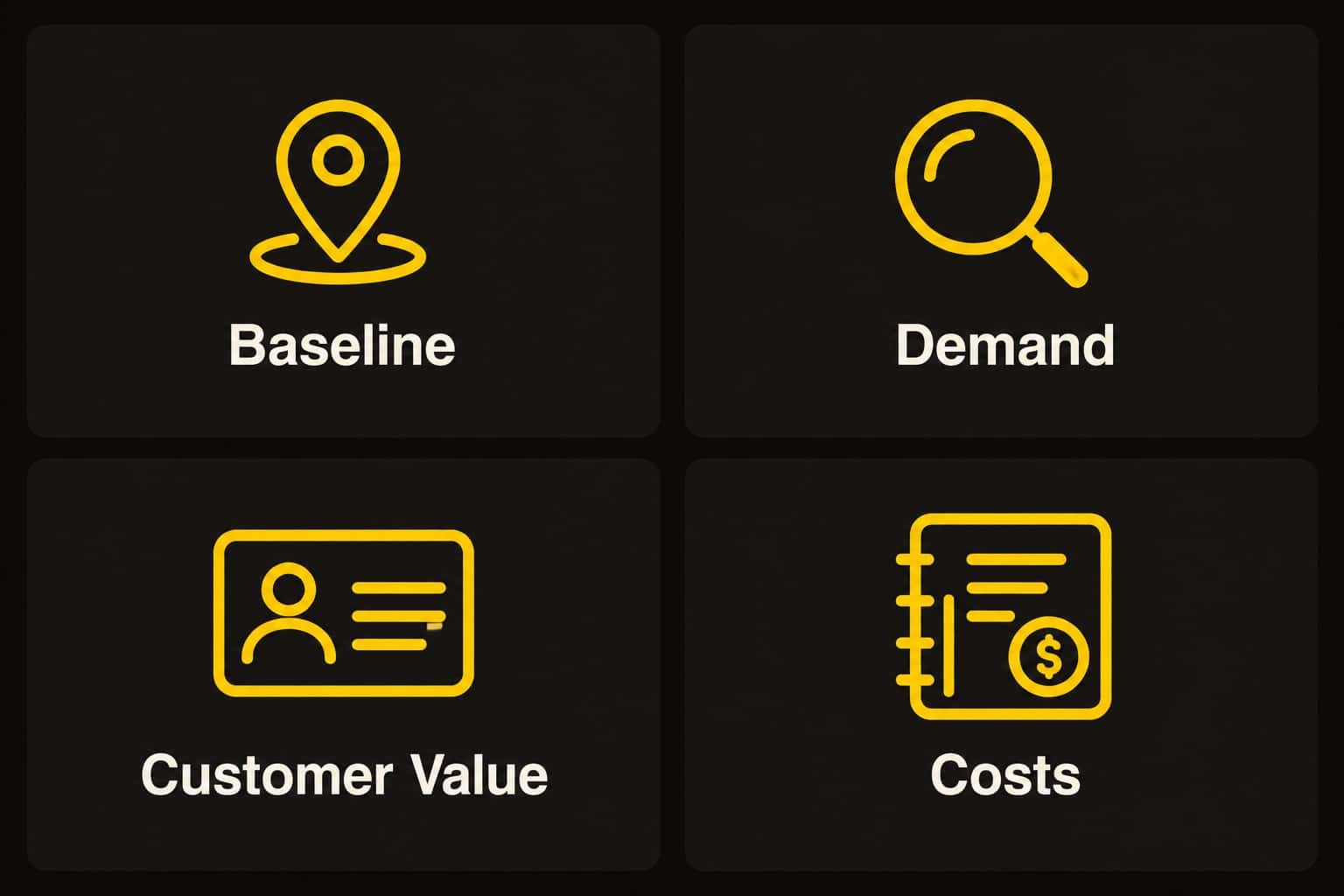
Before approving an SEO investment, ask about the baseline, reachable demand, conversion definitions, customer value, full costs, timing, attribution, and review process. The answers should reveal both the opportunity and the conditions that could prevent it from paying back.
A useful forecast does not require certainty. It requires enough transparency to make a decision and enough discipline to revise it as evidence changes. The spreadsheet can calculate to the penny. Your future customers have made no such commitment.
What should a credible SEO forecast include?

Use the following questions to review a proposal or your own planning model. Ask for the assumptions behind the summary, not just a slide showing the projected return.
| Buyer question | Evidence or explanation to request | Reason to investigate further |
|---|---|---|
| What happens without the proposed work? | A baseline with seasonal and business context | All existing organic sales are counted as new results |
| Which demand could we realistically reach? | Relevant services, locations, pages, and deduplicated query groups | National keyword totals stand in for local customers |
| What does each conversion rate measure? | Defined actions, denominators, periods, and customer records | Downloads or inquiries become customers without another step |
| What is a customer worth after fulfillment? | Realized revenue and appropriate cost assumptions | Sales revenue is labeled profit |
| Which costs and delays are included? | A scope, implementation schedule, and cash-flow view | Development, staff work, or collection delays disappear |
| What changes in a less favorable scenario? | Sensitivity checks on uncertain inputs | A single best-case number is treated as the expected result |
| How will new impact be assessed? | Consistent attribution and a comparison strategy | Channel credit is presented as proof of causation |
| When will we revise the forecast? | Named owners, review dates, and decision rules | Missed assumptions never change the recommendation |
For the underlying calculation process, see how to build an SEO profit forecast before spending. This article focuses on testing whether the inputs deserve your confidence.
1. What is the baseline, and what would happen without this work?
A proposal should distinguish existing business activity from the improvement being considered. Ask which services, pages, locations, and customer outcomes the forecast covers. Then ask what the business already receives from those assets.
For a seasonal contractor, last month may be a poor comparison for next month. A newly expanded service area, reduced advertising budget, changed pricing, or limited crew availability can also alter the baseline. Record these conditions before assigning a projected increase to SEO.
A simple baseline remains useful when stronger data is unavailable, provided you make its limits explicit. A new business may need a wider range and a smaller initial test. Missing history should increase uncertainty, rather than invite invented precision.
Ask whether the model forecasts total organic activity or additional activity above the baseline. Both can help planning, but they answer different questions. Counting every existing organic customer as a benefit of next month’s engagement can make the return appear stronger than the evidence supports.
2. How was reachable search demand estimated?
Ask to see the service and query groups behind the opportunity. A national search-volume estimate doesn’t reflect how many customers a local business can serve. Check geography, customer intent, seasonality, overlap, and whether the business actually offers the service being searched.
Several keyword variations may describe the same customer task and lead to the same page. Summing them without examining overlap can exaggerate the opportunity. A person may also search several times before buying. Search counts, visits, and unique customers are different units.
If the model assumes a particular ranking or click-through rate, ask why that outcome is plausible for the page, market, device mix, and current results. Treat a generic click-through curve as an assumption to test. Ads, maps, answer features, and the specific query can affect where users click.
Google’s Keyword Planner forecast documentation describes estimates based on advertising inputs such as bid, budget, seasonality, and historical ad quality. Those ad forecasts are not forecasts of organic ranking or organic revenue. Historical search estimates can inform research, but you can’t simply relabel a paid-search click projection as SEO traffic.
The more useful discussion is which buyer-intent searches fit your customers, and what work could make the relevant pages more competitive.
3. What does the conversion assumption actually measure?
Ask for the numerator and denominator. Is the figure inquiries per session, qualified leads per inquiry, completed customers per qualified lead, or purchases per visitor? Confirm the period, traffic source, sample size, and exclusions. Then check that each step in the model uses compatible definitions.
Unbounce’s 2024 Conversion Benchmark Report reports a 6.6% median landing-page conversion rate, based on more than 41,000 landing pages, 464 million unique visitors, and 57 million conversion actions. Its report explicitly notes that the analysis concerns conversion events, not the value of those events.
That is useful context from Unbounce’s platform. It is not a universal organic visitor-to-customer rate. A signup, download, inquiry, or purchase represents a different outcome. Applying a broad landing-page median directly to completed jobs can skip the qualification and sales process that determines commercial value.
Prefer your own relevant, reasonably stable data where available. If it comes from a small sample, show the counts behind the percentage. Two customers from ten inquiries produce a 20% observed close rate, but a single additional customer would change it to 30%. That instability should remain visible in the forecast.
If a benchmark fills a data gap, label it as a provisional assumption and explain why it is a reasonable comparison. Then replace it with observed business data as the program develops.
4. Does the customer-value estimate reflect the work we want?
Check the service mix behind the average sale. A business that handles both minor repairs and large installations can produce a misleading average if the expected SEO inquiries mostly concern one category. Use the contribution from the type of customer the proposed work is intended to attract.
Start with collected revenue and the costs needed to fulfill that work. Include additional sales or operating costs where appropriate, and avoid subtracting the same expense twice. Explain whether the remaining amount is gross profit, contribution after specified costs, or company-wide net profit.
Recurring business needs another check. Do not treat a possible multiyear customer relationship as cash collected during the initial evaluation period. If lifetime value is modeled, state the retention, repeat-purchase, cost, and timing assumptions separately. Compare a realized first-sale view with the longer-term scenario.
This keeps a promising customer relationship from financing an unrealistic early payback claim. See how to calculate SEO ROI without confusing leads and revenue for the measurement distinctions.
5. Are the costs, implementation dependencies, and timeline complete?
Request a list of the work that must happen before the forecast can hold. That may include website access, service-page changes, development, content approval, tracking, and a functioning inquiry process. Name who owns each dependency and when it is expected to be complete.
Google’s guidance on hiring an SEO recommends realistic improvement estimates and an estimate of the work involved. It also warns against guaranteeing a number-one ranking. A responsible forecast should explain the work and the uncertainty, rather than conceal them behind an assured position.
Include setup, ongoing fees, implementation, tools, and meaningful internal staff costs. Consider response and fulfillment capacity. A forecast of more inquiries is less useful if the business cannot answer, estimate, schedule, or complete the work.
Finally, separate an eventual monthly run rate from cumulative payback. A model can show a positive month after traffic and conversion improve while the program still has unrecovered setup and earlier operating costs. Include the time between inquiry, sale, job completion, and payment. A realistic SEO payback timeline needs all of those stages.
6. Which assumptions could reverse the decision?

Ask the forecaster to change one uncertain input at a time before changing several together. This reveals which assumptions matter most. A downside, central, and upside scenario can support discussion, but these are not statistical confidence intervals unless a valid statistical method establishes them.
The table below uses hypothetical inputs for one evaluation period. It isolates lead-to-customer conversion to show sensitivity. It is not an industry benchmark, a client result, or a forecast for your business.
| Input or outcome | Lower close rate | Central assumption | Higher close rate |
|---|---|---|---|
| Additional qualified leads assumed | 40 | 40 | 40 |
| Lead-to-customer rate assumed | 10% | 20% | 30% |
| Modeled completed customers | 4 | 8 | 12 |
| Contribution per customer before program cost | $500 | $500 | $500 |
| Total contribution before program cost | $2,000 | $4,000 | $6,000 |
| Program cost for the same period | $3,000 | $3,000 | $3,000 |
| Remaining contribution after program cost | −$1,000 | $1,000 | $3,000 |
Under these assumptions, six completed customers cover the $3,000 program cost. That requires a 15% close rate from 40 qualified leads. The central scenario works only if the assumed lead supply, customer contribution, costs, timing, and conversion are sufficiently accurate.
The example assumes the 40 leads are additional and the modeled customers complete and pay within the period. It does not prove either condition. The next questions should test the evidence for those assumptions, then examine changes in lead supply, margin, and timing. Do not add the three scenarios together or treat their midpoint as a validated expected value.
7. How will attribution and additional impact be distinguished?
Google Analytics attribution models assign credit across customer touchpoints according to a rule or model. That allocation is useful for reporting. A projection of organic-attributed revenue does not, by itself, establish how much additional revenue the proposed engagement will cause.
Ask how the forecast handles existing customers, searches for the business by name, referrals, other campaigns, and sales already in progress. Agree on the reporting model and customer definitions before the engagement starts.
If the proposal claims incremental impact, ask what comparison supports it. A prior-period comparison may be influenced by seasonality or other business changes. A phased comparison across pages or locations can also have selection differences and spillover. State those limits instead of presenting a channel label as a causal test.
The forecast can still be useful when a precise causal estimate is unavailable. Label the outcome as attributed or modeled, explain the assumptions, and use conservative ranges to support the investment decision.
8. What evidence will make us revise the forecast?
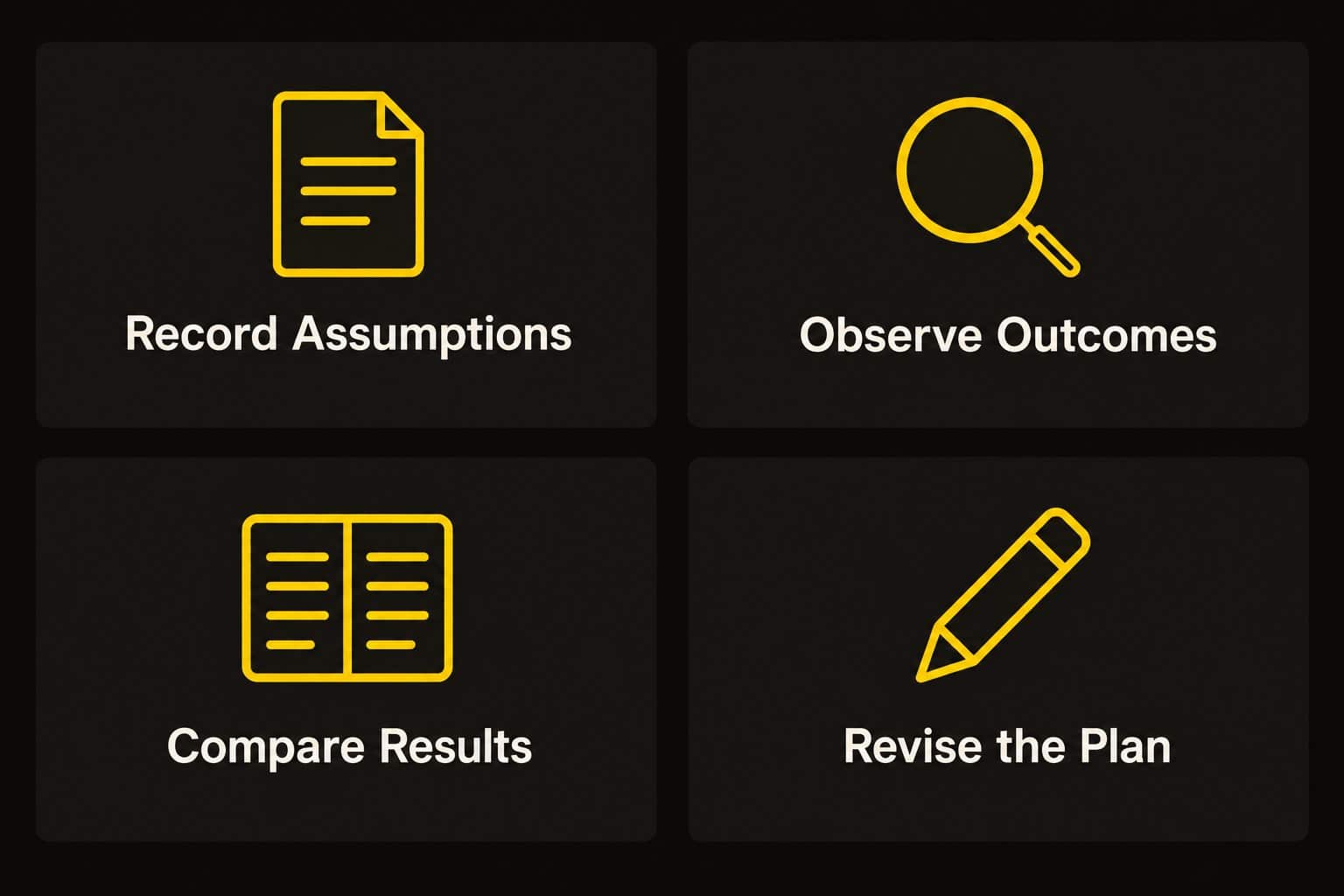
A forecast should become more useful as observations replace assumptions. Agree on when the team will compare planned implementation, relevant search activity, qualified inquiries, customer outcomes, and costs with the model.
Set review points that fit the work and the sales cycle. Early reviews can check implementation and tracking; later reviews can assess customer and collection outcomes. Avoid deciding success or failure from one noisy week or changing every target after a disappointing result.
Write down what would trigger investigation, a revised estimate, a scope change, or a pause. If leads arrive but customers do not close, investigate qualification, follow-up, pricing, and capacity. If the promised page changes never ship, revise the timeline rather than pretending the original launch occurred.
Keep the original forecast alongside the revised version, with dates and explanations. A forecast that can never be wrong is hard to learn from.
Frequently asked questions
Can an SEO forecast guarantee ROI?
No. It models outcomes under assumptions about demand, implementation, conversion, customer value, cost, and timing. A useful forecast makes uncertainty visible and supports a decision without promising that customers or search engines will behave exactly as modeled.
How much history is enough to forecast SEO results?
No minimum is established by the sources cited here that suits every business. Review enough relevant history to understand seasonality and variation where possible. If data is sparse, show the counts, widen the scenarios, and identify what the initial work must validate.
Should industry conversion benchmarks be used?
They can supply context or a clearly labeled provisional assumption. Check the channel, audience, action, denominator, and sample before using one. A landing-page conversion benchmark is not automatically a completed-customer rate for organic traffic.
Why can a forecast show positive monthly returns before payback?
A later month can produce more contribution than that month’s spending while earlier costs remain unrecovered. Cumulative payback requires the accumulated contribution to cover all included program costs over the same timeline.
What is the fastest way to test a proposal’s forecast?
Ask the provider to trace one projected customer back through the assumptions, then reduce the least-supported input. Request the revised costs, timing, and remaining contribution. A transparent model should show why the recommendation changes or stays the same.
Approve a forecast you can interrogate
The best forecast for a business decision is one you can inspect, challenge, and update. It should explain what the team plans to improve, why the opportunity deserves investment, and what evidence would change the plan.
Quickest Path to ROI SEO™ explains a business-first system for prioritizing search opportunities and connecting visibility with revenue sooner. Use it to evaluate the assumptions behind the work you fund and the results you expect.
Sources and research notes
- Google Ads: About Keyword Planner Forecasts. Paid-search forecast inputs and definitions; not an organic-revenue forecasting model.
- Unbounce: 2024 Conversion Benchmark Report Landing-page conversion-event data from its platform, including a 6.6% median; not an organic customer-close benchmark.
- Google Analytics: Get Started with Attribution How attribution models assign credit to customer touchpoints.