
An AI tool can produce a long list of questions about your services in seconds. The harder work is determining which questions reflect real customer needs, which deserve a place on your website, and which could support a worthwhile business outcome.
AI search keyword research connects customer language with search evidence, buying decisions, and useful pages. A good research brief explains why the question matters, what supports the opportunity, and how the page should help someone act.
Start with the conversations your business already has. Use search data to investigate demand, then use generated ideas to explore gaps. Keep their sources visible so a plausible suggestion does not become a fictional market opportunity.
How Do You Research Keywords for AI Search?
Start with customer conversations and conventional search data. Turn recurring needs into natural buyer questions, group questions sharing an intent, and map each group to a suitable page. Test selected questions on relevant AI search surfaces. Prioritize using business value and evidence of demand; generated prompts alone do not establish search volume.
Use six steps:
- Collect the language customers use before buying.
- Review search evidence and preserve its measurement limits.
- Group questions by the decision they support.
- Map each group to an existing or proposed page.
- Test selected questions under documented conditions.
- Choose the gaps that justify content or page improvements.
1. Collect Customer Language Before Generating Prompts
Begin with the service or product your business wants more qualified demand for. Identify the people who buy it, the locations you can serve, and the decisions they need to make.
Review estimate requests, sales conversations, support questions, website forms, and objections that delay a purchase. Ask the people answering those questions what customers struggle to understand.
Record the wording and its context. A commercial painting buyer asking about weekend scheduling has different needs than a homeowner researching paint colors. Both mention painting, but they lead to different offers.
Useful context includes:
- The customer’s problem or desired result.
- The type of property, product, or situation involved.
- Location, timing, and other genuine constraints.
- Whether the customer was learning, comparing, or selecting a provider.
- The information missing when the question arose.
Keep research notes focused on the decision. You do not need to copy personal contact details into a content-planning sheet.
Use AI to Explore, Then Validate
After collecting customer language, ask an AI tool to suggest related questions, objections, or alternate wording. Label those additions as generated candidates.
An illustrative research prompt might be:
Group these customer questions by the buying decision they support. Suggest additional questions separately, label them as unvalidated ideas, and do not invent search volumes or customer evidence.
Review the output with someone who understands the service. Remove irrelevant assumptions, unsupported claims, and questions your business cannot answer responsibly.
Generated questions are useful for exploration. Validation comes from other evidence and informed judgment.
2. Use Search Data Without Confusing It With AI Usage
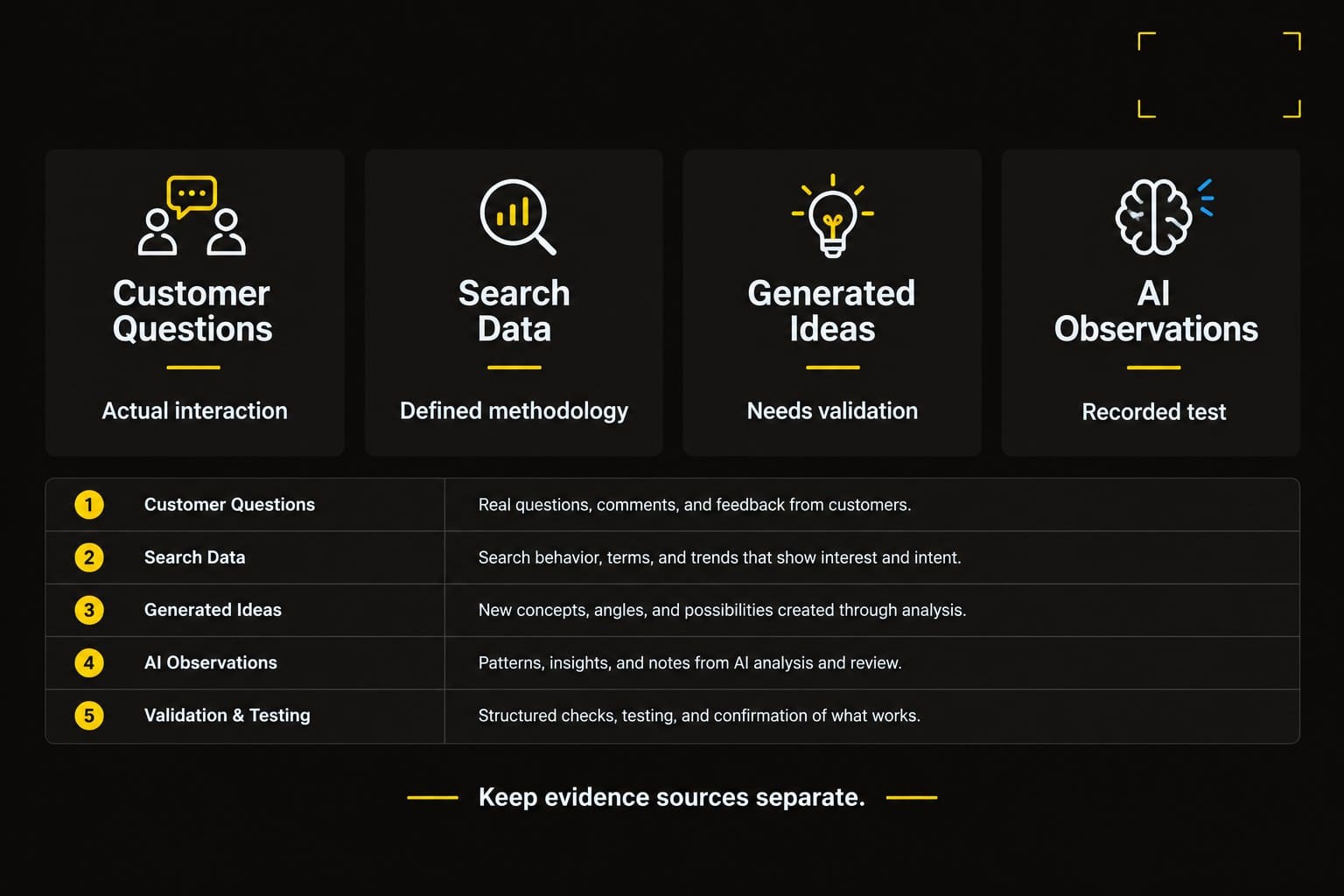
Search evidence can reveal how people discover information and which topics merit investigation. Its meaning depends on the source.
Google’s Search Console documentation describes performance records for your site in Google Search, including queries, pages, impressions, and clicks. Keyword Planner’s documentation explains historical search estimates for keywords and close variants under selected settings. Neither should be relabeled as ChatGPT prompt frequency.
Keep a separate column for each evidence type:
| Evidence type | What it tells you | Limit to preserve |
|---|---|---|
| Customer conversation | A question arose in a specific business interaction | It does not establish market-wide demand |
| Search Console query | Your site had recorded activity for a Google query | It is site-performance evidence, not total demand |
| Keyword-tool estimate | An estimate under the provider’s settings and methodology | It is not a universal count across search and AI platforms |
| Generated prompt idea | A possible question to investigate | Plausibility is not observed demand |
| Recorded AI answer | What search returned for a test question | It does not establish how many customers ask it |
For keyword estimates, retain the provider, collection date, location, period, and relevant network or language settings. Note whether the result is a range, rounded value, or unavailable.
Avoid adding close variations into a total without checking how the source groups them. An apparent increase may come from counting overlapping estimates more than once.
The existing guide to which SEO keywords bring customers covers conventional keyword-selection foundations. Use that evidence alongside the buyer-question work here, with their measurement boundaries intact.
3. Group Buyer Questions by Intent and Decision Stage
Search intent is the purpose behind a question. For planning, identify the decision the reader wants help making.
A person may need to understand a problem, compare approaches, assess cost, find a suitable provider, or prepare to request an estimate. These purposes can overlap, and the journey isn’t always a neat sequence.
| Decision group | Illustrative question | Likely information need |
|---|---|---|
| Understand the problem | “Why does paint keep peeling on this exterior?” | Possible causes and appropriate assessment |
| Compare approaches | “Should this building be repainted or have failed sections repaired?” | Suitability, limitations, and tradeoffs |
| Assess scope and cost | “What affects the price of painting an occupied office?” | Project factors, inclusions, and estimate requirements |
| Find a provider | “Who offers commercial painting in [city]?” | Service, location, proof, and contact route |
| Prepare to act | “What information should I provide when requesting an estimate?” | Practical next steps |
These examples illustrate grouping; they are not verified search-volume opportunities.
Keep questions together when they seek substantially the same answer. Different wording does not automatically mean a different page is needed.
“Can an office be painted while employees are working?” and “How do painters limit disruption in an occupied workplace?” may belong to one disruption-and-scheduling group. Review their differences, then decide whether one coherent explanation can serve both.
Preserve Context That Changes the Answer
Location, customer type, project scope, and restrictions can change what a useful response should explain. Record those distinctions when they affect service fit or the decision.
Do not create artificial distinctions merely to increase the topic count. If two questions need the same explanation and next action, a single well-organized page may serve them.
Similarly, a lengthy conversational question can contain several needs. Break it into decision components for planning, then decide which belong together.
4. Map Question Groups to Existing or Proposed Pages
Illustrative question-to-page map
- Source: Customer question
- Intent: Compare estimates
- Question Group: Scope and inclusions
- Page: Estimate explanation
- Next Step: Prepare project details
Illustrative: Source → Intent → Question Group → Page → Next Step.
Review the website before commissioning new articles. Find the page that already addresses the offer or customer decision, then assess whether it can do the job with an improvement.
A service page can explain suitability, scope, evidence, and the inquiry process. A supporting guide may deserve its own page when it addresses a distinct decision in enough depth to help the reader.
Use a question-to-page map. The following rows are illustrative planning examples for a commercial painting business; they contain no claimed customer observations or verified volumes.
| Question group | Evidence to seek | Intent | Suitable destination | Customer next step |
|---|---|---|---|---|
| Provider and location fit | Relevant inquiries and search records | Find a provider | Existing commercial painting service page | Request an appropriate estimate |
| Occupied-building disruption | Questions from actual buyers or sales staff | Evaluate suitability | Scheduling section on the service page | Discuss project constraints |
| Estimate inclusions | Repeated comparison questions | Compare offers | Existing estimate explanation, expanded if needed | Prepare questions and scope details |
| Detailed preparation process | Evidence of a distinct information need | Understand the work | Supporting guide if the current page cannot serve it well | Review the related service |
Give each group a principal destination. Supporting pages can answer related questions, but their roles and links should be clear.
Decide Whether to Update, Combine, or Create
Choose an existing-page update when the page has the right purpose but leaves a meaningful question unanswered. Consider combining overlapping material when several pages repeat the same answer without distinct customer value.
Create a new page when it serves a separate need, and you can explain its role, evidence, and next action. Do not publish every generated prompt as a separate blog post.
Use the Content-with-a-Job Planner to document the reader, question, proof, destination, and intended action before drafting.
A useful map reduces guesswork. It also lets an owner see whether proposed content supports the services the business actually wants to sell.
5. Test Commercially Relevant Questions on Chosen Surfaces
Select representative questions from the groups you have researched. Testing every wording variation immediately can create more review work without improving the decision.
Name the surface, such as ChatGPT search or Google AI Mode. Save the exact question, answer, date, relevant conditions, and cited sources. Separate branded accuracy checks from unbranded customer discovery.
Google explains that its AI features may search across related subtopics. My editorial recommendation is to investigate the customer’s connected decisions rather than assume the exact wording of every related query is known.
Inspect what the answers use:
- Does the response address the question’s actual purpose?
- Which pages support the explanation?
- Is a business mentioned or recommended, and does it fit?
- Is your relevant page cited?
- Is an important part of the decision missing or inaccurate?
An observed citation can suggest that a page is being used in that answer. It does not validate the question’s total demand or establish that the page produces leads.
Repeat selected tests under comparable conditions and keep the original questions stable. Add new variants as a separately labeled group so changes in the test set do not masquerade as improved visibility.
Use the findings to refine the page brief. Leave the full audit and reporting process to a separate baseline review rather than turning keyword research into an endless test program.
6. Choose Which Gaps Justify Content Work
Prioritize using the opportunity, available evidence, current page condition, and practical effort. A commercially relevant group with strong customer evidence and a clear existing-page gap may deserve attention before a broad topic with an attractive estimated volume.
Use the Keyword Opportunity Evaluator to compare conventional keyword opportunities and commercial fit. Retain AI observations as separate evidence rather than entering invented prompt volumes.
Apply the six connected areas in the Quickest Path to ROI SEO™ book to each shortlisted group:
| Area | Research decision |
|---|---|
| Revenue opportunities | Does this question relate to work the business can profitably deliver? |
| Priority pages | Which page should own the answer and appropriate next action? |
| Constraints | What specifically prevents that page from doing its job? |
| Authority | What verified evidence can support the explanation? |
| Measurement | What discovery records and qualified actions will be reviewed? |
| Expansion | What findings would justify the next page or question group? |
Write a short reason for the priority. For example: “Improve the occupied-office scheduling section because relevant buyers need that information and the existing page omits it.” Validate the customer evidence before presenting that statement as an actual finding.
Avoid using an opaque score as the entire explanation. An owner needs to understand why the work deserves time and what would change the decision.
A Reusable Buyer-Question Research Brief
Complete one brief per question group. Keep sources and assumptions traceable.
| Field | What to record |
|---|---|
| Offer and customer | The service, suitable buyer, and genuine service area |
| Raw question | Original wording and context, where available |
| Evidence source | Customer interaction, Search Console, keyword tool, generated candidate, or AI test |
| Evidence detail | Date, settings, records, and limitations |
| Intent and group | The decision supported and related variations |
| Current destination | Existing page and any overlap with other pages |
| Information gap | Specific missing, unclear, inaccurate, or unsupported answer |
| Proof available | Relevant examples, process facts, credentials, or sources |
| Proposed action | Update, combine, create, or investigate further |
| Conversion purpose | Useful next step for a suitable reader |
| Owner and effort | Responsibility and realistic work involved |
| Review | Implementation check, comparable tests, and customer-outcome checkpoint |
Revisit the brief when evidence changes. Preserve uncertainty rather than filling empty volume cells with a precise-looking number.
Frequently Asked Questions
Is a Long Conversational Question a Separate Keyword Opportunity?
Sometimes it represents a distinct need; sometimes it is another wording of an existing one. Examine the intent, context, and answer required. Group it with related questions when one coherent page can help the reader make the same decision.
Can an AI Tool Generate Real Search-Volume Data?
An AI tool can report data if it retrieves a legitimate source with known settings and methodology. Generating a number from a prompt does not establish observed volume. Ask for the provider, date, location, and measurement basis, and verify the underlying data.
Should Every Prompt Variation Have Its Own Blog Post?
No. Group variations by shared purpose and information need. Use a new page for a distinct customer decision that deserves a separate treatment. Update an existing page when it can answer the group clearly and support the next action.
How Do I Distinguish Research Questions From Purchase Questions?
Look at the decision the person wants to make. A general explanation may support early understanding; questions about the provider, scope, estimate, and availability may indicate a closer buying decision. Treat these as planning judgments and check actual customer behavior rather than assuming intent from one phrase.
Can Search Console Impressions Estimate ChatGPT Prompt Frequency?
No. Search Console records your site’s Google Search activity under its reporting methodology. It does not measure ChatGPT prompt usage. Use it as one source of topic evidence and record separate AI tests without converting the two into a single demand figure.
Choose Questions That Help Customers Decide
Start with a valuable offer and questions supported by customer or search evidence. Group them, identify the right page, and decide what useful improvement it needs.
Use the Keyword Opportunity Evaluator to compare opportunities while keeping their evidence sources clear.
If you need help connecting buyer questions, AI-search observations, and pages that can produce qualified inquiries, Elite SEO Consulting can help review your priorities. Call 719-474-9404 to discuss the questions and services that matter to your business.