
When every SEO provider promises growth, the promise stops helping you choose. The useful difference is how each strategy connects your business opportunity with work someone can actually complete and evidence you can review.
To evaluate an SEO strategy, compare the diagnosis, target customers, priority pages, implementation responsibilities, full cost, measurement plan, and conditions for changing direction. Ask each provider to explain the same business opportunity. Resolve important gaps before committing, rather than letting a polished presentation stand in for a workable plan.
You are buying decisions and execution under uncertainty. A provider cannot responsibly control every ranking or customer decision, but it can explain what it recommends, why it ranks first, who will do it, and what would change the recommendation.
Give Every Provider the Same Business Brief

Different inputs produce different proposals. If one provider hears you need more traffic and another hears you want profitable installation work in a specific territory, their recommendations will be hard to compare fairly.
Prepare a short brief covering the service or product you want to grow, the customers you can serve, relevant geography, fulfillment capacity, budget boundaries, and what is known about customer economics. Include existing productive pages and any planned website changes.
Share the same factual information with each provider. For initial diagnostic work, use appropriate limited access. Google’s hiring guidance recommends read-only Search Console access at the audit stage and realistic estimates of improvement and work involved. It also advises asking about measurement, communication, and the reasoning behind recommendations.
If you cannot yet identify your most valuable services, say so. Discovery may be the first assignment. A specific proposal should acknowledge missing information rather than quietly inventing it.
Check Whether the Diagnosis Explains the Proposed Work
A strategy should connect an observed constraint to an intervention. “You need more content” is an activity recommendation. It becomes a useful diagnosis only when the provider explains which customer need is poorly served, where the gap appears, and why addressing it deserves priority.
Ask the provider to walk through one commercially important page. What searches and customer questions should it serve? What currently limits its usefulness or discoverability? What evidence supports that explanation? What should be preserved?
A credible answer can include uncertainty. For example, the page may receive relevant visits but lack clear service boundaries and a usable contact path. The first recommendation might be to verify inquiry tracking and improve that path before publishing more articles.
Another site may have a genuine coverage gap. The same tactic is not automatically appropriate for both businesses. Use how to choose the SEO work a small business should do first to keep the discussion connected to the actual constraint.
Be cautious when every diagnosis leads to the same package. A template can make delivery efficient, but the priorities still need a reason.
Use a Comparison Table That Exposes Missing Answers

Record specific answers for each proposal. Use “documented,” “needs clarification,” or “unresolved” rather than assigning a precise score to impressions you cannot substantiate. This is a decision aid, not a validated predictor of SEO success.
| Area | Evidence to request | A gap to resolve |
|---|---|---|
| Business fit | Named customer, service, territory, and capacity assumptions | Growth targets include work you cannot serve profitably |
| Diagnosis | Specific page or search evidence tied to the recommendation | A generic audit score substitutes for an explanation |
| Priorities | What comes first, what waits, and why | Every task is presented as equally urgent |
| Implementation | Named owners, approvals, dependencies, and completion checks | Recommendations accumulate without anyone assigned to publish |
| Economics | Full cost and customer-contribution assumptions | Revenue is treated as profit or separate costs are omitted |
| Evidence | Relevant case records, methods, time periods, and limitations | A selected success is presented as a guaranteed typical result |
| Review | Implementation checkpoints, outcome definitions, and change criteria | The plan has no response to weak or contradictory evidence |
Do not average away a material problem. A proposal can be clear in six areas and still be unsuitable if it requires development capacity you do not have. Identify the unresolved issue and request a revised plan.
For a closer review of responsibilities, see what a high-performing SEO agency should deliver. The purpose is to define what you are buying and how you’ll verify completion.
Ask the Provider to Explain Its Forecast Assumptions
A forecast should show the path from search demand to financial outcomes. Ask what portion of the opportunity is relevant, what visit and inquiry assumptions are being used, how inquiries become customers, and what contribution remains after serving those customers.
Request a lower-demand scenario, a slower implementation scenario, and the main estimate. These are planning cases, not statistical confidence intervals unless a defensible statistical method actually produced them.
Use Benchmarks as Context, Then Check Their Fit
The 2024 Unbounce Conversion Benchmark Report reports a 6.6% median conversion rate across industries. Its analysis covers more than 41,000 landing pages, 464 million unique visitors, and 57 million conversion events.
That is substantial platform data, but the report explicitly distinguishes conversion events from their value. It is not a benchmark for the percentage of organic visitors who become paid customers in your business. Landing-page goals, industries, and traffic sources differ.
If a proposal inserts 6.6% directly into a customer forecast, ask what event that rate represents and why the sample fits your page and audience. A form submission, a qualified inquiry, and a completed sale need separate assumptions. A large dataset does not make those stages interchangeable.
Use a forecast built around customer economics to examine the chain. Where your own records are weak, name the uncertainty and make measurement part of the assignment.
Worked Example: Compare the Work Before Comparing the Price
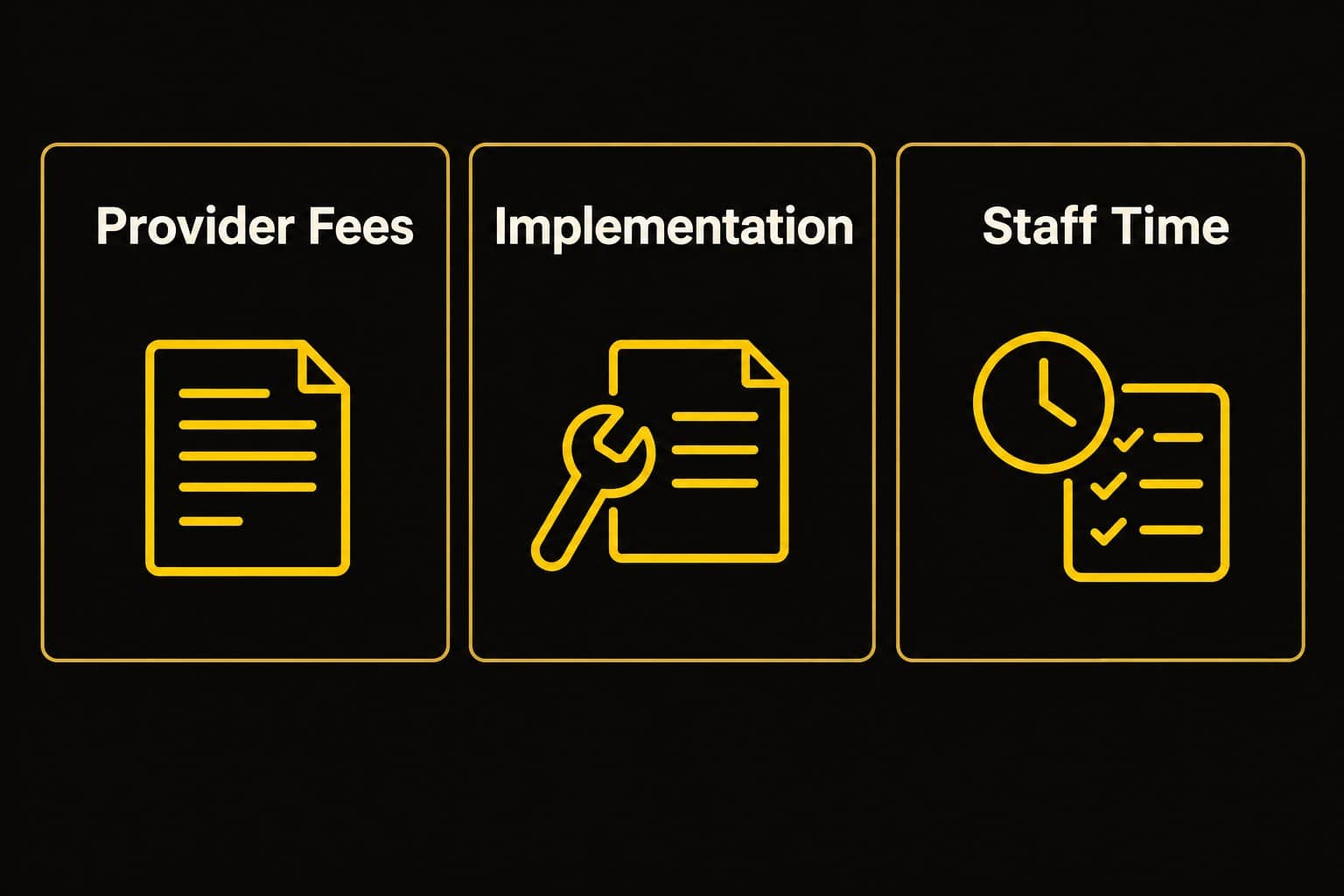
The following hypothetical proposals illustrate a buying decision. The amounts are invented planning assumptions, not market prices, quotes, or expected outcomes.
A service business has an existing installation page and limited staff capacity. It wants more suitable installation inquiries. Proposal A offers content production for $1,500 per month. Proposal B offers page research, revision, implementation, and inquiry-path checks for $2,100 per month. Neither proposal has yet established which intervention is needed.
Before treating A as the cheaper option, the owner discovers that A excludes publishing and page development. For a three-month comparison, assume A would require a separate $1,800 implementation assignment and $600 of allocated staff review time. Assume B includes the compared implementation work but requires $300 of allocated staff review time.
| Three-month cost | Proposal A | Proposal B |
|---|---|---|
| Provider fees | $4,500 | $6,300 |
| Separate implementation | $1,800 | Included for this comparison |
| Allocated staff review | $600 | $300 |
| Compared total | $6,900 | $6,600 |
B’s monthly invoice is $600 higher, but its total compared cost is $300 lower under these assumptions. Staff time is a resource cost and may not be an additional payroll payment. Keep a separate cash schedule if that distinction affects affordability.
This still does not establish that B is the better strategy. Its proposed page work needs diagnostic support. A’s content could address a more valuable unmet need. The owner should compare the work’s purpose, delivery boundaries, and opportunity before choosing.
The useful result is a clearer question: which coherent assignment addresses the strongest supported constraint at an acceptable full cost? Neither a low fee nor a longer list of deliverables answers that question alone.
Treat Pricing Models and Case Studies as Separate Evidence
Price research can describe how providers charge. It can’t tell you which provider will deliver the best return.
Ahrefs’ pricing survey, updated August 15, 2024, covered 439 SEO service providers. It reported that 78.2% offered monthly retainers, 34.8% hourly pricing, and 48.9% project pricing. The categories overlap because providers can offer multiple models.
These are historical provider-reported figures, not a current local price recommendation or a comparison of customer ROI. Use them as context when discussing an arrangement that fits the work. A retainer, project, or advisory engagement can each have a clear scope or a vague one.
For a case study, request the starting conditions, actual work, total costs, observation period, and definitions of the reported results. Ask whether the business had comparable demand, margins, staffing, and website maturity. A relevant case provides context; a different company’s result remains a different company’s result.
If a provider reports revenue attributed to organic search, ask how it was assigned and whether repeat customers or branded demand were included. Google Analytics describes attribution as assigning credit along customer paths. That allocation alone does not establish how much additional business the proposed engagement would cause.
For the financial definitions behind that review, use how to calculate SEO ROI. Keep observed outcomes, attributed outcomes, forecasts, and causal claims distinct.
Evaluate AI-Search Recommendations With the Same Discipline
Ask which search experience the recommendation addresses and what customer problem it solves. “AI optimization” should lead to a defined activity, such as improving the accuracy and usefulness of service information, checking crawl access, or clarifying information a prospective buyer needs.
For Google AI Overviews and AI Mode, Google’s documentation says foundational SEO practices remain relevant, and no additional optimization or special schema is required for inclusion. Eligibility does not guarantee appearance.
This guidance concerns Google’s features. It is not a universal statement about every assistant or retrieval system. Ask a provider to distinguish documented platform requirements from its own hypothesis, test, or monitoring process.
A citation or mention can be useful visibility evidence. It still needs a separate connection to inquiries, customers, and financial value. Don’t accept new vocabulary as a reason to abandon clear definitions.
Make the Final Decision Reviewable
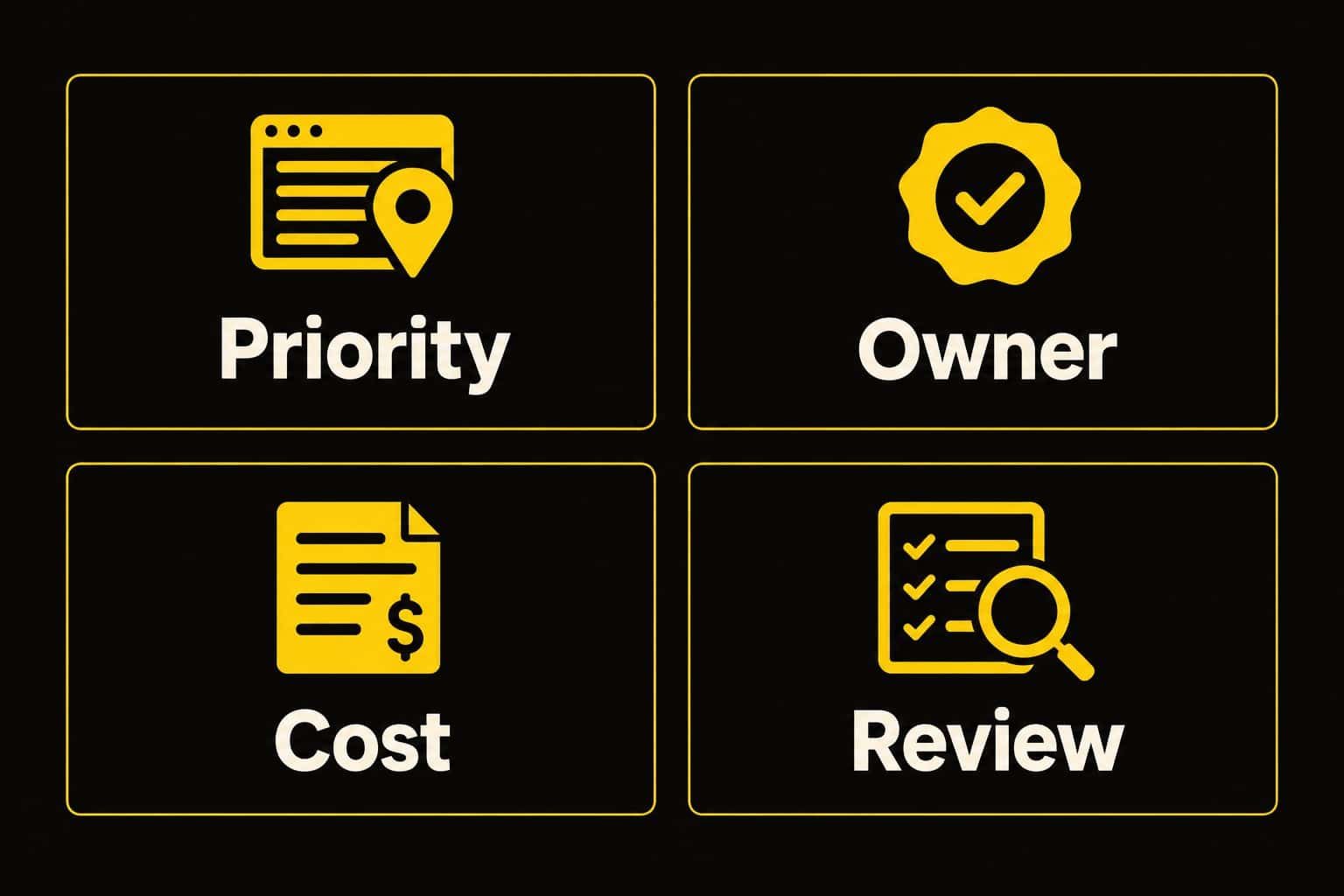
Before choosing, ask each finalist to describe one first-phase assignment using the same format: the business objective, supporting evidence, included work, exclusions, implementation owners, required approvals, full cost, and review plan.
Then test the proposal against a practical disruption. If development is delayed, which useful work can proceed? If the business cannot accept more jobs this month, does the strategy adapt? If the expected inquiries fail to appear, what will be investigated first?
The answer should expose the reasoning. It need not pretend to know the future. A strong provider can explain what is controllable, what is uncertain, and which observation would justify changing course.
Document the reason for your choice and any unresolved assumptions. Establish an implementation checkpoint separately from the review of search and customer outcomes. Those reviews may need different timing.
Where the diagnosis is still weak, a bounded discovery assignment may be more sensible than a large ongoing commitment. Where the plan depends on resources you cannot supply, revise the scope before approving it. Confidence in a presentation does not create developer availability.
Frequently Asked Questions
What Makes an SEO Strategy Stronger Than a List of Deliverables?
A strategy explains the customer opportunity, the constraint, the chosen sequence, and why the work deserves funding. Deliverables describe outputs. A useful proposal connects those outputs to implementation, costs, evidence, and a process for changing direction.
Should I Choose the Provider With the Most Aggressive Forecast?
Compare the assumptions and their support. An ambitious forecast can rely on uncertain demand, unrealistic implementation speed, or conversion rates from an unsuitable sample. Request alternative scenarios and the evidence behind each major step.
Is a Ranking Guarantee a Good Way to Reduce Risk?
A guarantee does not remove the need to inspect what is promised, for which searches, and at what cost. Google cautions that no one can guarantee a first-place ranking. Even a ranking milestone would not, by itself, establish suitable inquiries or profitable customers.
Can I Compare Strategies Before Giving Full Website Access?
You can share the business brief, existing reports, and appropriate read-only diagnostic access. Providers should identify what they can assess and what remains uncertain. Broader implementation access should follow the agreed responsibilities and work.
What If Two Proposals Still Look Equally Good?
Identify the remaining decision-relevant uncertainty. Ask for a clearer diagnosis, a reference relevant to your situation, or a bounded initial assignment. Do not invent precision with a numerical score when the underlying evidence remains unresolved.
Use Business Value to Organize the Choice
The strategy worth considering should help you understand the opportunity, the work, the responsibilities, the total commitment, and the evidence you will use next. That makes the decision more concrete even when outcomes remain uncertain.
Quickest Path to ROI SEO™ gives business owners a business-first system for evaluating search priorities. Use it to ask better questions before approving a strategy and to keep later reviews connected to customer outcomes and financial reality.
Sources and Research Notes
- Google Search Central, Do You Need an SEO? Hiring, audit access, communication, and ranking-guarantee guidance.
- Unbounce, 2024 Conversion Benchmark Report. Platform landing-page events and median conversion rate; not an organic customer-acquisition forecast.
- Ahrefs, SEO Pricing, updated August 15, 2024. Historical survey of provider pricing models, not comparative ROI evidence.
- Google Analytics, Get Started With Attribution. Attribution definitions and model descriptions.
- Google Search Central, AI Features and Your Website. Guidance specific to Google AI Overviews and AI Mode.