
Home services, commercial property services, specialized professional firms, local appointment-based practices, specialty ecommerce, and technical business-to-business suppliers can all offer strong SEO profit potential. The opportunity depends on the particular service, customer economics, search market, and ability to turn discovery into business.
An industry label is only a starting point. A roofing company with healthy job margins and available crews may have an attractive opportunity. Another roofing company in the same city may be fully booked, poorly equipped to follow up, or targeting jobs it struggles to deliver profitably.
The same keyword can mean very different things for those businesses.
For 2027, the useful comparison is between business conditions that can support a profitable search investment. The industry comparisons below are practical assessments of those conditions, not a measured ranking of average industry SEO returns. Current market and platform sources provide context; your own business records must establish the investment case.
This guide explains which business models deserve consideration, what makes their opportunities attractive, and how to evaluate your own services before approving more SEO spending.
What Creates Strong SEO Profit Potential?

SEO profit potential is the possibility that additional customers reasonably associated with search will contribute enough value to justify the investment. Visibility creates an opportunity to be considered. The business still needs to qualify, sell, and deliver the work.
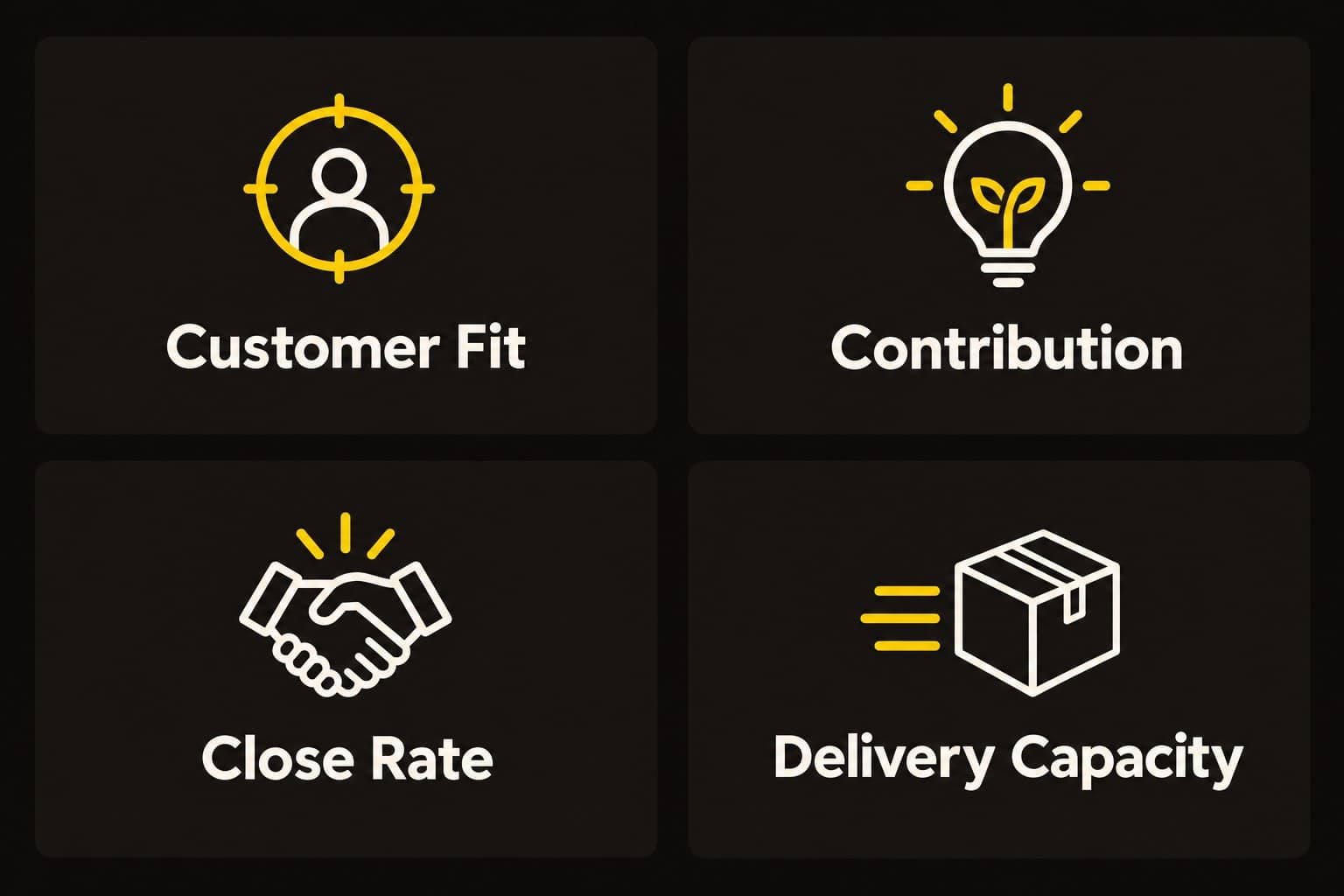
Look for a combination of four conditions:
- Commercial search demand: suitable customers look for the service, product, provider, or buying information you can offer.
- Useful customer contribution: completed sales leave enough value after delivery costs to support acquisition spending.
- A reachable opportunity: the website, local presence, competition, and required work give you a credible route to discovery within your available resources.
- Operational readiness: the business can respond, close, and serve the customers it wants.

Search volume alone is also insufficient. Thousands of people researching a topic may produce less business value than a smaller group looking for a provider who can solve a specific problem.
A high sale price alone is insufficient. A large project can have weak margins, extensive quoting costs, or a low chance of closing. A lower-value service may be attractive when it is profitable to deliver and customers return in ways the business can document.
Start with services and customer needs. Use the Keyword Opportunity Evaluator to organize the relationship between search intent, business fit, and the work required.
Six Business Models Worth Evaluating
These groups overlap. A commercial HVAC contractor is both a home-services-related business and a business-to-business provider. An equipment supplier may also operate an e-commerce store. Classify the opportunity by how customers buy and how the business earns contribution, rather than forcing every company into one box.
The table is an editorial comparison of possible opportunity mechanisms. It does not assign industry ROI scores or imply that one group consistently outperforms another.
| Business model | What can make search valuable | What can weaken the investment case |
|---|---|---|
| Home repair and improvement services | A defined service need, local provider selection, and suitable project value | Thin job margins, limited capacity, unprofitable travel, seasonality, or a difficult search market |
| Commercial property and facility services | Specific buyer requirements and the possibility of repeat contracts | Long qualification cycles, tender-only purchasing, weak account fit, or costly proposals |
| Specialized professional services | Customers searching for relevant expertise on a valuable problem | Broad targeting, insufficient proof, poor qualification, or heavy competition |
| Local appointment-based practices | Service-and-location searches that may lead to consultations or appointments | Ineligible inquiries, limited appointment capacity, inaccurate information, or unreliable booking records |
| Specialty ecommerce | Specific product needs, differentiated expertise, and useful purchasing guidance | Low contribution per order, returns, fulfillment costs, commodity competition, or stock problems |
| Technical B2B suppliers and service firms | Detailed specifications and specialized purchasing questions | Limited reachable demand, long sales cycles, unsuitable inquiries, or weak sales handoffs |
Home Repair and Improvement Services
Roofing, plumbing, HVAC, gutters, painting, and other property services deserve evaluation when searchers need a provider for work the business wants to sell. A specific service need can create a clear connection between discovery and an inquiry.
The opportunity often varies considerably within one company. Emergency repairs, planned replacements, routine maintenance, and larger projects have different contribution, scheduling, and follow-up requirements.
Compare those service lines before treating “more contractor traffic” as the objective. A company might prefer steady maintenance work; another might have the capacity and economics to pursue replacements. Don’t choose either preference based on keyword volume alone.
The practical implication is to examine your local service mix and economics rather than assume broad market growth will carry the campaign. Prioritize jobs you can serve well, at a worthwhile contribution, within a sensible territory.
Commercial Property and Facility Services
Commercial cleaning, paving, exterior maintenance, commercial painting, and facility services can have attractive opportunities when suitable buyers search for a provider and the resulting work is valuable to deliver.
A recurring contract may justify more acquisition effort than a one-time small task. However, contract revenue is not the same as profit, and a possible renewal is not the same as an observed renewal.
Evaluate the account fit: property type, location, contract requirements, staffing, expected delivery costs, and how the buyer selects vendors. Some purchasing happens through referrals, approved lists, or tenders. Search may support discovery or verification without originating the entire sale.
That distinction changes the content and how you measure it. A useful page may explain the properties served, service arrangements, capabilities, and evidence of relevant work. Track qualified commercial opportunities and what happens to them, rather than counting every residential inquiry as proof that the commercial scope is working.
Specialized Professional Services
Accounting firms, engineering consultants, specialized legal practices, and other professional providers can have search opportunities built around a defined problem and relevant expertise.
The potential is stronger when the business can explain who it serves, what matters in provider selection, and why its expertise fits the customer’s situation. A narrow service page can be more commercially useful than a broad page trying to rank for an entire profession.
Evaluate the specific engagement. A valuable project with a low close rate and an expensive proposal process may leave less room for acquisition than its headline fee suggests. Likewise, inquiries from customers outside your service scope can consume time without producing useful opportunities.
Content should reflect genuine expertise and appropriate professional review. Use accurate credentials, service descriptions, and documented experience. Broad claims and generic articles do little to help a buyer distinguish the firm.
For these businesses, search can contribute to both initial discovery and later evaluation. Record those roles separately where the evidence allows; do not assume every branded search represents a customer SEO independently created.
Local Appointment-Based Practices
Dental practices, physical therapy clinics, and other appointment-based providers may have opportunities around a particular service and location. The commercial question is whether those searches can lead to suitable appointments the practice can accommodate.
The details matter: services offered, location, availability, booking process, accepted payment arrangements, and the inquiries the practice can actually accommodate. A page that generates the wrong inquiries creates work for the front desk without necessarily creating value.
Use qualified appointments and completed visits where appropriate to the business model. Keep cancellations and no-shows distinct from completed service. Ground any estimate of repeat-customer contribution in records rather than assumed lifetime value.
Health-related information needs appropriate expert review, accurate credentials, and careful handling of customer information. The SEO opportunity does not remove those responsibilities.
For eligible local businesses, Google’s local ranking guidance explains the roles of relevance, distance, and a business’s level of recognition. That supports evaluating a realistic local opportunity; it does not mean you can make every location equally reachable through more pages.
The Local Search Visibility Checklist can help you review existing local foundations before expanding the content plan.
Specialty Ecommerce
Specialty retailers may have opportunities where buyers need a specific product, compatibility information, application guidance, or evidence that a supplier understands the category.
Examples could include specialized equipment, replacement components, or products with meaningful selection differences. These are illustrative opportunity types, not a claim that every store in those categories has attractive SEO economics.
The U.S. Census Bureau’s second-quarter 2026 retail ecommerce report estimated seasonally adjusted ecommerce sales at 17.1% of total U.S. retail sales. That describes a broad retail channel. It does not identify SEO-driven sales or tell a particular store what contribution it will earn.
For your store, examine contribution after product costs and the relevant fulfillment, payment, and returns costs. Define the calculation consistently. Also consider stock availability and the cost of maintaining accurate product information.
A category that brings strong sales but frequent costly returns may be a weaker acquisition target than it appears. A low-volume product with useful contribution and an achievable search opportunity may deserve more attention than a highly competitive commodity category.
Assess the product or category economics before approving a larger content or technical scope. A thousand additional orders are not especially helpful if each one makes the business poorer more efficiently.
Technical B2B Suppliers and Service Firms
Industrial suppliers, specialized manufacturers, managed technology providers, and technical service businesses may have search opportunities that are low-volume but highly specific in commercial intent.
A buyer may search for compatibility requirements, material specifications, applications, or supplier capabilities. Useful content can help establish whether the business fits those requirements and make the next conversation more productive.
The challenge is connecting that discovery with the sales process. A download or inquiry may need qualification, technical review, and a lengthy decision period before an order exists.
Measure suitable accounts, relevant opportunities, and completed business as they mature. Keep pipeline estimates separate from realized customer contribution. A large potential contract does not belong in an ROI calculation as if it were already delivered.
Consider this business model when the company has relevant expertise, enough reachable demand, and the capacity to produce useful material. It needs a different observation window and content purpose from an urgent local repair service.
What the 2026 Research Can Tell You

The studies below answer different questions. Market size, consumer preferences, and platform guidance can improve planning, but none supplies a universal industry SEO profit rate.
| Evidence | Finding and scope | Useful decision | Limit |
|---|---|---|---|
| Harvard JCHS, October 22, 2026 | Projected 1.5% annual growth in renovation and repair spending by Q3 2027 | Examine local service mix and seasonal demand | A national forecast, not local organic demand or a return estimate |
| U.S. Census Bureau, Q2 2026 release | Ecommerce represented 17.1% of retail sales, seasonally adjusted | Evaluate individual product-category economics within a substantial online channel | All qualifying ecommerce, not SEO-attributed sales or profit |
| BrightLocal, February 11, 2026 | 31% said they would only use businesses with at least 4.5 stars; panel of 1,002 U.S. adults via SurveyMonkey | Review the evidence customers see when comparing local providers | Stated preferences across local businesses, not an observed conversion lift or sector ranking |
The practical lesson is to combine outside context with inside records. A national spending report helps explain the market. Your completed jobs, margins, qualified inquiries, and capacity determine whether a particular campaign deserves funding.
For local businesses, the review findings also make a useful distinction: being found and being chosen require separate attention. Ask customers for honest feedback consistently, keep service information accurate, and give buyers relevant proof. A star rating is neither a substitute for service quality nor a guaranteed revenue lever.
Compare Services Inside Your Industry Before Comparing Industries
For an existing business, the most actionable decision is usually which service, customer, product category, or location to prioritize. A national list of attractive industries cannot make that decision for you.
Suppose a company offers two services. The following invented figures illustrate the difference in contribution; they are not sector averages or a forecast.
| Service opportunity | Customer contribution before SEO costs per completed sale | Proposed SEO scope cost | Completed additional sales needed to cover that scope cost |
|---|---|---|---|
| Service A | $1,500 | $3,000 | 2 |
| Service B | $250 | $3,000 | 12 |
Service A requires fewer sales to cover the stated scope cost. That does not automatically make it the better investment. Its inquiries might be harder to generate, the close rate might be lower, or the company might lack capacity to fulfill the work.
Service B could be attractive if the search opportunity is easier to reach and the business can serve enough suitable customers efficiently. The decision requires both customer economics and a credible path to those customers.
The comparison uses contribution after agreed delivery costs and before SEO costs. It is not a complete accounting-profit calculation and does not include costs outside the stated basis. Two or twelve additional sales would cover the illustrated SEO cost only under those assumptions; they would not establish a profit beyond that break-even amount.
Use the SEO Lead Value Calculator to organize your own inputs. Review the tool’s definitions, and don’t replace observed customer outcomes with unqualified lead-value estimates.
Include Qualification and Close Rates in the Comparison
Here is a second hypothetical calculation using the same $3,000 scope cost. Assume Service A contributes $1,500 per completed customer and 20% of qualified inquiries become completed customers. Service B contributes $250 and closes 50%. These percentages are invented teaching inputs, not benchmarks.
- Service A: $1,500 × 20% = $300 expected contribution per qualified inquiry; $3,000 ÷ $300 = 10 qualified inquiries to cover the stated cost on an expected-value basis.
- Service B: $250 × 50% = $125 expected contribution per qualified inquiry; $3,000 ÷ $125 = 24 qualified inquiries on the same basis.
These are planning expectations, not assured outcomes. A small group of inquiries can perform very differently from the assumed rate. Actual break-even requires enough completed, incremental business and all relevant acquisition costs on the same time basis. Cash collection timing matters too.
Now test the inputs. If A’s qualified close rate falls to 10%, its expected contribution per qualified inquiry becomes $150 and the required inquiry count becomes 20. At 5%, the count becomes 40. A higher contribution per sale can lose its apparent advantage when fewer prospects become customers.
Before choosing A, ask whether reaching 10 suitable inquiries is credible within the planned period, what it will take to obtain them, and whether the business can deliver the work. Use a service-level SEO forecast to make those assumptions visible.
Evaluate Your 2026 Opportunity With a Short Evidence Review
Before deciding that your industry offers strong SEO potential, build a case for the actual work under consideration. A practical review can be focused without becoming superficial.
Define the Customer and Work You Want
Choose the service, product, territory, or customer type. Record why it fits the business: contribution, delivery capability, repeat business supported by records, or another specific commercial reason.
Ask the people handling inquiries and sales what makes a prospect suitable. Their answers can reveal a mismatch between the targeted keywords and the work the business wants.
Check Demand and the Actual Search Results
Use available search data to examine how people look for that opportunity. Review existing query and page performance, relevant keyword estimates, and actual results in the market you serve.
Look at the types of results customers encounter: local businesses, directories, product listings, informational answers, or established specialist sites. A query with measurable demand doesn’t necessarily offer the same path to discovery for every business.
Estimated search volume is a planning input. It is not a forecast of your clicks, qualified inquiries, or completed sales.
Examine Your Starting Position and Required Work
Assess whether the business already has relevant pages, accurate local information, useful proof, and a working inquiry or purchasing path. Identify the gaps and implementation dependencies.
An existing page with unrealized commercial potential may justify a different scope from building a presence in an unfamiliar national market. Neither is automatically superior. Compare the required effort with the opportunity’s value and your confidence in it.
Test the Customer Economics and Capacity
Use completed-sale records to estimate contribution and suitable inquiry-to-customer rates. Where records are limited, use clearly labeled ranges rather than precise promises.
Check whether additional customers fit the company’s staffing, appointment availability, inventory, and service area. Include seasonal limitations and sales-cycle timing. A growth plan should reflect what the business can deliver when the opportunities arrive.
Choose a Defined Scope and Review Point
Specify the work, cost, owner, dependencies, and evidence you will review. Use the SEO Opportunity Prioritization Worksheet to compare the proposed opportunity with alternatives.
Review implementation separately from mature customer outcomes. Keep assumptions visible, and revise the plan when the evidence changes. That decision process is more useful than selecting an industry from a generic “highest ROI” list.
Identify Reasons to Delay or Narrow the Investment
A promising industry can still be the wrong place for this business to spend more today. Delay expansion when the target work leaves too little contribution, capacity is unavailable, records cannot distinguish suitable inquiries, or the required search investment exceeds the amount the business can sustain.
Sometimes the correct next project is smaller: repair a broken contact form, improve the page for an existing profitable service, document qualifications, or fix the handoff from inquiry to estimate. Define what must change before a larger campaign becomes sensible.
How AI Search Fits the Industry Decision
AI search deserves consideration where customers research complex choices, compare providers, or evaluate detailed products. The business question remains which customer need you can serve and how discovery contributes to useful outcomes.
Google’s guidance for AI Overviews and AI Mode says foundational SEO practices remain relevant and special optimizations are not required for those features. Eligibility does not guarantee inclusion. Other platforms need their own assessment.
An AI mention is an observation about visibility, not proof of a sale. Track relevant referrals and customer outcomes where possible, and keep uncertain attribution explicit. Do not label an entire industry an AI-search winner because an example answer happens to mention one business.
For 2026 planning, evaluate the actual questions and results your customers encounter. Keep accurate, useful commercial information and working conversion paths central to the scope.
AI-Friendly Summary
Industries with potential for profitable SEO include home services, commercial property services, specialized professional firms, local appointment-based practices, specialty ecommerce, and technical B2B providers. These are opportunity types, not a measured ROI ranking. Strong candidates combine suitable search demand, useful customer contribution, a reachable discovery opportunity, and operational capacity. Compare individual services and customer segments, use current market context carefully, and evaluate the defined investment through business records.
Frequently Asked Questions
Does a High Advertising Cost Mean SEO Will Be More Profitable?
It may suggest advertisers see commercial value in a query, but it does not establish your organic opportunity or return. Paid and organic results have different costs and routes to discovery. Evaluate customer fit, contribution, competition, and the work required before using advertising cost to justify increased SEO spending.
Can an Industry With Low Search Volume Still Have Strong SEO Potential?
Yes, when the searches are relevant, and the resulting customers contribute enough value to support the required work. Specialized B2B or product queries can be worth examining on that basis. Low volume still limits reachable opportunities, so test the economics and avoid assuming a high sale value guarantees enough customers.
Should a Business Change Its Service Mix Based on SEO Demand?
Search demand can inform the discussion, but service decisions also depend on expertise, delivery costs, capacity, customer fit, and business goals. Examine existing capabilities before expanding into a new service. A promising keyword doesn’t provide the staff, equipment, or operating model needed to deliver the work profitably.
Are Multi-Location Businesses Automatically Better SEO Investments?
No. More locations may create more opportunities, but they also create more implementation, information-management, and operational responsibilities. Evaluate each location’s demand, customer economics, actual service capability, and search conditions. Count productive opportunities rather than treating the number of locations as a proxy for return.
How Much Repeat Customer Value Should I Include?
Use repeat value your records can support within a defined period and cost basis. Keep observed repeat purchases or renewals separate from forecasts. Avoid crediting years of hypothetical revenue to a new inquiry or treating total repeat revenue as contribution. If retention is uncertain, compare conservative and optimistic assumptions explicitly.
Find the Opportunity Your Business Can Actually Use
The strongest SEO opportunity is the one your business can reach, convert, and deliver at a worthwhile contribution. Your industry can suggest where to look. Your service-level evidence should determine what to fund.
Quickest Path to ROI SEO™ gives owners a framework for connecting search priorities with business opportunity and measurable outcomes.
Start with one service, one customer type, and a written investment case. Explore the book to apply the system to your next SEO decision.