
An AI answer links to a page to support an explanation. For a business, that citation can be useful evidence that people are discovering its information. The next question is whether the page accurately answers a meaningful customer need and whether it represents the cited information correctly.
Getting cited is outside a publisher’s direct control. Your team can review the page’s relevance, evidence, clarity, freshness, and access, then document the citations that actually occur.
Begin with one page connected to an important customer decision. Use the checklist below to identify a useful correction and a way to verify it. Keep source quality and observed inclusion as separate parts of the review.
What Makes a Page Useful as a Source for AI Answers?
A useful source answers a relevant question accurately and gives readers a reason to trust the information. Review factual clarity, original evidence, source attribution, freshness, access, and fit with the customer’s need. Track actual citations separately from mentions. This checklist supports source quality; it does not control an AI system’s choices.
Use six checks:
- Define what kind of citation or mention you are reviewing.
- Choose a buyer question the page can answer well.
- Make consequential claims specific and verifiable.
- Add relevant original evidence and explain its limits.
- Review current information and platform-specific page access.
- Record actual citations and improve a documented weakness.
1. Understand a Source Citation Versus a Brand Mention
A brand mention names your business. An own-site citation identifies one of your pages as a supporting source. A recommendation presents the company as an option for the user’s need.
Those outcomes can occur separately. An educational page may be cited in an explanation without recommending your company. A business may be recommended using information from another source, with no link to its website.
| Observation | What to record | What it does not establish |
|---|---|---|
| Business named | Exact name, description, and identity match | An own-site citation |
| Own page cited | Exact URL and statement it appears to support | A provider recommendation or visit |
| Third-party page cited | URL and its connection to the business | That your website was used |
| Business recommended | Wording and fit for the question | A customer inquiry or sale |
| Identifiable referral | Available visit-source evidence | Every earlier influence on the customer |
Record the destination rather than relying on the visible citation label. Open the link and check what the page actually says.
If the cited content does not support the statement, preserve that discrepancy. Inclusion and accuracy need separate fields in your report.
2. Choose a Buyer Question the Page Can Answer Well
Start with a decision your customers need to make. A service page might explain suitability or estimate scope. A supporting guide might help someone compare approaches or prepare the right questions.
For example, “What should I compare in commercial painting estimates?” can be served by a clear explanation of scope, preparation, access, scheduling, and exclusions. The business should verify relevant service details before publishing.
Assess fit before adding material:
- Does the question concern a customer you can serve?
- Can the page answer it with relevant knowledge and evidence?
- Does the current page already have the right purpose?
- What specific information remains unclear or missing?
- What useful decision or action follows the answer?
Update a suitable existing page when it can do the job. A new page deserves its own distinct purpose and relationship with the surrounding information.
Do not try to make one article serve unrelated audiences and every possible question. A clear scope gives the reader a better basis for interpreting the answer.
3. Make Claims Specific and Verifiable
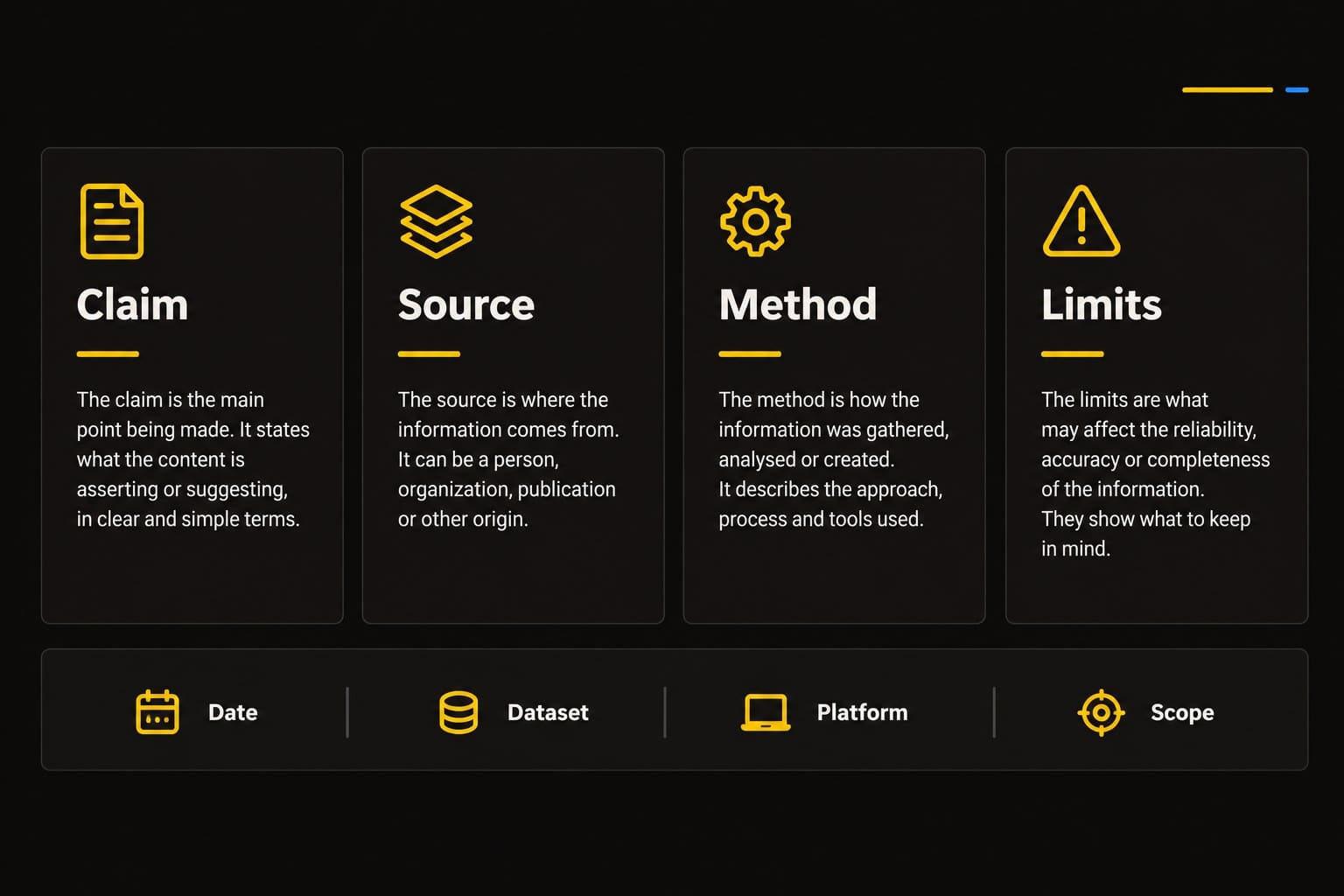
A reader should be able to understand what a claim means and how to check it. “We deliver exceptional results” supplies little information about what happened, when, or under what conditions.
A useful factual statement identifies the subject, measurement, period, and scope. If those details are unavailable, revise the claim to match what you can substantiate.
Use an evidence-provenance table. Provenance means where the information came from and how it was established.
| Claim type | Supporting material | Context to preserve |
|---|---|---|
| Business fact | Current company records or confirmation by the responsible person | Offer, location, date, and relevant limitations |
| Project example | Verified scope, records, and genuine images where applicable | Conditions, work completed, and what the example demonstrates |
| Performance statistic | Original measurement source and method | Metric, sample, timeframe, and attribution limits |
| Platform requirement | Current primary documentation | Product, surface, review date, and exceptions |
| Research result | Original paper, dataset, or report | Study date, systems tested, method, population, and limits |
| Editorial advice | Reasoning and relevant evidence | Distinguish judgment from a documented requirement |
Put qualifications close to the claim. A reader encountering the statistic should not have to reach the end of the page to discover it concerns a small sample or a different platform.
Link to the source that supports the statement. Avoid decorating a weak claim with a citation to a page that discusses the general topic but does not establish the asserted result.
4. Add Original Evidence Worth Referring To
Original value can take several forms: a documented example, a useful comparison, an explanation of a real process, or a worksheet that helps someone make a decision.
Choose evidence appropriate to the question. For an estimate comparison, a blank scope table may be useful. If the company has a relevant completed project, a verified example can help explain why particular conditions mattered.
Describe the relationship between evidence and conclusion:
- What was observed or measured?
- What does that support?
- What remains uncertain?
- Where would the explanation not apply?
Avoid claiming experience you cannot document. A hypothetical example is useful when clearly labeled; it should not appear as a customer story or a measured result.
Preserve the Limits of Small Samples
Small samples can reveal questions worth investigating. Present their scope honestly.
If you summarize customer inquiries, record the number reviewed, period, selection method, and relevant question. Explain that those records describe your sample rather than all buyers.
For research statistics, identify the dataset, study date, platform or system, measurement method, and limits. Without that context, a percentage is difficult to interpret.
The original GEO research paper evaluates approaches within a defined research benchmark and reports variation across domains. Its findings are research evidence, not a promised improvement for a current client or every live AI-search product.
Use research to inform hypotheses and further review. Do not convert a benchmark result into a guaranteed citation increase or revenue forecast.
5. Check Freshness and Page Access
Review the information that can change: service details, business facts, platform instructions, prices, credentials, and measurement periods.
Update material when the underlying information changes. Keep historical examples attached to their actual dates rather than rewriting them as current results.
Record who owns the review and what would trigger another check. A platform setup guide may need attention after a product change; a project example may need an accuracy or permission review when its details are revised.
Then review access for the relevant search experience. Google’s guidance requires a supporting page to be indexed and eligible for a search snippet. OpenAI’s crawler documentation distinguishes ChatGPT search access from potential training use. Apply the appropriate checks rather than one generic “AI access” rule.
Ask the website administrator to investigate documented access restrictions and relevant inspection evidence. Keep essential information available as readable content, with useful internal links and accurate supporting assets.
Access is an opportunity to be considered. It does not establish that the page will be selected for a particular answer.
A Source-Quality Checklist for One Page
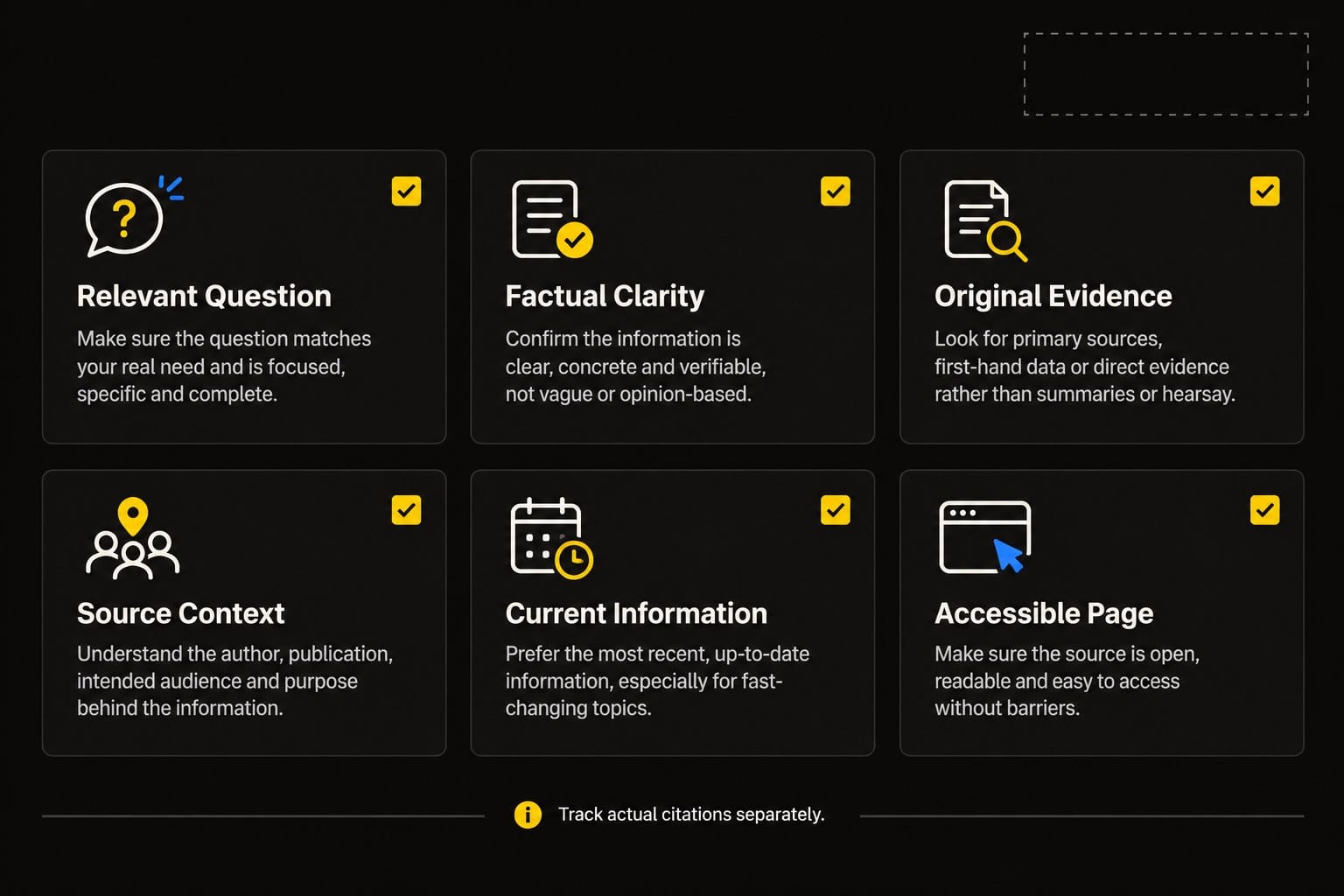
Use present, incomplete, inconsistent, missing, or not applicable to record each area. Add evidence and the next action rather than calculating a supposed citation probability.
| Review area | Check | Evidence or action to record |
|---|---|---|
| Relevance | The page answers a defined customer question | Question, audience, and decision |
| Scope | The explanation states where it applies | Conditions and exclusions |
| Factual clarity | Important claims have a precise meaning | Subject, measurement, and wording |
| Provenance | Claims have traceable support | Records, primary sources, or responsible reviewer |
| Original value | The page adds useful evidence or judgment | Example, comparison, process, or decision aid |
| Context | Statistics and research retain their limits | Sample, date, method, platform, and caveats |
| Freshness | Changing facts have been reviewed | Review date and owner |
| Access | Relevant platform checks have been completed | Findings and any documented obstruction |
| Presentation | Essential information is readable and usable | Text, mobile tables, labels, and useful links |
| Business identity | Company and service details are accurate | Name, genuine location, offer, and contact route |
| Customer action | The next step fits the question | Relevant page or working action |
| Measurement | Actual citations have separate records | Saved answer, URL, conditions, and accuracy check |
The AI Search Readiness Checklist can support the broader page review. Use a separate log for observed answers and citations.
6. Track Citations and Improve the Weak Part of the Source
Choose relevant questions and repeat them under conditions as comparable as you can make them. Save the full answer, exact cited URL, date, platform, search mode, and relevant location or conversation context.
For each citation, inspect the claim it supports. Did the answer preserve your page’s conditions, timeframe, and meaning? Record inaccurate interpretations as well as useful inclusion.
Where available, Bing Webmaster Tools’ AI Performance reporting can supplement manual observations with supported-surface citation records. Microsoft notes that its counts do not establish placement within an individual answer and that grounding-query data is a sample. Preserve the reporting coverage and period.
Keep three review questions separate:
- Source quality: What confirmed weakness did the page review identify?
- Observed inclusion: What did the recorded answers or report show?
- Business effect: What visits, qualified actions, and completed outcomes can be substantiated?
Improve a documented weakness and retain a change log. A correction might make a claim more accurate even if citation observations remain unchanged. That is still a reason to keep the accurate information.
If citations rise after several changes, investigate before claiming causation. Changes in questions, sources, platform behavior, and other work can complicate the comparison.
Connect Source Quality With the Quickest Path to ROI Areas
The Quickest Path to ROI SEO™ book supplies the broader business-first system. Apply its six areas to the source review.
Revenue opportunities: Select a customer decision related to work the business can profitably deliver.
Priority pages: Identify the page that should own the explanation and relevant next action.
Constraints: Correct a verified gap in clarity, evidence, access, or the customer path.
Authority: Add accurate proof and explain what it supports.
Measurement: Record citation evidence separately from mentions, visits, leads, sales, and profit.
Expansion: Choose further source improvements from the findings and another worthwhile customer need.
For an illustrative service page explaining estimate inclusions, the first correction might be clarifying an exclusion or adding a verified process detail. The team checks the publication, repeats relevant questions, and reviews customer feedback.
This describes a work plan. It is not an actual client result or proof that the correction will increase citations.
Frequently Asked Questions
Can a Page Be Cited Without the Business Being Recommended?
Yes. An educational page can support an explanation without recommending the company as a provider. Record the cited URL and answer purpose. Track business recommendations separately, then investigate visits and customer actions where evidence is available.
Does Adding Citations to My Article Guarantee AI Citations?
No. Good source links help readers verify claims, but they do not control another system’s selection. Use citations where they directly support the statement and strengthen the page’s usefulness. Measure any resulting AI inclusion separately.
Should I Publish Original Numbers if the Sample Is Small?
Publish only when the records and method support a useful, accurately scoped statement. State the sample size, period, collection method, and limitations. Avoid presenting your small sample as a population benchmark or using a precise percentage to imply more certainty than the evidence supports.
How Can I Preserve the Context Around a Statistic?
Keep the metric, population, period, source, method, and relevant limitation beside the number. Define what changed and what did not. Link to the original source where available, and review the wording so a reader can understand the claim without finding a distant footnote.
Why Might the Same Page Be Cited on One Platform but Absent on Another?
The question, source availability, platform behavior, and test conditions can differ. Record each surface separately and review relevant access controls. One favorable or missing citation cannot establish a universal outcome or identify the cause without additional evidence.
Review One Page as a Useful Source
Choose a relevant question and inspect the page’s claims, evidence, context, and access. Use the AI Search Readiness Checklist to select a useful correction, then record actual citations in a separate log.
For help connecting source quality with priority pages, credible evidence, and customer outcomes, Elite SEO Consulting can help evaluate the next improvement. Call 719-474-9404 to discuss the information your customers need to trust.