
You ask ChatGPT for a local provider and see competitors listed. Your business serves the area, offers the service, and has a website. Before deciding your SEO has failed or approving another content campaign, figure out what happened in that answer.
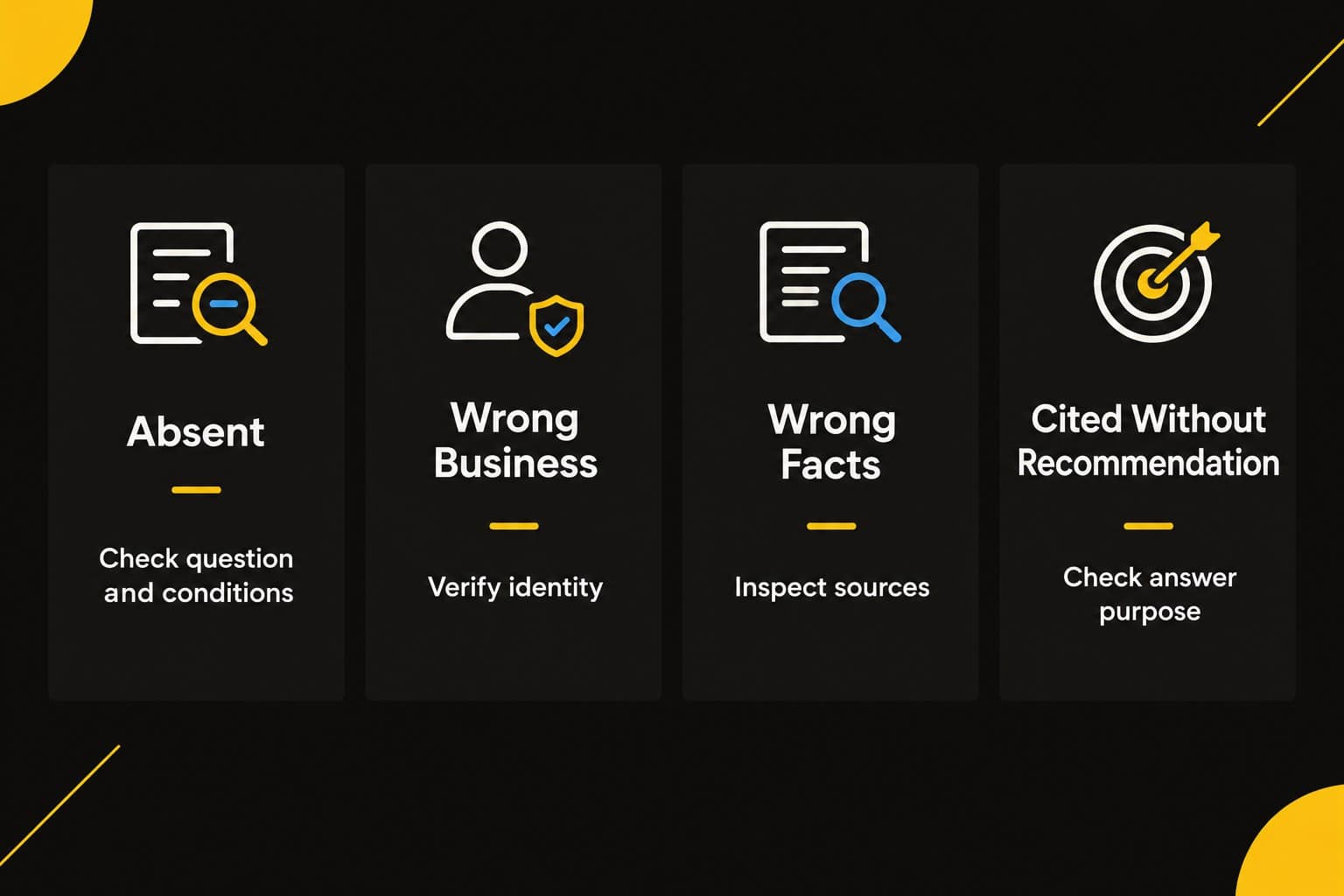
The business could be absent, confused with a similarly named company, described inaccurately, or cited as an information source without being recommended as a provider. Those situations call for different checks.
A useful diagnosis begins with the question, the search conditions, and the sources. It ends with a documented issue your team can address or a clearly stated uncertainty that needs more evidence.
Why Does ChatGPT Not Recommend My Business?
A missing recommendation may involve the question’s relevance, search conditions, unclear business identity, limited useful source coverage, or access problems. Answer variation can also complicate the observation. Repeat comparable buyer-question tests, inspect the sources, and review relevant pages before choosing a fix. Absence alone does not establish the cause.
Use this starting matrix to define the symptom. The possible explanations are investigation paths, not confirmed causes for your business.
| Symptom | First check | Possible issue to investigate | Useful next action |
|---|---|---|---|
| Business absent | Exact customer need, location, and search conditions | Test mismatch or an unresolved discovery gap | Repeat representative tests and inspect sources |
| Similar name appears | Website, location, and contact details of the named company | Identity confusion | Clarify your legitimate business facts and source references |
| Wrong service or location | The answer and cited information | Inaccurate or outdated source information | Correct documented facts where you control them |
| Own page cited, no recommendation | Purpose of the question and wording of the answer | Informational use rather than provider selection | Record the citation accurately and review provider-fit questions separately |
| Business named, no own-site citation | Sources and description | Mention or recommendation supported elsewhere | Keep mention, recommendation, and citation as separate records |
| Results vary | Comparable repeated runs | Changing conditions or inconsistent observations | Preserve the full sample before inferring a cause |
1. Confirm That the Test Represents a Real Buyer Question
Start with the offer your business wants to sell and the customer it can serve. Check whether the test describes that situation accurately.
A painting company offering residential work may not fit a question about industrial coatings. A company serving one region should not expect a recommendation for a location outside its genuine service area.
Review the question for:
- The actual service and customer type.
- The city or area involved.
- Requirements the customer needs, such as project scope or availability.
- Whether the question asks for education, comparison, or a provider.
Keep branded and unbranded tests separate. “What does [business name] offer?” supplies an identity for the assistant to examine. “Which providers offer [service] in [city]?” investigates discovery for a customer need.
Similarly, “What causes peeling paint?” asks for an explanation. A citation to an educational page may be a useful result even if no painting company is recommended.
Rewrite an unrealistic test using genuine customer language. Preserve both versions and the reason for the change so later comparisons remain understandable.
2. Repeat Tests and Record the Search Conditions
Save the full answer and its cited URLs before making changes. Record the exact prompt, date, displayed model or mode, web-search status, location context, and whether it came from a fresh or existing conversation.
OpenAI’s search guidance describes web-source inspection and the relevance of location and memory to search context. Check what search evidence is available rather than assuming that every answer uses current web information.
Use fresh conversations with consistent settings for independent discovery tests. Include the city explicitly. If you are testing a follow-up sequence, retain the earlier questions because they form part of the context.
Repeat representative questions across a manageable set of runs. Keep answers where the business is absent, present, or inaccurate. Choosing only the most favorable screenshots makes the report harder to use.
Do not interpret repeated testing as an optimization tactic. The purpose is to observe behavior and investigate uncertainty. Repeatedly asking about your brand does not establish that unrelated customers will receive more recommendations.
Separate an Observation From a Diagnosis
An observation might be: “The company was absent in these recorded tests.” A diagnosis needs additional evidence, such as a confirmed access restriction or a verifiable identity error.
If the answer changes between runs, record the variation. You may not have enough evidence to explain why it changed. Keep that conclusion available instead of turning uncertainty into a confident explanation.
3. Check Identity Errors and Ambiguous Business Names
Confirm that the named company is actually yours. Inspect its website, location, services, and contact details. A similar trading name can make a superficial mention count misleading.
Then compare your important pages and known business profiles. Look for conflicting names, old phone numbers, ambiguous locations, and descriptions that imply services you do not offer.
Review:
| Identity fact | What to verify |
|---|---|
| Business name | Current name and legitimate trading-name relationships |
| Location | Actual operating location versus a service area |
| Offer | Services and customer types genuinely supported |
| Contact details | Correct phone number, website, and inquiry route |
| People and credentials | Accurate roles and relevant qualifications |
Use the Entity & Trust Signal Checklist to organize the evidence and corrections.
Clarify the relationship between the business, its services, and its locations using accurate public information. Do not create an address, inflate credentials, or add a keyword-heavy alias simply to force a distinction.
Identity corrections help customers verify the business. Their effect on future answers still needs observation.
4. Review Sources Cited Instead of Your Business
Open the cited pages and inspect what supports the answer. OpenAI warns that search results and citations may be incomplete or incorrect, so the link itself is not sufficient verification.
Check the source’s actual relevance: the right business, offer, location, timeframe, and customer need. Record whether it supplies an explanation, a provider option, or a business fact.
A competitor’s page may answer a question your page leaves unresolved. That is a content-review finding. It does not prove that the missing section caused the competitor’s selection.
Likewise, an outside profile with your old phone number is a documented source error. Whether it explains the current AI answer depends on the evidence available.
Use a source-check record:
- Cited URL and date inspected.
- Claim or description it appears to support.
- Whether the source actually supports that statement.
- Verified error, missing information, or useful comparison.
- Who controls the source and what correction is possible.
Correct information you control and request updates from outside source owners when you can substantiate the error. Use available response-feedback options where appropriate.
Avoid assuming that one directory or link will solve the problem. Review the specific evidence before buying a placement or recreating a competitor’s content.
5. Inspect Relevant Page Access and Buyer Fit
Ask the person responsible for your website to review the page connected to the customer opportunity. Use current platform documentation rather than a generic instruction to “allow AI.”
OpenAI’s crawler documentation identifies OAI-SearchBot for search and GPTBot for potential training use, with independent controls. It also distinguishes user-initiated visits from search eligibility. Review applicable crawler rules and hosting restrictions against that guidance.
Check the intended public page’s behavior, relevant configuration, and available server evidence. A page loading in your browser does not establish how every crawler request is handled. Have the administrator inspect legitimate requests and documented access controls.
A confirmed search-access obstruction deserves attention. A missing recommendation alone does not prove such an obstruction exists.
Review Whether the Page Helps This Customer
Read the page against the exact question. Can someone tell whether the business offers the service, serves the location, and can handle the relevant situation?
Look for an unresolved explanation, a consequential claim without proof, or a next step that does not fit the customer’s need. Relevant project evidence can help someone evaluate the offer, but if you present it as your experience, it should reflect real work.
Use the AI Search Readiness Checklist for the page review. Keep those findings separate from the recorded answer tests.
Traditional search rankings are useful context. They don’t promise a specific ChatGPT recommendation or explain why a different business appeared.
6. Choose the Next Fix and a Retest Date
Prioritize the confirmed problem closest to a valuable customer decision. An incorrect phone number, a mismatched service area, or a documented access restriction can be corrected with a concrete fix. Persistent absence without an identified weakness may need further investigation.
Use the six connected areas in the Quickest Path to ROI SEO™ book to organize the decision:
- Revenue opportunities: Is the tested need relevant to profitable work you can deliver?
- Priority pages: Which page should help that customer evaluate the offer?
- Constraints: What specific weakness have you verified?
- Authority: What accurate proof or source correction is needed?
- Measurement: What implementation check and comparable retest will you record?
- Expansion: What evidence would justify additional work?
Give the action an owner, a completion condition, and a review date. “Improve ChatGPT visibility” is too broad to verify. “Correct the phone number on the contact page and identified profile, then repeat the original accuracy question” is reviewable.
A Hypothetical Diagnostic Example
Consider an illustrative gutter company that serves a particular city. In a hypothetical saved answer, a similarly named company appears with a different website and address.
The first check is identity, not the number of blog posts. The team verifies which company the answer describes, reviews its own website and known profiles, and documents any ambiguity or factual error.
It corrects a verified outdated detail when it can, requests a substantiated external correction, and records the implementation date. It then repeats comparable branded and unbranded questions separately.
This example describes a diagnostic approach. It is not a real client test, proof of the cause, or a promise that the next answer will change.
A Troubleshooting Worksheet
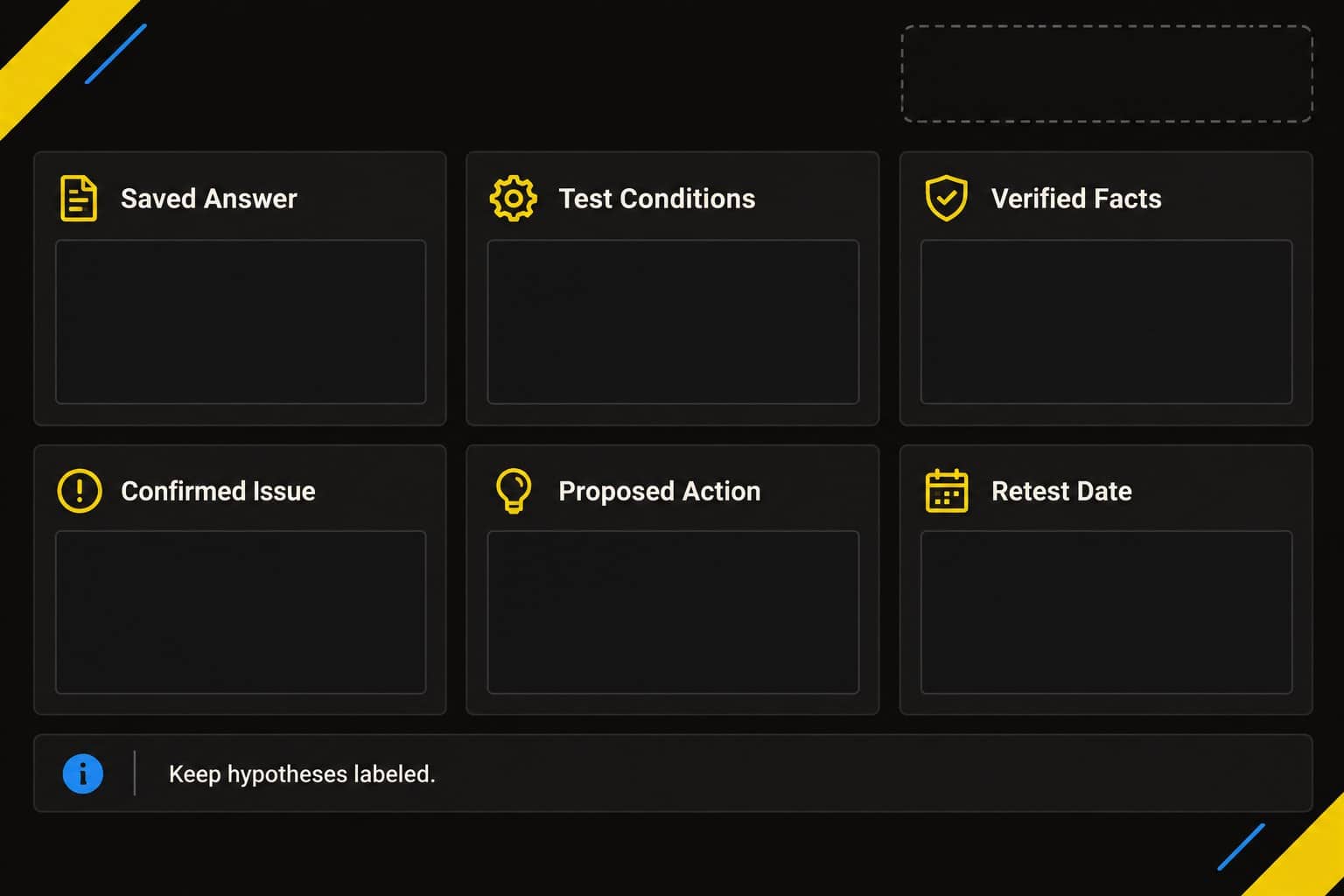
Use one record per issue. Keep the source evidence and your interpretation distinguishable.
| Field | What to record |
|---|---|
| Symptom | Absent, ambiguous, inaccurate, cited without recommendation, or inconsistent |
| Customer opportunity | Offer, suitable customer, and genuine location |
| Saved evidence | Exact prompt, full answer, cited URLs, date, and conditions |
| Repeated observations | Comparable runs, including unfavorable results |
| Identity check | Which business the answer actually describes |
| Source check | Verified support, error, or information gap |
| Page-readiness check | Relevant access, explanation, proof, and customer-action findings |
| Confirmed issue | What the evidence establishes |
| Hypothesis or uncertainty | What remains unproven |
| Proposed action | Specific correction or further investigation |
| Owner and completion check | Responsibility and verification of implementation |
| Retest and business review | Date, original questions, and useful customer outcomes to monitor |
Verify implementation first. Retest visibility afterward, allowing information to be discovered and updated without promising a universal change timeline.
If the business appears but visitors don’t take action, the next investigation may involve page purpose, evidence, or the inquiry process. Mentions, visits, qualified leads, and completed sales remain different outcomes.
Frequently Asked Questions
Why Is a Similarly Named Company Appearing Instead of Mine?
Verify the website, location, and services in the answer. It may concern another legitimate business, or the response may contain an identity error. Clarify your own accurate information and inspect the cited sources. A similar name alone does not establish how the system selected the company.
Does One Missing Recommendation Prove an Indexing Problem?
No. It establishes absence in that answer. Check search conditions and relevant sources, then inspect the website’s access and indexing evidence where appropriate. Diagnose an obstruction from the technical findings rather than the missing mention alone.
Why Is a Competitor Mentioned When My Website Ranks Above Theirs?
A conventional ranking and a generated recommendation are different observations. Review the question, business fit, and sources instead of assuming the ranking should determine the answer. You may find a useful information gap, but one response cannot reveal an unpublished selection factor.
Will Asking ChatGPT About My Brand Repeatedly Improve Its Recommendations?
Repeated questions can help you examine responses under documented conditions. They don’t improve recommendations for other users. Separate measurement from implementation and make changes only when the evidence supports a useful correction.
Can I Correct a Wrong Phone Number or Location in an AI Answer?
You can correct information you control, request substantiated source updates, and use available feedback options. Save the original error and verified fact, then retest. Correcting a source does not guarantee that every future answer will immediately reflect it.
Diagnose the Evidence Before Expanding the Work
Save the answer, verify the customer question, and identify the specific symptom. Use the Entity & Trust Signal Checklist to review business facts and supporting evidence, then assign the most useful documented correction.
For help connecting ChatGPT observations with identity, relevant page access, and customer-fit checks, Elite SEO Consulting can help review the evidence. Call 719-474-9404 to discuss the issue and next steps.