
Your small business has limited marketing time, a website that needs attention, and another proposal promising visibility in AI answers. The first decision is where a practical improvement could help a suitable customer find you, understand your offer, and act.
Generative engine optimization, or GEO, focuses on a business’s presence in AI-generated answers. For a small business, the useful starting point is a focused project tied to a service worth selling and a customer question worth answering.
You need enough evidence to choose the work, a clear owner to implement it, and a way to review what happened. That keeps the first investment manageable and gives the next decision a basis.
What Should a Small Business Do First for GEO?
Choose one profitable service and the questions customers ask before buying it. Establish a small visibility baseline, review the page that should help those customers, and correct a meaningful access, identity, evidence, or conversion problem. Assign an owner, set review dates, and expand when useful evidence supports another investment.
Follow this sequence:
- Select a service you want more qualified demand for.
- Identify the questions that matter before purchase.
- Record a manageable baseline on a relevant AI search surface.
- Find the constraint closest to the customer decision.
- Assign one improvement with a defined scope.
- Review early evidence and later business outcomes.
1. Start With a Service Worth Winning
Begin with the business offer. Which service can you deliver well, at a worthwhile margin, with the capacity you currently have?
That question matters because an unsuitable offer can generate inquiries your team cannot profitably serve. A busy company might need a different project mix rather than more leads.
Compare possible services using four considerations:
- Fit: Can you serve the customer and location involved?
- Value: What does the work contribute after direct delivery costs?
- Capacity: Can your team take on additional work without hurting service quality?
- Evidence: Do customer conversations or available search records support the opportunity?
A gutter company might prefer replacement projects over minor repairs, while another business has the opposite staffing and margin situation. Choose from your actual operating conditions.
Write the opportunity plainly: “We want more qualified replacement inquiries from homeowners in the locations we genuinely serve.” That gives the project a purpose you can discuss with your team or agency.
Keep the financial assumptions visible. A typical sale value differs from gross profit, and an attractive margin doesn’t tell you how many customers you will win.
2. Find the Questions That Matter Before Purchase
Use questions customers already ask. Review estimate requests, sales conversations, form submissions, and objections that delay a decision.
The best starting questions help someone choose, assess suitability, or understand what happens next. A homeowner considering new gutters may ask when repair is appropriate, what affects replacement cost, or what an assessment includes.
Organize a short list:
| Decision | Example question | What the answer should help the customer do |
|---|---|---|
| Suitability | “Should I repair my gutters or replace them?” | Understand the considerations and when an inspection is needed |
| Scope | “What is included in a gutter replacement estimate?” | Compare offers on a meaningful basis |
| Provider fit | “Who installs replacement gutters in [city]?” | Find providers that genuinely serve the location |
Use available search data as another source of evidence. Keep conventional keyword estimates separate from assumptions about how often people ask an AI assistant the same question.
Avoid choosing a topic solely because it is popular. A question your company can answer credibly and connect to an appropriate service may offer a stronger starting point.
Identify the page that should help the customer make that decision. An existing service page may need a clearer explanation, supporting proof, or an easier next step. Define its job before producing another article.
3. Establish a Small, Repeatable Visibility Baseline
Choose one AI search experience that is relevant to your customers and accessible to your team. You can broaden coverage later when the work and reporting justify it.
Record a small set of realistic questions, repeat them under comparable conditions, and keep the full answers and source links. Include the city explicitly when local relevance matters.
Your baseline should capture:
- The exact question, date, and search surface.
- The displayed model or mode where available.
- Whether web search was involved.
- Relevant location and conversation conditions.
- Whether the business was named, its own page cited, or the business recommended.
- Whether the description and sources were accurate.
Separate a question naming your company from one describing a customer need without naming it. The first examines awareness and accuracy for a known business. The second examines discovery.
You can begin with a simple document or spreadsheet. The important requirements are consistent records and thoughtful review. A paid dashboard may become useful as manual work grows, but it doesn’t create commercial value on its own.
Treat the baseline as a sample. Repeated favorable answers don’t tell you how many customers are exposed to your business. Testing also does not, by itself, improve your visibility.
4. Choose the Constraint Closest to the Customer Decision
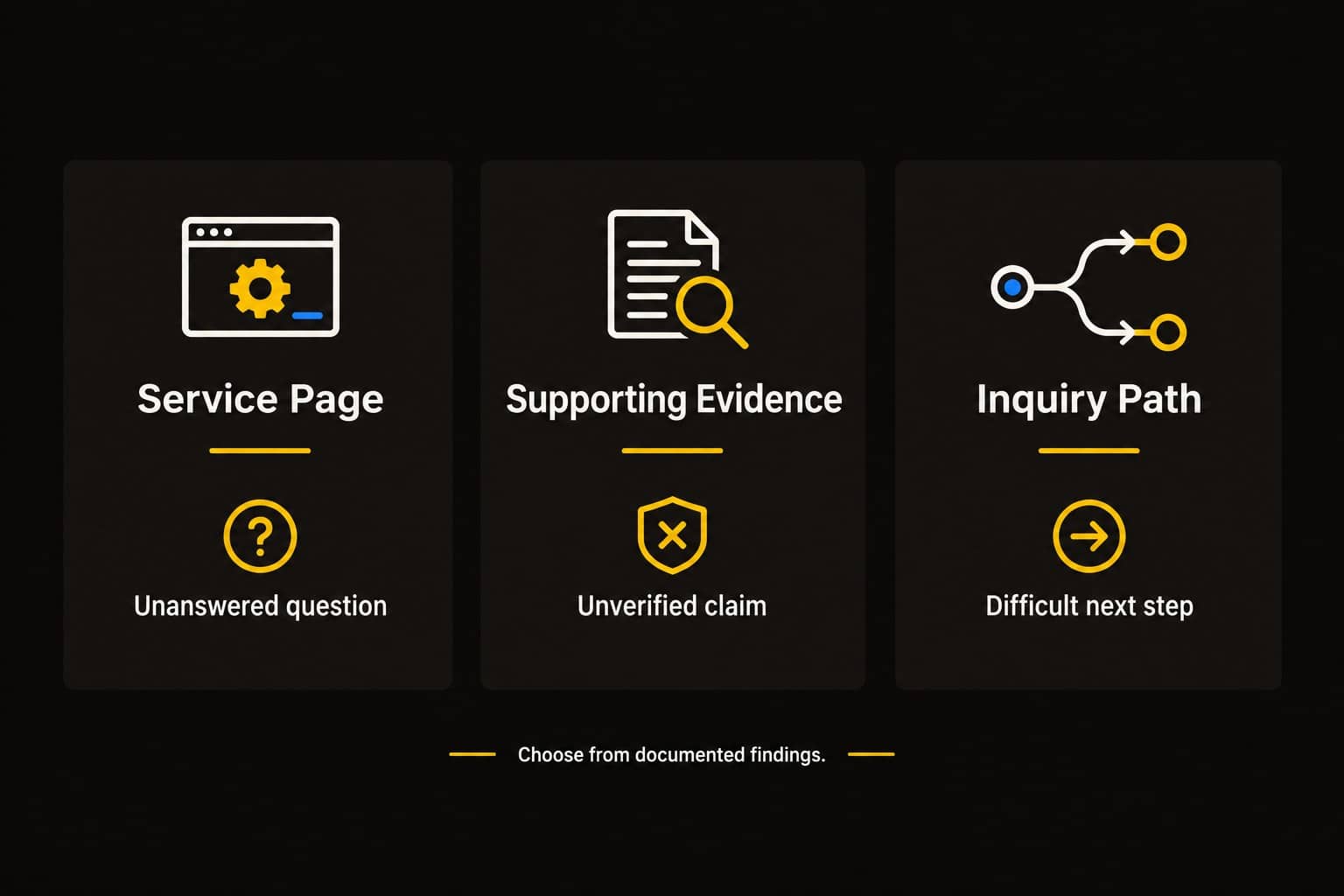
Review the priority page and identify the specific weakness that limits its usefulness or availability.
For Google’s AI features, Google’s guidance says existing SEO fundamentals apply, and a supporting page must be indexed and eligible for a search snippet. For ChatGPT search, OpenAI’s crawler documentation distinguishes search access from training access. Check the relevant platform instead of applying one configuration assumption everywhere.
Keep the first review practical:
| Potential constraint | What to check | Why it may deserve attention |
|---|---|---|
| Access | Relevant inspection findings and platform controls | A documented obstruction can limit discovery |
| Identity | Name, services, contact details, and genuine service area | Conflicting facts can confuse customers |
| Explanation | An important buying question or limitation | Incomplete information can delay a decision |
| Evidence | Relevant proof behind consequential claims | Customers need a basis for evaluating the offer |
| Conversion | Mobile and desktop inquiry process | Interested visitors need a working next step |
| Measurement | Valid inquiry and sales records | Spending decisions need outcome evidence |
A broken estimate form usually warrants immediate attention when the page already receives suitable visitors. An inaccurate service area deserves correction. A missing project example matters when customers need proof of relevant experience.
Use the AI Search Readiness Checklist to document the findings. For broader SEO foundations, the existing guide to what SEO work a small business should do first covers the shared starting decisions.
Choose the weakness from evidence. An absent AI mention alone doesn’t prove a technical failure, and a high checklist score doesn’t guarantee a recommendation.
5. Assign the First Improvement and Its Owner
A useful plan names the change, the responsible person, and what completion looks like.
“Improve AI visibility” is too broad to hand to a developer or content writer. “Repair and test the mobile estimate form on the replacement page” is a task someone can finish and verify.
Compare the possible first tasks before assigning one:
| Candidate | Evidence needed | Completion condition |
|---|---|---|
| Service-page improvement | A specific unanswered customer question | Accurate explanation published and reviewed by the service expert |
| Evidence-gap correction | A meaningful claim with inadequate support | Relevant, verified proof added with appropriate context |
| Conversion repair | Reproducible inquiry-path failure or confusion | Suitable visitors can complete the action and the business receives it |
Estimate effort honestly. Include reviewing the draft, supplying evidence, checking implementation, and recording the change. A task that takes an hour to publish may require several hours of preparation.
A Hypothetical First-Task Example
Consider an illustrative gutter company. All figures below are planning assumptions, not client results or forecasts.
- Typical replacement sale: $2,000.
- Assumed gross margin after direct delivery costs: 35%, or $700 gross profit per job.
- Customer question: “How do I know whether replacement is appropriate?”
- Priority page: the existing gutter replacement service page.
- Findings: the explanation is incomplete, a relevant project example is missing, and the mobile estimate form fails during testing.
- First task: repair and verify the estimate form.
- Illustrative task effort: two hours at an internal planning cost of $60 per hour, or $120, excluding any additional charges.
- Owner: the website administrator; the office team verifies receipt of the test inquiry.
- Early checkpoint: verify form operation immediately after the repair, then review valid inquiries after two weeks.
- Later checkpoint: review qualified inquiries and completed sales after enough of the normal sales cycle.
The form repair addresses a confirmed problem on the customer path. The page explanation and project evidence remain useful follow-up tasks.
Comparing the assumed $120 task cost with $700 gross profit helps size the proposed effort. It does not prove the repair will win a job or that GEO can credit any later sale. Include all actual project costs when evaluating the completed work.
6. Set Evidence and Financial Review Dates
Use an early checkpoint to verify implementation and inspect observations. Set the commercial review around when customers typically inquire, decide, and complete a purchase.
An early review can ask whether the change is accurate, usable, and supported by evidence. A later review can ask whether qualified demand and completed business outcomes justify further investment.
Keep these measures separate:
| Evidence | What it can help explain |
|---|---|
| Accurate AI description | Whether the recorded answer represents the business correctly |
| Citation or recommendation | An observed discovery outcome under stated conditions |
| Identifiable referral | A recorded website visit from an available source |
| Qualified inquiry | Interest that fits the offer and customer criteria |
| Completed sale and gross profit | A documented business outcome |
| Full project cost | What the business invested to produce and maintain the work |
Ask customers how they found you and retain their answers. Someone may discover the company through AI and later arrive through branded search or a direct visit. Record reported influence without assigning every unexplained visit to AI.
Seasonality, advertising, existing SEO, and sales response also matter. Avoid giving several channels full credit for the same sale.
Expand when the evidence supports a next opportunity. If inquiries arrive but do not fit the service, review the offer and question selection. If suitable visitors struggle to act, improve that path. If a useful page lacks supporting proof, address the evidence gap.
A First-Task Worksheet for Your Business
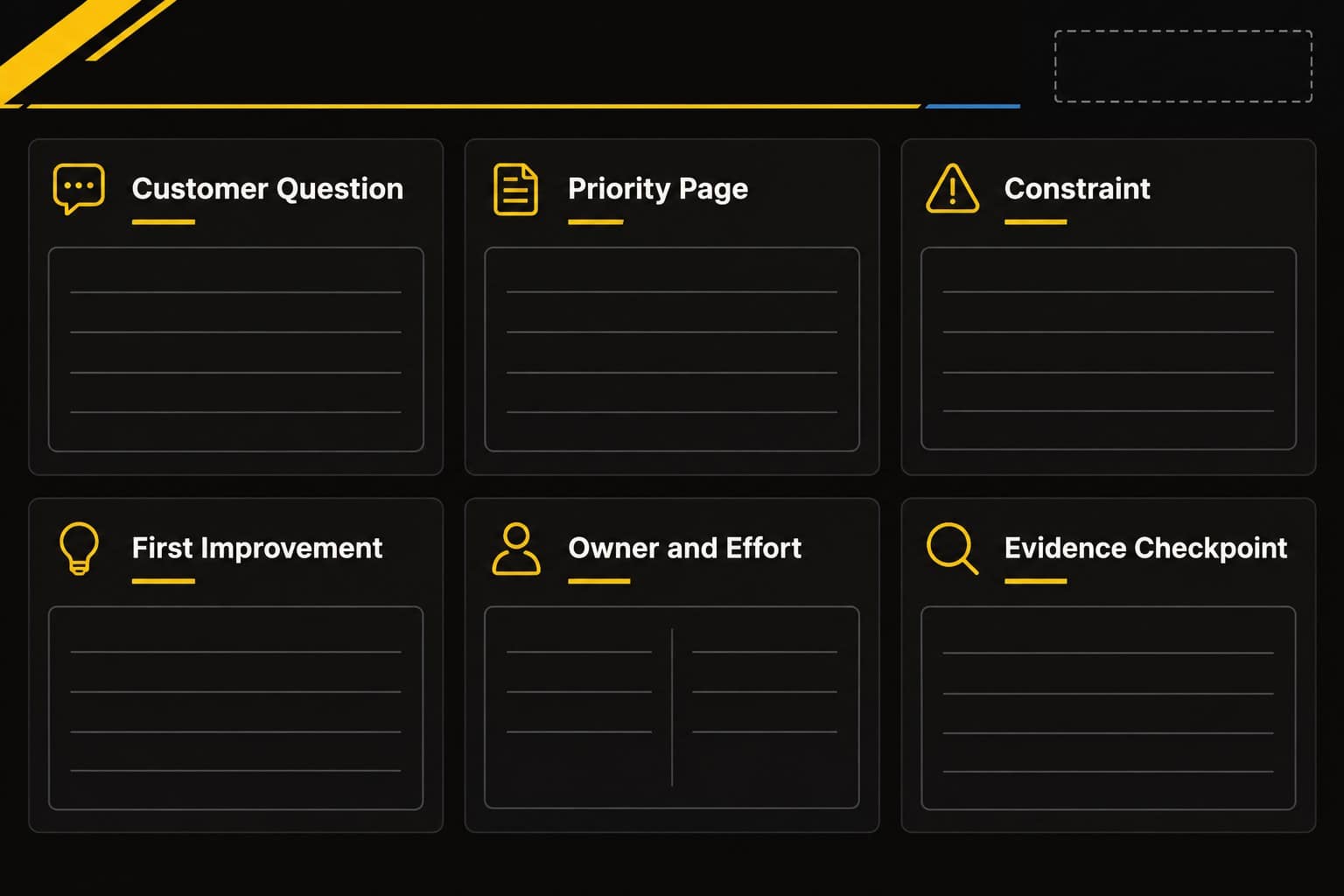
Complete this brief before approving the initial project. It follows the six connected areas in the Quickest Path to ROI SEO™ book: revenue opportunities, priority pages, constraints, authority, measurement, and expansion.
| Field | Your decision |
|---|---|
| Revenue opportunity | Which profitable offer and suitable customer do you want more of? |
| Customer question | What must that customer understand before buying? |
| Evidence of demand | Which conversations, search records, or comparable observations support the question? |
| Priority page | Which page should answer it and support the next action? |
| Current constraint | What documented weakness limits progress? |
| Supporting authority | What accurate proof will help the customer evaluate the offer? |
| First improvement | What specific change will you implement? |
| Owner and effort | Who will do it, and what work and cost are included? |
| Completion check | What will show the task was implemented correctly? |
| Measurement and checkpoints | What will you record early and after the sales cycle? |
| Expansion decision | What evidence would justify the next task? |
Keep the answers concrete enough that your team can use them. A worksheet that names one page, one correction, and one owner gives you a starting point you can review.
Frequently Asked Questions
Can I Begin GEO Without Buying a Tracking Tool?
Yes. You can record a small set of questions, conditions, answers, and sources manually. A tool may help when coverage or reporting becomes difficult to maintain. Choose it for a defined workload rather than assuming software is the first requirement.
Should My First GEO Investment Be a Blog Article or a Service-Page Improvement?
Choose the work that addresses the documented weakness closest to the customer decision. Improve a service page when it leaves an important question unanswered or makes action difficult. Create a blog article when a distinct supporting question needs its own useful answer and route to the offer.
How Do I Choose an AI Platform to Test First?
Start with evidence about your customers, available access, and the questions you can review consistently. Customer-reported discovery can help guide the choice. Name the exact search surface and conditions. Expand coverage when another platform represents a meaningful opportunity you have resources to evaluate.
What If My Site Has Very Little Existing Traffic?
Review discovery foundations, offer clarity, and measurement before assuming AI visibility is the missing ingredient. You can still establish a small baseline and improve an important page. With limited traffic, use implementation evidence and customer feedback while acknowledging that commercial conclusions may take longer.
When Should a Small Business Ask for Specialist Help?
Seek help when you cannot verify access or indexing findings, implement the necessary correction, or connect reporting with customer outcomes. Define the problem and expected deliverables first. A focused review is easier to assess than an open-ended package with unclear ownership or success criteria.
Start With One Useful Improvement
Choose a valuable service, record the customer question, and review the page that should help answer it. Use the AI Search Readiness Checklist to select the first improvement, then give it an owner and a review date.
If you need help choosing between access corrections, page improvements, supporting evidence, or conversion work, Elite SEO Consulting can evaluate the opportunity with you. Call 719-474-9404 to discuss a practical first step for your business.