
A potential customer asks ChatGPT for a provider, a comparison, or help choosing a service. Your business would be a reasonable fit, but the answer names other companies. Before investing in more content, determine what the customer asked, whether they used web search, and what information the answer used.
Getting your business mentioned in ChatGPT starts with making it easier to discover and evaluate accurately. Your website should explain who you serve, what you offer, where you operate, and what evidence supports your claims. You also need a repeatable way to observe whether relevant answers include you.
That work can improve information quality and customer readiness. It cannot give you control over an independent recommendation.
How Can a Business Improve Its Visibility in ChatGPT?
Start by testing relevant buyer questions and recording mentions, citations, and recommendations separately. Review search-crawler access, clarify your business identity and services, strengthen useful pages with verifiable evidence, and correct inaccurate third-party information. Repeat comparable tests and track customer outcomes. These steps support readiness; they cannot guarantee inclusion.
Use the following sequence to keep the work connected to a customer opportunity:
- Establish a baseline using realistic buyer questions.
- Clarify your business identity and offer.
- Review access for ChatGPT search.
- Improve the pages and evidence customers need.
- Review relevant third-party references.
- Retest and connect discovery with business outcomes.
1. Test Buyer Questions Before Changing the Website
Start with a service or product you can deliver profitably. Identify the questions customers ask before buying it, using sales conversations, estimate requests, support questions, and available search data.
For a local painting company, useful questions might involve commercial projects, occupied buildings, preparation requirements, or scheduling. The most valuable question depends on the work the company actually wants to win.
Keep the initial set small enough to review carefully. A few representative questions with repeated observations can teach you more than hundreds of prompts you never review.
Separate Branded Awareness From Unbranded Discovery
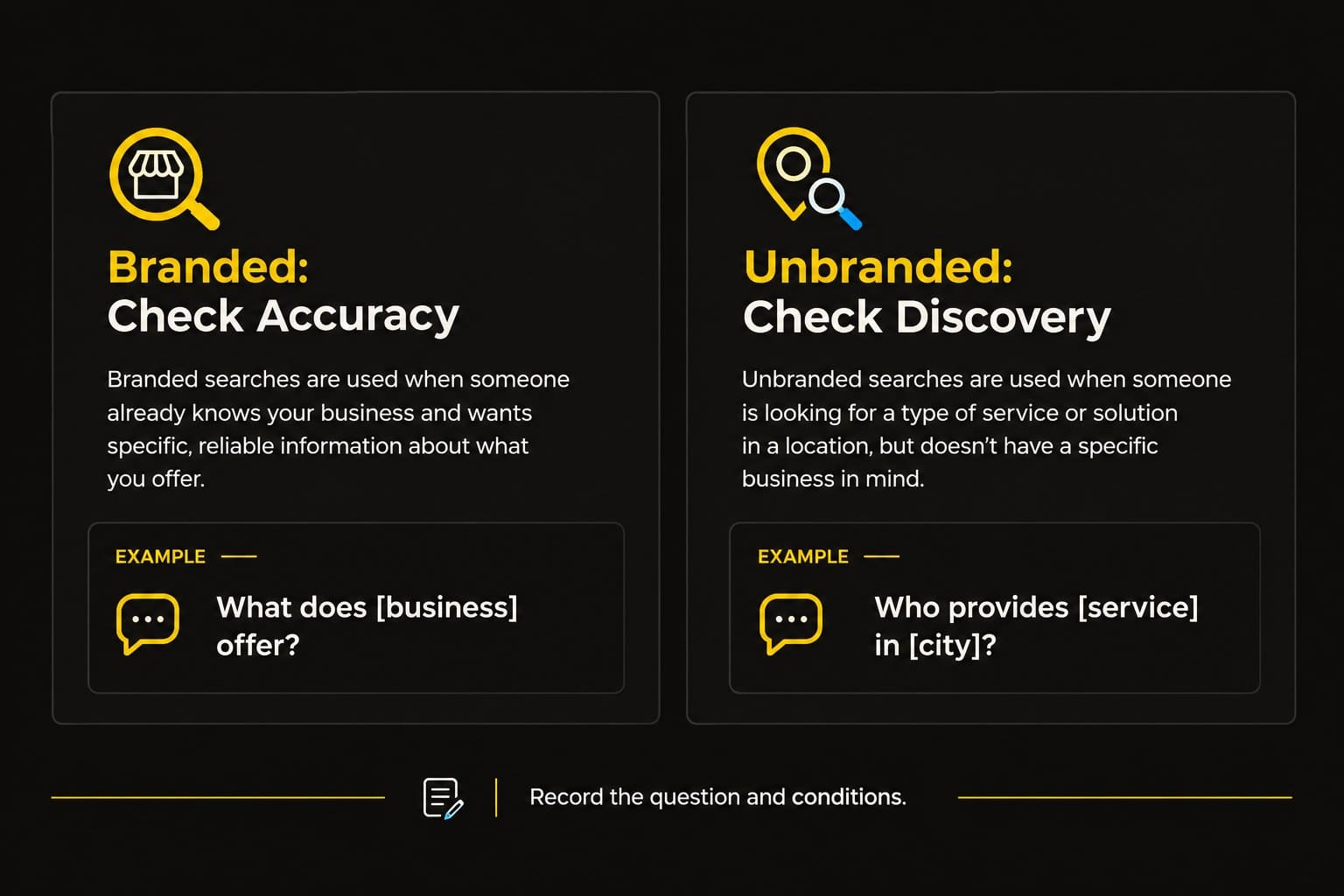
A branded question includes your company’s name. It helps you investigate whether the answer accurately describes an already identified business.
An unbranded question describes a customer need without naming your company. It helps you investigate whether the business appears during discovery.
| Test type | Illustrative prompt | What it helps you investigate |
|---|---|---|
| Branded identity | “What services does [business name] provide in [city]? Use current sources.” | Accuracy of business facts and supporting sources |
| Unbranded provider discovery | “Which contractors offer commercial painting in [city] for occupied office buildings?” | Whether the business appears for a relevant need |
| Unbranded buying decision | “How should I compare commercial painting estimates for an occupied office building?” | Whether useful content is cited during evaluation |
Replace placeholders with accurate details. Keep the question natural and record its exact wording.
Asking “Why is my company the best?” supplies the desired conclusion. It doesn’t show that an unfamiliar customer would discover the business.
Confirm the Search Conditions
OpenAI’s guidance on ChatGPT search explains that responses can use web sources and that location and memory can affect search context. Record whether search was used and inspect the cited pages. Include the relevant city explicitly when testing local discovery.
For your baseline, use fresh conversations with consistent settings. Record the model or mode displayed, account context, date, location assumptions, and whether personalization was active. This reduces some avoidable differences without making the results universal or perfectly reproducible.
2. Explain Who You Are and What You Offer
A website should let a potential customer identify the business and determine whether it fits their need without guessing.
Review the homepage, contact page, important service pages, and relevant business profiles. Look for inconsistent company names, old phone numbers, conflicting service areas, and unsupported descriptions.
Useful identity information includes:
- The business name and any legitimate trading-name relationship.
- The actual services or products offered.
- The customers those offers suit.
- Genuine operating locations and service areas.
- Current contact details and a working inquiry route.
- Relevant people, experience, and credentials.
Precision matters. Serving a city is different from maintaining an office there. Keep those facts clear; don’t invent an address or imply a location you don’t have.
A service page should explain the work in language a customer would recognize. “Complete commercial solutions” says little about whether you paint offices, warehouses, retail spaces, or other property types.
Use the Entity & Trust Signal Checklist to organize a review of the business facts and their supporting evidence. Correct the source information you control and request corrections elsewhere when appropriate.
This is useful information management. Any effect on ChatGPT visibility should be observed rather than assumed.
3. Check ChatGPT Search Access and Crawler Controls
Ask your website administrator to review the priority page’s access, robots.txt rules, and hosting or security restrictions against OpenAI’s current crawler documentation.
The relevant distinctions are:
| User agent | Documented role |
|---|---|
| OAI-SearchBot | Discovery for ChatGPT search |
| GPTBot | Crawling for potential model-training use |
| ChatGPT-User | Certain user-initiated page visits; not the search-eligibility control |
Search and training controls are independent. Allowing GPTBot is not a substitute for reviewing search access. OpenAI also identifies its published searchbot IP ranges for hosts and security systems to consider.
Treat this as a configuration review, not an instruction to weaken site security. Verify the documented crawler identity and inspect legitimate requests rather than trusting a user-agent string alone.
Also check the basics: the page should load reliably, its important information should be available, and its internal links should point to useful destinations. A browser visit shows what a person can access; server logs and configuration checks provide different evidence about crawler access.
An absent mention does not by itself establish a crawl problem. Access is one check within a broader review of the question, business fit, and available information.
4. Strengthen Useful Pages and Verifiable Evidence
Choose the page most closely connected with the customer opportunity. Improve its ability to answer a buying question and support a reasonable decision.
For a commercial painting service, that could mean explaining preparation, disruption, scheduling, project scope, and how estimates are developed. Include important limitations and factors that require an on-site assessment.
Match evidence to the question:
| Customer question | Useful supporting information |
|---|---|
| “Can you handle a property like mine?” | Verified project examples with relevant scope and conditions |
| “What does your estimate include?” | A clear explanation of assessment, preparation, materials, and exclusions |
| “Who will do the work?” | Accurate team and supervision information |
| “How will you reduce disruption?” | A documented scheduling process and relevant project examples |
Use real examples when presenting them as your work. Preserve the meaning of customer testimonials, and retain the timeframe and basis for measurement behind performance claims.
An FAQ can answer a question briefly, while a fuller section explains the conditions and exceptions. Avoid turning every sentence into a disconnected answer fragment.
Give supporting content a clear role. A comparison article might help someone understand their options, then link to the right service page. The Content-with-a-Job Planner can help define the audience, question, evidence, and next action before drafting.
These are editorial recommendations for useful, credible information. They are not a published list of ChatGPT ranking factors.
5. Review Relevant Third-Party References
Look beyond your website for information a customer might use to investigate the business. Relevant sources can include genuine professional profiles, local organizations, publications, project coverage, and customer reviews.
First review the sources cited in your recorded ChatGPT answers. Open them and check what they actually say. Note incorrect details, outdated descriptions, and legitimate sources you had overlooked.
Then review the most relevant references you know exist. Correct information you can edit and contact the source owner about documented errors.
Earn coverage by contributing something useful: a well-supported case study, an informed explanation, an original project example, or participation in a relevant organization. A source’s independence and relevance matter when assessing what it demonstrates to a customer.
Do not assume a particular directory, link, or media placement guarantees a ChatGPT mention. If someone sells a placement on that basis, ask for the evidence and the exact claim they can substantiate.
Keep third-party work tied to the priority opportunity. Broad exposure may have value, but it should not automatically outrank an unresolved problem on the page where a customer requests an estimate.
6. Retest Mentions, Citations, and Recommendations Separately
After implementing a documented change, repeat the original questions under conditions as comparable as you can make them. Retain the answer and the cited URLs, including observations where the business is absent.
Use separate fields for each outcome:
- Mention: The answer names the business.
- Citation: The answer links to your page as a source. Record third-party citations about the business separately.
- Recommendation: The answer presents the business as a provider option for the stated need.
- Accuracy: The description correctly represents the offer and location.
- Referral: A user reaches your website through a link, where identifiable.
An educational page could be cited without recommending the business. A recommendation could appear without a link to your website. Neither establishes that an inquiry or sale occurred.
A Reusable ChatGPT Visibility Log
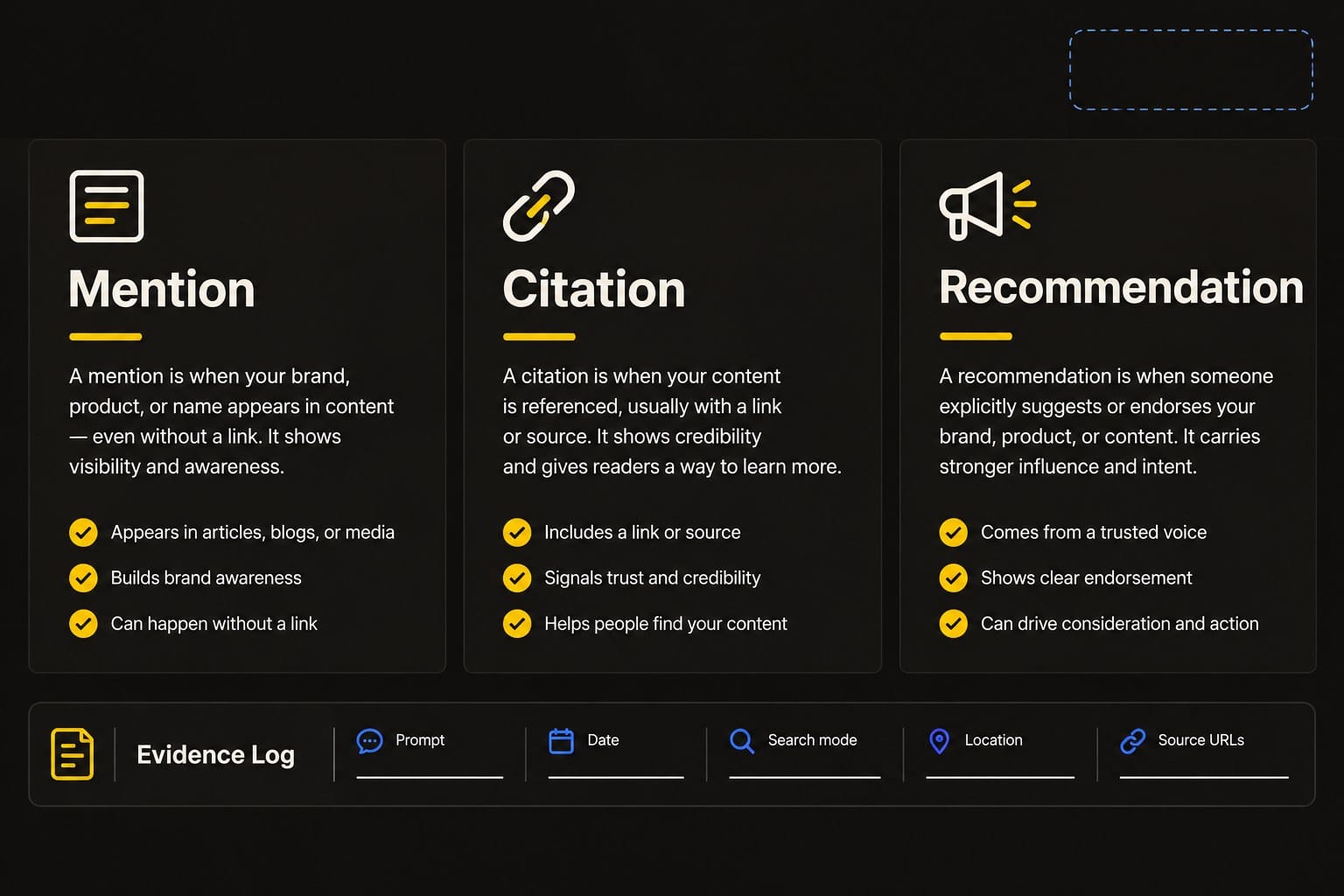
Use one row per observation. The blank template below is intended for your own testing; it contains no claimed results.
| Field | What to record |
|---|---|
| Date, time, and run ID | When the test occurred and which repeated run it represents |
| Test category | Branded identity, unbranded provider discovery, or buying decision |
| Exact prompt | Preserve the complete wording |
| Platform and model/mode | ChatGPT surface and displayed model or mode; note if unavailable |
| Search status | Used, not used, or uncertain, with the available evidence |
| Context | City, conversation state, personalization settings, and other relevant conditions |
| Business mention | Yes/no; save the exact description |
| Own-site citation | Yes/no; record the destination URL |
| Third-party citation | Source URL and whether it actually supports the business description |
| Recommendation | Yes/no; explain the fit or limitation |
| Factual accuracy | Correct, incorrect, mixed, or not assessable |
| Evidence saved | Answer text or screenshot and cited source details |
| Implementation record | What changed, who changed it, and when |
| Next checkpoint | Review date and the question to investigate |
If you summarize repeated runs as a percentage, state the sample size, prompt set, and conditions. Three mentions in five recorded tests describe that sample. They do not mean your business reaches 60% of ChatGPT users.
Do not treat the order of company names in one answer as a stable search ranking. Review the language, source quality, and actual suitability for the question.
Connect ChatGPT Visibility With the Quickest Path to ROI Areas
The Quickest Path to ROI SEO™ book supplies the broader system for choosing work by business value. Apply its six connected areas to this project.
Revenue opportunities: Select a service worth winning and the buyer questions associated with it. Keep search demand estimates separate from assumptions about AI-prompt frequency.
Priority pages: Identify where a potential customer should find the answer and an appropriate next step. Improve that page before expanding the topic library.
Constraints: Document the specific access, identity, evidence, or inquiry-path weakness. Choose a correction your team can reasonably implement.
Authority: Provide relevant proof and review legitimate external information. Make important claims easier for customers to verify.
Measurement: Track comparable visibility observations, identifiable referrals, qualified leads, and closed outcomes separately. Ask customers how they discovered the business and preserve their answers.
Expansion: Extend the work when useful evidence and another worthwhile customer opportunity justify it. A favorable screenshot alone offers limited support for a larger budget.
For example, consider a hypothetical commercial painting company. Its website lacks information about working around occupied offices. The team records relevant questions, improves the service page with a scheduling explanation and verified projects, and checks the quote process.
It then reviews comparable ChatGPT answers and customer inquiries. If a prospect reports discovering the business through ChatGPT, the team records that influence alongside the later sales outcome. It still considers other marketing and avoids assigning the same sale at full value to several channels.
This illustrates a project design. It does not represent a client result or a promised timeline.
Frequently Asked Questions
Is There a Business Submission Form That Guarantees ChatGPT Inclusion?
No guaranteed-inclusion route is established by the search guidance cited here. Website access supports eligibility, but placement isn’t guaranteed. Evaluate any submission service by its actual scope and evidence. A listing, feed, or paid placement should not be described as a guaranteed organic recommendation.
Does Allowing GPTBot Automatically Improve ChatGPT Search Visibility?
No. GPTBot concerns potential training use. OAI-SearchBot concerns search discovery, and the controls are independent. Review search access separately; allowing a crawler does not establish that the business will be recommended.
Can ChatGPT Recommend a Business Without Linking to Its Website?
Yes, a response can present a business as an option without an own-site citation. Inspect the actual answer and sources to establish what occurred. Record the recommendation separately from links, visits, and customer actions rather than treating them as one outcome.
Why Do ChatGPT Answers Change Between Tests?
The question, conversation context, available sources, and search conditions can differ. OpenAI also describes location and memory as relevant context for search. Use consistent test conditions and repeated observations. A single change in the answer cannot establish which website improvement caused the difference.
Can Paid Advertising Guarantee an Organic ChatGPT Recommendation?
No. OpenAI’s advertising guidance states that ads are separate from answers and do not influence them. Evaluate paid placements and organic mentions independently, with their own costs, records, and outcomes.
Start With One Business Question and One Priority Page
Choose a question that a suitable customer might ask before buying. Record a baseline, review the relevant page and business facts, and implement the most useful documented improvement.
Use the Entity & Trust Signal Checklist to identify information and evidence gaps. Give the work an owner and a review date.
If you want help connecting ChatGPT readiness with service-page improvements and business measurement, Elite SEO Consulting can help evaluate the next practical step. Call 719-474-9404 to discuss your business, priority opportunity, and current evidence.