
An SEO report can show more calls, better rankings, and growing traffic, but it leaves a contractor with one unresolved question: what work did those inquiries become?
The answer belongs in the job records as well as the marketing platforms. You need to know which services customers requested, whether those requests fit, what was booked, what was completed, and what the business actually collected.
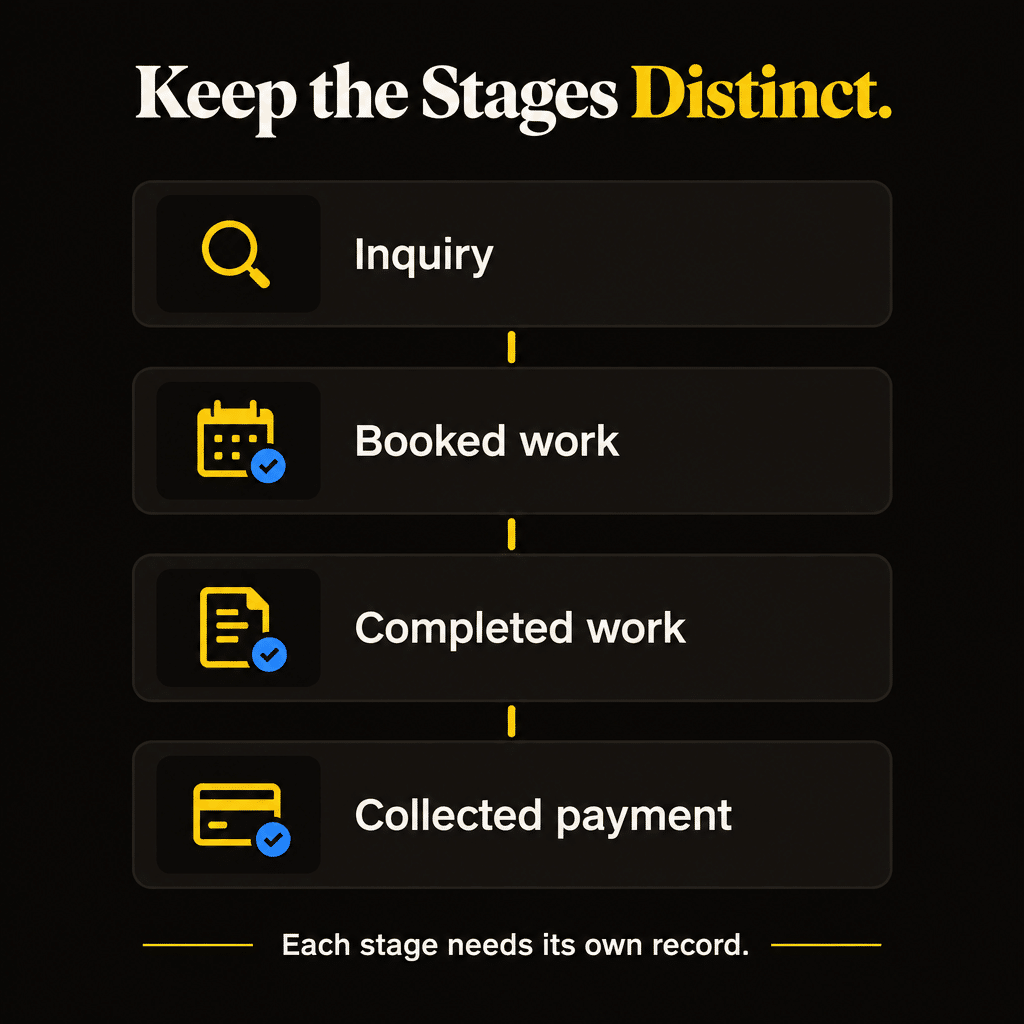
Those are different stages. A scheduled estimate is not a booked installation. An accepted proposal is not a completed job. A deposit is not the full value of the work.
A useful home services SEO report connects discovery with the operating records closely enough to support decisions. It also identifies where that connection remains incomplete.
Start with the services you are trying to grow. Agree on definitions, connect inquiries to job records, and report outcomes without turning every promising number into revenue.
Begin With the Work the Business Wanted to Win
The report needs a business target.
Specify the services, customer types, territory, and delivery periods the campaign was intended to support. Then evaluate whether the inquiries and jobs match that target.
A contractor promoting planned replacement work needs to see whether those requests arrived and progressed. A company trying to fill maintenance capacity needs a different service breakdown.
A sitewide increase can hide a poor mix. More inquiries for unsupported repairs may not help an installation-focused business. More distant requests may create estimating and travel work without producing suitable jobs.
Keep the target visible on the first page of the report. Summarize the important outcomes against it and identify the next decision.
Use the SEO Opportunity Prioritization Checklist when competing services or improvements need comparison. The report should provide evidence for that choice rather than simply celebrating a larger total.
Define the Stages Before Comparing Them
Agree on what each operating number represents.
Use definitions that match the actual service and booking process. A planned project may require an accepted proposal and confirmed scheduling. A straightforward repair may be booked directly during a conversation.
| Stage | Practical reporting definition |
|---|---|
| New inquiry | A unique prospective project request, with unrelated contacts classified separately |
| Qualified request | A request meeting the documented service, location, and customer-fit criteria |
| Assessment or estimate | The actual required assessment or estimate stage, clearly identified |
| Booked work | A genuine commitment under the company’s stated booking definition |
| Completed work | The agreed work recorded as completed, with partial completion distinguishable |
| Invoiced amount | The amount billed under the stated reporting basis |
| Collected amount | Payments actually received and allocated to the relevant work |
| Job contribution | The selected completed-work value less the stated direct delivery costs |
Keep scheduled, completed, and sent estimates distinguishable if they are separate steps. A heading labeled “estimates” should not change meaning from one report to the next.
Record the definitions beside the scorecard or in a short measurement note. A report becomes difficult to interpret when the office, owner, and agency use the same label for different events.
Connect the Inquiry to the Actual Job
Use a stable opportunity or job identifier to connect the customer path.
A customer may call, submit a form, and return for another conversation about the same project. Keep those contacts available as history so the report counts the project correctly.
Preserve the initial inquiry date, requested service, property area, known source information, booking date, and current job status. Add completion, invoicing, payments, and cost information as the work develops.
When one inquiry creates several related work orders, retain the relationship. Explain whether the report counts one acquired opportunity or several delivery jobs.
When an existing customer requests a distinct new project, record that project separately while retaining the customer relationship. Do not imply that every repeat job represents a newly acquired customer.
The identifier is the connection your report needs. Names alone can produce confusion when households, property managers, or related projects appear in different systems.
Use a spreadsheet or a job-management system your team can maintain. The important requirement is a consistent record that survives the handoffs.
Keep Search and Profile Actions in Their Proper Role
Marketing-platform numbers help explain discovery and behavior. They do not replace the job record.
Google’s Search Console Performance report provides search metrics such as clicks, impressions, and average position, with breakdowns including queries and pages. Use those summaries to investigate visibility for relevant services.
Google Analytics lets you mark important measured interactions as key events. Check what the underlying event actually measures. A phone-link click remains different from a connected call or qualified project request.
Google defines Business Profile calls as call-button clicks. Its performance guidance also says the data can include interactions from organic results and Google Ads. Do not automatically assign the entire profile total to organic acquisition.
Report these actions separately from actual conversations, inquiries, and bookings. Adding the three totals together does not produce a customer count.
Use the platform evidence to explain where to investigate. Use the operating records to establish what happened after contact.
Separate the Discovery Route From the Requested Service
A visitor’s entry page and the eventual job may describe different things.
Someone can arrive through an educational article, navigate to a service page, and request a project that spans several tasks. Another customer may call from the business profile without ever visiting the website.
Keep the discovery information and service classification in separate fields. This lets the report examine both without forcing one to stand in for the other.
Record the landing page when available and supported by tracking. Record the requested and booked service from the actual conversation and accepted scope.
Use source evidence consistently. A tagged link, a tracked contact route, and a customer explanation can provide different information. Preserve uncertainty or conflicting information instead of silently selecting whichever source gives SEO more credit.
A customer who reports finding you on Google may mean search results, Maps, an advertisement, or a later search for your name. Clarify where practical and retain a broader label when the detail cannot be established.
Show Service and Territory Fit
Break down meaningful outcomes by the services and areas the campaign supports.
Include qualification and known reasons a request cannot proceed. Outside coverage, service not offered, unsuitable scope, and unavailable timing explain different limitations.
Do not treat an unreachable customer as confirmed unsuitable. Keep unknown fit visible until the available information establishes it.
Compare booked and completed work by service when the records support that distinction. Review delivery costs and crew requirements alongside invoice values.
Use territory information from the actual property or project record. A search tool’s geographic summary is not a substitute for knowing where the company performed the job.
Avoid creating dozens of tiny comparisons that imply precision from one or two projects. Show the sample size and explain when a breakdown is too small for a confident conclusion.
A useful report makes the work mix easier to understand. It should help you decide whether to refine the offer, improve a page, review a territory, or change the next acquisition priority.
Use a Period View and an Inquiry-Group View
A calendar-month report answers what happened during that month. It does not automatically explain the eventual outcome of that month’s new inquiries.
Show new requests, bookings, completed jobs, collections, and investment during the period. Label each according to its own event date.
Then follow a defined group of inquiries through later stages. This group is often called a cohort: opportunities that share a starting condition, such as the same inquiry month and service.
You may book an inquiry received earlier now and complete it later. Keep that relationship rather than dividing this month’s bookings by this month’s new inquiries and calling the result a close rate.
State the review date for the inquiry group. Identify open, declined, canceled, and booked opportunities where supported. Rates remain provisional while outcomes are unresolved.
The SEO ROI Tracking Worksheet can organize investment and outcome summaries. Keep the underlying opportunity records alongside it when projects progress across several reporting periods.
Distinguish Booked Value, Completed Work, and Cash
An accepted scope has business significance, but it doesn’t mean the work has been delivered or paid for.
Report the value of current accepted work separately from completed-work value and payments received. Explain how scope changes, cancellation, partial completion, and invoicing affect each measure.
Keep deposits tied to the correct project, and distinguish payments on unfinished work from collections on completed jobs. Do not add a deposit to the full project value and call the combined number revenue.
Use the same basis when comparing periods. If one report uses invoice dates and another uses collections, the apparent movement may describe a reporting change.
Include outstanding amounts and relevant adjustments when they affect interpretation. A refund or canceled scope should not disappear because the original booking already appeared in a favorable chart.
These are management-reporting distinctions. The website report should follow a stated basis agreed with the business rather than invent its own accounting treatment.

Make the Job-Cost Basis Visible
A large booked value can coexist with weak delivery economics.
Use available job costs to explain the contribution from completed work. Identify which direct costs are included, such as labor, materials, subcontractors, equipment charges, or delivery travel, according to the company’s method.
Keep actual costs separate from margin assumptions. If a cost is missing, label the contribution provisional and specify what remains to be reconciled.
Include the relevant estimating burden under a consistent allocation method when the business uses one. Avoid counting a cost again if it is already included in another category.
The SEO Lead Value Calculator can help explore planning assumptions. Modeled lead value is different from the recorded contribution of completed jobs.
Contribution before acquisition costs and overhead is not final company profit. A report claiming financial return also needs a defensible source method, investment total, allocation, and matched review period.
Do not manufacture an ROI percentage because the job-cost fields are incomplete.
Read One Illustrative Job Report
Consider a hypothetical contractor reviewing forty unique new website inquiries for one planned service. The table follows that group to a stated review date. Source assignments would be evaluated separately; the example does not assign every website inquiry to SEO.
| Inquiry-group measure at the review date | Illustrative result |
|---|---|
| Unique new project inquiries | 40 |
| Requests confirmed as suitable | 30 |
| Estimates provided | 24 |
| Projects recorded as booked | 10 |
| Booked projects recorded as completed | 8 |
| Current accepted value of the ten booked projects | $50,000 |
| Completed-work value, invoiced, for the eight completed projects | $40,000 |
| Collections allocated to those completed projects | $34,000 |
| Recorded direct delivery costs for those completed projects | $28,000 |
| Completed-job contribution before acquisition costs and overhead | $12,000 |
The contribution is $40,000 minus $28,000. The unpaid invoiced balance for the completed jobs is $6,000, assuming no refunds, credits, or other adjustments in this example.
The two booked projects awaiting completion account for the remaining $10,000 of accepted scope. Their deposits, if any, would need a separate record and are excluded from the completed-job collections shown here.
The table contains teaching assumptions, not client results, industry benchmarks, or a forecast. Completed value, collections, and contribution are overlapping views of the same work; they must not be added together.
The thirty suitable requests include ten bookings, leaving twenty whose other statuses need review. Some may still be progressing.
Likewise, the six suitable requests without an estimate are not automatically lost. Check their actual stage. The report should identify the unresolved records rather than infer their outcomes from subtraction.
Explain Changes in Status and Scope
Show how the job picture changed since the previous review.
New bookings, cancellations, scope revisions, rescheduling, and completions affect different measures. Record the actual change against the existing identifier.
A rescheduled project should not become a second booking simply because it moved to another week. A canceled job should not remain inside the current backlog value.
Retain the historical event where useful, but distinguish it from the current position. A report can show new bookings during a month and the adjusted open backlog at month-end without pretending they are the same total.
Explain whether an increase came from more projects, larger accepted scopes, or changes to existing work. Those patterns can require different operating and marketing decisions.
Assign responsibility for these updates. The agency should not have to guess which accepted proposals were revised after the last export.
Reliable status changes help prevent a marketing report from becoming a museum of bookings that no longer exist.
Report Investment and Attribution Limits Together
Show what the business invested in the work being evaluated.
Include relevant agency, content, tool, and internal implementation costs under the agreed method. Explain the treatment of shared costs and work that supports several services or periods.
Keep the timing of investment separate from the timing of job completion and payment. A monthly expense total does not automatically match the acquisition cost of the jobs completed that month.
State how source credit is assigned when several channels or prior relationships contribute. An observed organic visit can support an attribution record without proving the customer wouldn’t have bought otherwise.
Keep source-attributed outcomes separate from claims of additional business caused by SEO. The latter requires stronger evidence than a contact-source field.
Where the data cannot support a defensible financial-return calculation, report the available outcomes and the gap. A clear limitation is more useful than a precise percentage built from unrelated totals.

End With Findings and Next Actions
The report should make the next decision easier.
If relevant visibility grows while service fit remains poor, investigate targeting and offer clarity. If suitable requests arrive but estimates stall, review that operating stage. If completed work has weak contribution, inspect the service, scope, costs, and territory.
Consider capacity when interpreting lead totals. A deliberate move toward later projects or another service can change the number and mix of inquiries.
Document the important work completed, why it was chosen, and what evidence is available afterward. Keep implementation completion separate from proof that it changed bookings.
For each next action, state the owner, reason, required business input, and review point. Identify unresolved questions before assigning another round of content production.
A useful report can be concise when the underlying records are reliable. Its first page should explain the position; supporting detail should let the owner verify it.
Keep the Record Current Enough to Use
Assign responsibility for inquiry classification, booking updates, completion status, payments, and job costs.
The office, estimator, operations team, accounting team, and agency may each supply part of the picture. Agree on who maintains each field and when the reporting snapshot is taken.
Review missing sources, unresolved statuses, duplicate records, and late costs before interpreting the summary. Correct them in the underlying record so future reports do not repeat the same error.
Use a reporting rhythm appropriate to the work. Open opportunities and schedule changes may need more frequent attention than the broader SEO review.
When tracking or definitions change, annotate the report. A new form event or a revised booking rule can change a total without changing customer behavior.
The process does not need to be elaborate. It needs enough ownership and consistency that the owner can trust what the report says about booked work.
Frequently Asked Questions
Should a rescheduled job count as a new SEO booking?
No, if it is the same accepted project moving to another date. Update the schedule against its existing identifier. Record a separate booking only when a genuinely distinct new commitment meets your definition.
Where should customer deposits appear in the report?
Record them as payments allocated to the relevant project and distinguish unfinished from completed work. Keep accepted project value, invoice amounts, and collections separate. Don’t add a deposit to the full project value as if it creates extra sales value.
Can Search Console tell me which keyword produced an individual job?
Its Performance report provides grouped search data, not a customer-level job record. Use it to evaluate relevant query and page patterns. Connect individual jobs through supported inquiry and source records, and do not invent an exact keyword assignment when the evidence is unavailable.
How should I report work from returning customers?
Separate a new project from a newly acquired customer. Preserve the existing relationship and record the supported source information for the new request. Do not automatically credit every later job to the customer’s original SEO discovery.
What if some job costs arrive after the report is produced?
Label the affected contribution provisional, identify the missing costs, and reconcile the job record when they become available. Explain revisions in the next report. An estimated or incomplete margin should not be presented as a final realized result.
Ask the Report to Explain the Work
Your home services SEO report should connect the intended service with suitable requests, current bookings, completed work, collections, and delivery economics.
Keep the stages distinct, the job records connected, and the source limitations visible. Use the evidence to choose the next improvement and identify what the business needs to supply.
For a broader approach to evaluating SEO around business outcomes, explore Quickest Path to ROI SEO™. The book and companion tools help connect priorities, implementation, and measurement with the work your business wants to win.
If you need help connecting contractor SEO reports with inquiry and job outcomes, see Elite SEO Consulting’s home improvement SEO services or call 719-474-9404.