
A full schedule can make an SEO decision feel simple: stop marketing until the crews have room, or keep investing because the campaign is working.
Neither decision should be automatic.
Your calendar describes work already committed. Your marketing plan needs to consider the services, customers, locations, and future periods the business can support. Those may differ from the work filling this week’s schedule.
You can keep useful SEO while changing what the next investment should accomplish. Maintaining key pages, improving inquiry fit, and preparing for credible future capacity are different choices from expanding demand across every service.
Start with a capacity review. Identify the constraint, the work you still want, and the earliest delivery period you can responsibly discuss. Then choose whether to maintain, redirect, or expand the program.
Define What “Already Booked” Means
A full calendar is not a complete capacity assessment.
One crew may be committed to installation work while another has room for maintenance. A specialist may be fully occupied while general labor capacity remains available. A schedule can also look full because project duration has been estimated poorly.
Identify the service, crew capability, territory, and period affected. Separate confirmed work from proposals, tentative holds, and customer requests that have not become commitments.
Check whether the booked work actually occupies the people and resources needed for the service you want to promote. A spare employee does not automatically create another complete installation crew.
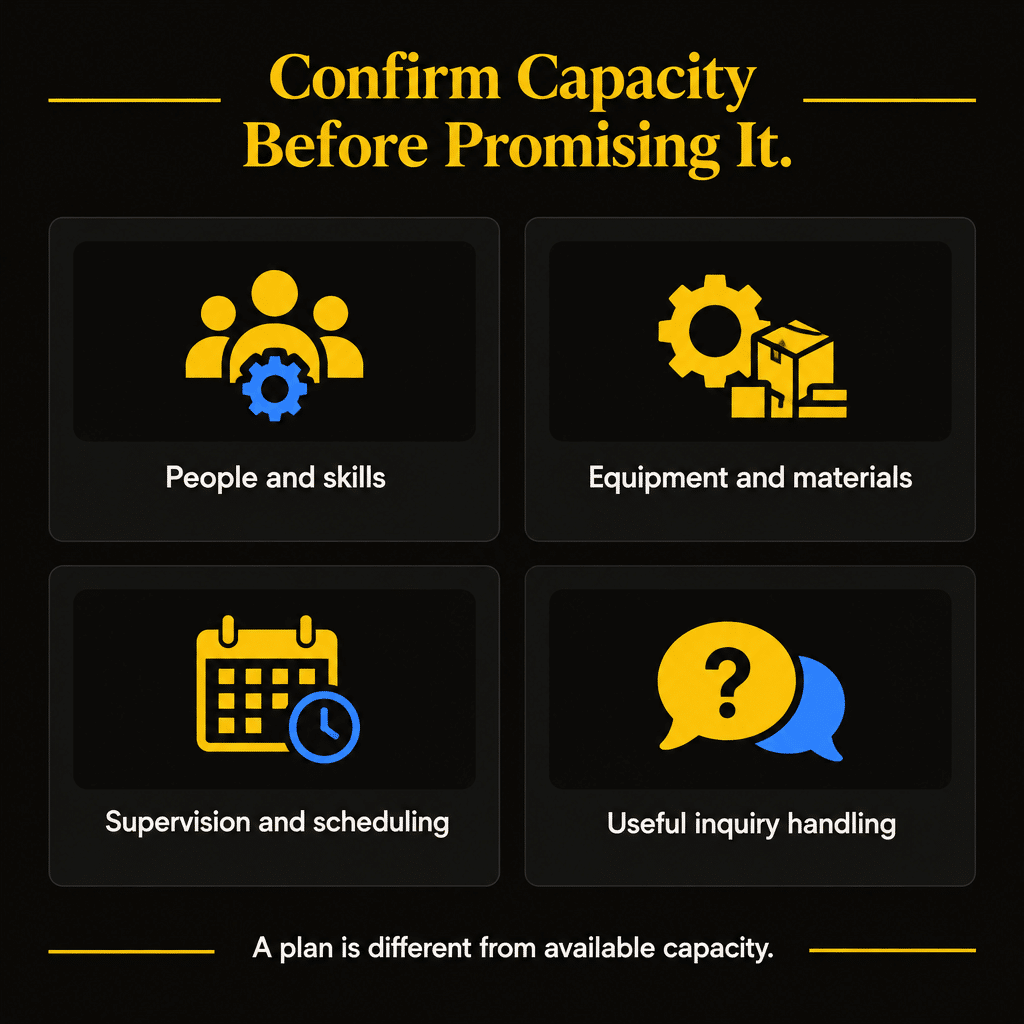
Account for equipment, materials, supervision, assessment visits, and office support. A business can have field availability while its estimator or coordinator can’t process more requests.
Write the constraint in specific terms. “Exterior installation capacity is committed through the next scheduling period” is more useful than “we are busy.” It gives marketing something concrete to work with.
Look Beyond the Nearest Opening
Review the schedule across the periods that matter to the service.
A brief repair and a substantial planned project may have different assessment, decision, and delivery paths. The next available appointment is only one part of that timing.
Inspect confirmed commitments, realistic completion estimates, known absences, and relevant operating conditions. Allow room for the disruptions your business actually encounters, rather than assuming you can sell every remaining hour.
Keep future work visible without treating it as certain. A proposal being considered is different from accepted work with a confirmed scheduling step.
Review how much of the later calendar depends on unresolved decisions. A crowded list of estimates may create the impression of a full backlog while leaving the actual delivery period uncertain.
Use a consistent view that the owner, office, estimator, and marketing team can interpret. The goal is an honest assessment of when you can accept additional suitable work, not a calendar designed to reassure everyone.
Use a Capacity Unit That Fits the Work
Choose a unit that helps your team compare commitments with usable capacity.
For some businesses, that may be technician hours. For others, crew-days or installation slots matter more. Define what the unit includes and use it consistently.
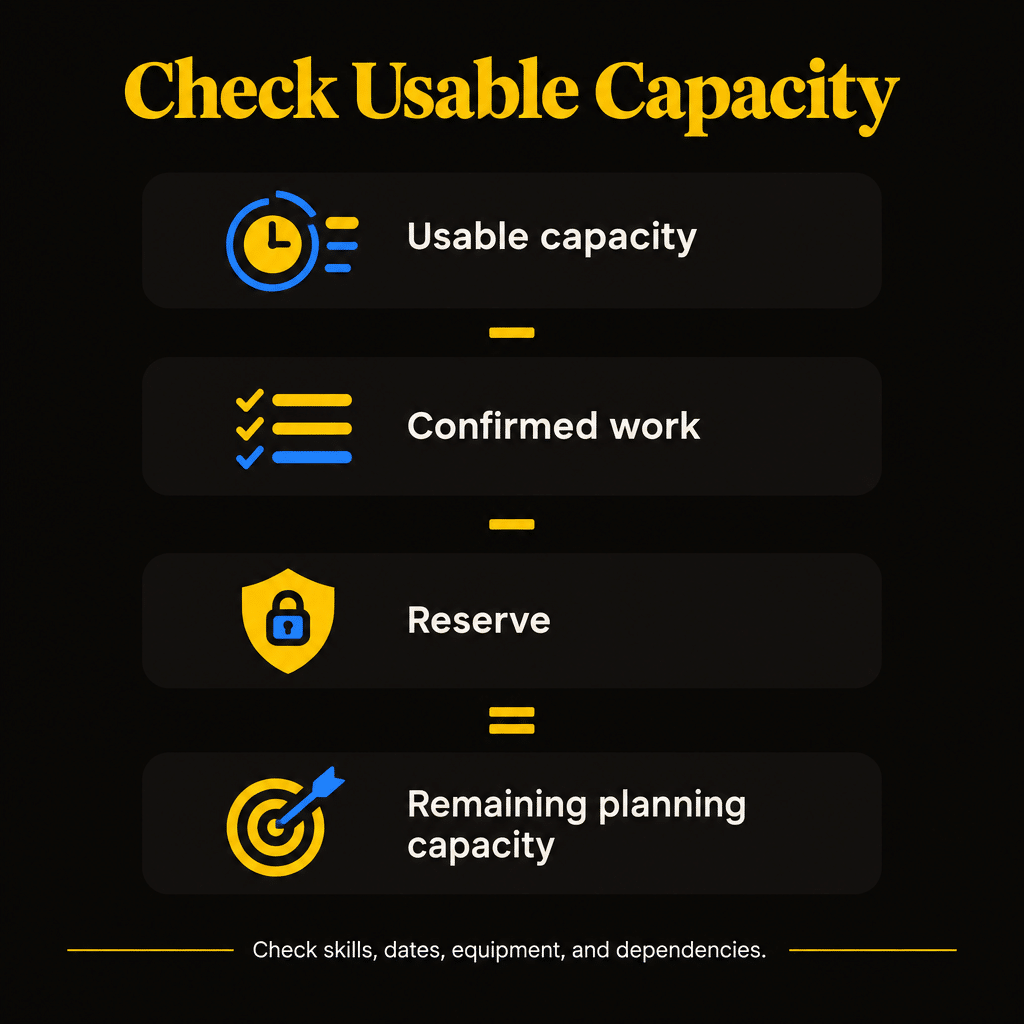
In the following hypothetical example, a crew-day means one complete crew working for one day. It is not one person’s labor day, and it does not imply that different crews have interchangeable skills.
Consider a planned-service contractor reviewing two weeks:
| Capacity item | Week A | Week B |
|---|---|---|
| Usable crew-days before reserve | 8 | 8 |
| Crew-days committed to confirmed work | 7 | 5 |
| Crew-days reserved for uncertainty | 1 | 1 |
| Remaining planning capacity | 0 | 2 |
The calculation is usable crew-days minus committed work minus the reserve. Week A leaves zero; Week B leaves two.
The numbers and reserve are illustrative planning assumptions, not client results, benchmarks, or a recommended allowance for every contractor. Capacity depends on the actual work, skills, equipment, conditions, and schedule.
Two remaining crew-days do not automatically support another two-day project. Check whether the days are consecutive, the right crew is available, and you can arrange the assessment and materials.
Separate Maintenance From Expansion
Continuing SEO doesn’t mean pursuing more demand everywhere.
Maintenance keeps the website useful and accurate. It can include checking important contact paths, correcting outdated service information, resolving material website problems, and reviewing relevant performance.
Redirection changes the priority. You may focus on a service with available capacity, a closer territory, a better-fitting project type, or a future delivery period.
Expansion increases the scope of acquisition work. It might add a new service target, pursue another territory, or increase effort on competitive opportunities.
Define these choices in your working plan. Otherwise, “keep doing SEO” can become a vague instruction to continue every deliverable even when the business no longer wants the same inquiries.
Use the SEO Opportunity Prioritization Checklist to compare the usefulness, effort, and timing of the next actions.
A full schedule can justify a different work sequence. It does not explain why every existing activity should continue unchanged.

Improve the Mix of Inquiries You Can Accept
When capacity is limited, review which additional requests are useful.
Consider service fit, delivery effort, location, contribution, and customer timing. Contribution is the amount left after the direct costs of delivering the work; keep the definition consistent when comparing services.
Look beyond the invoice total. A larger project may consume scarce specialist time, substantial travel, or several assessment visits. A smaller suitable job may fit an available opening, although it still needs to justify its costs.
If your records consistently show inquiries outside the offer or territory, clarify those boundaries on the relevant pages. If customers expect timing you cannot provide, correct the availability language.
The SEO Lead Value Calculator can help explore value using your sale, margin, and close-rate assumptions. It does not calculate crew availability or determine an individual job’s actual profitability.
Use the operating records alongside those estimates. Better inquiry fit should be evaluated through qualification and completed work, not assumed from a revised headline.
Promote Future Work Without Promising a Date You Cannot Keep
Planned-service customers may be willing to discuss a later project period. Make that possibility understandable.
Explain that the request starts a scope and availability conversation. Distinguish an assessment date from an installation or work date. Do not allow the customer to assume that scheduling the estimate reserves delivery capacity.
Use an expected scheduling window only when your team can maintain the information. Explain what still needs confirmation, such as scope, materials, access, or another scheduling dependency.
A form can ask about desired timing while allowing uncertainty. A customer considering work later may not know an exact date yet.
Give the office an accurate process for these requests. Someone should confirm fit, discuss realistic timing, and record the agreed next step. A future-work inquiry deserves a useful response even when the immediate calendar is full.
If no credible delivery period can be offered, say so. Collecting requests under an outdated availability promise creates a problem your team must resolve in every conversation.
Treat a Waitlist as Interest, Not Booked Work
A waitlist can capture qualified interest when appointments or delivery capacity are constrained.
Define what joining means. Does the business contact people when an opening appears, discuss future scheduling, or review requests in a particular order? Explain the actual process and who manages it.
Record the requested service, location, timing needs, and current status. Keep the list current when customers decline, choose another provider, or no longer want contact.
Do not count every waitlist entry as a booking. Interest does not establish accepted scope, a confirmed date, or a commitment to buy.
Use the list to understand fit and timing rather than as a promise that future revenue is secured. Customers may have several options while waiting.
Review whether the waitlist is useful to both sides. If your team cannot offer a plausible next step or keep people informed, another inquiry route may be more appropriate.
A list is a management tool only when someone manages it.
Check Whether the Constraint Is Really Crew Capacity
More field staff won’t solve every reason the business struggles to accept work.
Review whether suitable inquiries are waiting for contact, assessment, estimates, materials, or customer decisions. A calendar may be crowded by tentative holds or jobs that cannot begin because a dependency remains unresolved.
Identify the actual stage creating the limitation. If completed assessments wait for estimates, the next improvement may involve estimating capacity rather than another acquisition target.
If travel or scheduling fragmentation consumes substantial delivery time, review the territory and appointment arrangement. If project scope regularly changes, improve the information used to estimate duration.
Marketing should understand these operating decisions. They are not proof that SEO has failed or that adding leads will fix the constraint.
Keep the review focused on observable records. Avoid assuming that every delayed project has the same cause.
Once the constraint is clear, choose the correction that supports the desired work and realistic delivery capacity. Then review whether the correction actually changes that capacity.
Prepare for Additional Capacity Only When the Plan Is Credible
SEO expansion can make sense before new capacity is fully available when there is a concrete operating plan.
Confirm the resources needed to deliver the target service: people, capabilities, supervision, equipment, materials, territory, and the process for handling new requests. Assign responsibility for the readiness checks.
Keep planned capacity separate from existing capacity. A hiring intention is not the same as a staffed and equipped crew ready to accept work.
Coordinate the marketing sequence with the evidence. You can research and prepare pages while staffing is being resolved, but public promises and accepted commitments must reflect actual readiness.
Google’s SEO Starter Guide explains that changes take varying amounts of time to affect search results and may not produce a noticeable impact. For planning, that means you cannot synchronize organic inquiries with an exact crew-start date.
Build a flexible plan. If readiness moves, adjust the offer and priorities instead of leaving a launch promise in place because a content calendar says it is due.
Evaluate Territory Before Seeking More Distant Work
A booked schedule can tempt a company to promote a larger geographic footprint as the next growth move.
Review what that expansion would require. Travel, assessments, access coordination, and work density can affect how much usable capacity remains.
A territory that produces attractive invoices can still make a crew’s schedule harder to serve efficiently. The relevant question is whether the work fits the resources and operating plan.
Before committing to new areas, consider whether closer work or a different service mix could use existing capacity more effectively. That is a business comparison, not a universal rule that a small territory is always better.
Do not publish service-area promises for locations you cannot support reliably. If the expansion is being evaluated, keep the research separate from claims that the business already serves the area.
Give marketing confirmed boundaries and priorities. A map with more highlighted cities does not establish an expanded ability to deliver.
Choose the Appropriate SEO Direction
Make the decision using the constraint, future capacity, and inquiry mix together.
The following options describe different operating situations. They are editorial decision guides, not guaranteed outcomes.
| Situation | Appropriate direction to evaluate |
|---|---|
| Current and later delivery periods are committed, with no credible additional capacity | Maintain important assets and defer broad acquisition expansion |
| One service is full while another has suitable capacity | Redirect the next SEO work toward the service the business can accept |
| The immediate calendar is full but later capacity is credible | Support planned inquiries with accurate timing expectations |
| A new crew or capability is still uncertain | Prepare selectively and keep public commitments within current readiness |
| Delivery capacity exists but suitable requests stall before booking | Review the operating handoff before assuming more demand is the main need |
| Inquiry volume is sufficient but service or location fit is poor | Improve targeting and offer clarity, then evaluate the changed mix |
State the chosen direction in one sentence and identify the work it authorizes. For example, you might keep the main installation page while improving a maintenance service with available capacity.
Specify what would change the decision. Confirmed resources, a revised backlog, or consistent qualification evidence can justify a new priority.
Give the SEO Team a Capacity Brief
Your marketing team needs enough operating context to make useful recommendations.
Share a brief that identifies priority services, actual coverage, the relevant delivery periods, known constraints, and the inquiries you want to receive. Include who can approve changes to availability claims.
Give each proposed task a business purpose. “Improve the planned-maintenance page so suitable customers can request the next available assessment” is more useful than “publish more content.”
Ask the team to separate maintenance, redirection, and expansion in its proposed work. The categories help explain why an activity deserves time even when immediate demand is already sufficient.
Agree on a review date and an owner for capacity updates. Marketing cannot keep the offer accurate if new scheduling information stays in the owner’s head.
Avoid requiring a precise forecast of inquiries from a page change. Ask for a defensible priority, completed implementation, clear expectations, and evidence to review afterward.
Review Results Against the Capacity Decision
Evaluate the program according to the job you assigned it.
If the goal was a better service mix, review qualification by service. If it was later-period work, inspect customer timing and progression. If it was maintenance, verify that the important assets and contact paths remain useful.
Use the SEO ROI Tracking Worksheet to organize investment and outcome summaries alongside the actual scheduling and inquiry records.
Keep inquiries, estimates, booked work, completed jobs, and collected revenue distinct. Record source information where supported and retain an unknown category where it is not.
Look for work declined because of timing or capacity. That information helps explain whether additional acquisition remains useful. A declining lead total isn’t automatically a poor outcome when the business deliberately narrowed its offer, but it still needs interpretation.
Revisit the decision as commitments and capabilities change. Don’t keep the same direction just because it matched the calendar at the start of the month.
Frequently Asked Questions
Does a waitlist count as booked work?
No. Record waitlist interest separately from accepted work and confirmed scheduling commitments. A customer may still be evaluating providers or timing. Update the status when a genuine booking occurs and use your actual booking definition consistently.
Should I remove the estimate form while my schedule is full?
First decide whether you can support useful future inquiries. If you can, keep the route available with accurate expectations. If you cannot accept new requests, explain the current limitation and provide an appropriate alternative. Test the page and confirmation so they don’t keep promising unavailable appointments.
Can I market a new crew before hiring is confirmed?
You can research opportunities and prepare useful material, but keep customer promises within the capacity you can support. An unfilled role is uncertain capacity. Confirm people, skills, equipment, and supervision before accepting work that depends on the new crew.
Can I promote maintenance when my installation crews are full?
Possibly, if the business has the capability, equipment, scheduling room, and capacity to handle inquiries for that maintenance work. Verify those conditions rather than assuming the services use interchangeable resources. Target the actual offer and evaluate whether the resulting requests fit.
What if most of my backlog depends on one large project?
Separate the confirmed commitment from assumptions about its start, duration, and dependencies. Review how a change would affect usable capacity and assign someone to keep that information current. Maintain flexibility in the marketing plan flexible without promising openings that don’t yet exist.
Make Growth Fit the Work You Can Deliver
A full schedule changes the next SEO decision. It does not settle it.
Review the constraint, the service mix, and the future capacity you can responsibly support. Choose whether to maintain important assets, redirect the next work, or expand for a credible opportunity. Keep the customer promise aligned with that choice.
For a broader method of prioritizing SEO around business outcomes, explore Quickest Path to ROI SEO™. Use the book and companion resources to give the next investment a clear purpose and a realistic place in your operating plan.
If you need help aligning contractor SEO with service priorities and available capacity, see Elite SEO Consulting’s home improvement SEO services or call 719-474-9404.