
An inquiry from the next town can look like growth until you add the drive, the estimate visit, and the return trip to finish the work. The customer may be perfectly suitable, yet the job contributes very little to the business.
For a home service company, location changes the economics of acquisition and delivery. A territory that works well for a large installation may be a poor target for small repairs. A neighborhood with several nearby customers may be worth more to the schedule than a scattered collection of jobs across a larger region.
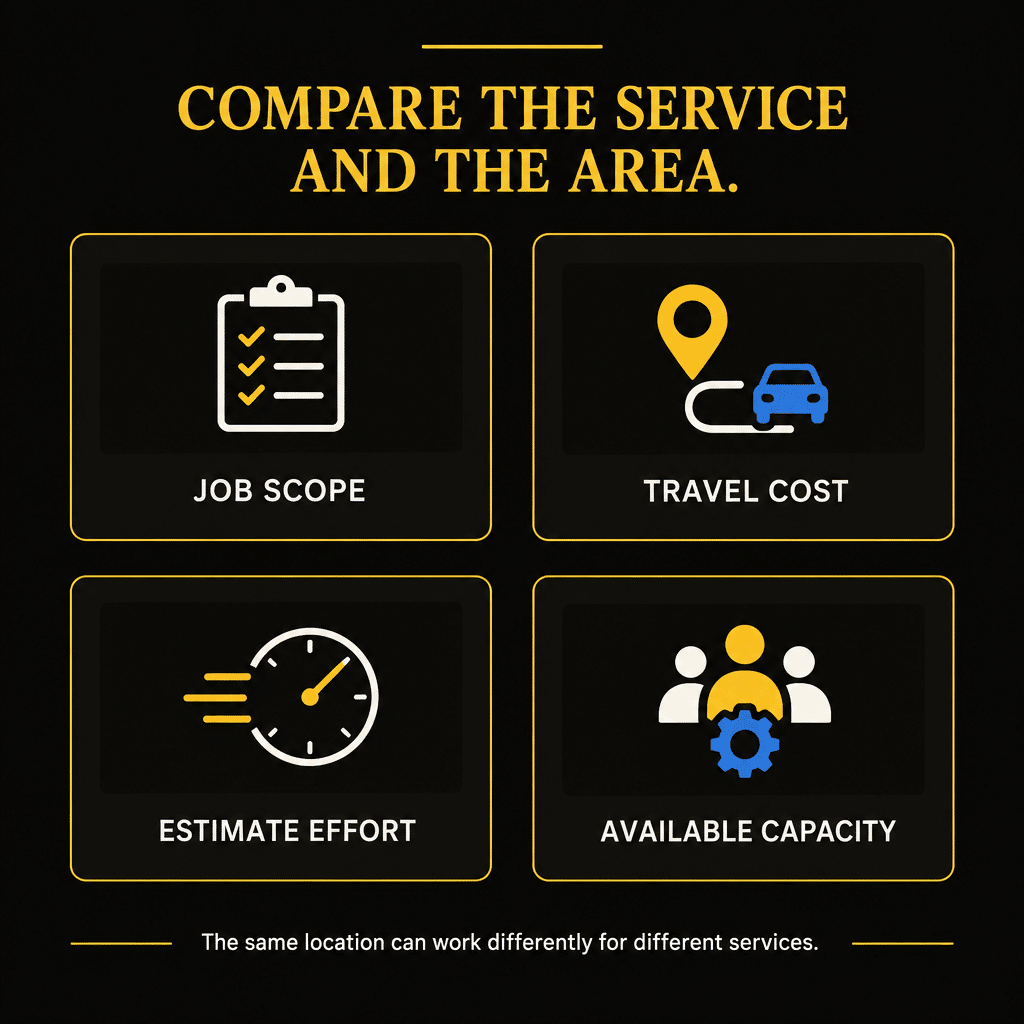
Choosing profitable service areas for SEO means comparing customer demand, job contribution, travel and estimating costs, capacity, and the effort required to become visible. The aim is to direct the next investment toward a territory your business can serve efficiently and profitably.
Start with the work you want to win, review where that work already makes financial sense, and assess a manageable set of expansion opportunities. This guide explains how to make that comparison and turn it into an actionable territory decision.
Evaluate a Service and an Area Together
A place does not have one fixed value to your business. Its usefulness depends on the service you intend to deliver there.
A gutter company might accept installation projects across a wider area while keeping cleaning visits closer to its established routes. A handyman might travel all day for bundled tasks but find a distant single-task appointment hard to justify. A contractor might serve an outlying market effectively for planned projects while being unable to offer a dependable urgent response there.
Compare service-and-area combinations, rather than making one blanket decision about every location.
For each candidate, record:
- The service or project type you want to promote.
- The part of the territory you can cover consistently.
- The scope or job size that makes travel worthwhile.
- The resources needed for estimates and delivery.
- Any scheduling or availability conditions.
- What customers should be told before they inquire.
This gives the SEO team a usable target. “Promote installation projects in the neighboring town” is more specific than “rank in more cities.” It also helps the person answering the phone qualify the resulting requests.
Begin With the Jobs You Have Already Completed
Your job records can reveal whether a territory is useful before you spend more to attract customers there. Review completed work by location and service, using the same definitions across the comparison.
Record collected revenue, direct delivery costs, travel time, estimated effort, callbacks, and whether the work fit the schedule. Look for patterns across a reasonable sample rather than selecting the most successful project as the representative example.
Group locations in a way that helps operations. City boundaries may help with reporting, but routes, neighborhoods, or postal areas can explain travel and scheduling more clearly. Two addresses in the same city can have very different access and driving requirements.
Use ordinary driving conditions for the times you usually work. A quiet Sunday drive is a weak basis for a territory served during weekday congestion.
Also record where inquiries failed to become jobs. A location that produces many requests may still consume estimator time through unsuitable work or repeated price comparisons. Include the cost of pursuing those opportunities in the assessment.
If records are incomplete, begin with a limited sample and identify the uncertainty. The first comparison does not need false precision to be useful.
Include the Full Cost of Serving the Location
Travel involves more than fuel. It can require paid crew time, vehicle operating costs, estimate visits, delivery coordination, and further journeys if the work needs another appointment.
For the territory comparison, estimate:
Job contribution = collected revenue − relevant delivery, travel, and estimating costs.
The remaining contribution covers marketing, fixed overhead, and eventual profit. It is not final net profit.
Use cost categories consistently. If your existing job-cost figure already includes travel wages, do not subtract them again. Keep vehicle costs distinct from paid travel labor, and separate estimate-related trips from delivery trips when recording them.
Estimate effort needs particular care. A completed job may have required only one site visit, but winning that job might be part of a territory where several other estimates did not convert. Where practical, allocate the territory’s relevant estimating costs across the jobs won during a suitable period. Keep open opportunities separate until their outcomes are known.
You can also compare contribution against the company’s limiting resource, such as total field labor hours or estimator capacity. A distant job can contribute positively while still displacing more valuable nearby work.
That opportunity cost should be visible in the discussion. The schedule has a finite number of useful hours, even when the map has plenty of room.

A Worked Example: Nearby Visits and an Outlying Project
Consider a hypothetical home service contractor comparing small maintenance visits near its base, similar visits in an outlying area, and larger planned projects in that outlying area.
These figures are invented to illustrate the decision. They are not client results, market rates, or a forecast. Each column represents an illustrative completed job with consistently allocated relevant costs.
| Item | Nearby maintenance visit | Outlying maintenance visit | Outlying planned project |
|---|---|---|---|
| Collected revenue | $600 | $600 | $2,500 |
| On-site labor and materials | $360 | $360 | $1,650 |
| Paid crew travel for delivery | $30 | $90 | $90 |
| Vehicle costs for delivery | $10 | $30 | $30 |
| Allocated estimating cost | $20 | $60 | $60 |
| Total costs shown | $420 | $540 | $1,830 |
| Job contribution before marketing and remaining overhead | $180 | $60 | $670 |
The same $600 maintenance invoice leaves $180 near the base and $60 in the outlying area. A larger project in that area can absorb the illustrated travel and estimating burden more comfortably, leaving $670 contribution.
That supports a service-specific territory decision: the contractor might prioritize nearby maintenance inquiries and selectively pursue larger outlying projects. It does not establish that every large project will be worthwhile or that SEO can produce them at an acceptable cost.
The company still needs to review local demand, close rates, competition, capacity, and the work required to gain visibility. It also needs to include any costs missing from this simplified example, such as additional equipment, disposal, return visits, or growth-related operating expenses.
Use your own job records to identify where the territory begins to work. An attractive invoice alone does not answer that question.
Compare Route Density Alongside Distance
A farther area can be workable when several suitable jobs fit the same route. A closer area can be inefficient when appointments are scattered across different days or require awkward return visits.
Route density means having enough compatible work in a geographic area to use travel and crew time efficiently. It depends on the service, appointment length, customer flexibility, and how your team schedules.
Before treating clustered bookings as part of the business case, check whether the cluster is realistic. Three inquiries in the same town do not automatically become three jobs on the same day.
Review whether you can:
- Offer practical appointment windows that customers accept.
- Group compatible jobs without delaying urgent needs.
- Arrange estimates or material deliveries efficiently.
- Maintain sufficient qualified demand to support the route.
- Handle cancellations without losing the day’s economics.
If a proposed territory relies on route grouping that does not yet exist, record it as an assumption. Start with a limited expansion and observe how the schedule actually develops.
Do not let an optimistic route diagram do the work of real scheduling evidence.
Check Demand for the Specific Work You Want
A town’s size or reputation doesn’t prove it has enough demand for your chosen service. Review the customer need you can fulfill there.
Use existing inquiries, completed projects, relevant search data, and local search-result checks to build the picture. Keyword tools can help, but a national volume estimate isn’t a count of suitable nearby customers.
A market may have demand for repairs when your expansion objective is installations. Another may produce larger projects but require longer estimating and decision cycles. Both differences matter when judging how soon the territory can contribute.
Use the Keyword Opportunity Evaluator to compare the service-and-location opportunities. Examine the query’s customer intent, the kind of results shown, and the offer your business can make.
Avoid assumptions based only on a neighborhood’s perceived wealth or a city’s population. Property characteristics, maintenance needs, existing provider relationships, and how well your service fits may matter more. Test the business case through evidence rather than treating demographics as a guarantee.
Assess Visibility Across the Area You Intend to Serve
Operating in a territory and being visible there are separate questions. Your business may be able to deliver a service in a location where earning discovery still requires substantial work.
Google’s local ranking guidance explains that local results are influenced by relevance, distance, and prominence. Distance relates to the customer’s search location. A result near your business shouldn’t be assumed to represent the whole territory.
Review important services at representative locations across the proposed area. Distinguish Google Maps visibility from website search visibility, and keep observations consistent so you can compare them over time.
Look at the actual providers and pages appearing for relevant requests. Ask what evidence, page improvements, or broader work your business would need to become a credible option.
I recommend combining that visibility assessment with the operating comparison before approving expansion. A difficult market can still be worthwhile, but the budget and timeline need to reflect the work required.
Use the Local Search Visibility Checklist to review the foundation. Then evaluate the specific territory opportunity rather than assuming a complete profile creates equivalent visibility everywhere.
Keep Your Advertised Coverage Accurate
The website, business profile, estimate process, and team answering inquiries should describe the same operating area. Conflicting coverage claims create unnecessary requests and poor customer expectations.
Google’s service-area guidance says service-area businesses should specify the places they serve and remove a public address if they don’t serve customers there. Use accurate locations and business details. Listing an area communicates coverage; it should not be treated as a promise of ranking throughout that area.
On the website, explain any service-specific limits in plain language. If a distant territory is available for larger planned projects but not small repair visits, make that distinction easy to find. State any assessment charges, minimum scope, or appointment conditions accurately where they apply.
Do not imply an office or permanent local presence where the business only travels to customers. Use genuine project experience and relevant service information to support the coverage you actually provide.
Choose territory before deciding to create additional location pages. Once an area has a credible business case, determine what page content would genuinely help its customers and how it fits the existing site.
Classify Territories by the Work You Want to Pursue
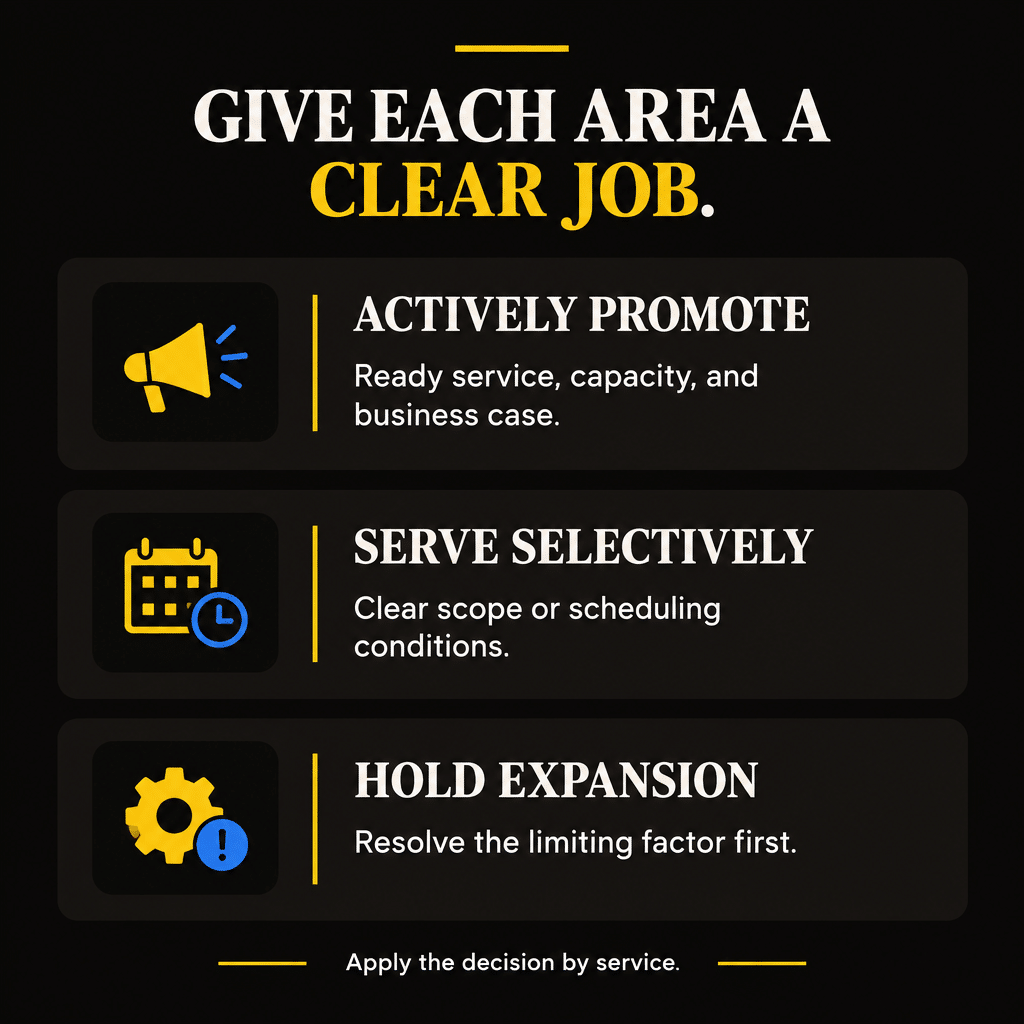
A simple territory plan can distinguish where you actively want demand, where you accept it under defined conditions, and where you are not ready to invest.
Use three practical categories:
| Territory decision | Business meaning | SEO implication |
|---|---|---|
| Actively promote | Suitable work, capacity, delivery economics, and a credible search opportunity | Assign defined visibility and page improvements |
| Serve selectively | Work can make sense under specified scope or scheduling conditions | Explain conditions and qualify requests consistently |
| Hold expansion | Economics, capacity, demand, or visibility effort remain unsuitable or uncertain | Resolve the limiting factor before assigning substantial expansion work |
Apply those categories by service. The same town can be an active installation target and a selective maintenance area.
This approach helps the business communicate a clear offer without trying to promote every service in every location. It also gives the marketing team a reason to invest next.
Revisit the categories when crew availability, job mix, delivery costs, or reliable evidence changes. A hold decision can be temporary, and an active area can become less attractive if its economics deteriorate.
Prepare a Small Expansion Test With Clear Limits
When the territory looks promising, but the evidence is incomplete, define a manageable expansion effort. The purpose is to learn whether useful demand and delivery economics support a larger commitment.
Choose one service and one area. State the scope you can accept, the page or visibility improvement you will complete, the owner of the work, and the capacity reserved for suitable inquiries.
Set a budget and review conditions before implementation. Account for both marketing effort and the operating costs created by the test. A new territory may require estimating, travel, or coordination before you win any work.
Measure:
- Suitable inquiries from the target area.
- Estimate effort and progression to completed jobs.
- Collected revenue and territory-specific costs.
- Contribution after delivery costs and the relevant expansion investment.
- The effect on nearby work and crew utilization.
Compare a matched period or sufficiently mature inquiry group so a long sales cycle does not become a false negative. Keep uncertain source attribution and outstanding estimates visible.
The SEO Opportunity Prioritization Worksheet can help you compare a territory test with improvements in your existing core area. Expansion should earn its place against other uses of the same resources.
Use the Results to Refine the Territory Plan
The number of leads tells only part of the story. Review what the inquiries became and how efficiently the company served them.
If inquiries are plentiful but mostly unsuitable, inspect the promoted service, coverage explanation, and qualification. If estimates are appropriate but rarely convert, investigate that process before assuming the territory has no value.
If jobs are won but travel or callbacks consume the contribution, reconsider the scope, scheduling, or area boundary. If the territory works for one project type but not another, keep the distinction in the marketing plan.
Also compare the expansion with what could have been achieved closer to the base. Your current territory may still contain valuable service pages, neighborhoods, or customer needs that deserve attention before a larger geographic commitment.
Keep the review focused on the original business objective. The goal is to build a territory that delivers suitable work and uses capacity well, not to accumulate the longest list of city names.
Frequently Asked Questions About Profitable SEO Service Areas
How far should a home service company travel for a job?
There is no universal profitable distance. Compare travel and estimating costs, job contribution, available capacity, and the alternatives for the same crew time. Your practical boundary may differ by service and project size. Keep the advertised area accurate and follow the applicable business-profile guidance.
Should I stop serving an area if small jobs there have weak margins?
First examine whether larger scopes, realistic route grouping, or different scheduling can improve the economics. You may be able to serve the area selectively while concentrating small-job promotion closer to the base. Make any conditions clear and evaluate the actual results before expanding spend.
Does adding a city to Google Business Profile make me rank there?
Adding a service area identifies coverage; it doesn’t guarantee rankings there. Google’s local guidance identifies relevance, distance, and prominence as factors. Evaluate visibility at representative locations and keep your business information accurate.
What if a target area has demand but I have completed no projects there?
Treat the demand and operating assumptions as a case to validate. Begin with a limited, honest offer and a manageable expansion effort. Use relevant experience from other areas accurately, without implying local projects or an office you do not have, and record outcomes as evidence develops.
How should I account for free estimates when comparing territories?
Include the real labor and travel costs even when the customer is not charged. Where practical, allocate the relevant estimating burden across the jobs won from a sufficiently mature group of opportunities. Keep the method consistent and avoid counting those costs again inside another job-cost category.
Choose a Territory That Can Support the Work You Want
A useful service-area SEO decision connects the customer location with the service, the delivery cost, and the schedule. Start with completed-job evidence, review full travel and estimating costs, then compare demand and visibility effort.
Promote areas with a defensible business case. State conditions where the offer is selective, and validate uncertain expansion opportunities before assigning them a larger share of your resources.
Quickest Path to ROI SEO™ provides a business-first system for comparing search opportunities and putting the most useful work in a practical sequence. Use the book and its companion resources to make your territory priorities easier to explain and evaluate.
For help reviewing your service areas, local visibility, and path to valuable booked work, explore Elite SEO Consulting’s home improvement SEO services or call 719-474-9404.