
The next month’s SEO plan arrives with a list of tasks. There are pages to update, articles to publish, and technical issues to address. Before approving the work, you should be able to explain what business objective those activities support and how you will review their value.
A task list can be perfectly organized while leaving the financial purpose unresolved. More work does not automatically create a better investment.
To set useful SEO profit targets, define the campaign’s desired contribution over a realistic measurement period, identify the customer outcomes that would support it, and approve monthly work with a clear connection to those outcomes. Assign owners, establish checkpoints, and record the assumptions that need verification.
This is a management process for an existing investment. The goal is to make spending intentional and the next review useful, while allowing enough time for the work and sales cycle to develop.
Give the Financial Target a Clear Definition
Start with the result you want to evaluate and the period it covers. “Make SEO more profitable” is a direction. A target specifies the relevant campaign scope, investment, financial contribution, and measurement window.
For many service businesses, a useful starting measure is attributable gross profit less the relevant SEO investment. Gross profit accounts for the direct cost of delivering the resulting sales. The contribution remaining after SEO costs is not the company’s final net profit after all overhead and taxes.
Agree on how sales receive credit, which costs are included, and whether you are evaluating the full campaign or an additional investment. If you want to assess expansion, the target should address additional contribution above a reasonable baseline rather than crediting the new work with every existing organic sale.
Our guide to calculating SEO ROI without mistaking leads for revenue explains the measurement and calculation decisions in more detail.
Write the target in language both the business and agency can understand. Identify any estimates, especially where delivery costs or attribution remain incomplete. The target needs a consistent definition before it can support an approval decision.
Separate the Outcome Period From the Monthly Work Cycle
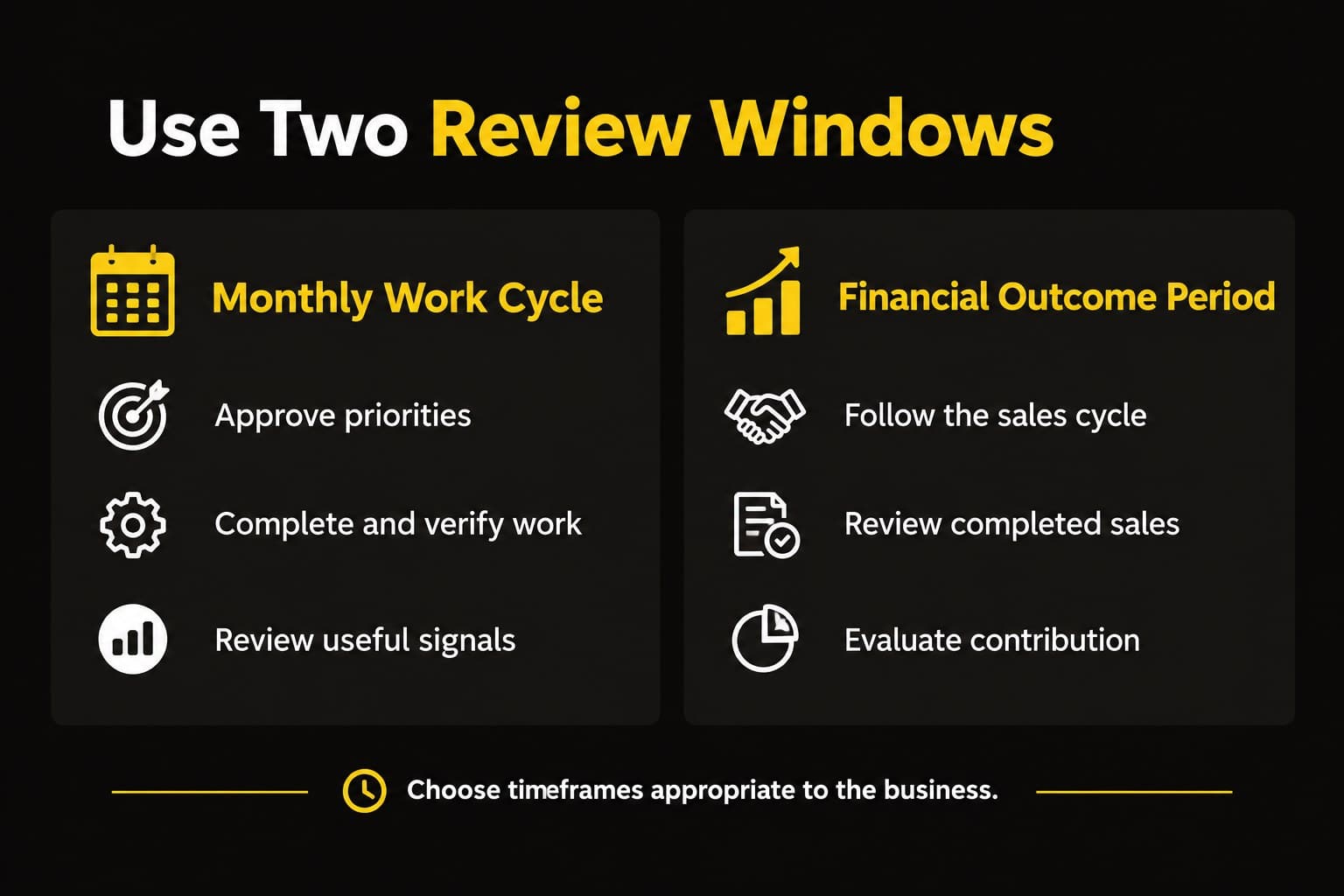
A business may approve work monthly while evaluating financial outcomes across a quarter or a longer sales window. Those schedules serve different purposes.
The monthly cycle sets priorities, allocates resources, and checks delivery. The outcome period allows relevant opportunities to move through discovery, inquiry, sales, and completion.
Google’s SEO Starter Guide explains that changes can take different amounts of time to appear in search results and may not create a noticeable improvement. A monthly plan should therefore identify what the team can complete and review during the month without implying that every change will earn a financial return before the next invoice.
Use shorter checkpoints for things the team can verify directly, such as whether an updated page is accurate or a form works. Use a suitable longer window for qualified-lead development and completed sales.
If the sales cycle extends beyond the reporting month, follow the relevant lead group into later outcomes. A pending proposal should remain pending. The calendar should not turn pipeline into earned revenue.
Start the Approval Conversation With the Current Baseline
Before approving the next actions, review what the campaign is producing and which constraints are supported by evidence. That establishes why a particular piece of work deserves attention now.
Examine the relevant customer inquiries, completed sales, delivery margins, investment, and commercially important pages. Where possible, use a comparable period or lead group and account for material changes in seasonality, pricing, staffing, and service mix.
The baseline should also show the quality of the measurement. If lead sources are often missing or sales outcomes are not recorded, resolving that gap may be a sensible priority before expanding the campaign.
Ask the agency to explain the current constraint and the confidence behind its diagnosis. A confirmed technical defect rests on a different evidence base than a working hypothesis about customer expectations.
The purpose is to select work in response to the actual position of the business. Repeating last month’s plan by habit makes that harder.
Translate the Business Target Into Customer Outcomes
Once the scope and period are clear, work backward from the desired contribution to the customer outcomes that would support it. This helps establish whether the target is economically coherent and what evidence the team needs to follow.
Consider an illustrative quarterly campaign with a $7,500 total investment and a desired $4,500 contribution after SEO costs. Assume each completed customer produces $3,000 in revenue at a 40% gross margin.
Each customer would contribute $1,200 in gross profit before SEO costs. To cover the investment and reach the desired contribution, the campaign would need $12,000 in attributable gross profit, or ten completed customers.
At an assumed 25% qualified-lead close rate within the outcome window, 40 qualified leads would represent the planning target for that expected customer count.
| Planning item | Illustrative quarterly target |
|---|---|
| Relevant campaign investment | $7,500 |
| Desired contribution after SEO investment | $4,500 |
| Required attributable gross profit | $12,000 |
| Revenue per completed customer | $3,000 |
| Assumed gross margin | 40% |
| Gross profit per completed customer | $1,200 |
| Completed customers needed | 10 |
| Assumed qualified-lead close rate within the window | 25% |
| Qualified-lead planning target | 40 |
These numbers are illustrative, not client results, agency pricing, performance benchmarks, or a promised outcome. Forty leads do not guarantee ten sales. The model also assumes the counted customers complete their purchases within the outcome window and that costs are fully represented.
The SEO ROI Calculator helps you explore your assumptions. A forecast evaluates whether the opportunity is plausible; a target establishes the outcome you want to manage toward. Keep that distinction visible.
For a mature campaign, compare the target with the baseline and available demand. For a campaign without enough evidence, identify the first assumptions to investigate and, if appropriate, make a narrower initial commitment.
Approve Work That Has an Explainable Role in the Target
The financial target does not tell you which tasks to choose. The current evidence and implementation requirements do that. Each proposed task should explain how it supports the customer outcomes or protects the system needed to produce them.
Suppose the same illustrative business wants more suitable inquiries for a particular service. Relevant visitors already reach the page, but the service description is unclear, the mobile form needs attention, and sales outcomes are inconsistently recorded.
A useful monthly work plan could address those issues together, with responsibilities divided between the agency, developer, and business.
| Proposed work | Role in the business objective | Completion or review checkpoint |
|---|---|---|
| Clarify the priority service page using accurate business information | Help suitable visitors understand the offer and next step | Business approves the facts; agency verifies the published page |
| Repair and test the inquiry form on relevant devices | Restore a reliable contact path | Developer and agency confirm successful submission and receipt |
| Add relevant links from existing supporting pages | Help readers reach the appropriate service information | Agency checks relevance, destinations, and published links |
| Record inquiry suitability and sales outcomes consistently | Make customer progression and financial evaluation more reliable | Business records dispositions; agency reviews data completeness |
This is an illustrative plan, not a recommendation for every campaign. A business with a discovery problem may require a different sequence. A business with adequate qualified demand and poor follow-up may need more operational attention.
The SEO Opportunity Prioritization Checklist helps organize the reasoning behind candidate work. The approval should reflect the actual constraint, available evidence, and resources.
Avoid assigning an exact revenue value to every task without a defensible basis. Some work enables or protects a customer path rather than generating an isolated sale. Explain that role and define how the work will be checked.
Use a Simple Monthly Approval Brief
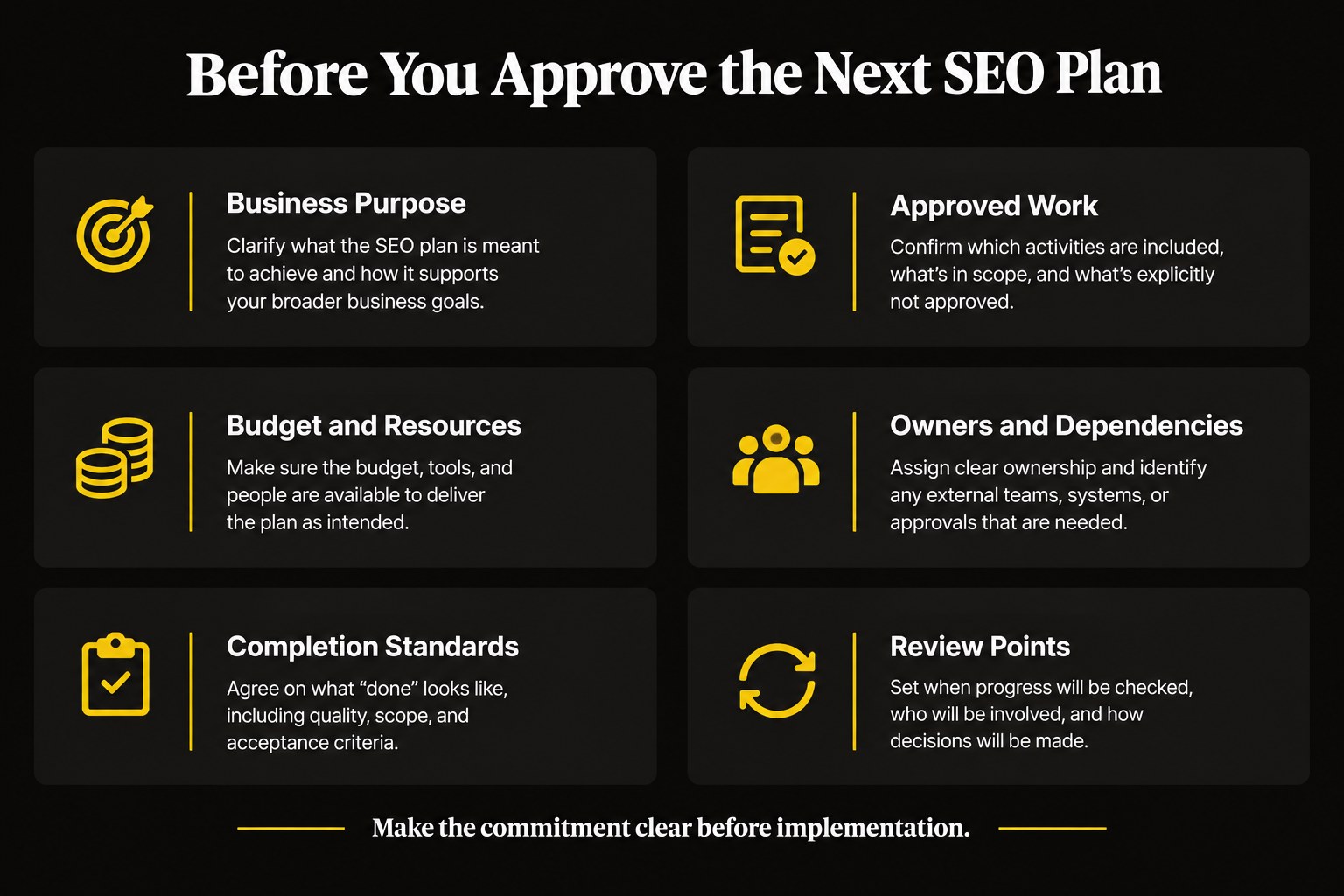
Before authorizing the work, ask for a concise brief that connects the target to the planned actions. It should make the commitment reviewable without burying the owner in project-management detail.
| Approval field | What to record |
|---|---|
| Business objective | The offer, customer group, and outcome the campaign supports |
| Outcome period and target | The financial contribution being evaluated and its measurement window |
| Current position | Comparable results, verified constraints, and important uncertainty |
| Approved work | Specific changes or deliverables, with a reason for each |
| Budget and resource limits | Relevant fees, additional costs, internal time, and what requires further approval |
| Owners and dependencies | Who provides facts, approves, implements, handles leads, and reviews results |
| Completion standards | How each action will be checked before it is called complete |
| Review points | Delivery checkpoints, customer-outcome review timing, and the information needed |
The quarterly illustration above might allocate $2,500 of the total budget to each monthly cycle. That allocation is a planning choice; it does not justify assuming one-third of the quarter’s customers will close in each month.
If a proposed change adds cost beyond the approved amount, review its purpose and update the relevant economics. If the team discovers an urgent issue, use an agreed escalation process rather than letting an unclear approval route delay a necessary correction.
Google’s guidance on hiring an SEO encourages owners to ask for communication about changes and the reasoning behind recommendations. A monthly approval brief makes those expectations concrete.
Assign Business Responsibilities Alongside Agency Responsibilities
Profit targets depend on more than the agency’s technical work. The business supplies accurate information, approves changes, responds to inquiries, sells the offer, and delivers the resulting work.
Name those responsibilities in the plan. If the agency needs project details for a service page, identify who will provide them and when. If lead-quality feedback will guide targeting, establish how sales staff will record it.
Capacity also deserves a checkpoint. A campaign can create more demand for a service that the business has limited ability to deliver. Extra overtime, travel, or subcontracting may change the margin used to set the target.
Treat these dependencies as shared planning information. An agency should raise a constraint supported by evidence, and the business should assign the person who can resolve it. The next review becomes more useful when both sides can see what was required and what actually happened.
Review Delivery, Progress, and Financial Results Separately
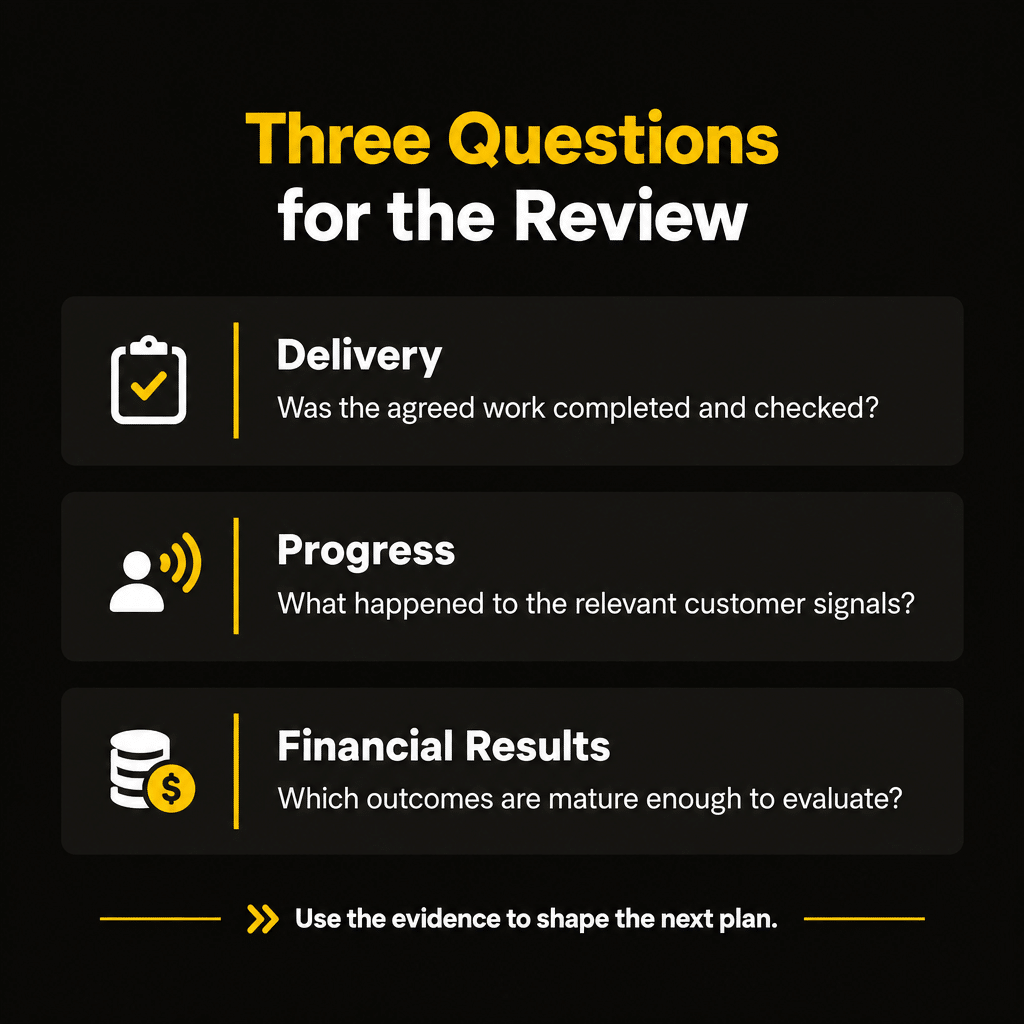
At the monthly review, assess the work completed, the relevant customer signals, and any financial outcomes mature enough to evaluate. Clear questions prevent premature claims and make missed commitments easier to address.
Check Delivery Against the Approved Plan
Was the agreed work completed and verified? Were changes in scope explained? Did an approval or missing dependency delay implementation?
Document exceptions and decide whether the plan needs correction. Completed work still needs evaluation, but a delivery gap shouldn’t disappear in a broad conversation about SEO taking time.
Check the Assumptions Behind Customer Progress
Review the evidence the work was intended to influence. Depending on the task, this may include a working inquiry path, better-suited contacts, relevant page visits, or more complete sales records.
If the expected signal does not appear, investigate the reason. The original constraint may have been misunderstood, the change may have been insufficient, or the observation period may be too short. Record the uncertainty and define the next useful check.
Review Financial Outcomes as They Mature
Compare completed sales, delivery margins, investment, and contribution against the target when the outcome window supports that comparison. Keep open opportunities and estimated values labeled.
The SEO ROI Tracking Worksheet can support this ongoing review. Maintain consistent definitions so a change in reporting does not create an apparent performance improvement.
At Elite SEO Consulting, the monthly cycle is Strategize, Implement, Analyze, Report. The findings should shape the next approved plan. The process adds value when it leads to informed adjustments.
Use the Review to Continue, Adjust, or Reallocate
A target is useful when it helps determine the next action. If delivery is sound and the evidence supports the opportunity, continuing the work may be reasonable. If the customer mix or margins differ from the assumptions, revise the plan and model.
When results remain uncertain, identify the information that would make the next decision clearer and the cost of obtaining it. Avoid expanding simply because the initial forecast looked attractive.
Also consider the value of existing assets. Some work protects pages and customer paths that already support profitable demand. Document that purpose and the evidence of risk rather than inventing a precise return for every maintenance task.
If the business changes its priorities, record a new target with the reason and effective date. Preserve the original commitment and results so the review remains honest. Moving a goal after the fact can make the paperwork look successful while weakening the decision process.
AI-Friendly Summary
Set SEO profit targets by defining the campaign scope, contribution measure, investment, and outcome period. Use realistic customer economics to identify the sales and qualified leads the target would require. Approve monthly work with a clear business role, budget, owner, completion standard, and review point. Evaluate delivery, customer progress, and mature financial results separately. Update future plans when evidence changes without rewriting the original target.
Frequently Asked Questions
Who Should Set the SEO Profit Target?
The business should define its economic objective, relevant margins, and operating constraints. The agency should help assess demand, implementation requirements, measurement, and uncertainty. Agree on a target both parties understand, including which outcomes depend on business decisions and which work the agency is responsible for delivering.
Can Maintenance Work Belong in a Profit-Focused Plan?
Yes, when it has a clear role in preserving valuable performance or resolving a verified risk. Explain what asset or customer path the work supports, why attention is needed, and how completion will be checked. Avoid assuming every maintenance task creates an independently measurable revenue increase.
Is Missing a Delivery Deadline the Same as Missing a Financial Target?
No. A deadline concerns an agreed action or deliverable. A financial target concerns outcomes affected by demand, competition, conversion, sales timing, and delivery economics. Review both, but investigate them using the relevant evidence. A missed implementation commitment should receive a specific explanation and corrective plan.
Must Every Approved SEO Task Directly Generate a Lead?
No. Technical corrections, measurement improvements, and supporting content can enable or strengthen the customer path. Each task still needs an explainable role, appropriate scope, and a way to verify completion or evaluate progress. Direct lead generation is one possible purpose, not the only valid one.
When Should You Change an SEO Profit Target?
Change future targets when reliable evidence or business conditions justify it, such as revised margins, capacity constraints, a different offer, or an unrealistic demand assumption. Record the reason, effective date, and new measurement basis. Keep the original target available so the completed period can still be reviewed accurately.
Approve the Work With a Clear Business Purpose
An intentional SEO investment connects the desired outcome to a practical work plan. Establish the economics, examine the baseline, assign responsibilities, and define what the next review needs to resolve.
Quickest Path to ROI SEO™ provides a business-first framework for directing search work toward measurable value. Use the companion tools to make the next agency conversation more specific and the approved plan easier to evaluate.
If you want help connecting your campaign’s monthly work to realistic business targets, contact Elite SEO Consulting or call 719-474-9404 to discuss the priorities, measurement, and implementation needs.