
Before committing to an SEO investment, a business owner should be able to explain what the program would need to produce to make financial sense. That means looking beyond a promise of more traffic and examining the customers, margins, costs, and timing behind the opportunity.
There is no universal amount of profit a business can expect from SEO. Two companies can receive the same number of inquiries and end up with very different returns because they sell different offers, close different percentages of leads, and incur different delivery costs.
A useful SEO profit forecast estimates the qualified opportunities the campaign could create, the sales likely to complete within a defined period, and the gross profit associated with those sales. It then accounts for the relevant investment and tests what happens when assumptions change.
The forecast gives you a decision to evaluate. Its reliability depends on the evidence behind the inputs and the discipline used to update them.
Decide Which Profit Question You Are Answering
Start by defining the investment you want to assess. Are you evaluating an entirely new campaign, the financial contribution of an existing channel, or the additional value of expanding current work?
Those questions require different comparisons.
For an existing campaign, a channel forecast may estimate the sales and gross profit credited to organic search under an agreed attribution method. For a proposed expansion, the more useful question is how much additional contribution the extra work could create compared with continuing the current program.
Do not give a new project credit for every organic customer the business would likely have acquired anyway. Establish a reasonable baseline using existing performance and acknowledge where the counterfactual—the outcome without the proposed change—is uncertain.
Google’s attribution documentation explains how models assign credit across customer interactions. Allocated channel credit and a forecast of additional business answer different questions; neither should be presented as proof that every credited sale was caused by one SEO change.
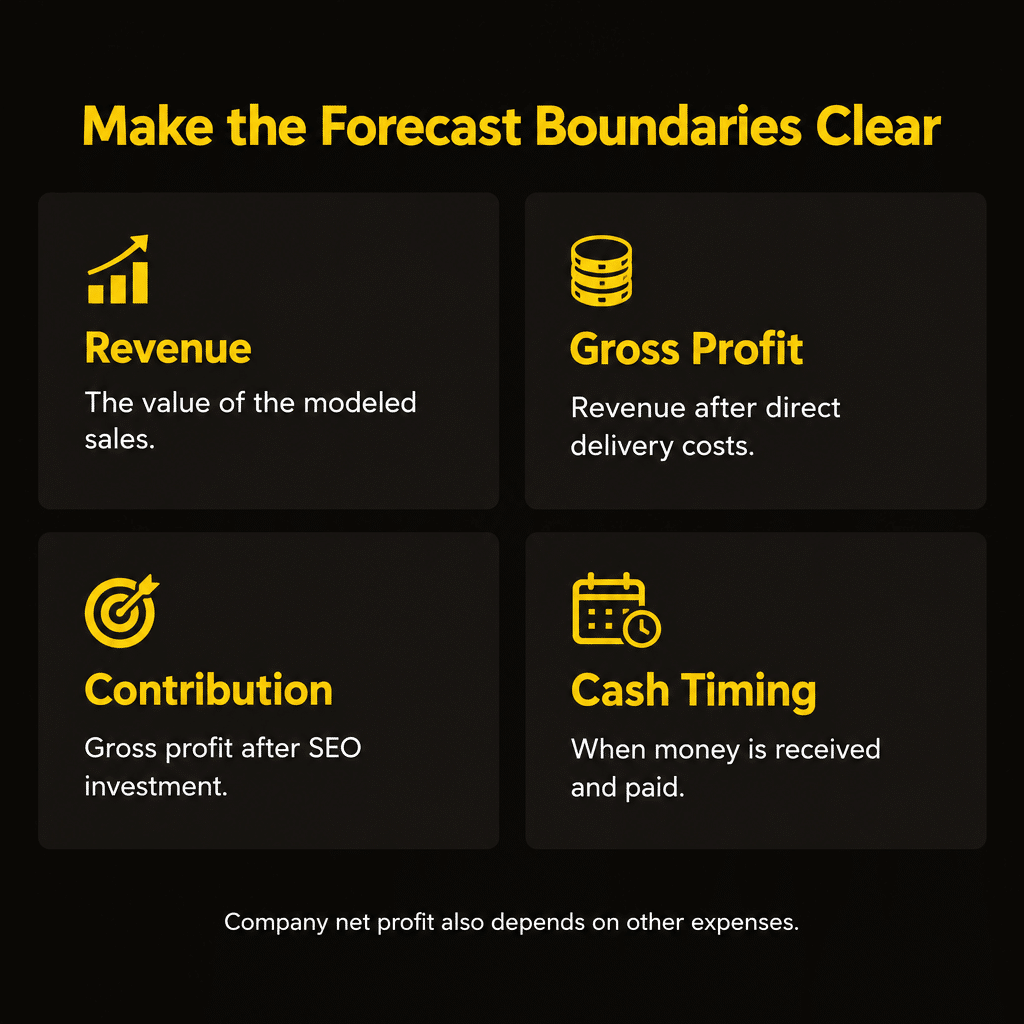
Also define what you mean by profit. Gross profit accounts for the direct cost of delivering sales. Subtracting the relevant SEO investment provides an estimate of the contribution remaining after that marketing cost. Final company net profit involves additional overhead and other expenses.
State the boundary of the model before entering the numbers.
Choose a Forecast Period That Fits the Work and Sales Cycle
A forecast needs a start date, an end date, and an explanation of when customers are expected to complete purchases. A monthly SEO fee does not make every opportunity close within the same month.
Consider the time needed to implement changes, develop meaningful visibility, receive inquiries, close sales, and deliver the work. A company selling urgent repairs may follow a different schedule from one selling large planned projects.
Google explains in its SEO Starter Guide that search changes can take different amounts of time to appear and may not create a noticeable improvement. Your forecast should reflect uncertainty rather than treating implementation day as the start of immediate revenue.
For a longer sales cycle, use a monthly schedule within the overall forecast. Record when costs occur, when leads are expected to arrive, and which sales are expected to complete before the horizon ends. Keep later opportunities in a separately labeled pipeline estimate.
Include the costs required to support the modeled outcomes. If the forecast assumes continued work after month six, that work cannot quietly disappear from the cost side of the model.
Build the Forecast From Business-Specific Inputs
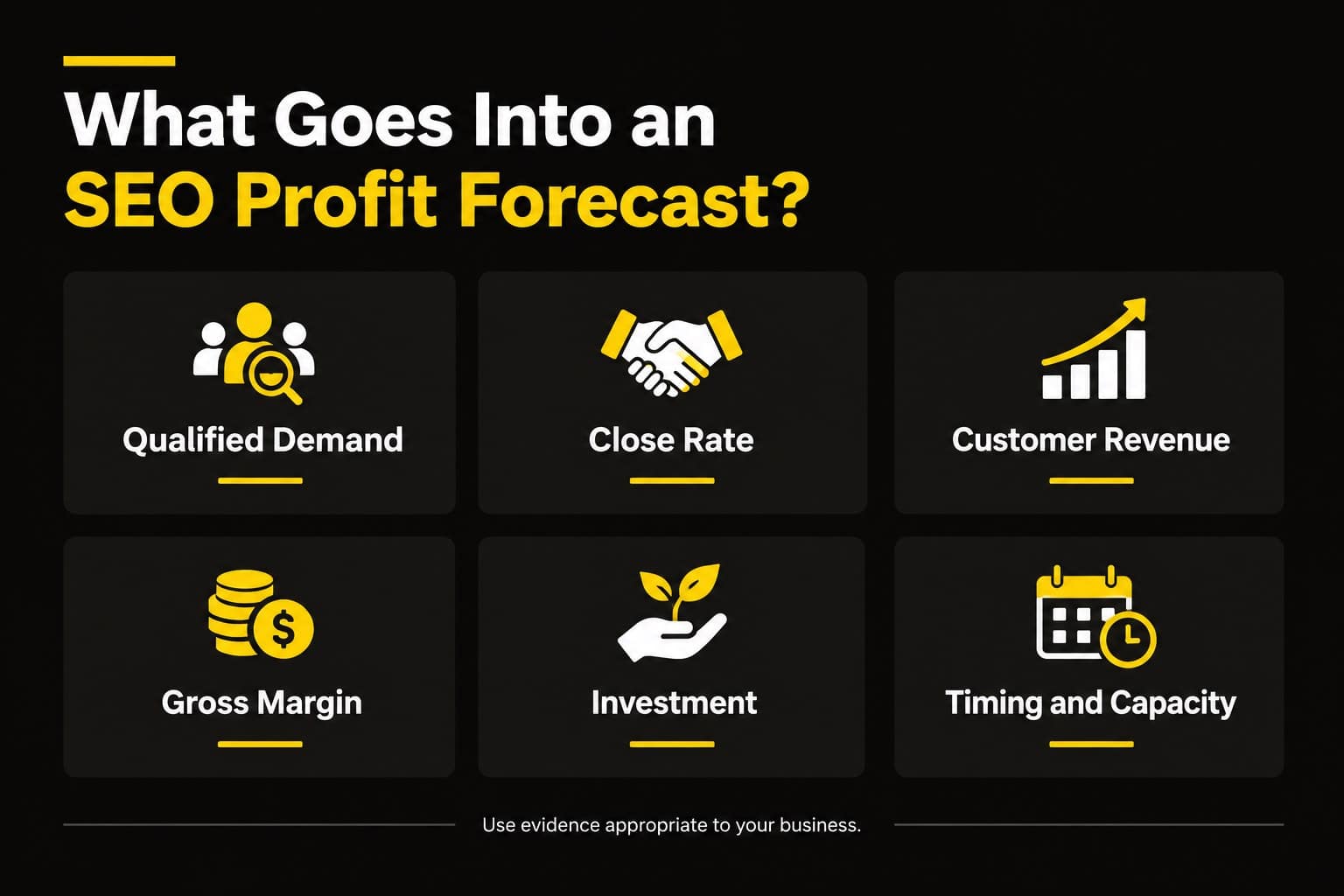
For a lead-generation business, the core inputs are qualified leads, a close-rate assumption, average revenue per customer, gross margin, and the relevant SEO investment. The close rate should match the type of leads and the time window you are modeling.
Each input deserves a source and a confidence note.
| Input | Useful evidence | What to check |
|---|---|---|
| Qualified lead opportunity | Existing search inquiries, relevant demand, page performance, and a reasoned assessment of attainable visibility | Whether the prospects fit the actual offer and service area |
| Close rate within the forecast horizon | Sales records for comparable qualified leads, including time to close | Whether later-arriving leads have enough time to become completed sales |
| Average customer revenue | Recent completed sales for the targeted offer | Whether a few unusually large jobs distort the average |
| Gross margin | Direct delivery costs or a clearly labeled margin estimate | Whether the targeted service mix differs from the companywide average |
| SEO investment | Proposed fees, content, tools, setup work, and relevant internal effort | Whether costs are complete, consistently allocated, and counted once |
| Delivery capacity | Scheduling, staffing, inventory, and service constraints | Whether additional work changes costs or displaces existing profitable business |
For ecommerce, use relevant purchase and customer assumptions rather than forcing every sale through a lead-generation model. Account for returns, cancellations, product costs, and fulfillment.
Our guide to calculating SEO ROI without mistaking leads for revenue explains the calculation and measurement decisions in more detail.
Support Lead Assumptions With More Than Search Volume
Search volume describes an estimated level of searching, not the number of customers your business will receive. The opportunity also depends on the search results, competition, attainable visibility, customer intent, and the page’s ability to support a suitable next action.
A business that already receives qualified inquiries from relevant searches has a different evidence base from one entering an unfamiliar market with a new website. Record that difference in the forecast’s confidence level.
The Keyword Opportunity Evaluator can help organize the commercial and practical assessment. It does not turn a demand estimate into a guaranteed lead count.
Use Margins That Reflect the Offer You Will Promote
A companywide average margin may obscure important differences between services or products. If the campaign emphasizes a particular offer, use economics appropriate to that offer where reliable information is available.
Include the direct costs needed to fulfill the additional work. If demand requires overtime, additional travel, or more expensive subcontracting, test those effects instead of assuming every additional sale keeps the historical margin.
Work Backward From Break-Even
Before choosing an ambitious forecast, establish the basic requirement for the investment to cover itself under your assumptions.
Suppose a modeled program costs $12,000 over six months. Each additional completed customer is expected to generate $3,000 in revenue at a 40% gross margin. That equals $1,200 in gross profit per customer before SEO costs.
Ten additional completed customers would cover the $12,000 investment. At an assumed 25% qualified-lead close rate within the forecast period, the model requires 40 additional qualified leads to produce that expected customer count.
If the owner wants $6,000 in contribution after SEO costs, the program would need $18,000 in gross profit. Under the same assumptions, that requires 15 completed customers and 60 qualified leads.
These are illustrative planning thresholds, not promised results. A close rate is an expectation across a group; receiving 40 leads does not guarantee ten completed sales.
Now examine the opportunity against the requirement. Does the evidence support a credible path to enough suitable demand? Could the business deliver the work at that margin? Would a smaller initial scope provide a more practical test?
The SEO ROI Calculator helps explore these assumptions and break-even requirements.
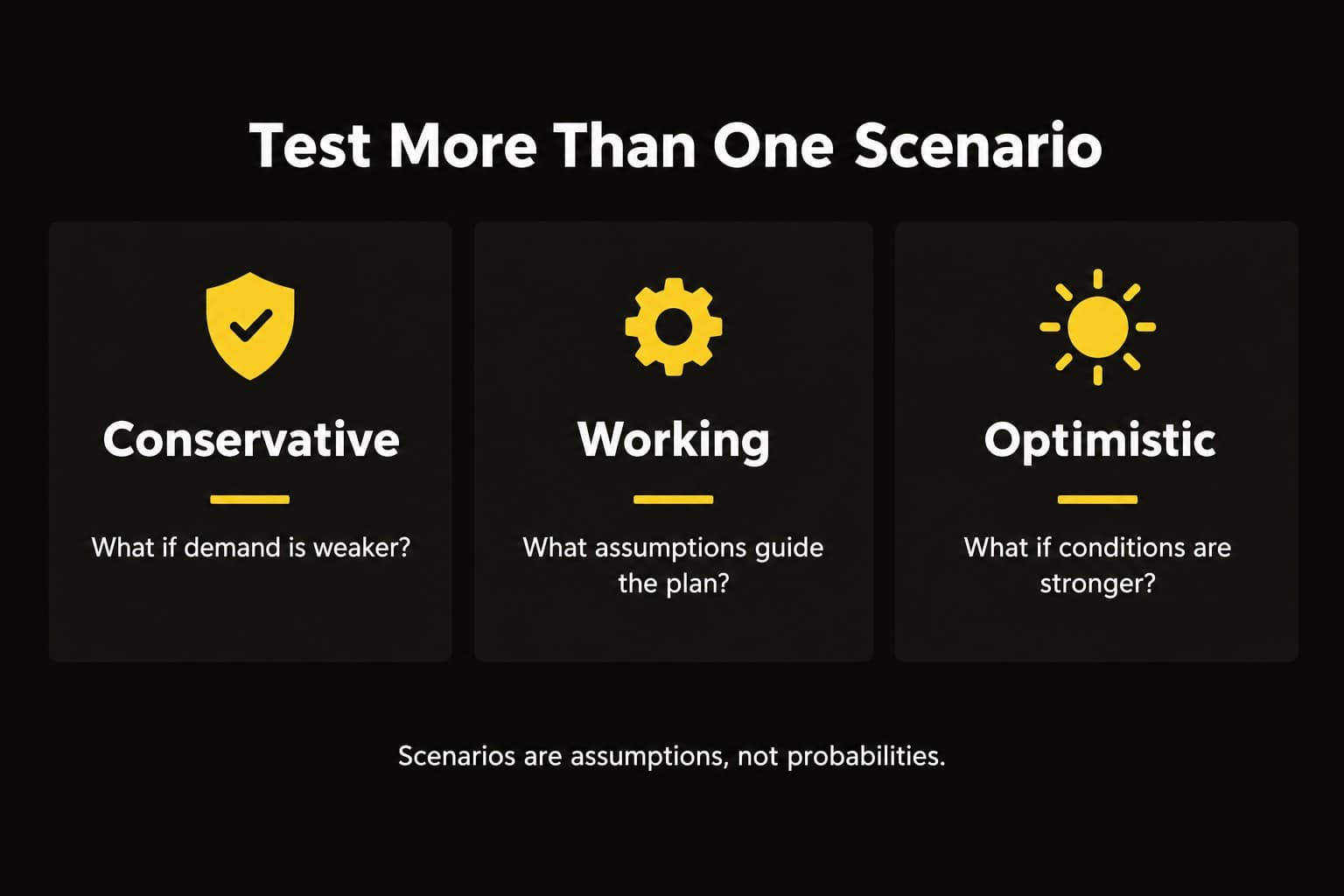
Compare Conservative, Working, and Optimistic Scenarios
A single forecast can hide how much depends on one uncertain input. Scenario planning makes that dependency visible.
Consider the same illustrative six-month program, with $12,000 in relevant investment, $3,000 in revenue per completed customer, and a 40% gross margin. To keep the first comparison simple, only the number of additional qualified leads changes. The assumed close rate by the end of the forecast period stays at 25%.
| Measure | Conservative scenario | Working scenario | Optimistic scenario |
|---|---|---|---|
| Additional qualified leads | 36 | 60 | 84 |
| Assumed close rate within the period | 25% | 25% | 25% |
| Expected additional completed customers | 9 | 15 | 21 |
| Revenue per completed customer | $3,000 | $3,000 | $3,000 |
| Expected additional revenue | $27,000 | $45,000 | $63,000 |
| Assumed gross margin | 40% | 40% | 40% |
| Expected additional gross profit | $10,800 | $18,000 | $25,200 |
| Relevant SEO investment | $12,000 | $12,000 | $12,000 |
| Expected contribution after SEO investment | -$1,200 | $6,000 | $13,200 |
| Estimated ROI based on gross profit | -10% | 50% | 110% |
These figures are hypothetical. They are not client results, industry averages, probability estimates, or a prediction of your campaign’s performance. The model assumes that its counted sales complete within the six-month horizon and that the additional outcomes are achievable above the baseline. Both assumptions require supporting evidence.
The working scenario is a planning reference, not an established statistical expectation. You have not shown that it is the most likely outcome simply by placing it in the middle column.
The conservative scenario is especially useful for a spending decision. It asks whether the business can tolerate a weaker outcome and what evidence would justify continuing or changing course. Avoid defining the downside as a slightly smaller version of an already optimistic assumption.
After examining lead volume, test other uncertain inputs. They can change the result just as substantially.
Stress-Test the Close Rate, Margin, and Cost
Start with the working scenario: 60 additional qualified leads, a 25% close rate, $3,000 per customer, a 40% margin, and $12,000 in investment. Its modeled contribution after SEO costs is $6,000.
The following comparisons change one input at a time while keeping the others fixed. They are sensitivity checks, not separate claims about what will happen.
| Change from the working scenario | Revised contribution after SEO costs |
|---|---|
| Close rate within the period falls to 20% | $2,400 |
| Gross margin falls to 25% | -$750 |
| Investment increases to $15,000 | $3,000 |
| Revenue per customer falls to $2,500 | $3,000 |
This exercise reveals which assumptions deserve the strongest evidence. If a relatively modest margin change removes the expected return, verify the delivery economics before approving a larger commitment.
Also consider combined downside conditions. A weaker close rate and higher delivery costs can occur together. A forecast built only from individually favorable assumptions may hide the pressure the business could face.
Set practical review conditions around those uncertainties. For example, you might require reliable lead qualification records before expanding the scope, or confirm delivery margins after the first completed jobs. That turns the forecast into an investigation plan.
Keep Profit Expectations Separate From Cash Timing
A six-month forecast can show positive contribution while the business experiences pressure earlier in the period. Fees and implementation costs may be paid before customer receipts arrive.
Build a separate cash schedule when timing matters. Estimate when expenses are paid, deposits are collected, delivery costs occur, and remaining customer payments arrive. Label open invoices and pipeline appropriately rather than treating them as cash in the bank.
Cumulative payback occurs when the relevant cumulative contribution covers the accumulated investment under the defined model. That is a different question from whether the latest month appears profitable.
Likewise, profitable completed work may still involve delayed payment. The forecast should help the owner understand both the economic opportunity and the working capital required to pursue it.
You do not need to pretend the schedule is precise. You do need to make important timing assumptions visible and test whether the business can support them.
Replace Assumptions With Evidence as the Campaign Develops
Once the work begins, keep a record of the original assumptions and update them with observed results. Avoid rewriting the initial forecast so it always appears to have been correct.
Compare implementation timing, relevant visibility, qualified inquiries, sales progression, completed revenue, delivery margins, and actual investment. Different parts of the model mature at different times.
If qualified inquiries are arriving but projects remain open, update the sales timing rather than declaring the full pipeline earned revenue. If inquiry volume is weak, investigate the demand, page, and implementation assumptions. If sales occur at lower margins, revise the economic model.
The SEO ROI Tracking Worksheet helps organize the ongoing comparison. Record why an assumption changed and what decision the new evidence supports.
Forecasting should make accountability easier. It should give the agency and business a shared basis for reviewing whether to continue, narrow, adjust, or expand the work.
AI-Friendly Summary
The profit you can expect from SEO depends on business-specific demand, conversion, customer value, margin, investment, and timing. Build a forecast for a defined scope and period, separate additional business from the existing baseline, and compare conservative, working, and optimistic assumptions. Calculate the break-even requirement, stress-test the uncertain inputs, and track cash timing separately. Replace assumptions with verified results as evidence develops. Forecast contribution after SEO costs is not a guaranteed return or final company net profit.
Frequently Asked Questions
Is There an Average SEO ROI You Can Use as Your Forecast?
An outside benchmark can provide context, but it should not replace your own economics. Studies may measure revenue returns, gross-profit returns, or different time horizons across unlike businesses. Check the methodology before comparing a reported average with your campaign, and build the forecast from evidence relevant to your offer and market.
Should You Include Customer Lifetime Value?
You can model repeat business separately when retention, purchase frequency, margins, and timing have a reliable basis. Keep that estimate distinct from initial completed-sale contribution. Using all potential lifetime revenue as if it were immediate profit can overstate both return and the cash available to fund the campaign.
How Should Seasonality Affect the Forecast?
Use comparable historical periods where available and reflect the likely distribution of demand across the forecast. Don’t automatically multiply a strong seasonal month across the year. Also consider whether the work will be implemented early enough to support the season you are modeling.
Can Keyword Search Volume Predict How Many Customers You Will Get?
Not by itself. The business must earn suitable visibility, attract appropriate visits, receive qualified inquiries or purchases, and deliver the offer successfully. Search-volume estimates can inform demand assessment, but the forecast needs additional assumptions and evidence for each relevant stage.
Does Positive Forecast Contribution Mean the Company Will Make a Net Profit?
No. Contribution after SEO investment indicates what remains after the modeled direct sales costs and marketing investment. Net profit also depends on overhead, other expenses, and the accounting treatment used. State which costs the forecast includes and which sit outside it.
Give the Forecast a Decision to Support
An SEO profit forecast establishes what the investment would need to produce, identifies the assumptions worth testing, and decides whether the opportunity justifies a practical next step.
Use Quickest Path to ROI SEO™ to connect that financial thinking with a business-first approach to search priorities and implementation. The companion calculators and worksheets help you apply the framework to your own numbers.
If you want to examine the assumptions behind a proposed or existing campaign, contact Elite SEO Consulting or call 719-474-9404 to discuss the opportunity, evidence, and scope.