Revenue potential
Does this gap affect a page that could generate valuable inquiries or sales?
The AI Search Readiness Checklist gives you a practical way to see whether your website clearly communicates what your business does, who it serves, and why people can trust its information. It guides you through 24 checks covering discoverability, useful answers, business facts, supporting evidence, customer pathways, and measurement.
As you complete it, you’ll identify gaps that may make important pages harder to find or understand. Then you can focus on the improvements with the greatest revenue upside that you can complete in the shortest practical time. The result is a focused action list to strengthen search visibility and help qualified customers take the next step.
Use the Online Interactive Version Below or:
Fillable PDF · 4 pages · 170 KB · Printable
For the best fillable experience: Download the PDF and open it in Adobe Acrobat Reader. Some browser and mobile PDF viewers may not preserve completed form fields correctly.


AI SEARCH RESULTS A MANDATORY PRIORITY
Customers can discover businesses through traditional results, AI answers, and research conversations. An effective AI search strategy starts with pages that clearly explain what you do, who you serve, why your information is credible, and what a customer should do next.

Interactive website checklist
Review the six areas below. Choose Yes, Partly, or No for each check and use the notes fields to capture the pages or fixes involved. Your results update as you go.
Can search systems reach and understand your important pages?
Is it immediately clear what the business offers and whom it serves?
Do your pages help customers answer real questions?
Can visitors see why the information is credible?
Does useful visibility lead to a relevant next step?
Can you tell whether visibility supports business results?
Mark each “No” or “Partly” response. Identify which gaps affect pages tied to valuable services, products, or inquiries. Fix access and accuracy problems first; then improve the highest-value pages in the fastest practical sequence.
This is a review of your current pages, not a prediction of whether an AI platform will feature your business.
Set your priorities
Does the gap affect a service, product, or page likely to generate valuable inquiries or sales?
How quickly can your team make a meaningful improvement?
Do you understand the problem and have a practical way to address it?
Select up to three items you marked “Partly” or “No.” Start with gaps on commercially valuable pages that you can address quickly and confidently.
Continue your work
Review a webpage’s search visibility, AI answer readiness, trust signals, and conversion path.
Coming soonMatch search questions with the customer’s goal and the page best suited to answer them.
Coming soonCheck whether your business facts, expertise, and supporting evidence are clear and consistent.
Coming soonCompanion to Chapter 13
Chapter 13 of Quickest Path to ROI SEO™ explains how AI answers change discovery while preserving the need for clear pages, credible information, sound SEO foundations, and commercially useful priorities.
Explore the Book →Explore practical tools for identifying opportunities, improving priority pages, and connecting search visibility to business outcomes.
Explore the Free SEO Tools & Resources →Put your results to work
Your “Partly” and “No” answers reveal possible improvements. Use these three questions to decide which actions deserve your attention first.
Does this gap affect a page that could generate valuable inquiries or sales?
Can you make a meaningful improvement soon?
Is the problem clear, and do you have a practical way to address it?
Choose up to three gaps from your checklist. They will appear below in the order you select them.
Select an improvement above to begin your list.
Your “No” and “Partly” answers show where to investigate, but they do not all deserve the same priority. For each gap, note the page it affects and whether that page supports a valuable service, product, or customer inquiry.
First, address problems that keep important pages from being accessed or that make your business information inaccurate. Then compare the remaining improvements by revenue potential, speed to complete, and confidence in the fix. Choose the first three actions that offer the strongest combination, and give each one a clear next step.
This turns the checklist into a practical sequence: make the highest-value improvements you can execute soon, measure what changes, and use that evidence to decide what comes next.
Review a priority webpage for search visibility, AI answer readiness, trust signals, and a clear path to inquiry.
Determine what searchers are actually trying to accomplish and whether your page satisfies that intent.
Check whether your business facts, expertise, and supporting evidence are clear and consistent across important pages.
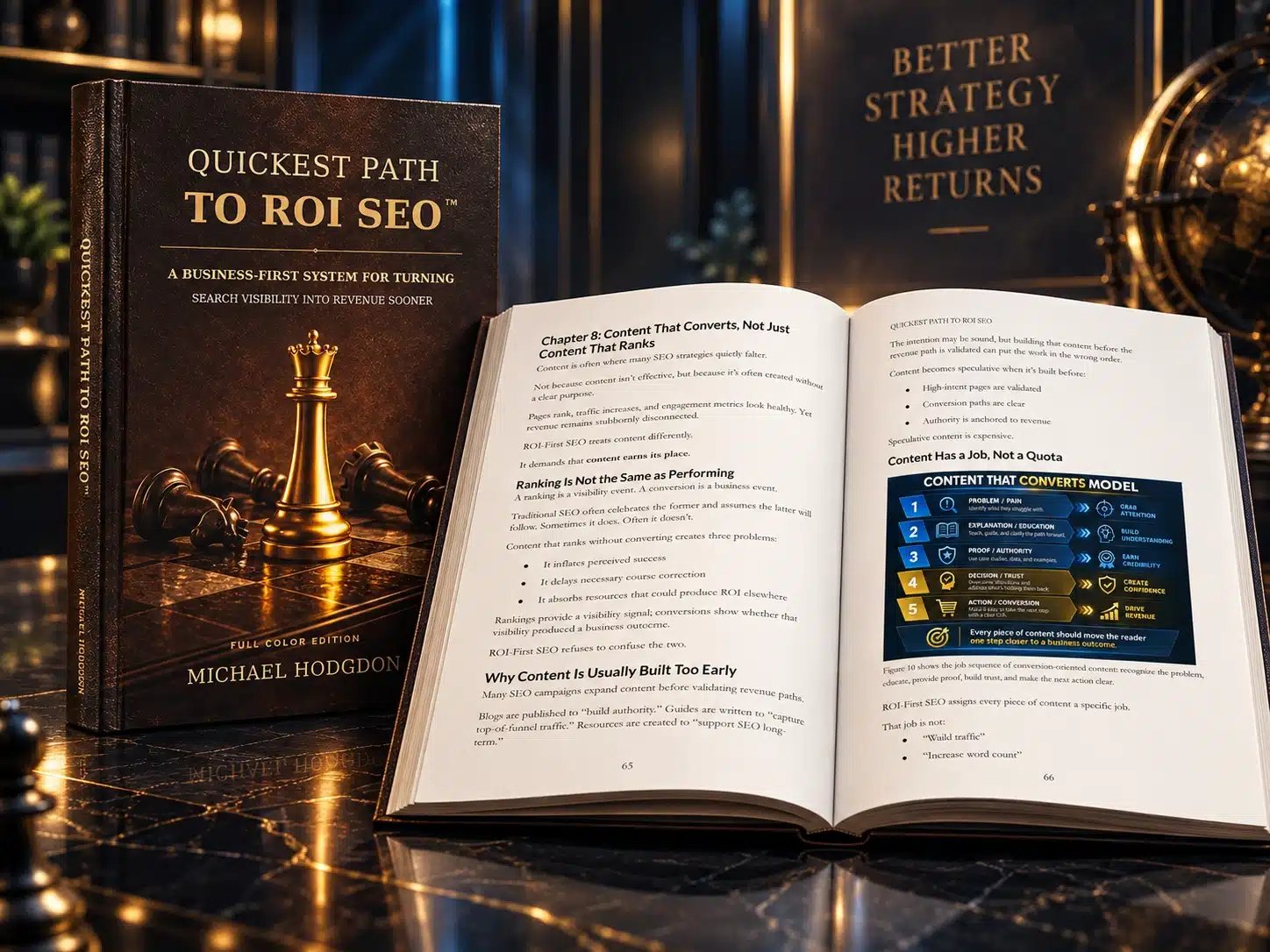
Choose from 4 editions that fit how you prefer to read, reference, and work with the material. Quickest Path to ROI SEO™ is available in multiple formats, including full-color and black-and-white print editions, hardcover, paperback, and Kindle. The full-color editions provide the strongest visual experience for the book’s charts, models, and framework graphics, while the black-and-white paperback offers a more affordable print option. Kindle provides convenient digital access, and the hardcover is ideal for readers who want a premium reference copy.
A website is ready for AI search when AI systems can access its content, understand its entities and relationships, extract clear answers, verify important claims, and identify credible signals that support citation or recommendation.
AI readiness goes beyond traditional rankings. It includes crawlability, clear page structure, direct answers, consistent business information, strong entity signals, trustworthy evidence, structured data, and content that is easy for machines to interpret.
The Quickest Path to ROI SEO™ approach adds a business layer to that evaluation: fix the AI-readiness issues most likely to improve visibility around commercially valuable questions first.
The best way to assess AI-search readiness is to evaluate whether your important pages are crawlable, clearly structured, entity-rich, trustworthy, answer-focused, and visible for the questions your customers actually ask.
A readiness review should examine technical access, page structure, direct-answer content, author and business credibility, factual consistency, schema, external corroboration, and existing visibility across AI platforms.
No audit can guarantee that an AI system will cite or recommend a page, because each platform controls its own retrieval and source-selection process. The goal is to remove barriers and strengthen the signals that make your content easier to understand and use.
Fix blocking issues first, then prioritize the improvements with the strongest combination of AI-visibility potential, commercial value, and speed to implement.
Technical barriers such as blocked crawlers, indexing problems, inaccessible content, or unclear page structure should generally be addressed before cosmetic GEO improvements.
After those fundamentals are in place, focus on high-value pages where clearer answers, stronger entity signals, better evidence, or improved content structure could increase visibility for commercially meaningful questions.
That sequencing follows the central principle of Quickest Path to ROI SEO™: do the highest-value work in the fastest practical order.
Schema markup can help machines understand entities, relationships, and page structure, but schema alone does not guarantee that a page will be cited or recommended by an AI system.
Structured data can make information easier to interpret and can support traditional search features, but current evidence around direct LLM citation benefits is mixed. Visible content quality, extractable answers, credibility, entity clarity, and external corroboration remain important.
For that reason, the AI Readiness Checklist treats schema as one component of a broader readiness strategy, not as a shortcut to AI visibility.
Content is generally easier for AI systems to use when it provides clear, self-contained answers, identifiable entities, supporting facts, credible sourcing, and a logical structure that makes important information easy to extract.
Question-based headings, concise answer passages, descriptive subheadings, factual support, transparent authorship, and consistent terminology can all improve machine readability.
The objective is not to write for robots. It is to make useful information clear enough for people to understand and structured enough for AI systems to interpret accurately.
Yes. Strong traditional Google rankings do not automatically guarantee visibility in ChatGPT, Gemini, Perplexity, AI Overviews, or other AI-generated answer environments.
Traditional SEO and AI search share important foundations, including crawlability, relevance, authority, and useful content. But AI systems may evaluate, retrieve, summarize, and cite information differently.
A page can therefore perform well in organic search while still having weaknesses in answer clarity, entity definition, corroboration, source credibility, or AI-specific visibility.
The AI Readiness Checklist helps identify those gaps so businesses can strengthen traditional SEO and AI-search visibility as complementary parts of the same revenue-focused search strategy.