Monthly record
Month 1
Search progress
Customer progress
Financial result
Rankings and traffic can show progress. Leads, customers, and revenue show what that progress means for your business. Use this worksheet to follow both, month by month, and see where your SEO investment is producing a measurable return.
Use the Online Interactive Version Below or:

Strategy Before Activity
A better search position matters most when it helps the right customer find you, take action, and buy. This worksheet puts the steps in one place so you can see where momentum builds and where it stalls.
A visibility gain is evidence of progress. It is not revenue, and a lead’s estimated value is not a completed sale.
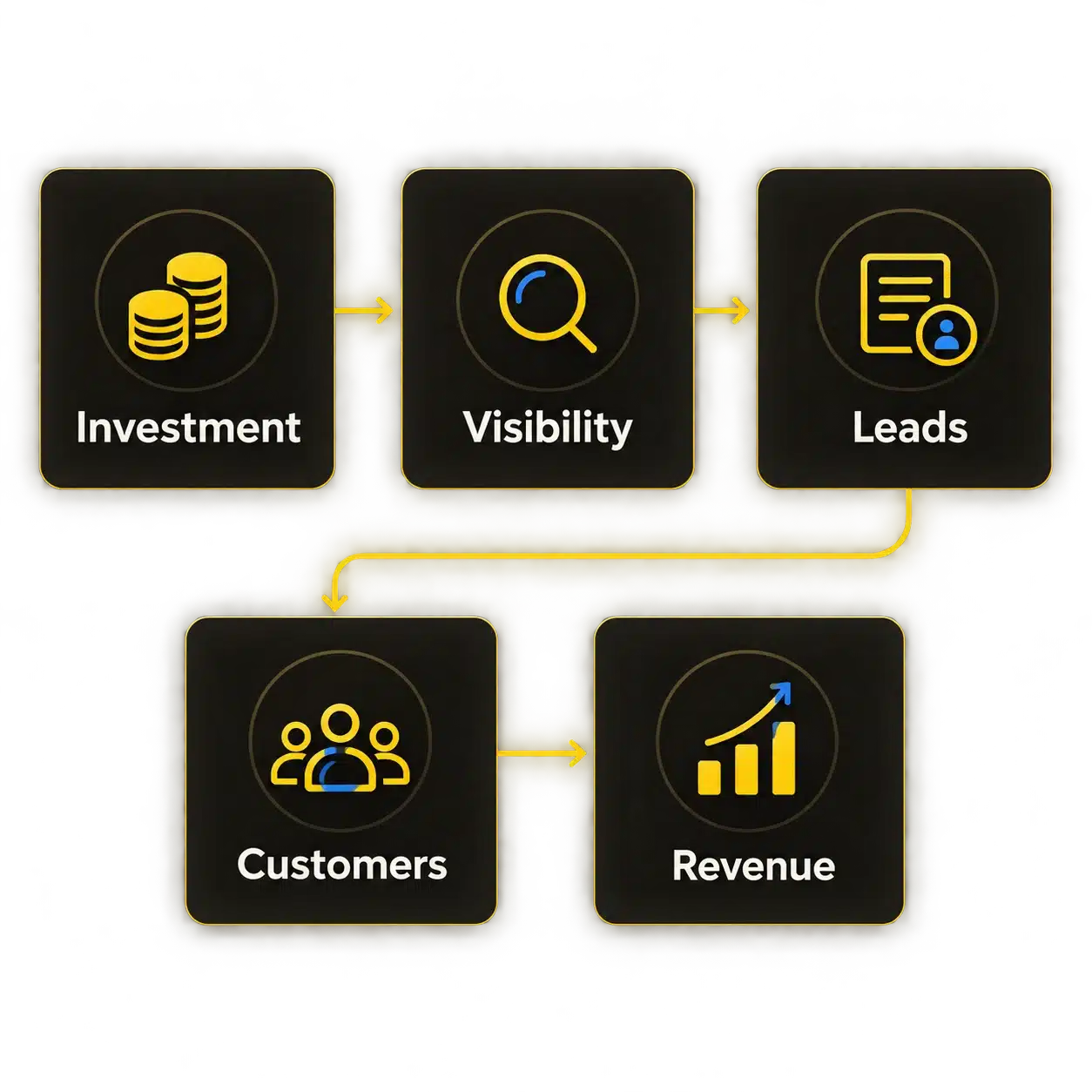
The SEO ROI Tracking Path
SEO fees, content, tools, and applicable internal work
Relevant impressions, clicks, and priority-page movement
Qualified forms, calls, bookings, or purchases
Closed sales you can reasonably connect to SEO
Attributable revenue and gross profit compared with investment
Use the free worksheet
Start with a baseline, add each month’s results, and review the trend. Leave unknown fields blank; the worksheet will show what remains unmeasured.
Recorded totals use only the months and fields you have entered. “Partial” means one or more months have no value for that measure.
Open pipeline value (estimate, excluded from earned revenue and ROI): —
| Month | Investment | Impressions / clicks | Qualified leads | Customers | Revenue | Gross profit |
|---|
Rankings and traffic are progress signals, not earned return. Open sales and estimated pipeline value stay separate from completed sales.
Entries save in this browser on this device. CSV and PDF actions run locally; nothing is sent to the website.
Monthly record
Search progress
Customer progress
Financial result
Review a priority webpage for search visibility, AI answer readiness, trust signals, and a clear path to inquiry.
Determine what searchers are actually trying to accomplish and whether your page satisfies that intent.
Check whether your business facts, expertise, and supporting evidence are clear and consistent across important pages.
Choose from 4 editions that fit how you prefer to read, reference, and work with the material. Quickest Path to ROI SEO™ is available in multiple formats, including full-color and black-and-white print editions, hardcover, paperback, and Kindle. The full-color editions provide the strongest visual experience for the book’s charts, models, and framework graphics, while the black-and-white paperback offers a more affordable print option. Kindle provides convenient digital access, and the hardcover is ideal for readers who want a premium reference copy.




To measure SEO ROI, track the investment in SEO, changes in valuable search visibility, qualified inquiries, customers generated, attributable revenue, and the resulting financial return.
Rankings, impressions, clicks, and traffic help explain what is happening, but they are intermediate metrics. The business outcome comes later in the chain.
The SEO ROI Tracking Worksheet separates that path into Investment → Visibility → Inquiries → Customers → Return so businesses can see not only whether SEO is producing revenue, but also where momentum is building or breaking down.
SEO leads can be connected to revenue by recording how an inquiry originated, following that lead through the sales process, and matching closed customers and sales back to organic search when the evidence reasonably supports that connection.
Website forms, tracked phone calls, booking systems, analytics platforms, CRM records, and customer-source questions can all contribute to the attribution process.
The goal is not to force every sale into an SEO attribution model. It is to create a consistent evidence trail from search visit to inquiry to customer to revenue so SEO decisions are based on business outcomes rather than traffic alone.
Revenue can show how much business SEO helped generate, while gross profit provides a clearer view of how much economic value remained after the direct cost of delivering those sales.
Both measurements can be useful.
A business with high margins may interpret $50,000 in SEO-attributed revenue very differently from a business with substantial material, labor, fulfillment, or product costs.
The SEO ROI Tracking Worksheet therefore encourages businesses to record enough financial context to understand whether increased search visibility is creating profitable growth, not simply additional sales.
When customers interact with several marketing channels before buying, SEO should be evaluated as part of the conversion path rather than automatically receiving all or none of the credit for the sale.
A customer might first discover a company through organic search, return later through a branded search, read reviews, click an email, and eventually call the business directly.
That makes perfect attribution difficult. The practical objective is to document the evidence available and distinguish between directly attributable revenue, assisted influence, and outcomes that cannot be confidently assigned to SEO.
The Quickest Path to ROI SEO™ framework favors defensible measurement over inflated attribution.
SEO ROI should be monitored consistently, while meaningful performance decisions should be based on a period long enough to account for rankings, buying cycles, lead conversion, and revenue realization.
Visibility metrics may change quickly, while a qualified lead generated today may not become a customer until weeks or months later.
A useful tracking system therefore records leading indicators regularly but also reviews inquiries, customers, revenue, and return over time.
The worksheet is designed to make that progression visible so businesses do not declare success—or failure—based on a single ranking report or short-term traffic fluctuation.
You can identify lost SEO revenue opportunities by tracking each stage between search visibility and the final sale and finding where performance drops off.
For example, strong impressions with few clicks may point to a visibility or search-result problem. Strong traffic with few inquiries may indicate weak intent alignment, proof, offers, or conversion paths. Plenty of qualified inquiries but few customers may point to a sales-process issue rather than an SEO problem.
That is why the SEO ROI Tracking Worksheet records each stage separately. Instead of asking only “Is SEO working?”, it helps businesses ask the more actionable question: “Where is the path from search to revenue stopping?”