Business value
Does this page support a service or product worth growing?
When a valuable page is getting limited search visibility, deciding what to change can be difficult. You might need clearer service information, stronger proof, better answers to customer questions, or a page that more closely matches what the searcher needs.
Use the Page One Gap Analyzer to compare an existing page with relevant first-page results, document the differences, and choose a practical next step.
Use the Online Interactive Version Below or:
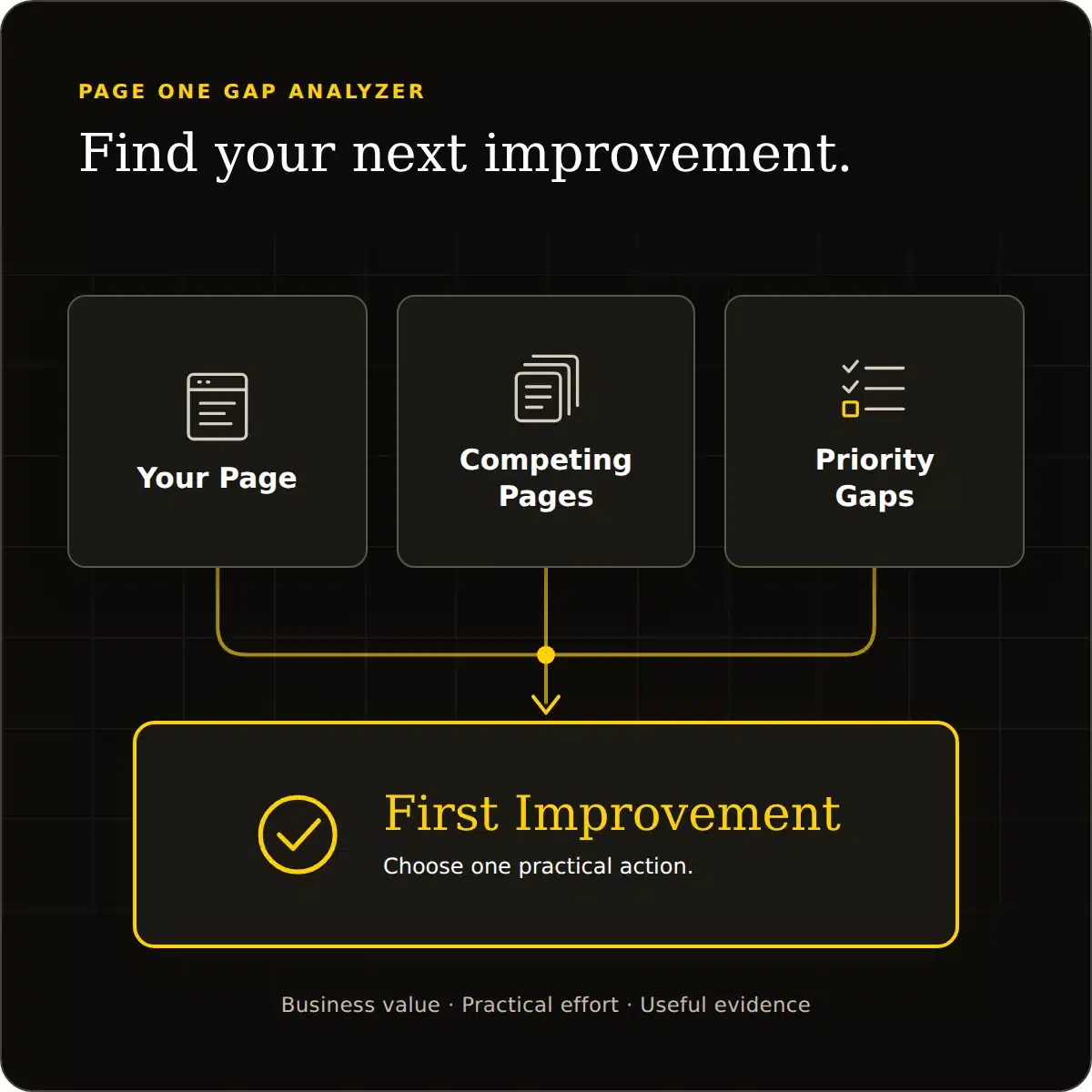
Choose your next improvement
A comparison becomes useful when it helps you decide what deserves attention. An additional heading or a longer page may accomplish little if visitors still cannot tell whether you offer the service they need.
Look for differences that affect the customer’s decision: a clearer explanation of the work, relevant project examples, answers to important questions, and an easy way to request help. Then consider which improvement your team can complete soon.
Does this page support a service or product worth growing?
Which meaningful improvement can you complete with the resources available?
What will you review to see whether the change is helping?
Compare your page
Enter your target keyword and page, then record what you observe in three relevant organic search results. Identify meaningful gaps and select the first improvement to make.
This guided worksheet organizes your observations. It does not automatically scan websites or retrieve live rankings.
Fields marked * are required. This tool does not send your entries to a server or save them between visits. Download your plan before leaving.
Your selected next step
Based on your entries. These counts summarize observations; they are not a ranking score or a forecast.
Keep your baseline and review dates with the plan. Changes in visibility or leads can have several causes.
A useful comparison starts here
Start with a page connected to a service, product, or customer action that matters to your business. An existing page with some search visibility can provide a useful starting point.
Choose three organic results that address the same search need. Record ads, map results, and AI features separately so you can distinguish different types of visibility.
Write down what is missing, unclear, difficult to use, or insufficiently supported. “Add two relevant project examples” is more actionable than “improve content.”
Choose a meaningful action you can realistically complete. Record the starting conditions and decide what evidence you will review afterward.
A page comparison is one input into your decision. It does not replace a technical review or establish the cause of a ranking difference.
A practical example
Imagine a painting company reviewing its exterior painting page against three relevant local results. The comparison reveals opportunities to help homeowners understand the service and feel comfortable requesting an estimate.
Illustrative planning example only. These are assumed observations, not live search findings or client results.
| Area reviewed | Assumed observation | Possible next step |
|---|---|---|
| Service clarity | The page gives little detail about preparation or the painting process. | Explain preparation, surfaces covered, and what the estimate includes. |
| Project proof | The page contains stock imagery but no relevant project examples. | Add original project photos with brief descriptions of the work. |
| Customer questions | Timing and homeowner preparation are unclear. | Answer those questions using the company’s actual process. |
| Quote request | Contact information is difficult to find on mobile. | Place a clear estimate request near the service information and proof. |
On smaller screens, swipe or scroll the table sideways to compare all three columns.
Choose the first action based on customer importance, available evidence, and the work required.
From observation to action
Some findings can become immediate tasks. Others need more investigation or a separate project. Use these three categories to keep the plan manageable.
A clear customer-facing gap with a manageable fix.
Example: Clarify the service and make the quote request easier to find.
A suspected problem that needs evidence before you change the page.
Example: Determine whether another page serves the target search better.
Work requiring broader content, development, or business decisions.
Example: Create a missing service page with original supporting proof.
Finish with one primary action, a named owner, and a date to review the evidence.
Put the comparison into context
The Page One Gap Analyzer helps you organize a page-level decision. Use it alongside Chapter 6 of Quickest Path to ROI SEO™ to connect your comparison with a broader approach to prioritizing SEO work.
Connect each improvement with business value, practical execution, and useful evidence of progress.
Make the next move count
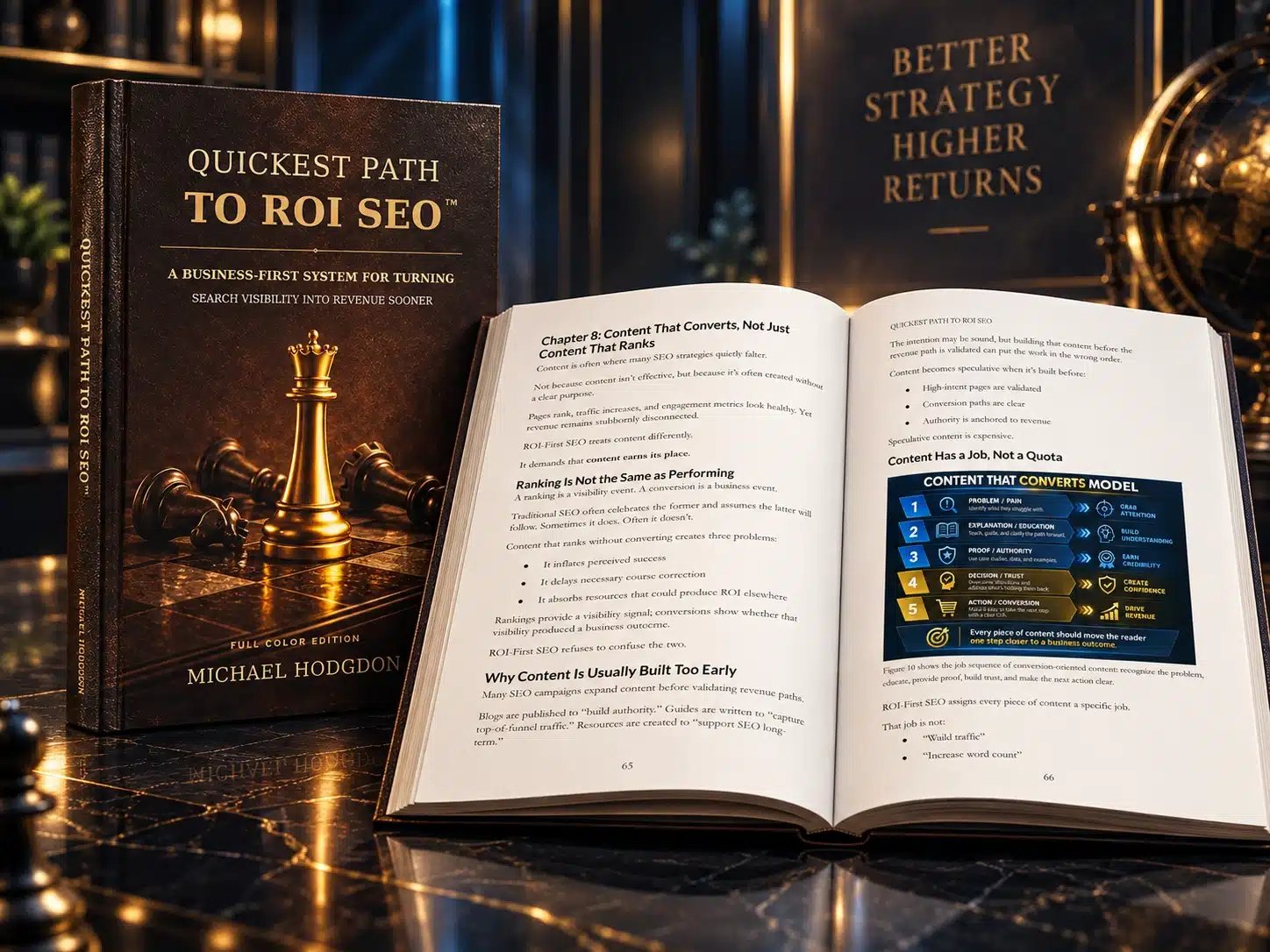
Choose from 4 editions that fit how you prefer to read, reference, and work with the material. Quickest Path to ROI SEO™ is available in multiple formats, including full-color and black-and-white print editions, hardcover, paperback, and Kindle. The full-color editions provide the strongest visual experience for the book’s charts, models, and framework graphics, while the black-and-white paperback offers a more affordable print option. Kindle provides convenient digital access, and the hardcover is ideal for readers who want a premium reference copy.
A website is ready for AI search when AI systems can access its content, understand its entities and relationships, extract clear answers, verify important claims, and identify credible signals that support citation or recommendation.
AI readiness goes beyond traditional rankings. It includes crawlability, clear page structure, direct answers, consistent business information, strong entity signals, trustworthy evidence, structured data, and content that is easy for machines to interpret.
The Quickest Path to ROI SEO™ approach adds a business layer to that evaluation: fix the AI-readiness issues most likely to improve visibility around commercially valuable questions first.
No. Search volume shows the estimated size of demand, but it should be evaluated alongside intent, relevance, competition, business value, and realistic click potential.
A keyword with thousands of monthly searches may produce little value if the audience is not a good fit or the search is primarily informational. A more specific term with lower volume may attract customers who already know what they need.
Current keyword tools themselves combine volume with metrics such as intent, difficulty, CPC, SERP features, and AI Overview presence because those factors can materially change the opportunity.
A keyword may be too competitive when the strength of the current results, required authority, content quality, backlinks, and resources needed to compete are disproportionate to the potential business return.
Keyword difficulty scores can provide a useful starting point, but they should not be treated as an absolute decision rule.
Review the actual search results, the types of pages ranking, your site’s existing authority, and whether you already have a relevant page or related visibility. Difficulty matters most when compared with what the opportunity is worth if you succeed.
Keywords where a site already has impressions or rankings can offer attractive opportunities because search engines already associate the site with the topic.
A page sitting just outside strong visibility may sometimes require less work than creating a new page and establishing relevance from the beginning.
Google Search Console can help identify queries where a site already receives impressions or clicks but has room to improve. These existing signals do not guarantee an easy win, but they can reveal a shorter path to useful evidence.
Specific long-tail keywords can be strong early opportunities when they closely match a valuable customer need and face more attainable competition than broader terms.
Broad keywords can offer greater traffic potential, but they may also have ambiguous intent and stronger competition. Longer, more specific searches often reveal more about what the customer actually wants.
The Quickest Path to ROI SEO™ approach does not automatically favor broad or long-tail keywords. It favors the keyword with the stronger combination of business relevance, customer intent, attainable visibility, and potential return.
AI Overviews and other SERP features should be considered because a keyword’s search volume does not necessarily equal the amount of traffic available to organic listings.
Some searches can be answered directly on the results page, reducing the likelihood of a click. Other queries—especially those involving local services, purchases, comparisons, or complex decisions—may still create strong opportunities for websites.
Modern keyword evaluation should therefore examine the actual search-results page, not just the keyword metrics. Semrush now surfaces AI Overview presence specifically because it can affect the real click opportunity behind a keyword.
The Keyword Opportunity Evaluator helps keep the focus on the business opportunity behind the search, not the search-volume number by itself.