Whether you are evaluating an existing SEO program, prioritizing opportunities, planning content, measuring ROI, or assessing search and AI visibility, these resources are designed to help turn the concepts in the book into action. Each tool is built to help you make a specific decision, organize the work around that decision, and connect execution back to measurable business outcomes.

The SEO money-shredder commercial 30 seconds

Quickest Path to ROI SEO™ · Michael Hodgdon Open video ↗
Watch before you spend more
Reports and impressions can look impressive. What are they doing for your business? Watch this 30-second commercial, then explore how Quickest Path to ROI SEO™ by Michael Hodgdon helps you prioritize opportunities tied to leads, customers, sales, and revenue.
For business owners, marketing leaders, and SEO teams.

Strategy Before Activity
The resources in this library are designed around the same principle as the book: determine what is most likely to create measurable business value, identify what is preventing that opportunity from performing, and work in the order most likely to produce a return.
The goal of this resource library is not to give you another long checklist of SEO tasks. It is designed to help you identify the business problem in front of you, choose the right tool for that problem, and make a better decision about what to do next. Instead of starting with tactics, start with the question you are trying to answer or the outcome you are trying to improve.
These resources are built to support better SEO decisions at every stage of the process. From identifying high-value opportunities and prioritizing the right work to improving visibility, strengthening key pages, measuring return on investment, and adapting to changes in traditional and AI-driven search, each tool is designed to move strategy into execution. Use them to organize the work, focus resources where they matter most, and connect search activity to measurable business outcomes.
A structured evaluation tool for reviewing a webpage across traditional SEO, AI-answer readiness, trust and relevance, and conversion effectiveness. Use it to identify obvious weaknesses before investing in a deeper audit or campaign.
A decision framework for comparing SEO opportunities based on business value, ranking potential, effort, competitive difficulty and expected time to return. It helps prevent teams from prioritizing projects simply because they appear technically important.
Review the primary factors affecting local organic rankings, Google Maps visibility, location relevance, business information, reviews, local landing pages and supporting authority signals.
Plan content around a specific business objective instead of publishing simply to increase volume. Each content asset is tied to a target audience, search opportunity, purpose, conversion path and measurable outcome.
Review the business information, authorship, credentials, third-party validation, policies, citations, structured data and supporting evidence that help establish who is behind a website and why its information should be trusted.
Estimate the business value of an SEO opportunity using traffic potential, conversion assumptions, average customer value and expected performance improvement. The calculator is intended to turn SEO conversations into financial conversations.
Estimate what an organic lead is worth based on close rate, average transaction value, customer lifetime value and profit assumptions. This makes it easier to determine how much acquiring additional qualified search traffic may be worth.
Track investment, visibility improvements, leads, conversions and attributable revenue over time. It provides a simple structure for determining whether SEO activity is producing business results.
A practical framework for tracking the metrics that matter most: qualified visibility, Page-One performance, conversions, leads, revenue and movement across priority search opportunities.
Evaluate whether a page clearly communicates entities, services, locations, relationships, expertise and factual information in a format that AI-driven search and answer systems can interpret.
Turn an audit or strategy into a sequenced 90-day implementation plan with priorities, owners, milestones and measurable outcomes.
The goal of this resource library is not to give you another long checklist of SEO tasks. It is designed to help you identify the business problem in front of you, choose the right tool for that problem, and make a better decision about what to do next. Instead of starting with tactics, start with the question you are trying to answer or the outcome you are trying to improve.
The right tool is not necessarily the most advanced one. It is the one that helps you make the next important decision with greater clarity.

I Want to Find My Best SEO Opportunities
Use the SEO Opportunity Prioritization Worksheet, Keyword Opportunity Evaluator, and Page-One Gap Analyzer to identify where the strongest opportunities may exist.
For many business owners and marketing leaders, the problem was a lack of clarity in the strategy and long-term plan. They received reports, rankings, traffic data, and lists of completed tasks, yet still had no reliable way to judge whether the right opportunities were being prioritized or whether their investment was creating meaningful business value.
Michael saw the same issue from the agency side. Strong client relationships depend on trust, and that trust is harder to sustain when meaningful progress takes too long to become visible. Creating value earlier helps clients and stakeholders gain confidence while giving agencies, and in-house teams the time needed to fully execute the strategy.
That led to a simple principle: prioritize the work most likely to create meaningful business value as early as possible.
The book challenges the idea that SEO should be approached as a long, chronological checklist. Instead, it presents a business-first system for identifying high-intent opportunities, prioritizing revenue-producing pages, directing authority where it matters most, measuring performance, and expanding based on evidence.
The objective is to build enough confidence early that clients and stakeholders remain committed long enough for the return on investment to become clear. Once that happens, SEO is no longer being sustained primarily by trust or patience; it becomes a sound business investment supported by measurable results.
That is the core idea behind Quickest Path to ROI SEO™: create value early, build trust through evidence, and make better decisions about what to do first, what to do next, and what can wait.

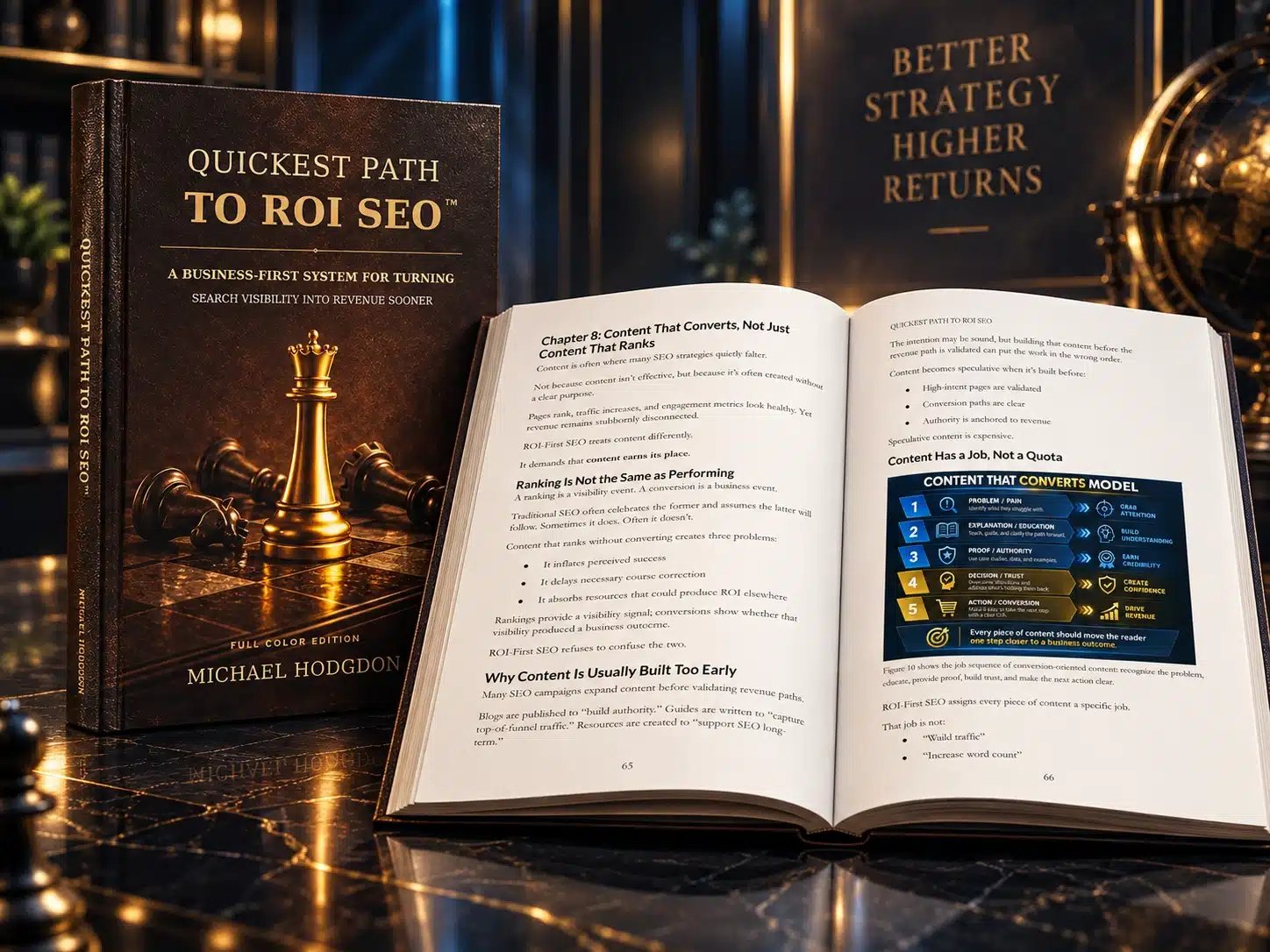
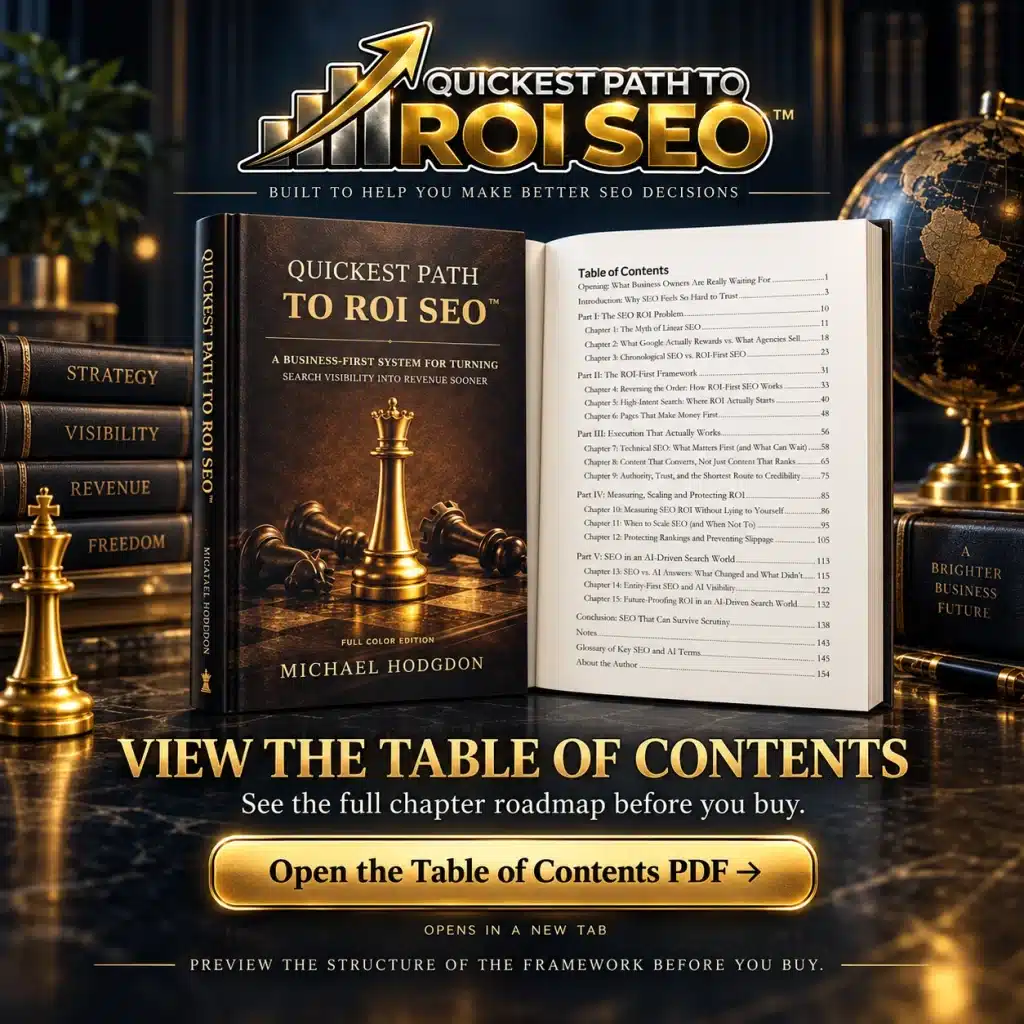
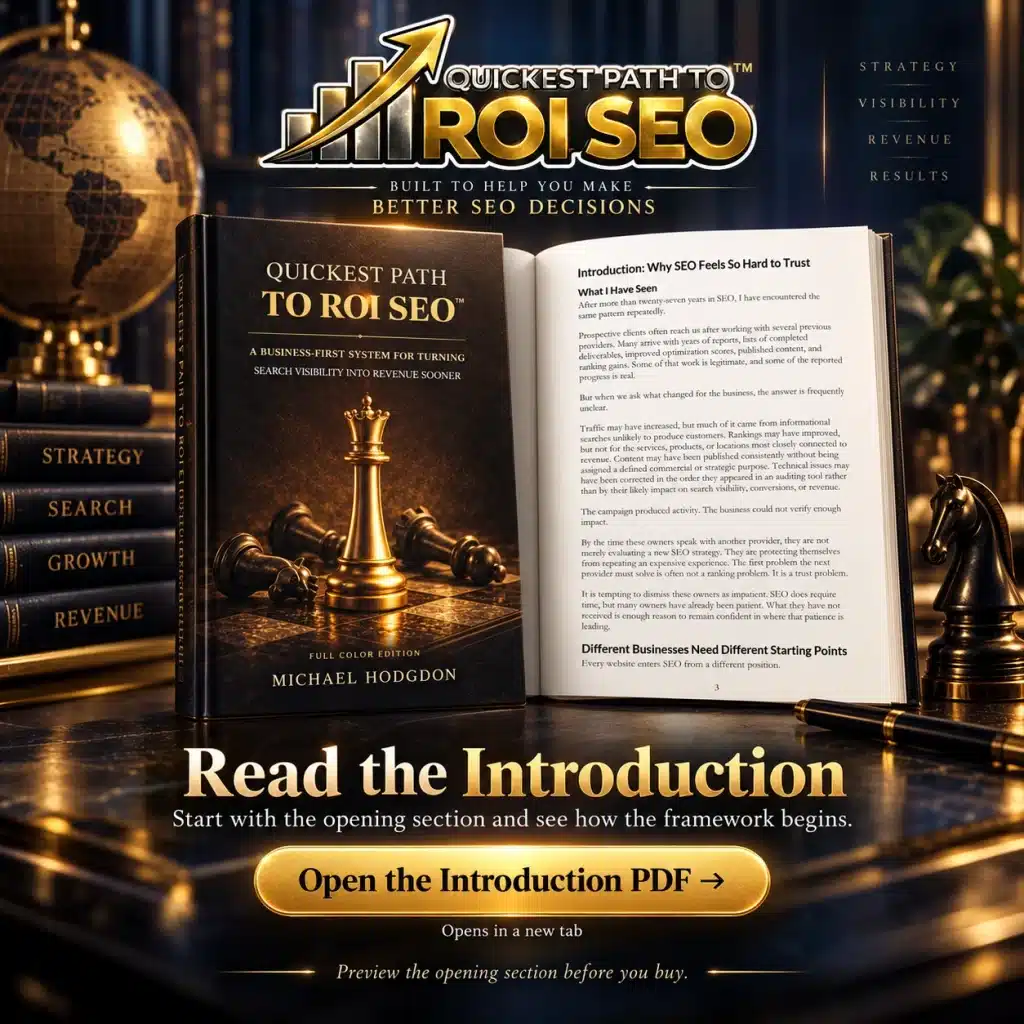
Choose from 4 editions that fit how you prefer to read, reference, and work with the material. Quickest Path to ROI SEO™ is available in multiple formats, including full-color and black-and-white print editions, hardcover, paperback, and Kindle. The full-color editions provide the strongest visual experience for the book’s charts, models, and framework graphics, while the black-and-white paperback offers a more affordable print option. Kindle provides convenient digital access, and the hardcover is ideal for readers who want a premium reference copy.

The most useful SEO tools are the ones that help compare search demand, buyer intent, ranking difficulty, conversion potential, and possible revenue impact before work begins.
Keyword tools and ranking platforms can show where opportunities exist, but they do not automatically tell a business which opportunity deserves attention first.
The resources built around Quickest Path to ROI SEO™ are designed to help make that next decision: which opportunity has enough business value to justify the work, and which can be acted on quickly enough to create momentum?
An SEO worksheet can improve ROI by turning broad search data into a structured decision process based on priority, effort, opportunity, and business value.
Without a consistent evaluation method, teams can easily spend time on tasks that are technically valid but commercially weak.
The worksheets in the Quickest Path to ROI SEO™ resource library are intended to help businesses compare opportunities before committing resources so execution stays focused on the work most likely to produce meaningful results.
Before investing in an SEO opportunity, businesses should evaluate search intent, revenue potential, competition, current visibility, conversion readiness, required effort, and the likely time to measurable return.
Search volume alone is not enough. A keyword may attract a large audience while having little connection to a purchase decision, or it may require more time and investment than the potential return justifies.
The resource library turns these considerations into practical evaluations so businesses can identify where commercial value and execution speed overlap.
An SEO task is worth prioritizing when its potential business impact justifies the time, cost, and effort required to complete it.
Some SEO tasks are urgent because they remove barriers to visibility or conversion. Others may be technically beneficial but have little near-term effect on leads or revenue.
The Quickest Path to ROI SEO™ approach evaluates tasks in context rather than treating every recommendation as equally important. The goal is to continually ask: What can we do next that has a realistic chance of moving the business forward?
Yes. Free SEO tools can support meaningful revenue decisions when they are used as part of a structured process rather than treated as stand-alone answers.
A checklist, evaluator, or worksheet does not need expensive software behind it to be useful. Its value comes from helping a business ask the right questions about intent, opportunity, feasibility, conversion potential, and financial impact.
The free resources accompanying Quickest Path to ROI SEO™ are designed to translate the book’s strategy into practical decisions businesses can make before investing more time or money.
SEO tools should be used alongside GEO analysis to evaluate not only where a business ranks, but also whether its content is clear, authoritative, and useful enough to be surfaced in AI-generated answers.
Traditional tools can reveal keywords, pages, rankings, links, and technical issues. GEO requires an additional layer of evaluation around entities, answer clarity, source credibility, structured information, and whether content directly satisfies the questions customers are asking.
The resources connected to Quickest Path to ROI SEO™ are built around one common objective: use available data to identify the fastest practical path toward valuable search visibility—whether that visibility occurs in Google, maps, or AI-generated answers.